
You’re on hour 26 of a “24-hour” call. Your joints started screaming around 3 a.m., the migraine hit at 5, and now your vision is doing that shimmery thing it does right before things go really bad. The pager still goes off. You’re still cross-cover for 40 patients. And you’re suddenly realizing: if you do not speak up, no one is going to step in and save you.
If that’s you—or close to you—this is the playbook you should have been handed on Day 1 but weren’t.
Step 1: Get Clear On Your Reality (Not The Fantasy In Your Head)
Most interns with chronic illness make the same early mistake: they try to “prove” they can handle everything. They overcompensate, hide symptoms, and then crash so hard it scares everyone, including program leadership.
You cannot advocate for yourself if you’re vague about your own limits.
Sit down—before or early in intern year—and answer these questions like you would for a complex patient, not like a hero:
- What specifically makes your condition worse?
- What does a mild flare look like for you? A bad one? A dangerous one?
- What tasks or shifts consistently push you over the edge?
(Night float? 28‑hour calls? Back-to-back ICU weeks?) - What helps in a concrete way?
(Scheduled breaks, sitting for notes, consistent meal times, hydration, meds at specific hours, cooler environments, less lifting.)
Write this out like a mini H&P on yourself. Do not rely on “I’ll know when it’s too much.” You usually won’t, because training culture rewards ignoring your body.
Practical move:
Keep a 2–3 week log during a tough rotation.

Track:
- Hours worked
- Type of shift (day, night, call)
- Symptoms (1–10 scale)
- What you ate and roughly when
- Sleep amount and quality
- Meds—on time vs late or missed
- Any near-miss health events (almost syncope, severe pain, aura, blood sugar crash, heart rate spikes, etc.)
Patterns will show up. You’ll see exactly what destroys you and what you can sustain. That becomes ammo for the discussions you’re going to have.
Step 2: Know Your Rights Without Making It A Legal War (Yet)
A quick reality check: residency programs are not “doing you a favor” by accommodating a disability. They are obligated under the ADA (or equivalent laws if you’re outside the U.S.) to provide reasonable accommodations if you can perform the essential functions of the job with those accommodations.
You do not need to be on the brink of collapse to qualify. “Chronic illness that substantially limits one or more major life activities” is the bar, not “bedbound.”
The important pieces:
- You do not have to disclose your exact diagnosis to every attending, chief, or co-intern.
- You do need to be specific about functional limitations when talking to GME or your program director:
“I cannot safely drive home after 28-hour shifts due to X,”
“I need protected time around 9 p.m. and 9 a.m. to take medication that must be taken with food,”
“I cannot safely do long stretches without sitting due to POTS/joint instability.”
Many hospitals have a GME disability/HR office separate from your program where you can discuss accommodations confidentially. This is usually where formal stuff lives (documentation, letters, etc.), not in the gossip channels of your department.
Use an outcome-focused frame:
You’re not saying “I want to work less because I’m special.”
You’re saying, “Here’s what I need to function safely so I can be a reliable, effective intern over the long term.”
That framing lands better with the people who control your schedule.
Step 3: Decide How Open You Want To Be (Different Layers, Different Stories)
You don’t owe everyone your entire medical chart. But if you tell no one anything, you give up control over how people interpret your behavior.
Think in layers:
GME / Disability Office / Program Director
They need:- Enough detail to understand functional limits
- Documentation from your physician when needed
- Clear requests: shift modifications, leave, specific accommodations
Chief residents / rotation schedulers
They need:- The “function version,” not necessarily the diagnosis:
“I have a chronic medical condition that flares with prolonged overnight shifts, so I’m approved/being evaluated for X accommodation.” - Heads-up when you’re about to go off the rails health-wise.
- The “function version,” not necessarily the diagnosis:
Co-interns / close colleagues
These are the ones who will actually help you survive nights at 3 a.m.- Share selectively: “I have a chronic condition; sometimes I’ll need 10 minutes to take meds or sit down or my body revolts. If that happens, I’ll swap you a task or pick up something later for you.”
- Pick at least 1–2 people per rotation who know enough to recognize when you’re in trouble.
Everyone else
They get: professional, minimal, boundary-respecting.
“I’ve got a medical condition I manage; I may need brief, scheduled breaks but I’ll make sure the work’s covered.”
You are allowed to say “That’s personal” if someone gets nosy.
Step 4: Turn Your Needs Into Concrete, Defensible Requests
Vague: “I need my schedule to be lighter because I don’t feel well.”
That gets you labeled “not committed.”
Specific and defensible: “On standard 28-hour calls, I am experiencing [X: presyncope, uncontrolled pain, arrhythmia etc.] that impairs my ability to function safely. I’d like to discuss [Y: night float instead of 28s, transition to shorter call, protected rest block, or graduated schedule] supported by my physician’s letter.”
Here’s how to think about possible accommodations:
| Need / Issue | Possible Accommodation |
|---|---|
| Can’t tolerate 28-hr shifts | Night float system, shorter calls, extra post-call protection |
| Meds at strict times with food | Scheduled 10–15 min breaks at set hours |
| Orthostatic/POTS, joint issues | Ability to sit for notes, stool in rooms, limited lifting |
| Unpredictable severe flares | Option for intermittent FMLA/short leave, backup coverage system |
| Heat/intolerance of PPE | Cooler space for breaks, limited time in hot environments |
The test: If you wrote your request as an order in the chart for a fragile patient, would it be specific enough to execute?
If not, tighten it.
Step 5: Plan The Conversation With Your Program Director (Do Not Wing It)
You get one good “first impression” conversation about this. Do it right.
Outline your agenda:
- A 60-second summary of your situation
- What you’ve done to manage it yourself
- The specific safety and performance concerns
- Your clear, concrete asks
- Your plan to still meet core training requirements
Example script (adjust to you):
“I wanted to meet because I’m running into some serious, predictable problems related to a chronic medical condition.
Over the last [X] weeks on [rotation], I’ve consistently gotten [symptoms: near-syncope, uncontrolled pain, severe fatigue] around hour [N] of long calls, to the point where I’m worried about patient safety and my own.I’ve tried [hydrating aggressively, adjusting meds with my specialist, optimizing my sleep routine, logging symptoms], but despite that, I’m still having episodes that aren’t compatible with repeated 28‑hour calls.
I believe I can absolutely complete this residency and do good work if we make some adjustments. With my physician, we’ve identified a few specific accommodations that would likely allow me to function safely: [list 1–2 well-thought-out requests]. I’m very willing to be flexible and meet all essential requirements; I just need to do it in a sustainable way.
Can we talk about what’s possible within program and GME policies?”
You’re framing yourself as:
- Insightful about your limits
- Serious about patient safety
- Solution-oriented, not just complaining
Bring:
- Your notes/log with clear patterns (not a 40-page diary, but a 1–2 page summary)
- A letter from your treating physician if you’ve already discussed accommodations
- A short list (not a manifesto) of proposed options
Step 6: Work With, Not Against, The System That Does Scheduling
You can have a perfectly sympathetic PD who still hands everything to the chiefs and says, “Make it work.” If the chiefs think you’re unreliable, you’re going to get the worst of both worlds: technically “accommodated” on paper, resented in practice.
Your job: make it very easy for chiefs and co-residents to help you without feeling cheated.
Some ground rules:
Volunteer for things you can do reliably.
If 28‑hour calls destroy you but you can crush day float or weekend rounding, say that explicitly and back it up with action.Trade, don’t just take.
“If I can swap out of 2 of these overnight calls, I’m happy to pick up [extra clinic half days / extra early-morning prerounds] on weeks I’m stable.”Communicate early, not at meltdown.
If you know a flare is brewing, tell the chief the day before:
“I’m in a flare but currently functional. If I hit my usual wall around 3 a.m., I may need a 15-minute break to medicate and reset. I’ll keep you updated.”Keep it about safety.
Chiefs are thinking coverage and patient load. Translate your need directly into that language:
“If I push through this, the risk is I’m the person making meds reconciliations and cross-cover decisions while presyncopal.”
Step 7: Have a Real Flare Plan (Like A Code Blue, But For You)
You need a pre-agreed protocol for when your illness goes from “managed” to “this is not safe.”
If you’ve ever thought, “I’m too sick to be here, but I cannot leave or everyone will hate me,” that’s a systems failure. Fix it before it happens again.
Sit down with your PD or chief and propose something like:

| Step | Description |
|---|---|
| Step 1 | Early Symptoms |
| Step 2 | Short break, meds, hydrate |
| Step 3 | Reassess in 30 min |
| Step 4 | Notify senior or chief |
| Step 5 | Transfer urgent tasks |
| Step 6 | Chief decides - send home or modify duties |
| Step 7 | Document, follow up with PD |
| Step 8 | Can continue safely? |
You want answers to:
- When I hit X (vomiting, presyncope, vision changes, uncontrolled pain, aura), who do I call first?
- What immediately gets handed off? Admissions? Cross-cover pages? Rapid responses?
- Who decides if I go home vs. stay with modified duties?
- How is that documented so I don’t get dinged later as “unprofessional”?
Then you tell at least one trusted senior per rotation:
“Hey, just so you know, if I suddenly say I’m in a flare, the plan with the PD is [X]. I’m not abandoning you, I’m following what we set up.”
That transparency builds trust instead of gossip.
Step 8: Manage The Culture Piece (Stigma, Whisper Networks, And Your Own Guilt)
You will run into people who think chronic illness = weakness. Some will say it out loud; many won’t. The culture is getting better, but not that much better.
What you can control:
Your narrative about yourself
If you walk around acting like your illness is an embarrassing flaw, others will treat it that way. This is hard, but try on:
“I have a long-term condition I manage. I’m still a capable physician. My brain works. My work ethic is solid. I just have different physical guardrails than you.”How you handle pushback
Someone says: “We all do 28‑hour calls, you’re not special.”
You respond calmly:
“I understand the workload. I’m not asking to do less; I’m asking to do it in a way that is safe and cleared by GME. That’s already been discussed with leadership.”
Then stop. Don’t overshare, don’t defend your diagnosis.Who you invest energy in
Some attendings will never get it. Fine. Do your job, keep it professional, move on.
Find the faculty and seniors who actually do get it—anyone who’s had cancer, pregnancy complications, mental health treatment during training, an injury. There are more of them than you think. Those are your allies.
And yes, the guilt. Let me be blunt: being hospitalized because you pushed too hard on a principle of “fairness” doesn’t help your co-residents, your patients, or your career. It just makes more work for everyone.
Reasonable accommodation is not “cheating.” It’s playing the long game.
Step 9: Protect Your Actual Health Like It’s A Premium Consult
You’ve probably already sacrificed half your personal health routines to survive intern year. That’s normal. But chronic illness requires a basic non-negotiable set of rules.
Non-negotiables are not “I will always sleep 8 hours.” That’s fantasy. Think like this instead:
- “I will never do back-to-back 28‑hour calls without at least X hours of horizontal, no-pager rest between.”
- “I will not skip more than one dose of [critical med] in a week.”
- “If I reach [specific symptom threshold], I will activate the flare plan, even if I feel guilty.”
Set these in advance with your treating physician. Document them. When you’re exhausted and tempted to say “It’s fine, it’s fine,” you follow the script, not your guilt.
And schedule your own care like shifts:
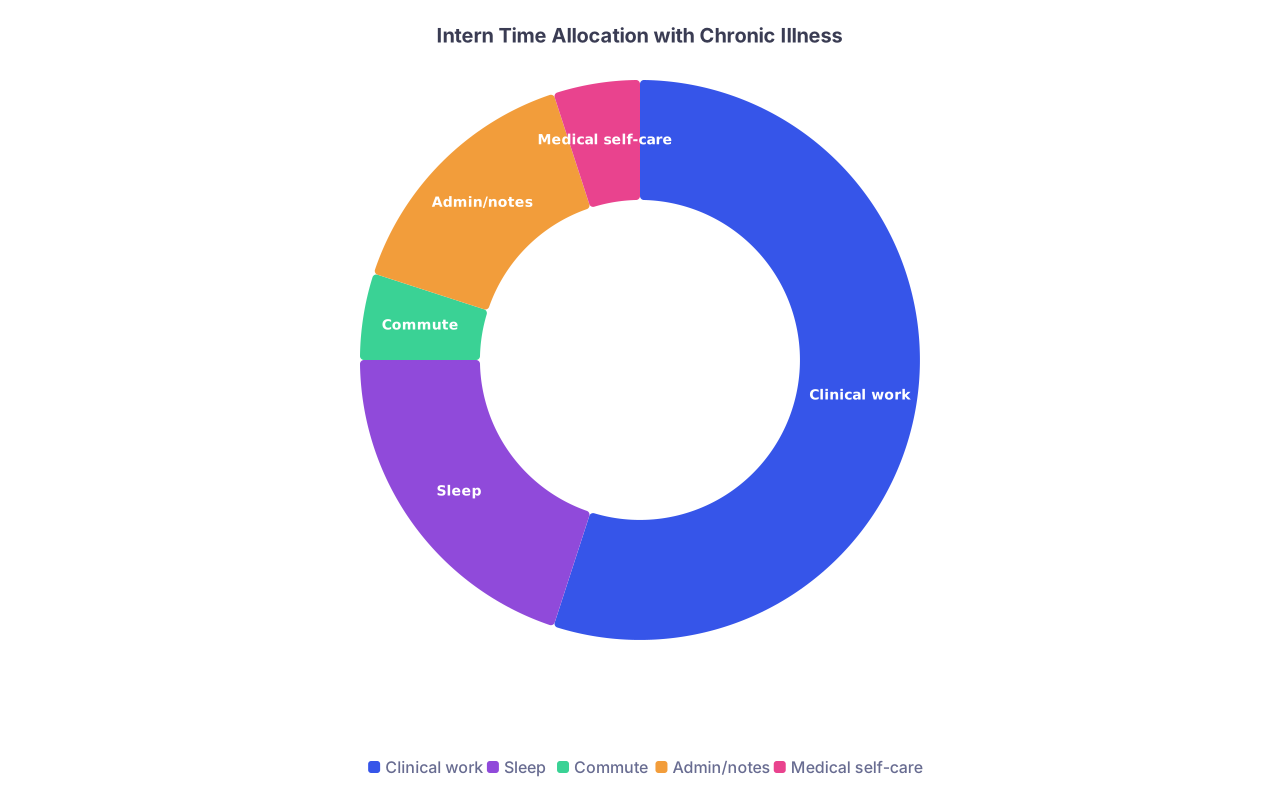
| Category | Value |
|---|---|
| Clinical work | 55 |
| Sleep | 20 |
| Commute | 5 |
| Admin/notes | 15 |
| Medical self-care | 5 |
Is that ideal? No. But that 5% of “medical self-care” (appointments, labs, med adjustments, PT, therapy) has to be real, calendared time. Not “I’ll squeeze it in someday.”
If you need documentation or med adjustments to support accommodations, your specialist must stay in the loop. They cannot write a solid letter or adjust meds if you ghost them for 14 months.
Step 10: When The Program Itself Is The Problem
Sometimes you do everything “right” and still hit a wall: PD dismissive, chiefs hostile, GME unhelpful. Then you’re not just managing a chronic illness; you’re dealing with a dysfunctional system.
At that point, start playing on parallel tracks:
Document everything
Dates, times, what was requested, who said what, any retaliation-ish behavior (sudden poor evals with no prior feedback, social exclusion from schedules, etc.).Escalate strategically
- GME office
- Institution disability office / HR
- Ombuds office if available
- Specialty board if clinical requirements are being unfairly blocked
Quietly explore alternatives
- Transfer to another program
- Switch specialties to something more physically sustainable
- Consider part-time or flexible tracks if available

You don’t announce any of this loudly. You explore, you gather info, you protect your health and career.
And no, leaving a toxic program is not “quitting medicine.” It’s sometimes the only way to stay in it.
Quick Example: Turning A Vague Struggle Into A Concrete Plan
Let’s take a real-ish scenario.
You: intern with moderate-severe Crohn’s, prone to flares with sleep deprivation and missed meals, especially on 28‑hour call.
Bad approach:
- Tell no one
- Power through first 4 calls, end up in the ED on your own service with a flare
- PD hears about it third hand, decides you “lack resilience”
- Suddenly you’re “that intern”
Better approach:
- Before heavy rotations: meet with GI, get specific: “No more than X 28‑hour calls per month,” “must have access to bathroom at least every Y hours,” “requires medication at A and B times with food.”
- Meet PD with that letter, plus your own log from med school sub‑I or early wards.
- Request: reduce call frequency slightly, cluster calls when you’re most stable, guarantee 15–20 minute windows around med times, quick access to food stash.
- Tell chiefs: “I have an approved medical accommodation limiting my 28s and I need predictable short breaks at X and Y times. I’m happy to take additional weekend day coverage or admissions to balance.”
- Tell 1–2 co-interns: “I have Crohn’s. Flares happen. If I say I need 10 minutes urgently, that’s what’s going on. I will absolutely cover for you in other ways.”
Does that erase all pain? No. But it markedly drops the risk of disaster, and people have a framework to help rather than roll their eyes.
If You’re Reading This While Actively Falling Apart
You might not have the bandwidth for 10 steps. Here’s the emergency version for this week:
- Email your PD and say you need a brief meeting about “a medical issue impacting your ability to safely complete certain shifts.”
- Before that meeting, email or portal message your main specialist: “I’m an intern, my current schedule is [X], I’m having [symptoms]. I need a brief letter outlining what schedule modifications or accommodations would be medically reasonable.”
- At work, pick one senior you trust and tell them, “I have a chronic condition that’s flaring. If I look like I’m fading, I may need a few minutes to medicate/hydrate/sit. I’m not trying to disappear—I just don’t want to collapse on you.”
Start there. Then build the rest.
The Bottom Line
Three things to carry with you:
- You are allowed to need accommodations and still be a serious, committed physician. Those things are not in conflict.
- Vague suffering gets you nowhere. Specific, documented patterns plus concrete requests get taken seriously.
- Protecting your health is not selfish. It’s how you make sure you are still standing—licensed, trained, and alive—five years from now.
Intern year is a grind for everyone. For you, it’s a grind with extra rules. Learn the rules, enforce them, and stop pretending you’re a robot. You’re a human with a chronic illness. And you can still do this—on terms that do not break you.