
It’s 5:45 a.m. on a Tuesday in early October.
You badge into the workroom, toss your bag down, and open Epic. You’ve been an intern for three months. You’re not the fastest, not the smartest, and your notes still get redlined. But you are here. On time. Again.
What you don’t see is this: two floors up, your program director is scrolling through an email from one of your attendings. Three names are mentioned as “solid, dependable interns.” One of them might be you. Or not.
Let me tell you how that list actually gets made.
By October, every program director already has a mental map of their intern class divided into a few quiet categories:
- “Rock solid – I don’t worry about them.”
- “Fine – still watching.”
- “Potential problem – keep an eye on.”
- “Liability – multiple people have complained.”
They won’t say that in a town hall. But that’s the truth. And “reliable” is the line between the first two and the last two.
This is not about who’s brilliant. It’s about who they trust not to blow up patient care at 3 a.m. or disappear when things get hard.
Let’s break down how that judgment forms — and what you can actually control.
What “Reliable” Really Means to PDs (Not What You Think)
Everyone thinks reliability means “always shows up and does their work.” That’s the kindergarten version.
The real residency definition is harsher and more specific:
“When this intern is involved, I can safely assume the basics are done, I won’t get surprised in a dangerous way, and they won’t create extra drama.”
Program directors quietly score you along three axes, usually without realizing they’re doing it:
- Clinical follow-through – Do you close the loop on what you start?
- Behavioral predictability – Are you consistent in how you show up?
- Emotional load – Do you make the system calmer or more chaotic?
If you’re strong in all three by October, you’re tagged as reliable. If you repeatedly break trust in any one, you get a mental red flag.
Here’s the part no one admits: this decision is often made on shockingly thin data. A handful of days, a few emails, a couple of comments in a CCC meeting. Which means small things you think “don’t matter” absolutely do.
The Timeline: How Fast They Decide
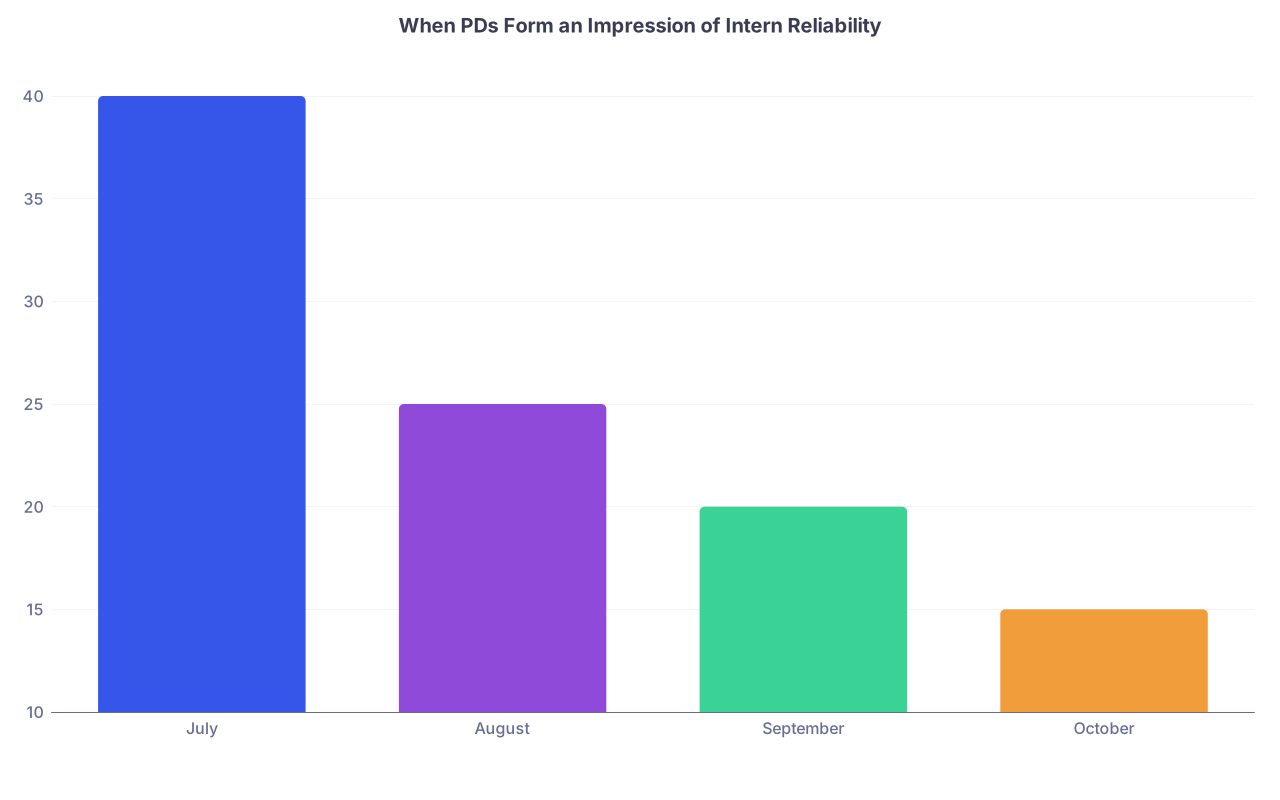
By the time pumpkin spice lattes are back, this is roughly where you stand:
| Category | Value |
|---|---|
| July | 40 |
| August | 25 |
| September | 20 |
| October | 15 |
About 40% of that impression is formed in July. Another 25% in August. After that, you’re mainly confirming the pattern, not establishing it.
July: First Impressions Aren’t Fair, But They Stick
The first month is chaos for everyone. But attendings and senior residents still notice:
- Who reads the room and adapts.
- Who panics when called.
- Who says “I’ll do it” and then… doesn’t.
I’ve heard an APD say during a CCC in September: “I know it’s early, but I just don’t worry when she’s on nights.” That comment came from three weeks of nights. That intern was locked in as “reliable” for the year.
Flip side: I’ve also heard, “He’s nice, but I never quite trust that the plan is actually done.” That stuck too.
August–September: Patterns, Not Episodes
By month 3, no one cares about one bad shift. They’re watching patterns:
- Chronically late notes vs sometimes late after a brutal day.
- Frequent “forgot to…” vs occasional honest misses with self-correction.
- Always needing rescue vs occasionally overwhelmed on legitimately insane days.
By October, your PD is not looking for perfection. They’re scanning for signal: “Is this intern trending safe and dependable… or not?”
How PDs Actually Hear About You
You think your PD is reading all your evaluations and spending deep thought on each one. No. They’re skimming.
The real pipeline that shapes “reliable” vs “not” looks like this:

| Step | Description |
|---|---|
| Step 1 | Attendings |
| Step 2 | Chiefs |
| Step 3 | Senior Residents |
| Step 4 | Nurses and Staff |
| Step 5 | Program Leadership |
| Step 6 | CCC Meeting |
Most PDs get your reputation through:
- Offhand comments from chiefs: “If I have to staff a sick admit, I’d rather work with X than Y.”
- Wing calls from nursing leaders: “We’re getting a lot of concerns about this intern not answering pages.”
- One or two strongly worded attending evals that say something like “I couldn’t trust them to follow through on basic tasks.”
Here’s what this means: your behavior with nurses and seniors is as important as your polished performance in attendings’ line of sight. Often more.
I’ve seen a quiet, not-flashy intern saved by nursing feedback. CCC meeting, people were lukewarm on her. Then the nurse manager says, “She’s the only one I don’t have to chase for orders. She always comes back and closes the loop.”
Instant reframe: “OK, she’s reliable. Just needs to speed up.”
Versus the opposite: a charismatic, smart intern everyone initially liked — but nursing repeatedly documented delays in responding to abnormal vitals and orders being incomplete. Committee reluctantly moved him into the “risk” bucket.
Your daily micro-interactions are not invisible. They’re just… delayed. You feel nothing in July. It shows up in October when you can’t defend yourself.
The Five Behaviors That Quietly Mark You as “Reliable” by October
There are certain patterns that, when PDs see them repeated, flip an internal switch: “We’re good with this one.” Nobody tells you what these are. They just expect you to figure it out.
Here they are.
1. Closing the Loop — Every. Single. Time.
This is the core reliability metric.
Did you order the CT? Fine. Did you:
- Check that it was actually scheduled?
- Follow up on the result today?
- Communicate the findings and plan to the patient, the nurse, and your team?
If not, you didn’t finish the job.
Interns think “I placed the order” is the work. PDs and attendings think “the result impacted the plan and everyone knows it happened” is the work.
The interns who become “reliable” do this almost compulsively:
- When someone mentions a task on rounds, they write it down in one place and physically check it off.
- Before sign-out, they quickly scan: “Is there anything ordered that hasn’t resulted yet that could change tonight’s plan?”
- If something slips and they catch it later, they own it and fix it without theatrics.
The pattern that kills your reliability label: multiple “Oh, I thought someone else was doing that” moments. You only get to say that once without consequences.
2. Answering Pages Like a Professional, Not a Grad Student
Let me be blunt: nothing tanks an intern’s reputation faster in October than being known as “the one who never answers pages.”
Nursing, RT, consultants — they all gossip, and it gets upstairs.
Reliable interns:
- Answer pages quickly or call back as soon as humanly reasonable.
- If they’re truly buried, they say, “I see your page; I’m in a code/urgent situation, I’ll call you in 5–10 minutes,” and then actually do it.
- They don’t show attitude on the phone.
The secret here: PDs don’t see your pager log. They hear the summary judgment from staff: “She’s responsive” vs “We always chase him.”
Once you’re in the second bucket, it’s very hard to crawl out.
3. Consistent Morning Performance: Pre-rounds, Labs, and Updates
By October, no one expects perfect differentials. They do expect that by table rounds:
- You’ve seen your patients.
- You know their new vitals, overnight events, and key labs.
- You’ve updated your seniors/attending on anything acute before we sit down.
You know what makes someone look unreliable in one blow?
- The senior finds out from the nurse or the EMR that the Hgb dropped to 6.4 at 6 a.m., and you’re just now seeing it at 8 a.m.
- A patient was hypotensive overnight and you “hadn’t checked the flowsheet yet.”
PDs don’t hear the nuance, they hear the summary from attendings:
“I worry they’ll miss important changes.”
That’s code for: unreliable.
The “reliable” interns usually have a simple system:
- A consistent pre-rounding time that they actually respect.
- A morning checklist that forces them to glance at vitals, I/Os, and new labs for every patient.
- A low threshold to quickly text or find their senior if something looks off.
You don’t have to be fast. You have to be steady and thorough.
4. Owning Mistakes Without Melting Down or Deflecting
Every PD knows interns will screw up. August and September are basically a rolling blooper reel.
What they care about is the shape of your mistakes and your reaction:
- One: You missed a lab or forgot to put in DVT prophylaxis.
- Two: You get defensive, blame the nurse, or hide it. Now we have a problem.
The reliable group consistently does this instead:
- “I missed that K of 2.9 this morning. I should have caught it when I checked labs. I already repleted it and updated the nurse. I’m adding a lab check to my morning checklist.”
You think that confession will sink you. It doesn’t. Properly handled, it actually earns you points. I’ve heard PDs say things like: “She’s made some errors, but she learns from them. I trust her trajectory.”
The interns who scare leadership are the ones whose stories don’t match the chart, or blame everyone else, or look like they’re crumbling every time someone points out a mistake. That screams “long-term problem.”
5. Emotional Stability on Bad Days
Reliability isn’t just: do you get tasks done. It’s: are you someone we can put in a high-stress environment without setting off a chain reaction.
By October, attendings and seniors are whispering versions of these lines:
- “When things get busy, she gets a little scattered but stays polite and keeps working.”
- “He completely unravels when we get a sick admit. You can’t even talk to him.”
- “She cries in the stairwell every other call night. I don’t know how long she’ll last.”
Are those fair? Not always. Are they real? Yes.
You can be anxious. You can be overwhelmed. Everybody is. What PDs pay attention to is:
- Do you still communicate clearly?
- Do you still prioritize patient safety?
- Do you seek appropriate help without freezing or disappearing?
One of the quiet markers of a “reliable” intern is their senior saying:
“When the wheels were coming off, I could still depend on them to do what we agreed on.”
That counts more than a beautifully written progress note on a calm day.
The Stuff That Doesn’t Matter as Much as You Think (At Least for Reliability)
There’s a category error many interns make. They confuse “impressive” with “reliable.”
Program directors would prefer you to be both. But if they have to choose for now, they choose reliable over impressive every time.
Here’s what’s overrated in the reliability conversation by October:
- Being the smartest diagnostician on the team.
- Asking 100 “high-yield” academic questions on rounds.
- Having gorgeous notes with full literature review paragraphs.
- Doing procedures already at a PGY-2 level.
I’ve watched intern A: brilliant, always quoting trials, but constantly behind on discharges, loses track of orders, pages unanswered.
Intern B: slower on differentials, asks fewer questions, but every consult is called on time, every lab followed up, nurses love them.
Guess which one gets tagged “rock solid” and quietly handed more responsibility in January? B, every time.
PDs know they can teach knowledge. They cannot (easily) teach basic dependability.
Silent Red Flags That Put You in the “Unreliable” Column
You want the unfiltered list? Here it is — the stuff we talk about in CCC and PD meetings that doesn’t always show up bluntly on your end-of-rotation evaluations.
These are the patterns that will get you labeled “unreliable” by October if they repeat:
Repeated late or incomplete sign-outs.
“Oh, I forgot to mention the pending troponin / the fact that the patient is on BiPAP / the patient told me they want to leave AMA.”
Once is fine. Twice is bad luck. Three times is who you are.Same feedback from different services.
Two or three attendings saying some version of “needs to follow through” is the kiss of death for your reliability reputation.Nursing escalating around you.
If nurses routinely skip you to go straight to your senior or attending, PDs will assume they tried to work with you and you failed that trust.Unpredictable absences / call-outs.
People get sick. PDs get it. But the intern who calls out multiple times, always on call days or weekends, with vague reasons? Everyone notices. “Not dependable” gets quietly written next to their name.Chronic late-charting on critical things.
Not talking about finishing your note at 9 p.m. I mean critical admission H&Ps missing until the next morning, or consult notes not appearing at all until someone yells.
If you see yourself in one of those, you’re not doomed. But you don’t have unlimited time to course-correct before that becomes your permanent label for the year.
How to Tilt Things in Your Favor Over the Next 4–6 Weeks
You’re probably asking the only question that really matters: “What can I do right now to be seen as reliable by October or November?”
Here’s the playbook I’ve seen interns use successfully when they were on the bubble.
1. Build One Ruthless System for Tasks
Stop trusting your memory. Interns who “keep it all in their head” bleed reliability.
Use a single, visible system for tasks — a notebook, a OneNote page, a to-do list app. The format doesn’t matter. Your consistency does.
The reliable pattern looks like:
- Every to-do that’s mentioned gets written down in real time.
- You check your list several times a day: late morning, mid-afternoon, pre-sign-out.
- You explicitly say out loud in the afternoon: “These are the 3 things I still need to get done before I go.”
When seniors see that, a subtle thing happens. They relax a little around you.
2. Over-Communicate Until People Trust Your Under-Communication
Early on, it’s better to be slightly annoying than mysteriously silent.
For the next month, err on:
- “Hey, just wanted you to know I saw the repeat lactate, it’s downtrending, I updated the nurse.”
- “CT scan completed, they didn’t see an acute PE, I’ll close the loop with the patient now.”
- “I’m running 20 minutes behind on my notes but patient care tasks are done; I’ll finish after sign-out if needed.”
What this does is build a track record: when you say something is done, it’s done. That’s reliability.
3. Fix One Highly Visible Weakness Fast
You don’t have to reinvent yourself. But you should find one thing that’s publicly annoying people and crush it.
Maybe:
- You’re always 10–15 minutes late. Fix it. Be aggressively early for two straight weeks.
- Your sign-out is sloppy. Spend one weekend tightening your template and practicing ahead of time.
- Nurses think you’re unreachable. For one month, answer pages within 5–10 minutes almost obsessively.
Leadership and seniors do notice sharp positive shifts. I’ve watched an APD say, “He was rough in July, but to be fair, he’s really improved this month. I’m less worried now.” That’s the window you’re working with.
What PDs Remember About You at Year’s End
When the Clinical Competency Committee sits down in December or January, they’re not pulling up your best note or your worst day. They’re anchoring to a gut summary.
It usually sounds like one of these sentences:
- “She’s slow, but thorough and reliable. I don’t worry about her patients.”
- “He’s smart, but I never quite feel comfortable that everything is done.”
- “Solid, low-drama, always there. I wish everyone were like that.”
- “We keep hearing the same complaints about follow-through.”
You don’t control everything. Wrong place, wrong senior, rough rotations — that’s real. But you control enough of your pattern to push yourself into the first or third sentence instead of the second or fourth.
Quick Comparison: What PDs Actually Value for Reliability
To hammer it home, here’s how things shake out when we’re talking reliability (not brilliance, not stardom).
| Factor | Impact on Reliability Label |
|---|---|
| Timely follow-up of labs/tests | Very High |
| Responsiveness to pages | Very High |
| Quality of sign-out | High |
| Being liked/social | Low |
| Academic chit-chat on rounds | Low |
| Note formatting / aesthetics | Low |
If you’re going to spend your limited energy somewhere, spend it on the “Very High” and “High” column first. You can impress people with knowledge later. Right now, you just need everyone to breathe easier when you’re on the schedule.
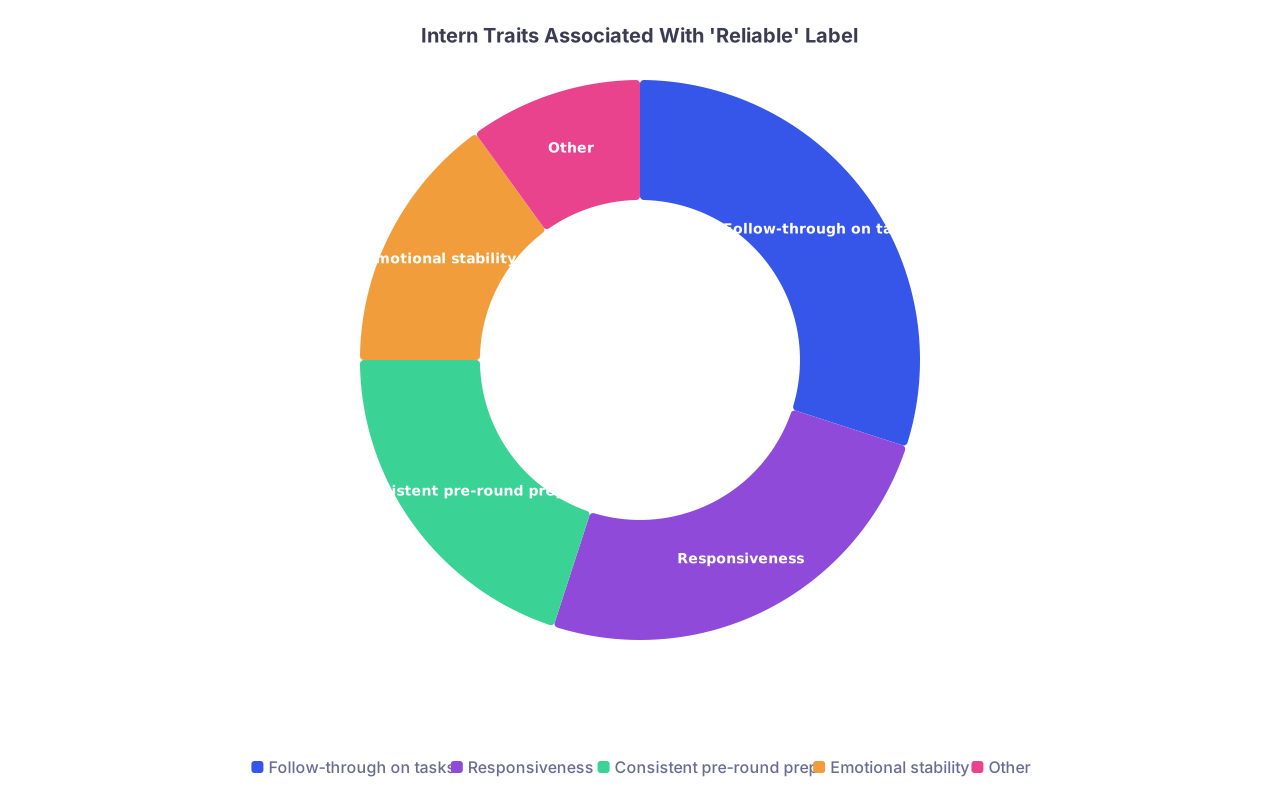
| Category | Value |
|---|---|
| Follow-through on tasks | 30 |
| Responsiveness | 25 |
| Consistent pre-round prep | 20 |
| Emotional stability | 15 |
| Other | 10 |