
It’s 5:12 pm on a Tuesday. Sign-out is in eighteen minutes.
Your list is still open, three progress notes are “in progress,” discharge summary is half-written, and your senior just said, “Can you page endocrine about Ms. Ramirez before we sign out?”
You feel it in your gut: you’re behind. Again.
Here’s the part nobody said out loud in orientation:
On most services, people form their real opinion of you from two things you probably see as “admin junk” — your notes and your pages.
Not your Step score.
Not your med school.
Not your “I’m very passionate about…” intro.
Your paper and your pager. That’s where your reputation is built or destroyed.
Let me walk you through how attendings, seniors, consultants, and night float actually judge you off those two things. Because they do. Constantly.
What Attendings Really Look for in Your Notes (That You Don’t Get Told)
Your program gave you a documentation lecture that was 90% billing, compliance, and “don’t commit fraud.” Fine. Necessary. But that’s not how your team reads your notes.
Here’s what’s really happening.
Your Note Is a Daily Snapshot of Your Clinical Brain
Every attending I’ve worked with does some version of this: they open your note before rounds or during downtime and silently ask:
“Does this intern actually understand what’s going on with this patient?”
They don’t care about your templated review of systems. They scroll right past most of the autopopulated junk. Their eyes go straight to:
- Your one-liner
- Your assessment of the main problem
- Your plan, problem by problem
And they’re grading you. Informally. But very, very real.
Intern A’s note for a septic patient:
72yo F with history of DM2 and HTN admitted with sepsis, likely urinary source, now improving on IV antibiotics.
Problem list:
- Sepsis
- UTI
- DM2
- HTN
Plan:
- Continue current management
- Monitor vitals
- Continue home meds
Intern B’s note for the same patient:
72yo F with DM2, HTN, and CKD3 admitted with septic shock likely 2/2 E. coli pyelonephritis, now hemodynamically stable off pressors, still requiring IV antibiotics.
Problem list:
- Septic shock – improved but still high risk
- On ceftriaxone day 3 for E. coli UTI (see 1/3 BCx, UCx)
- Vitals stable, off pressors x 36h, lactate normalized
- Plan: Continue ceftriaxone for total 7–10 days, narrow if sensitivities allow, maintain MAP >65, daily CBC/BMP
- AKI on CKD3 – likely pre-renal vs ATN from sepsis
- Cr 2.0 (baseline ~1.2), UOP 0.7 mL/kg/hr
- Plan: Avoid nephrotoxins, f/u BMP qAM, consider renal if no improvement in 48h
- DM2 – stress hyperglycemia
- Holding home metformin, on basal-bolus regimen, goal BG 140–180
- HTN – holding home lisinopril, reintroduce when renal function improves
Same patient. One of those interns is going to be trusted. The other is going to be “watched.”
Every program director I know says some version of this behind closed doors: “You can tell who’s going to be fine by reading their notes for a week.” They’re not joking.
The Silent Categories You Get Placed Into From Your Notes
Most teams mentally sort interns into three buckets based on documentation. Nobody announces this. But they act on it.
| Intern Type | How Notes Look | How People Treat You |
|---|---|---|
| “Safe pair” | Clear, accurate, prioritized | Trusted with autonomy |
| “Noisy brain” | Long, unfocused, scattered | Micromanaged, double-checked |
| “Dangerous” | Wrong, inconsistent, sloppy | Avoided, complained about |
“Safe pair of hands” intern
Your notes: Short but accurate. Problems prioritized. Plans make sense. You update the one-liner. You don’t miss big events (like the patient going to the ICU yesterday…). People stop pre-charting on your patients because they trust you.
“Noisy brain” intern
Your notes: Walls of text. Ten active problems all treated equally. Social details buried. Labs pasted in instead of interpreted. You write “continue current management” five times. You copy forward ancient nonsense and never clean it up. Seniors start asking, “Did anything actually change?” because they can’t tell.
“Dangerous” intern
Your notes: Wrong data. Old meds. Incorrect O2 requirements. You say “no acute events” when the nurse documented hypotension to 70s overnight. Your assessment is disconnected from the vitals and labs. Word gets around. The chief resident knows your name, and not in the way you want.
You want to be the “safe pair of hands” intern. That starts with how you write.
The Copy-Forward Trap That Makes You Look Lazy (And Unsafe)
Everyone uses copy-forward. Everyone. Faculty too. The issue isn’t using it. It’s how obviously and sloppily you use it.
Let me tell you what attendings mutter when they read certain notes.
The Red Flags of a “Lazy Copy-Forward” Intern
I’ve watched attendings scroll and say under their breath:
- “Still says ‘on 3L NC’—she’s been room air for three days.”
- “This still says ‘requiring Levophed’—he’s been on the floor since Monday.”
- “Apparently the patient had a fever of 102 last night? Funny, nobody mentioned it on rounds.”
Here’s what actually sets people off:
Old Events Left in as If They’re Current
“Admitted overnight for…” showing up for eight days straight. “On pressors” when that was 4 days ago. Makes you look checked out.Problem List That Never Evolves
You still have “rule out PE” three days after a negative CTPA, normal vitals, and everyone moved on. People will literally say, “Has this intern even looked at their own plan?”Medication Lists That are Fiction
You keep listing home meds you actually discontinued, or vice versa. Pharmacy hates this. So do consultants. It triggers pages, and your name gets associated with “always wrong meds.”No Response to New Events
The patient went to CT guided biopsy yesterday. Your note: no mention. ID changed antibiotics. Your plan: still listing old regimen. This is where you stop being “just sloppy” and start being “unsafe.”
Here’s the truth program directors don’t say to your face: a couple of egregious copy-forward disasters, and people start asking, “Do we need to formally counsel this intern?”
Not because of style. Because of patient safety.
Problem Lists: Where Seniors Decide if You “Get It” or Not
Most interns underestimate how much they’re judged off their problem list.
The problem list is where we see your ability to:
- Prioritize
- Synthesize
- And actually manage multiple things at once
On rounds, when your senior is opening your notes ahead of you, this is what they’re asking themselves:
“Does this intern understand what we are actually treating today?”
What an Intern Who “Gets It” Does Differently
Strong interns:
- Put the main reason for admission first, complications second, chronic stable stuff last
- Remove solved problems
- Merge duplicative nonsense like:
- “Sepsis”
- “Leukocytosis”
- “Tachycardia”
- “Fever” When it’s all the same episode
If your problem list reads like:
- Leukocytosis
- Fever
- Tachycardia
- Sepsis
- UTI
- Possible bacteremia
- Concern for infection
You look like someone who can’t synthesize.
If your problem list reads like:
- Septic shock 2/2 E. coli pyelonephritis with bacteremia – improving
- AKI on CKD3 – likely pre-renal/ATN from sepsis
- DM2
- HTN
Now you look like someone who can think. Not copy.
This is what seniors talk about when they’re fighting over which interns they want on their teams next block.
Discharge Summaries: The Attending’s Real QA Tool
Most interns see discharge summaries as annoying busywork. A thing to slam out at 5:30 pm after everything else.
Faculty see something else: the official story of the hospitalization. And the cleanest lens into how you think.
Why Discharge Summaries Matter More Than You Think
Here’s where your discharge summaries secretly matter:
- Consultants read them to understand what happened if the patient bounces back
- The ED pulls them up at 2am when the patient returns
- Risk management reads them when stuff goes sideways
- Program leadership sometimes does random spot-checks for quality
So when your discharge summary is a chaotic copy-forward graveyard, people notice. And they remember whose name is on it.
Good discharge summary = “I want this intern on my service again.”
Bad one = “This intern does not close loops. I don’t trust their follow-up.”
A strong discharge summary shows:
- Why the patient came in (specific, not “generalized weakness”)
- What the main working diagnosis was when they LEFT (even if still not 100% definitive)
- What big decisions got made: procedures, major medication changes, significant consultations
- What still needs to be done: follow-ups, labs, imaging, pending results (with who is responsible)
If you write:
“Patient admitted with shortness of breath. Improved with treatment. Discharged in stable condition.”
…you’ve just told everyone: “I didn’t really track this admission.”
And yes, attendings talk about it.
The Dark Art of Paging: How You Sound on the Other Side
Now let’s talk about your pager, because this is where your reputation spreads outside your own team.
You think you’re “just calling endocrine” or “just paging cards.” The consultants are doing something else: they’re ranking you in their heads.
And they gossip. Across services. Over coffee. In lounge conversations you’re not invited to.
How Consultants Really Classify Interns From Their Pages
They will not say this on rounds, but here are the silent archetypes nearly every attending/radiologist/consultant uses.
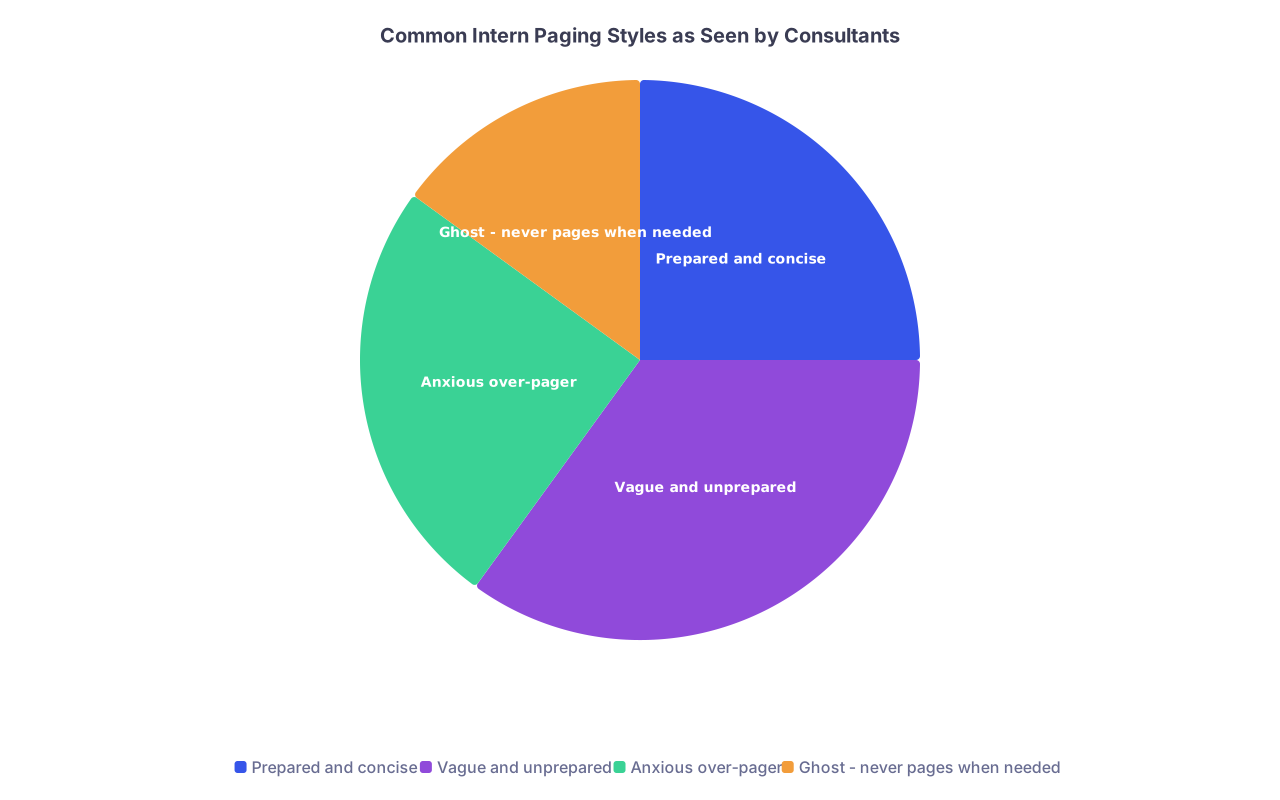
| Category | Value |
|---|---|
| Prepared and concise | 25 |
| Vague and unprepared | 35 |
| Anxious over-pager | 25 |
| Ghost - never pages when needed | 15 |
1. The Prepared, Concise Intern (Everyone’s Favorite)
You page cards and say:
“Hi, this is Dr. Lee, the medicine intern on 7W. I’m calling about a new consult on Ms. Smith, MRN 12345, 68-year-old with new onset atrial fibrillation with RVR, HR 150s, BP stable 120s/70s, no prior AF history. TSH normal, BMP with K 4.2, Mg 1.7, trops negative so far, echo yesterday normal EF. We’ve started metoprolol 5mg IV x2, HR now 120s. Main question is long-term rhythm vs rate control and anticoagulation given CHADS-VASc 3 and recent GI bleed two months ago.”
That call gets you an attending who thinks, “Thank God, someone who knows what they’re doing.”
2. The Vague, Unprepared Intern (Most Common)
You say:
“Hi, um, I’m calling about a patient with afib and I think we need help.”
They ask for vitals, you fumble. Labs? You haven’t checked. Telemetry? No idea. What meds did you already give? “I think maybe some metoprolol?” They have to pry every detail out of you.
They hang up and say to their fellow: “That intern had no idea what was going on.”
Your name is in their head now. Not in a good way.
3. The Anxious Over-Pager
You page neurology for every headache. Cards for every PVC. ID for every positive urine culture. You call GI to “make them aware” of a patient with constipation.
You think you’re being thorough. They think you’re wasting their time.
There’s a sentence I’ve heard more than once in consultant workrooms:
“I’m not responding urgently, it’s that intern again. It’s never anything.”
You do not want to be that intern.
4. The Ghost Intern
Opposite problem. You never page until it’s a disaster.
I’ve seen this: intern sits on rising troponins, new neuro deficit, progressive hypotension, because they’re either scared to page or still “watching it.” Consultants eventually get called by the senior or attending when it’s already ugly.
Now your reputation is: “the intern who doesn’t call until the patient is crashing.”
That one sticks. For years.
How Nurses Judge You From Your Pages and Callbacks
You are not just being judged “upward.” The nursing staff is constantly recalibrating their opinion of you based on how you answer pages.
And unlike faculty, nurses talk. To each other. Across units. Night shift to day shift. If you’re “that intern,” it spreads.
The Fastest Ways to Lose Nursing Trust
Three behaviors ruin you with nurses faster than almost anything else:
- Ignoring Pages or Taking Forever to Call Back
They know you’re busy. They’re not expecting 10-second response times. But when:
- They page twice about a BP of 70/40 and you respond 25 minutes later
- They page about chest pain and you say “I’ll come in a bit” and show up an hour later
- They get attitude when they escalate
Your name will be in the charge nurse’s mouth at shift change. “If you have a sick patient with Dr. X, you need to page the senior, not the intern.”
- Being Dismissive on the Phone
You sigh. You say, “Yeah, just recheck in an hour,” to everything. You say, “That’s fine” without listening. You say, “That’s expected” when they’re worried.
They stop trusting you. They start going around you.
- Never Following Through on What You Say
You tell them, “I’ll put in the order.” You don’t.
You say, “I’ll come examine the patient.” You don’t.
After a few rounds of that, you’re labeled unreliable.
And when nursing leadership complains about “unreliable housestaff,” your name is on that short list.
The Anatomy of a Page That Makes You Look Like a Senior, Even as an Intern
Let me give you the structure that separates “lost intern” from “this person is sharp” when you’re paging.
Memorize this skeleton. Live in it.
When paging a consultant or cross-cover:
Who you are and where you’re calling from
“Hi, this is Dr. Patel, the neurology intern on 9E.”Who the patient is and why they’re in the hospital
“Calling about Mr. Jones, 74-year-old man admitted for decompensated heart failure.”The specific problem/question
“He developed new expressive aphasia about an hour ago, and I’m concerned about stroke. I’m calling to ask if you can assess for emergent imaging and intervention.”Key vitals and stability
“Currently BP 160/90, HR 88, satting 96% RA, blood glucose 130.”What you’ve already done
“We activated stroke alert, got a stat non-contrast CT head which shows no bleed, labs are pending, NIHSS is 8.”Clear question or request
“We’d like your recommendations on next steps, including CTA/perfusion and thrombolysis candidacy.”
That’s it. Not a speech. Just organized, relevant information.
Same with paging at night about deterioration:
“Hi, this is Dr. Chen, the night float intern. I’m calling about Ms. Lopez in 642B, 58-year-old with severe pancreatitis. Over the last hour, vitals worsened: HR 120s, BP down to 80/50, sat 92% on 4L, UOP minimal. She’s febrile to 39.2, lactate 4.3 from 2.0, now altered from this afternoon. We’ve given 1L LR, started broad-spectrum antibiotics, and drawn blood cultures. I’m concerned she’s becoming septic and hemodynamically unstable. I’d like you to come assess with me and help decide if she needs ICU transfer and pressors.”
That call makes you sound like a senior. Even if you’re terrified, which you probably will be. That’s fine. The structure carries you.
How This All Adds Up to Your Reputation Block After Block
Let me tell you how this actually plays out over time. Not the fake “every evaluation is independent” story. The real version.

| Step | Description |
|---|---|
| Step 1 | First Month Notes and Pages |
| Step 2 | Senior Trust Increases |
| Step 3 | Senior Double Checks Everything |
| Step 4 | Good Eval Comments |
| Step 5 | Mixed or Negative Comments |
| Step 6 | Word Spreads to Other Teams |
| Step 7 | Future Rotations Pre Judge You |
| Step 8 | More Autonomy or More Micromanagement |
| Step 9 | Consistently Clear and Reliable? |
Month 1–2: People are “getting a feel” for you. Your notes and pages are the only objective trail of your thinking and your responsiveness.
By month 3–4, you’re already “known”:
- “She writes clean notes, always up to date.”
- “He never knows what’s going on when you call him.”
- “Her discharges are great, everything’s closed out.”
- “You have to read between the lines on his notes, nothing is prioritized.”
By the time your semi-annual reviews roll around, your written work and paging behavior have already shaped the narrative about you. Your evals are not written in a vacuum.
Attendings remember:
- The intern whose note saved them time and made sign-out safe
- The intern whose sloppy documentation forced them to do everything themselves
- The intern who always called early with a clear story when a patient was crashing
- The intern who never called until things were on fire
That’s the reputation you are building with every SOAP note and every “can I run something by you?” page.
Concrete Habits That Quietly Make You “The Reliable Intern”
You do not need to be brilliant. You do not need to be the fastest.
You need to be consistently safe, clear, and easy to work with. Your notes and your pages are the cheapest way to get there.
Here are a few habits I’ve seen transform interns from “meh” to “I want them on my team again” within one block:
Update the one-liner every 1–2 days
Not every month. Every time the story changes. Floor to ICU. New diagnosis. New main problem.Prune your problem list daily
Delete solved issues. Merge redundant ones. Reorder by what will kill the patient first, not alphabetically.Never write “continue current management” without specifying what that is
Future you has no idea what “current” meant on day 7.Before you page, spend 90 seconds pulling up vitals, last note, and relevant labs
Do that, and your calls instantly sound smarter. Because they are.When you say you’ll do something on a page, write it down and close the loop
Order placed. Note written. Patient seen. That’s how you build trust.
You do this for three months straight? People will start requesting you on their services. I’ve seen it happen with interns who weren’t the “smartest” of their class, but were relentlessly reliable on paper and pager.
Years from now, you won’t remember the exact wording of your septic shock note or that one awkward cardiology consult page. You’ll remember something more important: how you quietly turned “just documentation” and “just paging” into proof that you were someone people could trust when it actually mattered.