

It’s 10:37 pm. You’re “off” today, technically. But you’ve spent half the evening looking at the block schedule your future program sent, zooming in on the words “night float” and “q4 call” like they’re sentencing guidelines. Your group chat is buzzing about a weekend trip three months from now, and all you can think is:
“I’m never going to see any of you again, am I?”
You start doing the math. 80 hours a week. One golden weekend… maybe… every so often. Holidays? Probably gone. Weddings? Probably missed. Family birthdays? Definitely missed. And that little voice in the back of your head whispers the nightmare scenario:
What if intern year doesn’t just strain my relationships — what if it quietly kills them?
I’m going to be blunt: this is a real fear. And not a stupid one. I’ve watched people’s marriages crack, long-term relationships implode, best friendships fade to “happy birthday!” once a year. So yeah, your anxiety isn’t making this up.
But the story that you’ll “never see family or friends at all” during intern year? That part is a lie your brain is telling you because it doesn’t have actual data yet.
Let’s get you some data.
What intern year actually looks like (time-wise)
Your brain is probably running on vague horror stories: “I basically lived in the hospital,” “I didn’t see my partner for a month,” “intern year was a blur.” You know what no one ever says? The actual numbers.
So let’s quantify the thing you’re scared of.
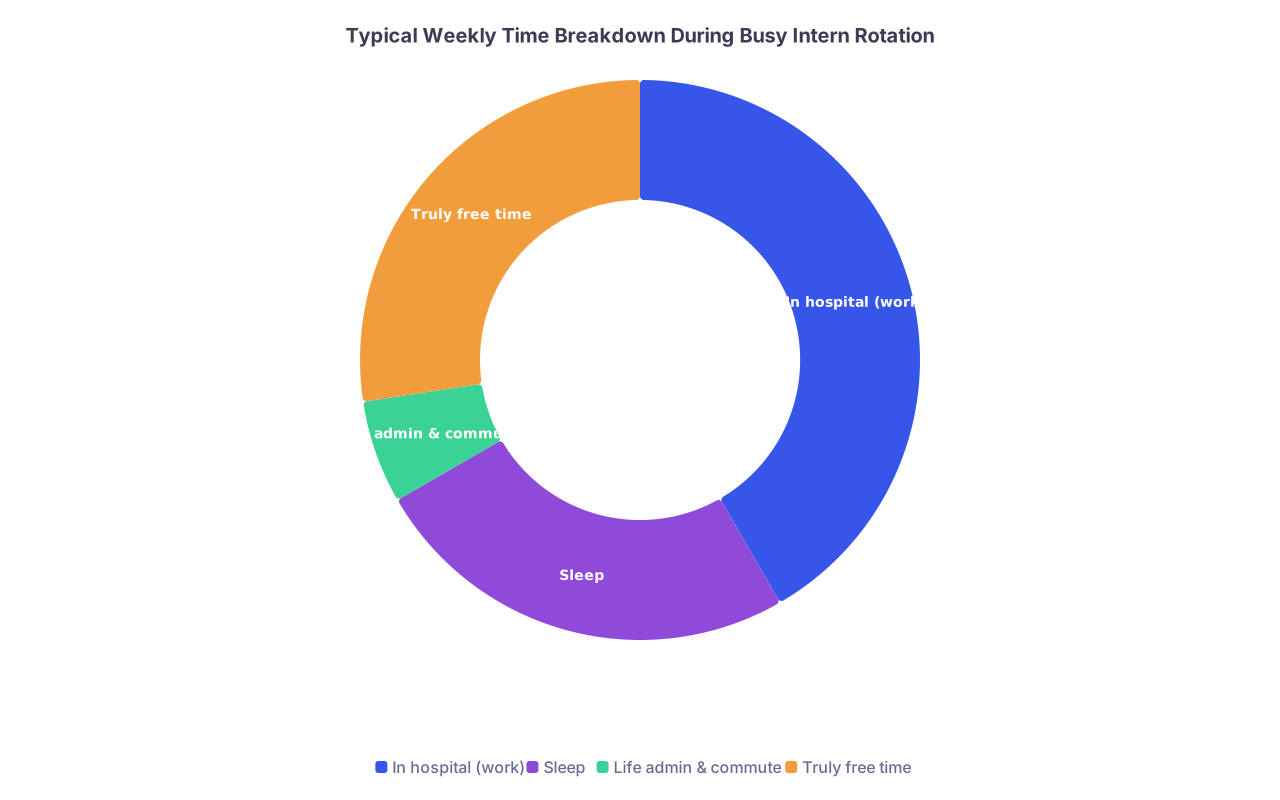
| Category | Value |
|---|---|
| In hospital (work) | 70 |
| Sleep | 42 |
| Life admin & commute | 10 |
| Truly free time | 46 |
Even on a rough 70-hour week, there are still hours that are technically “yours.” The problem isn’t that there are zero hours. It’s that those hours are:
- Scattered
- Unpredictable
- Full of exhaustion and decision fatigue
And then you look at those messed-up chunks and think, “No normal human with a normal life can match this, so I’ll just drift away from everyone.”
Here’s the slightly uncomfortable truth: intern year doesn’t automatically erase your relationships. It forces you to choose. Repeatedly. Intentionally. And yes, sometimes painfully.
But “forced to choose” is a very different beast than “never see them again.”
The worst‑case scenarios you’re imagining (and how close they are to real life)
Let’s drag your internal horror reel out into the light, because I know what it looks like.
Scenario 1: You go weeks without seeing anyone you love
You’re picturing ICU → night float → wards, back to back, and suddenly you realize you haven’t had a face-to-face conversation with anyone outside the hospital in… an entire month.
Could that happen?
Yes. If you let everything become passive.
I’ve watched two versions of the same intern:
Intern A waits for “a free weekend” to see people. It never quite comes. There’s always something: post-call, too tired, random mandatory teaching, extra notes. By November, they’re “sorry I’ve been MIA” texting everyone once a week and silently panicking that everyone is moving on without them.
Intern B accepts that free time will never feel clean. So they pre-plan weird little windows: brunch at 11 am after a 24-hour call (they leave early and crash later), FaceTime with their parents every Sunday at 7 pm no matter what, 20-minute walks with their partner between shifts, even if one of them is holding coffee and the other is basically a corpse.
Same schedule. Very different loneliness.
You can absolutely go weeks without a proper hangout if you treat seeing people like “bonus” instead of “maintenance.” That’s the bad news.
The good news: you don’t need full free weekends to keep relationships alive. You need consistency and some deliberate effort that will feel awkward and forced at first.
Scenario 2: Your friends slowly stop inviting you
This one hurts. The idea that while you’re drowning in cross-cover pages, your friends look at your name in the group chat and think, “They’re always busy. Don’t bother asking.”
I have seen this happen. It’s not always malicious. It’s self-protection on their side, honestly. People get exhausted being rejected.
Here’s when it tends to go bad:
- You say “I’ll try” to everything but rarely commit or follow through
- You respond in the group chat once every 2–3 weeks with walls of guilt
- You don’t tell people your actual schedule, just “I’m so busy, I’m dying”
- You radiate “I’m miserable and everything sucks” every time you do show up
People start thinking: “We’re just making them feel worse / more guilty,” so they back off.
The fix — again, not magical, just intentional — is being weirdly explicit and proactive.
You say things like:
“I can’t make Saturday, I’m on call. But I’m off next Thursday night. Could we do a quick dinner, even like 6–8 pm?”
Or:
“I’m about to start nights for 2 weeks, but please still invite me to stuff. I might say no a lot, but I want to feel included.”
That kind of sentence feels needy when you type it. It’s not. It’s survival.
Scenario 3: Your family thinks you’re “too busy” for them now
This one is brutal if you come from a close or high-contact family. The guilt hits hard. You miss one birthday. Then a cousin’s wedding. Then a holiday. Suddenly you’re the “doctor who’s never around.”
I’ve heard parents say, “We don’t want to bother you” in that half-proud, half-sad voice. Which feels like a gut punch.
You can’t fix the fact that residency is objectively demanding and sometimes inflexible. What you can fix is the story your family tells themselves about your absence.
There’s a difference between:
- “They never call, I guess their career matters more than us.”
vs - “They’re slammed right now, but we always talk on Sunday nights and they visit twice a year when they can.”
Same workload. Different narrative. The second one doesn’t happen by accident.
You basically have to over-communicate early. Not once. Repeatedly.
What real intern contact with family/friends can look like
Let me be practical for a second, because vague “stay connected!” advice is useless when you’re on your fourth consecutive 13-hour day.
Here’s what tends to actually work, across a lot of interns I’ve seen:
| Relationship Type | Typical Pattern That Actually Works |
|---|---|
| Parents/Guardians | 1 scheduled call weekly or biweekly |
| Partner/Spouse | Daily brief check-ins + 1 real block of time weekly |
| Close Friends | 1 meetup/month or 1 long call/month |
| Siblings | Texts/memes + one real call every few weeks |
Do some people do more? Sure. Do some do less? Also yes. But this is the range that feels both doable and enough to not lose people.
The key word in that table is “scheduled.”
You will not spontaneously remember to call people when you’re post-call, dehydrated, and haven’t eaten a real meal in 18 hours. Your brain will choose bed, scrolling, or staring at a wall. And honestly? Fair.
So you outsource it to structure:
- Sunday night 8:30 pm = parents
- Wednesday 9 pm = partner “no phones” time if you live apart (or if you live together, this becomes no-notes, no-EMR, just-being-humans time)
- First Saturday of the month = brunch with local friend group, even if you’re that zombie at the end of the table
Will you miss some of these because of call, codes, admissions from hell? Of course. But you’ll make more of them than if they never existed.
The sick, sad comparison game: “Everyone else is still living their lives”
This one creeps in when you check Instagram on your 15-minute “I might actually pee and inhale a granola bar” break.
You see:
- Trips
- Engagements
- Happy hour photos
- Babies
- Gym selfies at 5 pm with the caption “done for the day!”
And you’re there, badge lanyard digging into your neck, wondering if you accidentally picked the one career that requires you to sacrifice your entire 20s or 30s.
Here’s the ugly truth I’ll just say out loud: your life will not look like your non-med friends’ lives during intern year. It just won’t.
You will miss things. Big things. Things you’ll be sad about years later.
But here’s what that comparison leaves out:
You’re seeing their highlights in what is often a 9–5, 5-day-a-week life. You’re not seeing their boredom, or the fact that many of them also see their friends once every week or two, not daily. Adults are already busy, even without medicine.
Intern year compresses the chaos. It makes everything more dramatic. But it doesn’t mean you’re uniquely doomed to isolation forever. Your timeline is just louder, messier, and way less Instagram-pretty.
The specific people who are at highest risk of feeling isolated
I’m not going to sugarcoat this: some groups get hit harder.
- Folks who moved far from home, with no pre-existing local support
- People whose partners are in completely different time zones or careers
- First-gen or from tight-knit cultures where daily family contact is the norm
- People starting intern year after a breakup, divorce, or friendship fallout
If that’s you, your fear is not overreacting. You’re right that this will feel heavier.
That just means you have to be a bit more deliberate about building scaffolding around yourself before the July chaos hits. Things like:
- Asking your co-interns early if they want to do “dinner after sign-out” once a week
- Finding one or two non-med people local to you who understand odd hours (bartenders, servers, nurses, night-shift people — they get it)
- Telling your family exactly how you want them to support you: “Please keep texting, even if I’m slow to reply. It helps to see your messages.”
Relationships during intern year don’t happen on default mode. Default mode is isolation. So you have to hack the settings a bit.
What about romantic relationships — are they doomed?
This is probably living rent-free in your brain too.
You’ve heard the horror stories:
- “We broke up three months into intern year.”
- “My partner said they felt like a roommate.”
- “We basically lived on parallel tracks.”
Those stories are real. But they usually share the same patterns.
The relationships that don’t survive intern year tend to:
- Assume things will “just work out” without changing habits
- Avoid hard conversations about expectations, sex, emotional labor, finances
- Interpret exhaustion as rejection: “You don’t want to spend time with me” vs “You’re post-call and barely conscious”
The ones that do survive (and I’ve seen a lot of those too) are wildly unromantic on the surface. They look like:
- Calendars on the fridge with circled “our time” blocks
- Talking logistics like a business: “Okay, you work 7–3, I work 6–6, so our overlap is 7–9 pm. Let’s protect one of those hours.”
- Being honest about energy: “I want to see you tonight, but I’m so fried I can offer takeout and a show, not deep conversation.”
Not cute. Very functional. But it works.
Your fear that “no one will want to be with me because of my schedule” isn’t the full story. The better framing is: “I need someone who can handle structure, communication, and weird compromises.” Which, yes, narrows the field. But doesn’t erase it.
Concrete ways to not disappear from your own life
Let me give you a few practical things you can actually do now, before intern year, so you’re not trying to duct-tape your life together in October.
1. Tell people explicitly: “I’m scared of losing you this year”
Is that cringe? A little. Does it work? Yes.
You sit your partner / best friend / parent down and say something like:
“I’m really excited for residency, but I’m also scared I’m going to disappear into it and lose touch with you. I don’t want that to happen. Can we set up some standing calls or times to see each other and treat them like real commitments?”
This gives them a role, not just a front-row seat to your burnout.
2. Decide your non-negotiables now
You will not be able to prioritize everything. If you try, you’ll fail at all of it and spiral. So you pick.
Maybe it’s:
- My parents get a call every week unless I’m on nights
- I will visit home twice this year, even if it means flying post-call and sleeping on planes
- I will see my closest friend in person at least every 2–3 months
You write these down. Literally. Because future-you, in the haze of sign-outs and discharge summaries, needs present-you’s clarity.
3. Embrace the “low-effort touch”
Not every interaction has to be deep. You don’t need hour-long phone calls to stay in people’s lives.
Things that actually work:
- Sending a 10-second voice memo on your walk from the hospital to your car
- Dropping a photo from your day with “thought of you when I saw this”
- A meme in the group chat at 2 am during night float
Is that the same as a weekend getaway? No. But it keeps the emotional thread from snapping.
4. Accept that some relationships will fade — and that’s not a failure
Here’s the part that’s hard to swallow: some friendships will not survive intern year in the form you know them now.
Not necessarily because anyone did anything wrong. Sometimes it’s just:
- Different life stages
- Different cities
- Different tolerance for mismatched schedules
That hurts. It triggers the “I’m being left behind” panic.
But losing certain relationships isn’t proof you chose the wrong path. It’s proof you’re human with finite time and energy in a job that demands more than it should.
What usually happens over a couple of years is this:
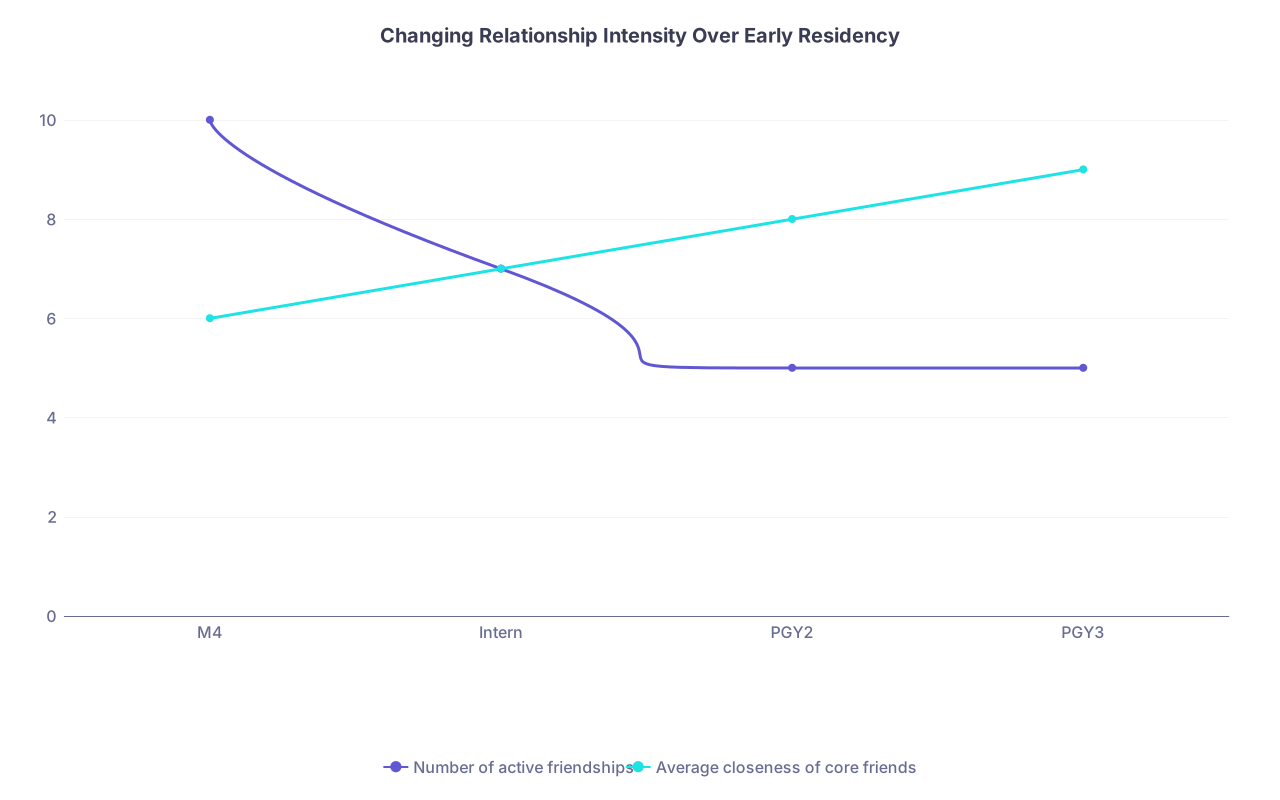
| Category | Number of active friendships | Average closeness of core friends |
|---|---|---|
| M4 | 10 | 6 |
| Intern | 7 | 7 |
| PGY2 | 5 | 8 |
| PGY3 | 5 | 9 |
The circle gets smaller. But often deeper. The people who understand your weird life become your people in a way that’s actually pretty profound.
You’re not wrong to be scared
You’re not overreacting. You’re not “soft.” You’re not melodramatic.
You’re standing at the edge of a year that really will ask more of you than feels reasonable — physically, emotionally, relationally. You’re looking at your parents, your siblings, your partner, your friends, and wondering which of them you’re going to lose along the way.
The fear exists because you care. If you didn’t, you wouldn’t be reading this.
So here’s the perspective I want you to walk away with:
Intern year will almost definitely change your relationships. Some will stretch and come out stronger. Some will drift and fade. Some will hurt in ways you’ll only fully understand later.
But you are not doomed to vanish from everyone’s life. You are not signing a contract to be a ghost.
You’re stepping into a year where time becomes weird, effort matters more than intention, and small, unglamorous acts — a scheduled call, a tired brunch, a 30-second voice memo from the hospital stairwell — are what hold your world together.
Years from now, you probably won’t remember exactly how many weekends you lost to call. You’ll remember who picked up the phone anyway, who showed up in the cracks of your schedule, and how you fought — awkwardly, imperfectly, but honestly — to keep them in your life.


