
It’s 1:30 a.m. on night float. Your list feels like it’s breathing. Ten cross-cover pages in 20 minutes. Two new admissions. Your senior just casually says, “Yeah, go see those two admits, I’ll handle the cross-cover for now,” and you nod like that’s reasonable. But in your head you’re thinking, “How is everyone else doing this and not falling apart?”
You look over and your co-intern is typing at 100 mph, seems weirdly calm, and already finished their notes. Their list is as long as yours. They even had time to eat. You haven’t peed in 6 hours and you’re honestly about to cry in the stairwell.
And the question creeps in:
What if my co-interns just handle the workload better than I do?
What if I’m the weak link?
What if everyone else is built for this and I’m… not?
Let’s walk straight into that fear. Because pretending you’re not thinking it doesn’t make it go away.
The Ugly Fear: “Maybe I Don’t Belong Here”
Here’s the raw version of the thought most people won’t say aloud:
“I ranked this program. They picked me. But watching my co-interns, it feels like they accidentally chose the wrong person. Everyone else is faster with Epic, knows every dosing, writes perfect notes, remembers guidelines, and somehow still jokes with the nurses. I’m just trying not to miss a potassium of 2.7 and kill someone.”
I’ve seen this play out over and over.
The intern who:
- Takes 45 minutes to write the first admission note of the night while their co-intern cranks out two.
- Stares at a page from the nurse about “soft pressures” and panics for a full minute before deciding what to do.
- Loses track of to-dos during pre-rounding because they got interrupted four times.
- Realizes during sign-out they forgot to order an important lab and now feels like absolute trash.
Meanwhile, their co-intern says, “Oh yeah, I already ordered it,” like it’s nothing.
Here’s the thing you’re not seeing in that comparison: you’re grading yourself on visible chaos and them on their curated highlight reel. You see your own panic in 4K. You’re only seeing their surface-level calm.
A lot of supposedly “better handling” is just “better at hiding panic.”
And yes, sometimes they really are faster or more efficient. That part stings. So then the question becomes: if they’re truly better at handling the workload right now… what does that actually mean about you?
Less than you think.
What “Handling the Workload Better” Actually Looks Like
Let’s define what your brain is labeling as “better,” because right now it’s probably one vague, crushing blob.
In reality, it usually falls into a few buckets:
| Area | What You See in Others | What You Assume About Yourself |
|---|---|---|
| Speed | They finish notes fast | I'm slow and incompetent |
| Knowledge | They answer questions easily | I know nothing |
| Calmness | They look unfazed | I'm panicking internally |
| Organization | Their list looks clean | I'm always behind and messy |
| Stamina | They stay late less | I can't keep up |
Most interns I’ve watched who say “my co-interns are better” are usually reacting to one thing: speed. The other person seems faster. Finishes tasks earlier. Logs out sooner.
Let me be blunt: speed is massively overvalued during the first year. Residents brag about “I did 8 admits in a night.” No one brags about “I called the attending when I was worried and probably prevented a disaster.” But that second one matters more.
There are interns who look efficient because they chart by exception and never double-check anything. They fly. Nurses don’t love them. Seniors don’t fully trust them. They’re “handling the workload” until something goes very wrong.
There are other interns who are slower, ask questions, take an extra minute to think through an order set. They feel behind constantly. But six months in, they’re solid and safe and everyone wants them on their team.
So when you say, “My co-interns handle this better,” you need to ask: better at what? And does that “better” actually translate into better doctor… or just better optics?
Why You Feel Like You’re Drowning When Others Look Fine
Let me say the thing you probably won’t hear during orientation:
Residency workload is designed for someone who:
- Knows the system (EMR, workflow, hospital layout)
- Knows the medicine well enough to not look up every tiny thing
- Knows their own limits and has hacks for staying functional on no sleep
You, as a brand-new intern, typically have… none of that.
So if you feel like you’re underwater while someone else is cruising, a few big factors could be at play:
Previous experience advantage
They rotated at this hospital as a med student. They know the nurses, note templates, order sets. They’ve literally written that admission H&P before. That’s a massive head start.Personality differences
Some people tolerate uncertainty better. They’re more okay with “good enough.” You might be the type who can’t move on until everything is 100% controlled and perfect. That’s not laziness vs competence; that’s temperament.Invisible help
Some co-interns are texting seniors, friends, or chief residents in the background. Or their senior is quietly protecting them. You only see the final output, not the scaffolding they’re leaning on.Different learning curves
I’ve seen interns who are complete chaos for the first 3 months and then something clicks. Others start strong and plateau. You can’t call the match in July.You’re too anxious to see your own progress
Anxiety makes you disregard every small win as “bare minimum” and highlight every stumble as “proof I suck.” It’s a rigged scoring system.
So yeah, maybe your co-interns are “handling the workload” better right now. But right now is not the whole story.
The Worst-Case Scenario You’re Secretly Imagining
Let’s name the horror movie running in your head. Usually it sounds like:
- I’ll be the slowest one.
- My seniors will think I’m incompetent.
- The program will regret taking me.
- I’ll make a mistake because I’m overwhelmed.
- I’ll be that intern everyone talks about: “Yeah, they just couldn’t handle it.”
Now let me tell you what actually happens with the “slow,” overwhelmed intern in real life.
They are:
- Given more structure. Seniors check in more. Expectations get tailored a bit.
- Given feedback that stings: “You need to tighten up your time management, your notes can’t take this long.”
- Stressed and embarrassed. They go home and spiral. Then slowly, they adapt.
You know what does not happen in real life 99.9% of the time?
They don’t get fired. They don’t get publicly shamed in some grand announcement. They don’t single-handedly sink a service.
Most programs would rather invest in you than replace you. Because recruiting is expensive, and they already committed to you. It’s literally in their interest for you to get better.
So the actual “worst” common outcome isn’t catastrophic. It’s uncomfortable:
You get called in for a talk. You get told very directly, “You’re behind your co-interns on efficiency. Let’s work on it.” You feel like garbage for 48 hours. And then you start improving with a plan.
Is that fun? No. Is it survivable? Yes.
Concrete Ways to Get Closer to “Handling It”
Let’s say you really are slower than your co-interns right now. Instead of marinating in shame, you need moves. Practical, unsexy, boring moves.
Here’s how I’ve seen struggling interns actually change the game:
1. Ruthlessly simplify your “brain”
If your patient list / “brain” is 2 pages of chaos, your mind will feel like that too. You need a structure where you can glance and know:
- What’s sick?
- What’s pending?
- What absolutely must happen before sign-out?
Something like:

If your current system isn’t working, steal someone else’s. Ask the efficient co-intern, “Can I see your list template?” They’ll show you. Copy shamelessly.
2. Separate “thinking time” from “typing time”
A lot of slowness comes from trying to fully think and document at the same time. It’s brutal on a tired brain.
Try this on admissions or progress notes:
- Take 2–3 minutes after the encounter to jot down your plan in ugly shorthand on scrap paper or your list.
- Only once you’re clear on your plan, sit and type the note in one go.
Context switching back and forth between “hmm what could this be” and “write in nice full sentences” is where time vanishes.
3. Use “good enough for now” more often
Perfectionism is a time sink. This shows up as:
- Editing your own note paragraphs three times.
- Re-reading the whole chart before every minor decision.
- Spending 10 minutes hunting for the exact perfect guideline.
You’re an intern, not UpToDate. You’re not submitting your note to New England Journal. If your assessment is coherent, safe, and your plan is reasonable and discussable with a senior, it’s enough.
Ask yourself: “Is this safe, or am I polishing?” Then stop at safe.
Talking to Seniors Without Sounding Incompetent
I know another fear hiding here: “If I tell my senior I’m struggling, they’ll think I can’t hack it.”
There’s a difference between helpless and honest.
Helpless sounds like:
“I can’t do this, I’m too slow, there’s too much.”
Honest sounds like:
“I’m getting through everything, but I’m consistently staying late and I think my workflow is inefficient. Could I run through how I’m organizing my day and get your input?”
One of the most clutch moves I’ve seen interns do is a short, focused conversation:
“Hey, I’ve noticed my co-interns finish notes earlier and I feel behind. Can you watch how I pre-round or structure my day for a bit and tell me where I’m losing time?”
Most seniors respect that. Because it shows insight, not weakness.
And yes, some seniors are jerks. If they just say “work faster,” that’s not coaching, that’s laziness on their part. But at least you’ll know you asked.
You’re Comparing Your Intern Year to Their Highlight Reel
Let’s zoom out for a second.
Early residency often looks like this:
- July: “I’m going to die. This is impossible.”
- August: “Okay, I’m not going to die, but I’m always behind.”
- October: “Wait. I finished pre-rounding on time. What sorcery is this?”
- January: “I just answered a question the medical student didn’t know. When did that happen?”
- End of year: “Wow. I still feel like I know nothing, but also… I’m an actual functioning doctor?”
You are judging yourself on, like, July 13th.
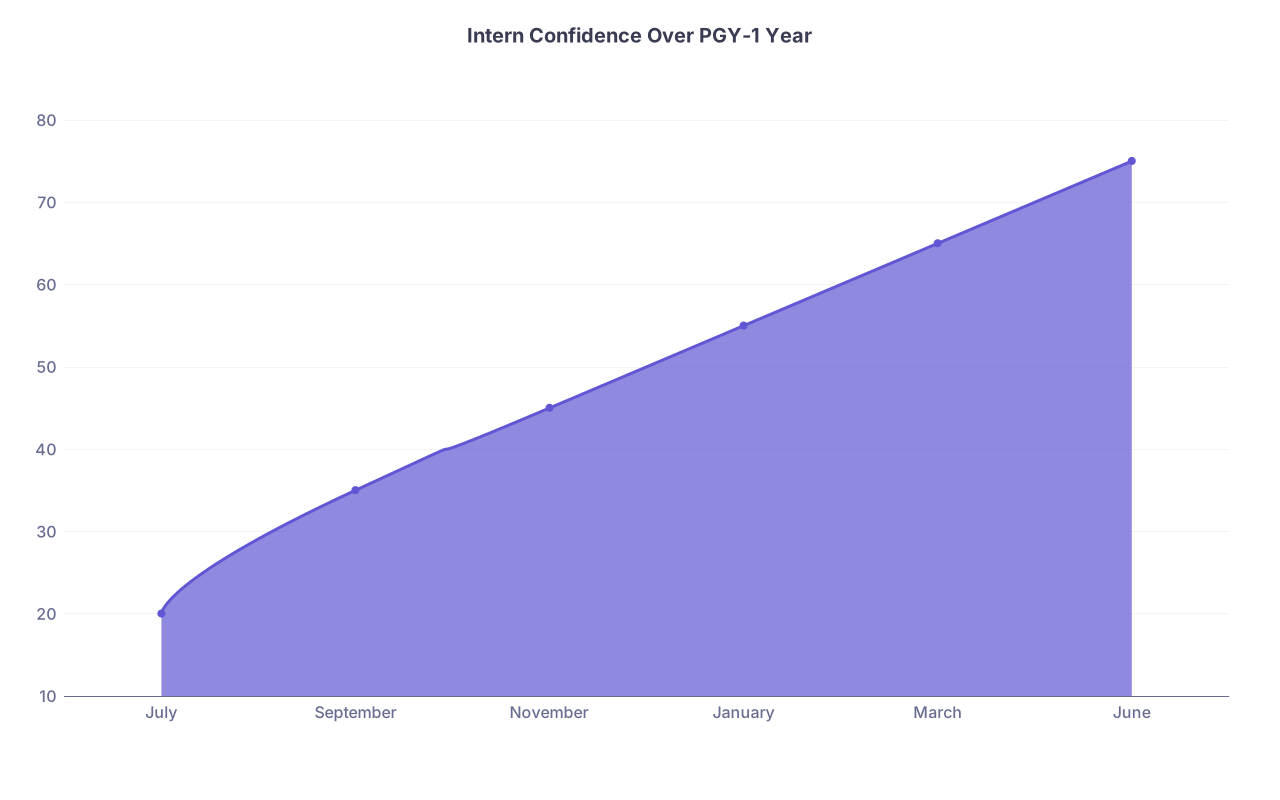
| Category | Value |
|---|---|
| July | 20 |
| September | 35 |
| November | 45 |
| January | 55 |
| March | 65 |
| June | 75 |
Confidence doesn’t spike in week one. It trickles in through tiny, repetitive wins: managing a mild DKA without panicking, catching a bad lab before the nurse calls, getting through a full call night without feeling utterly lost.
Your co-intern who seems calm may have seen more of those wins earlier (better prep, home institution, different rotation schedule, whatever). You’re not broken. You’re just not there yet.
The word “yet” matters way more than you think.
A Quick Reality Check: What Actually Matters Long-Term
Three years from now, no one will care which intern wrote the fastest notes that first month.
They will care about:
- Who they trust on nights.
- Who double-checks when they’re unsure.
- Who nurses feel safe paging.
- Who keeps their cool when something’s crashing.
- Who quietly improves instead of collapsing under insecurity.
Handling the workload is not about never feeling overwhelmed. It’s about not letting that overwhelm make you dangerous or paralyzed.
If you’re still worrying about how your performance compares, that actually tells me something positive: you care. Dangerous residents are the ones who stop caring, stop asking, and think they’re above feedback.
You’re not that. You wouldn’t be reading this if you were.
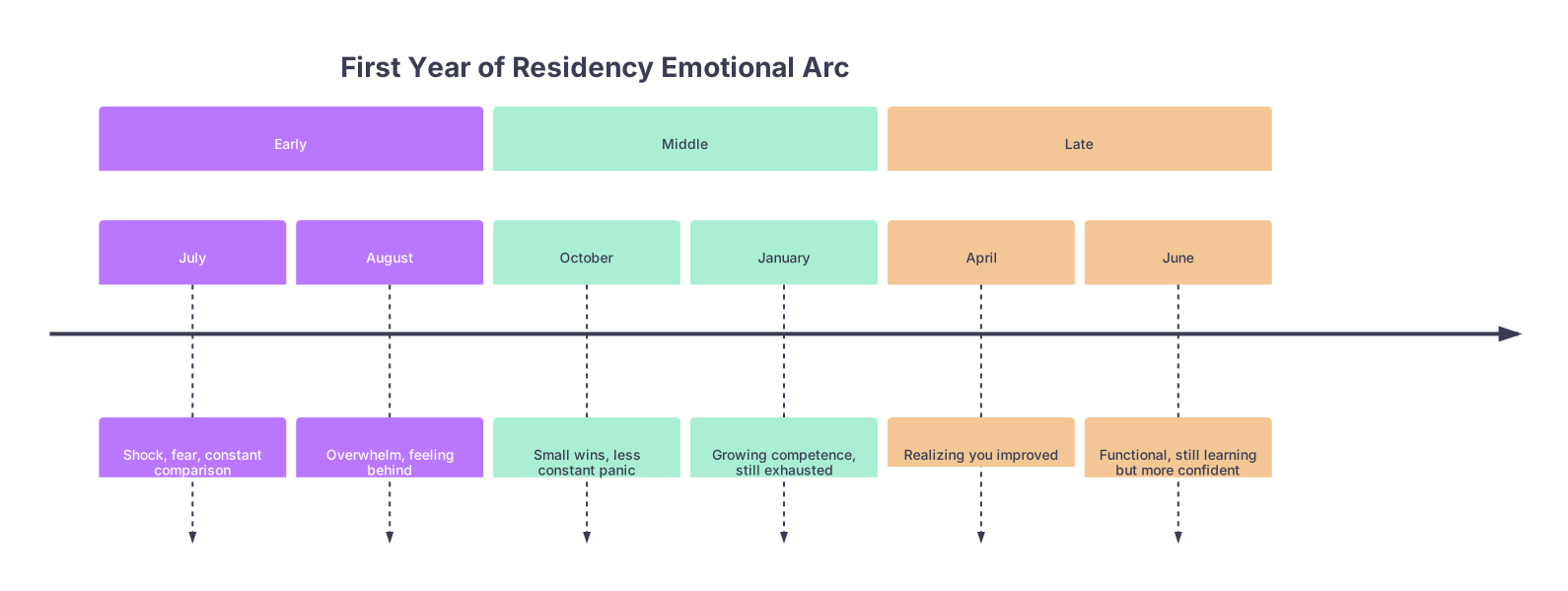
| Period | Event |
|---|---|
| Early - July | Shock, fear, constant comparison |
| Early - August | Overwhelm, feeling behind |
| Middle - October | Small wins, less constant panic |
| Middle - January | Growing competence, still exhausted |
| Late - April | Realizing you improved |
| Late - June | Functional, still learning but more confident |
If You Do Only One Thing Today
Don’t try to “fix everything” or magically become as fast as the golden co-intern overnight.
Do this instead:
Think of one specific moment in the last week you felt behind or inadequate. “I was the last one finishing notes,” or “I lost track of tasks during rounds.”
Then, message or ask one person you trust (a senior, chief, or co-intern):
“Hey, I’ve been struggling with [that specific thing]. Could I grab 10 minutes sometime to see how you approach it? I feel like I’m reinventing the wheel and it’s not going great.”
That’s it. One tiny, concrete step.
You don’t need to become the best intern. You just need to become a slightly more functional version of yourself than you were last week. That’s how everyone else you’re comparing yourself to actually got there.