
It’s 2:37 a.m. You’re sitting in the call room, staring at your sign-out list, and your eyes keep blurring. You’ve still got three cross-cover pages to deal with, notes from earlier that you barely remember writing, and you’re doing the math in your head:
“If I admit two more. And the attending wants full notes. And I still have to round at 6:30. I’m going to be here… what, 16 hours? 18? And I’m already at 78 hours this week. I can’t keep this up. But if I say something—if I tell someone I’m struggling—am I going to get labeled as weak? What if they think I can’t hack it? What if this ruins my residency?”
That’s the headspace you’re in, right? Torn between “I literally can’t keep doing this” and “I will burn my entire career to the ground if I complain.”
Let me just say it up front: you’re not crazy for worrying about backlash. That fear is baked into residency culture.
But it’s also not as simple as “say nothing or get fired.” There’s a way to do this that protects you, respects patient safety, and doesn’t brand you as the Problem Intern for the next three years.
Let’s break it down.
What You’re Actually Afraid Of (And Which Fears Are Real)
You’re not just asking, “Can I tell them I’m struggling?”
You’re really asking:
- Will they think I’m weak?
- Will this go in my file?
- Will I get a bad evaluation or not get re-signed?
- Will someone quietly decide I shouldn’t go into fellowship X because I “couldn’t handle intern year”?
Here’s the ugly truth from what I’ve seen and heard in multiple programs:
Some of these are real risks. Not in a dramatic, “you’re going to be fired tomorrow” way, but in a quieter, more annoying way: people talk, reputations form, and some attendings are stuck in 1995.
But here’s the other truth: programs are absolutely terrified of certain words now—“burnout,” “unsafe,” “patient safety,” “duty hour violations,” “ADA,” “disability,” “retaliation.” And you can use that reality to your advantage.
So the game isn’t “say nothing vs say everything.”
The game is: how do I communicate that I’m at my limit and need help without looking like I just don’t want to work?
What Programs Actually Care About (Underneath the Noise)
Programs don’t lose sleep over your feelings. They lose sleep over:
- Patient harm
- ACGME accreditation issues
- A resident imploding mid-year
- A resident leaving and creating a staffing nightmare
They don’t want you falling apart. They just don’t want a whiff of “lazy,” “disengaged,” or “blames everyone else.”
So if you go in with:
“I’m tired, this is hard, the hours suck.”
That’s unfortunately going to sound like every stereotypical complaining intern they half-ignore.
But if you go in with:
“I’m concerned that the current hours and workload are affecting patient safety and my ability to function safely, and I want help problem-solving this before something bad happens.”
Now you’re talking their language. You’re not just venting; you’re flagging a risk.
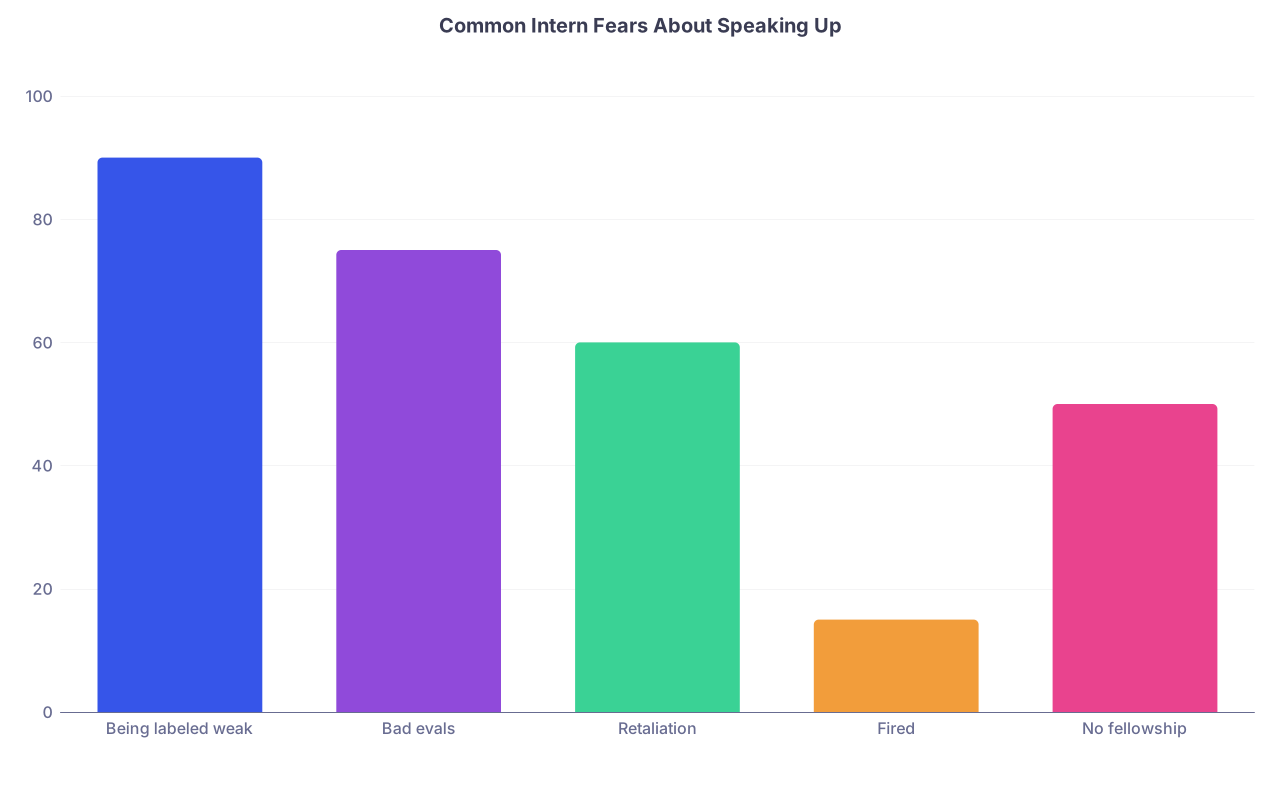
| Category | Value |
|---|---|
| Being labeled weak | 90 |
| Bad evals | 75 |
| Retaliation | 60 |
| Fired | 15 |
| No fellowship | 50 |
(Those percentages aren’t literal data, but they’re pretty close to what I hear over and over.)
Where and How You Say It Matters… A Lot
This is where people screw themselves without realizing it.
Who you don’t start with
Don’t start with:
- The attending who brags about doing “120-hour weeks back in the day”
- The malignant senior who already thinks everyone younger is soft
- The group text during a meltdown shift
That’s how reputations get cemented.
Who you do start with
Think of this as a ladder.
- A trusted senior or chief you actually like
- Your APD/PD or wellness/education chief, depending on how serious it is
- GME/HR or counseling if it’s reached “I might quit or collapse” territory
The safest first move is usually a senior or chief resident you halfway trust. Something like:
“Hey, I’m struggling with the hours and how I’m coping. I’m worried I’m going to miss something important. Can I get your advice on how people usually handle this?”
You’re not accusing the program. You’re asking for mentorship. That’s a very different vibe.
If they shrug you off completely or mock you? Good, now you’ve identified who not to trust. Then you escalate.
How To Talk About Struggling Without Sounding Like You’re Quitting
You’re scared that if you say “I’m struggling,” they’ll hear “I can’t do this at all.”
So you have to be very clear on three messages at the same time:
- I care about doing this job well.
- The current situation is pushing me past a safe limit.
- I’m asking for help/problem-solving, not trying to bail.
Here’s a script you can actually use with a chief or PD:
“I wanted to check in because I’m feeling stretched past what’s safe. The hours and volume lately have gotten to a point where I’m noticing I’m slower to process things and I’m making more near-mistakes. I’m not saying I don’t want to work hard—I do—but I’m worried that if I keep going like this, I’m going to miss something serious. I’d like help figuring out how to make this sustainable so I can function safely.”
Notice what’s in there:
- “Near-mistakes” = patient safety concern without needing a catastrophe
- “Make this sustainable” = you’re invested long-term
- “Function safely” = now this is their problem too, because ACGME would absolutely care
You’re not whining about fairness. You’re flagging risk and asking for solutions.

| Step | Description |
|---|---|
| Step 1 | Struggling with hours |
| Step 2 | ED/GME/PD right away |
| Step 3 | Talk to trusted senior or chief |
| Step 4 | Try suggested changes |
| Step 5 | Meet with PD or APD |
| Step 6 | Document concerns and involve GME |
| Step 7 | Monitor and follow up |
| Step 8 | Immediate danger? |
| Step 9 | Helpful? |
| Step 10 | Still unsafe? |
The Line Between “This Is Hard” and “This Is Unsafe”
Residency is supposed to be hard. That’s the party line you’re going to hear from everyone.
But there’s hard, and then there’s dangerous.
When you’re here:
- You’re tired but still thinking clearly
- You’re annoyed at the hours but not constantly fantasizing about leaving medicine
- You can still study a bit on days off, even if not much
That’s “normal miserable” intern year.
When you’re here:
- Microsleeps while writing orders
- You re-read the same med list three times and still don’t process it
- You’re forgetting basic things you never used to forget
- Thoughts like “If I get in a car accident on the way home, at least I’ll sleep in the hospital”
That’s not just “toughing it out.” That’s unsafe. For you and patients.
Programs know this. They just sometimes pretend not to until someone says the quiet part out loud: “I don’t feel safe practicing at this level of fatigue.”
When you tie your struggle explicitly to safety—without melodrama, just facts—you shift the conversation from “you being weak” to “the system being potentially out of compliance.”
They pay attention to that.
But What About Actual Backlash? Let’s Talk Worst-Case Scenarios.
You’re probably thinking:
“Okay, fine, but what if I speak up and they:
- Slap me with a remediation plan
- Start nitpicking every little thing I do
- Don’t renew my contract at the end of the year”
Here’s how this tends to actually play out.
Most common outcome
You get some version of:
- “Yeah, intern year is brutal. Hang in there.”
- A few small tweaks (someone helps you reprioritize tasks, a senior shields you a bit on a brutal week, maybe a schedule switch)
- And a generic “let us know if it gets worse.”
Is it magical? No. But you’ve at least signaled that you’re watching your safety and you’re not going to silently combust.
Medium-bad outcome
You get tagged as “a bit fragile” by one or two people who gossip too much. Your eval has some vague line like “needs to continue working on efficiency and stress tolerance.”
Annoying? Yes. Career-ending? No.
Fellowship directors read hundreds of these. They know half of them are noise. If your clinical performance is solid and you’re not a disaster, one or two vague comments won’t sink you.
Actual-bad outcome (but rare)
You complain in a very confrontational way, with accusations and zero self-awareness, and you repeatedly refuse all feedback. Then yes, you can absolutely get on someone’s bad side and make your life miserable. Or if performance really is unsafe and you don’t improve, there can be formal remediation.
So you avoid that by:
- Focusing on safety and sustainability, not “this is unfair”
- Owning your part: “I know I still need to work on efficiency, but right now I feel like the hours are pushing me into unsafe territory”
- Asking for specific help, not just venting
You’re not walking in as The Defendant. You’re walking in as a professional saying, “I want to do this job well; I need support to keep it safe.”
Practical Phrases You Can Use Tomorrow
If you’re on service and drowning right now, here are things you can actually say that are honest but not career-suicidal:
To a senior, mid-shift:
“I’m at the point where my brain is starting to fog. Can we go over priorities so I don’t miss anything important?”
To a chief, via email:
“I wanted to check in about my current schedule and workload. I’m finding that with the current hours, I’m making more near-mistakes than I’m comfortable with, and I’m worried about sustaining this safely for the rest of the block. Could we talk about strategies to make this more manageable while still meeting expectations?”
To your PD, in a meeting:
“I’m not asking to work less hard, but I am concerned the current combination of hours and workload is pushing me beyond a level where I feel safe. I want to find a way to keep showing up fully without burning out or putting patients at risk.”
None of that is “I can’t hack it.” It’s “I want to be safe and effective, and I need your help to do that.”
| Situation | Safer Phrase | Risky Phrase |
|---|---|---|
| Mid-shift overwhelm | "Can we review priorities? I’m worried I’ll miss something." | "This is too much, I can’t do this." |
| PD meeting | "I want to keep this sustainable so I can function safely." | "You’re violating duty hours and this program is toxic." |
| Email to chief | "I’m making more near-mistakes than I’m comfortable with." | "These hours are ridiculous and unfair." |
When You Need to Pull the Emergency Brake
There is a level where you stop worrying about backlash and start worrying about surviving:
- You’re having daily thoughts of self-harm
- You’re using substances to get through shifts or sleep
- You’re so sleep-deprived you’re a danger to yourself driving home
- You’ve had multiple near-misses or actual errors that scare you
At that point, the correct move is not “craft the perfect politically safe email.” It’s:
- Talk to someone today—PD, GME, Employee Health, or the hospital’s confidential counseling
- Use words like “unsafe,” “I’m not okay,” “I need urgent help”
Yes, it’s scary. Yes, you’re afraid of the fallout. But I’ve watched people wait too long, and the crash is always louder than the early warning could’ve been.
Programs have legal and accreditation obligations around this stuff. Once you say clearly, “I am not safe to keep functioning at this level,” they have to take that seriously. Maybe imperfectly, but seriously.

You’re Not Broken For Struggling With This
You know what I wish someone had told me and my co-interns bluntly?
If you’re falling apart because of 80-hour weeks, inconsistent supervision, constant high acuity, and relentless emotional stress—that doesn’t mean you’re weak. It means your brain and body are working as designed. You weren’t built for this.
Yes, some people look like they’re thriving. You don’t know what they’re doing on their days off, or what their coping looks like. You don’t see the senior crying in their car in the parking garage. I promise you, it’s happening.
You’re allowed to say, “This is too much. I need help.” That’s not a failing. That’s actually exactly what we tell patients to do.
The trick is just being smart about how and where you say it.
What You Can Do Today
Don’t over-theorize this. Take one concrete step:
Open your email or messages and draft one sentence to a trusted senior or chief:
“I’m finding myself really worn down by the hours lately and I’m worried I’m not functioning at my best — do you have time this week to talk about how people usually handle this?”
You don’t even have to send it yet. Just write it. Look at the words. Notice that nothing in that sentence screams “weak” or “incompetent.” It just sounds… human.
Then decide: send it, or tweak it, or schedule a time in your calendar to talk to them in person.
But do not keep pretending that “maybe next month will be better” is a plan. It’s not. Start with one small, low-risk ask for help and build from there.
FAQ (Exactly 5 Questions)
1. Will telling my PD I’m struggling with the hours go in my permanent record?
Probably not in the dramatic way you’re imagining. PDs don’t usually document “intern complained about hours” in some official file. What might show up is vague language in evaluations like “needs to continue building resilience” if the conversation is handled poorly. If you frame it around patient safety, sustainability, and a desire to improve, most reasonable PDs won’t weaponize that against you.
2. Can I get fired for saying the hours feel unsafe?
Getting outright fired solely for saying “I’m worried I’m too fatigued to be safe” would be extreme and a massive risk for the program. What’s more likely is: they’ll monitor you more closely, maybe set up a plan, maybe look for other performance issues if they’re already concerned. If you’re functioning fine clinically and just asking for support, termination is very unlikely. Residents who get let go are generally having repeated, serious performance or professionalism issues beyond just “I’m tired.”
3. Should I mention “burnout” or “mental health” directly, or is that too risky?
If what you’re experiencing really is burnout or depression/anxiety, avoiding those words doesn’t magically protect you. The safer move is to be honest but specific: “I’m experiencing significant burnout and it’s affecting my concentration and sleep, and I want to address this before it compromises patient care.” Programs are increasingly cautious around mental health and retaliation. Just don’t frame it as “I’m broken and can’t do this,” but as “I’m struggling and want to get better and be safe.”
4. What if my co-residents tell me never to complain to leadership?
Co-residents are often jaded and protecting themselves. They’ve seen bad responses and don’t trust the system. Sometimes they’re right. But blanket “never tell PD anything” advice is too extreme. Use them as intel: ask, “Who is actually safe to talk to? Which chiefs/PDs are reasonable?” Then choose your person strategically. Silence helps malignant systems more than it helps you.
5. How do I know if I should just suck it up vs actually speak up?
Ask yourself two things:
- Are you just exhausted and annoyed, or are you genuinely noticing more near-mistakes, memory lapses, or blank moments?
- If a patient or med student told you they felt exactly like you do—same symptoms, same thoughts—would you be worried about them practicing safely?
If you’d worry about someone else in your condition, it’s past the point of “suck it up.” That’s your sign to at least talk to a trusted senior or chief and say, “I think I’m right at the edge of safe right now. Can we talk about this?”