
The fantasy that “it’ll get better after intern year” is dangerously oversold.
If you’re already wondering, “What if I burn out before PGY2?” you’re not being dramatic. You’re reading the room.
Let me say the thing no one wants to say out loud: yes, you can burn out in your first year. You can crash hard. You can be the intern crying in the stairwell at 4:30 a.m., googling “what happens if I quit residency” on 2% battery.
But that worst-case scenario usually doesn’t come out of nowhere. There are early warning signs. Most people just ignore them because everyone else looks miserable too, so it feels “normal.”
Let’s not do that.
The Lie They Sell You About Intern Year
You know the script:
“Intern year is the hardest, then it gets better.”
Translation in real life?
“It’ll get marginally more predictable, but you’ll be more tired, older, and have more responsibility.”
The scary part is this: programs and seniors normalize some really unhealthy stuff. You hear things like:
- “Oh, you’re exhausted? That means you’re doing it right.”
- “If you’re not staying a little late, you’re not working hard enough.”
- “We all survived. You will too.”
Survived is doing a lot of work in that sentence.
Intern-year burnout is common, especially in IM, gen surg, OB/GYN, EM, and ICU-heavy programs. It’s not just being tired. It’s this toxic cocktail of sleep debt, emotional overload, moral distress (“why are we doing this to this patient?”), and zero time to recover.
But burnout usually creeps in months before you fully feel it. Think of it more like a slow leak than a tire blowout.
The Real Early Warning Signs (That Everyone Pretends Are “Normal”)
I’m not talking about “I’m tired after a 28-hour call.” Of course you are. I mean the pattern, the drift.
1. You stop bouncing back between shifts
You know in med school where one good night of sleep kind of reset you? That starts to disappear.
Early warning version:
- You get a full post-call day off, sleep 10–12 hours, and still wake up heavy.
- You walk into your next shift already counting the hours until you can lie down again.
Really red flag version:
- Days off don’t feel like “rest” anymore. They feel like “recovery triage.”
- No amount of sleep fixes this constant lead-in-your-chest feeling.
That’s your body telling you: “Hey. This isn’t just ‘busy.’ I’m not resetting anymore.”
2. Your empathy meter starts flatlining
At first, you care about everyone. The sweet old lady with CHF, the psych patient who keeps leaving AMA, the family that needs a 45-minute goals-of-care talk.
Months in, it shifts.
Subtle version:
- You start dreading certain patient types.
- You catch yourself thinking, “I just don’t have it in me for this conversation right now.”
Danger zone version:
- You find yourself not caring if someone gets better or not. Not in a “cold clinician” way, but in a “nothing feels real” way.
- You start referring to patients as “the pancreatitis in 12” and not even notice you’re doing it.
- Bad news conversations feel like reading from a script you’re not emotionally present for.
That’s not you being “hardened.” That’s emotional exhaustion and depersonalization, classic burnout pillars.
3. You lose yourself outside the hospital
This one sneaks up.
Early:
- You stop doing small things you used to enjoy: cooking, reading, gym, hobby stuff.
- Days off vanish into doomscrolling and Uber Eats.
Later:
- You realize you don’t even know what you like anymore.
- If someone asks, “What do you do for fun?” your brain blank screens.
- You start thinking, “There’s just residency and sleep. That’s it.”
When your identity shrinks to “I am an intern and that’s all I am,” you’re in dangerous territory. Because if that one thing starts to suck (and it will), you have nothing else anchoring you.
4. The “tiny” mistakes start creeping in
Not the big terrifying ones. The small, stupid, embarrassing ones.
Early:
- Forgetting to pend discharge orders until 4 p.m.
- Reordering home meds twice.
- Missing a lab follow-up during a busy call night.
More serious pattern:
- Constantly feeling mentally foggy, even on lighter days.
- Struggling to retain information you know you learned before.
- Needing to triple-check everything, not because you’re careful, but because your brain feels unreliable.
Everyone makes mistakes. But if your error rate starts tracking with your exhaustion and detachment, that’s a system screaming: something is off.
5. Persistent dread that doesn’t leave, even off-service
I’m not talking about the Sunday Scaries. I mean this awful, baseline dread that sits in your chest like a stone.
It shows up as:
- You wake up and the first thought is, “I can’t do this again.”
- You count months to vacation, to rotation changes, to the end of the year like it’s a prison sentence.
- You fantasize about getting mildly sick or injured just to get time off. Not dramatic ICU stuff. Just “if I broke my ankle, I could stop for a bit.”
That last one? I’ve heard it whispered more times than I can count. That’s not “weakness.” That’s your brain asking for an emergency exit.
6. Your internal monologue turns vicious
This happens quietly. You start talking to yourself like a malignant attending.
Stuff like:
- “You’re so behind. Everyone else is dealing with this better.”
- “You’re not cut out for this. You’re fooling everyone.”
- “You’re already this burned out and it’s only PGY1. You’ll never make it.”
If your automatic thoughts are constantly self-punishing and hopeless, your burnout isn’t just situational anymore. It’s eating into your self-worth.

What Actually Pushes People Over the Edge Before PGY2
It’s rarely “just” hours or “just” one brutal rotation. It’s the combination.
| Factor | What It Looks Like Day-to-Day |
|---|---|
| Chronic Sleep Debt | Always tired, never restored |
| Toxic Culture | Shaming, yelling, no support |
| Moral Distress | Doing care you feel is harmful |
| Isolation | No safe people to vent to |
| Loss of Control | No say in schedule or workload |
If two or three of those line up at the same time for months, that’s when people break.
Think:
- Heavy ICU months back-to-back
- A program that worships “grit” and mocks vulnerability
- Zero formal mental health access that feels safe
- Maybe something personal on top of that: breakups, illness in family, money issues
You’re not weak if this combination flattens you. You’re human.
How to Tell “Normal Hard” From “Dangerous Hard”
You are going to be tired. Overwhelmed. Questioning life choices at 3 a.m. That part is standard.
What’s not standard is how long and how deep it goes.
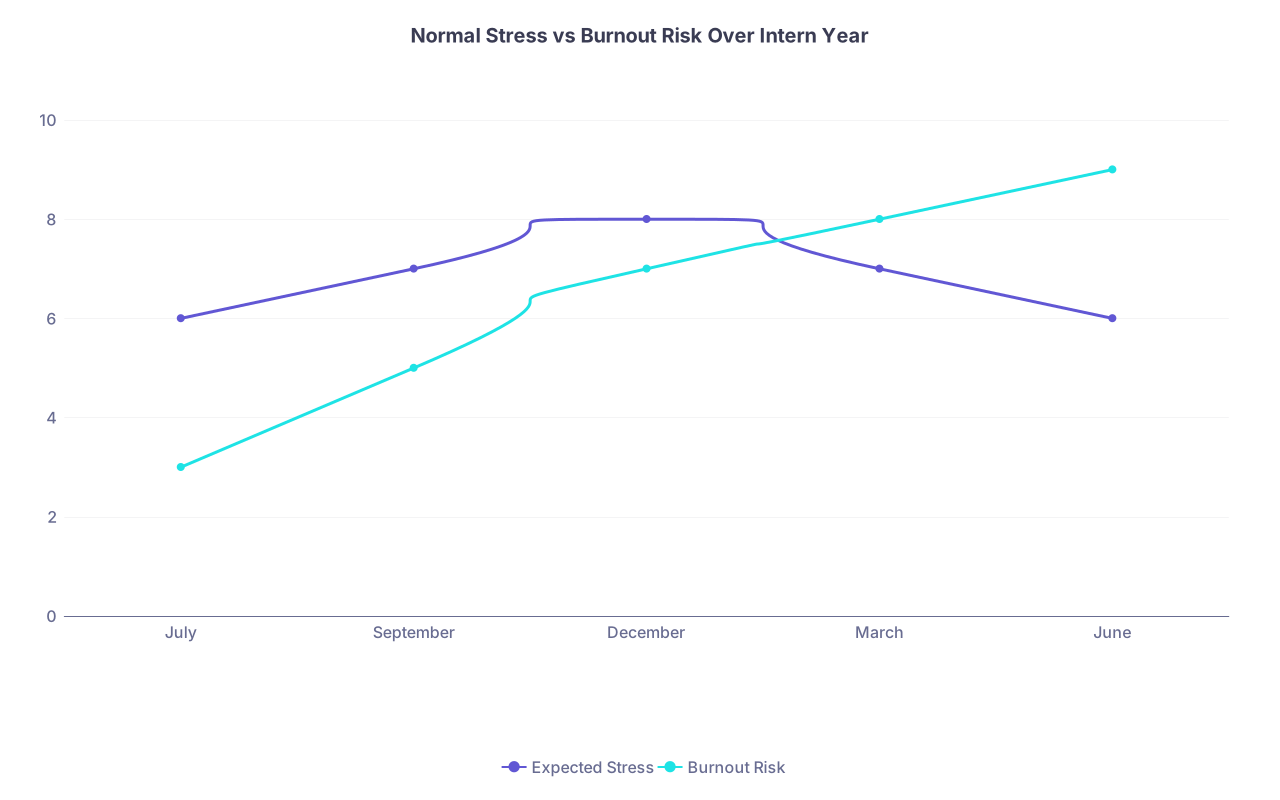
| Category | Expected Stress | Burnout Risk |
|---|---|---|
| July | 6 | 3 |
| September | 7 | 5 |
| December | 8 | 7 |
| March | 7 | 8 |
| June | 6 | 9 |
Here’s the rough rule I’ve seen play out:
- If you have 1–2 bad weeks after a brutal call stretch, but you semi-bounce back when the schedule eases, that’s normal-hard.
- If the baseline dread, exhaustion, and numbness stick around for 4–6 weeks straight, regardless of rotation, that’s dangerous-hard.
If nothing—days off, lighter rotations, talking to co-interns—shifts the needle even slightly? That’s your early-warning siren.
What If I Actually Burn Out Before PGY2?
Let’s go full worst-case, because I know that’s where your brain goes anyway.
Say by March you’re:
- Exhausted beyond functioning
- Not caring about patients
- Making more mistakes
- Crying in your car regularly
- Googling non-medical careers on your lunch break
What happens?
First, here’s what doesn’t automatically happen:
- Your career is not instantly over.
- You are not automatically “unhirable.”
- You’re not the first resident this has happened to. Not even close.
Real possibilities I’ve seen:
- Residents taking a leave of absence and coming back.
- Residents transferring programs or even specialties.
- Residents stepping away from residency and finding other careers in medicine (industry, consulting, teaching, MPH, etc.).
- Residents quitting clinical medicine entirely and building something new.
Does it suck? Yes. Is it painful, complicated, and full of paperwork and awkward conversations? Also yes.
Is it survivable? Absolutely.

| Step | Description |
|---|---|
| Step 1 | Severe Burnout |
| Step 2 | Ask for Help |
| Step 3 | Adjust Schedule or Leave |
| Step 4 | Transfer Program |
| Step 5 | Different Program or Specialty |
| Step 6 | Return with Support |
| Step 7 | Consider Non Clinical Paths |
| Step 8 | Public Health or Admin |
| Step 9 | Industry or Tech |
| Step 10 | Stay in Program |
The part everyone underestimates is how much earlier intervention changes the trajectory. People who speak up when they start sliding often don’t end up leaving. People who keep pushing until they’re in freefall have much fewer options.
Things You Can Do Before You Hit the Wall
I know the instinct: white-knuckle it, don’t complain, don’t look weak. That instinct is exactly how people break.
Here’s what “early intervention” looks like in reality (not Instagram wellness nonsense):
Track your baseline like it’s a vital sign.
Literally rate your daily exhaustion, dread, and joy (0–10) for a few weeks. If your “dread” is living at 7–9 for a month straight, that’s data.Identify one brutally honest human in your orbit.
Not the “everything is toxic” intern, not the “back in my day we worked 140 hours” attending. Someone who’ll say “You look worse than you think you do” or “No, this actually isn’t normal.”Talk to someone with some power but also some humanity.
Usually a chief resident, APD, or a trusted faculty. Not with “I’m weak,” but with:
“I’m noticing X, Y, Z early signs of burnout. I want to be safe and effective long-term. Can we figure out adjustments before I fall apart?”Use the mental health resources. Then keep using them.
Yes, I know the fears: “Will the program know?” “Will this follow me?” Often programs have confidential counseling through GME or outside providers. Ask anonymously if you have to. Burnout that goes untreated becomes depression. Depression untreated can become dangerous.Guard one non-negotiable thing that’s not medicine.
One hour a week that is not negotiable unless the hospital is literally on fire. Therapy, lifting, choir, online gaming with friends, walking with a podcast. I don’t care what it is. But something that reminds you you’re a person, not just a badge number.
Is this enough to cure systemic problems? No. But it can keep you from silently shattering before PGY2.
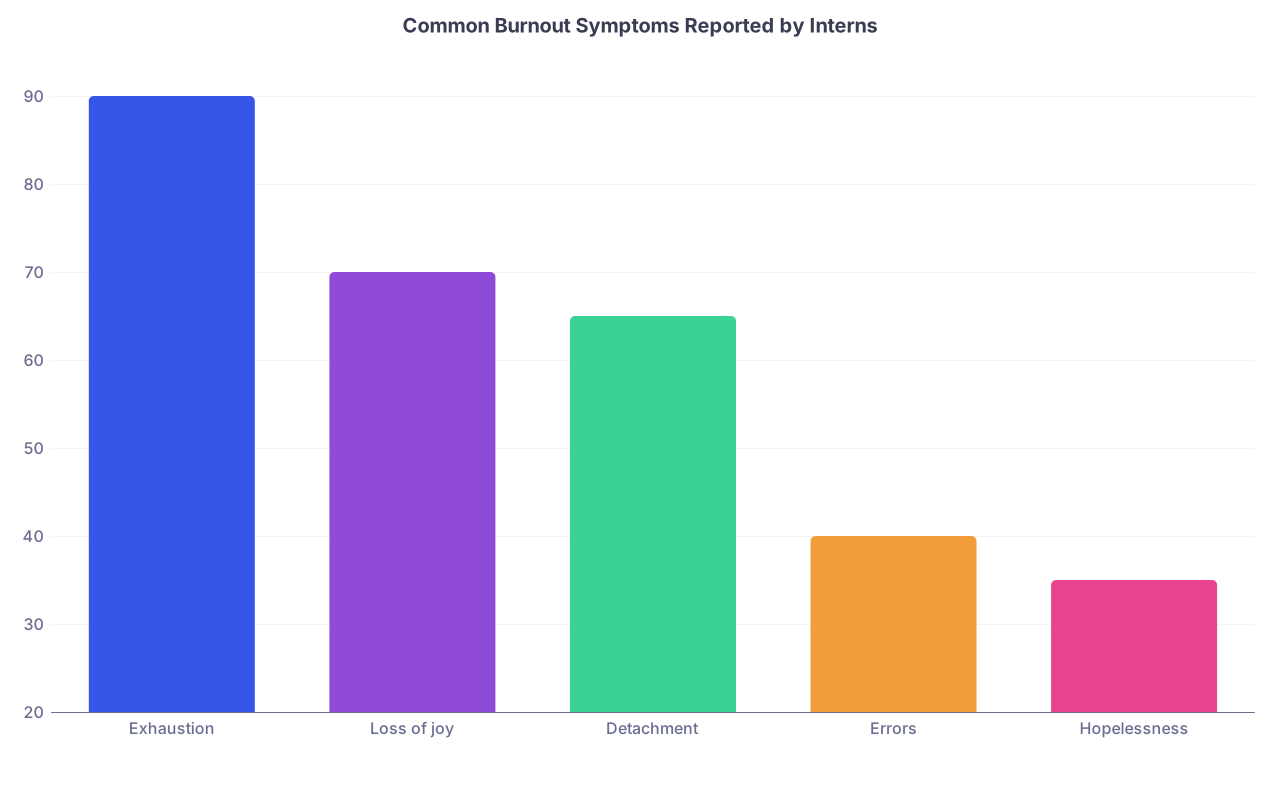
| Category | Value |
|---|---|
| Exhaustion | 90 |
| Loss of joy | 70 |
| Detachment | 65 |
| Errors | 40 |
| Hopelessness | 35 |
What If I’m Already Seeing These Signs Right Now?
Then you’re already ahead of a lot of people. Because you’re not just numbing out and pretending everything’s fine.
If you’re:
- Dreading every shift
- Feeling like a husk of a person
- Wondering if you made a huge mistake going into medicine
Here’s the uncomfortable but honest truth: this doesn’t automatically mean you’re not cut out for this. It means residency is hitting your limits under these circumstances, with this support, at this time in your life.
You’re not a robot. You’re not a machine that should be able to run at 110% indefinitely just because you “chose this.”
You’re allowed to struggle. You’re allowed to get help. You’re allowed to change your mind later if you need to.
The goal right now is not to decide your entire future. The goal is to keep you from grinding yourself into dust before PGY2 because you were too scared to admit you were struggling.
FAQ: The Things You’re Probably Afraid to Ask Out Loud
1. If I tell my program I’m burned out, will they think I’m weak or dangerous?
Some people might judge you silently. That’s reality. But the people whose opinions matter for your safety and progression—chiefs, PD, mental health providers—have seen this before. Many of them have been there themselves. What actually scares programs is the resident who’s clearly falling apart and refuses to acknowledge it until something bad happens. Saying, “I’m struggling and I want help early” is responsible, not weak.
2. Can I still become a good attending if I already feel this burned out as an intern?
Yes. Plenty of excellent attendings had absolute hellscape intern years. The question isn’t “Am I doomed?” It’s “What needs to change between now and then so I don’t calcify into a bitter, empty shell?” That might be boundaries, therapy, a different program, or even a different path in medicine. Burnout now doesn’t mean lifelong misery—it means something is off right now.
3. How do I know if this is “just stress” or actual depression/anxiety?
Rough rule: if the low mood, hopelessness, or anxiety is constant for more than 2–4 weeks regardless of rotation or workload, if you lose interest in everything you used to care about, or if you have thoughts like “people would be better off without me,” that’s beyond “normal stress.” That’s treatable mental health stuff. And yes, that absolutely shows up in interns who look “fine” on rounds.
4. Is it career suicide to take a leave of absence during residency for burnout or mental health?
Not automatic career suicide. Messy? Sure. But I’ve seen residents take 3–6 month leaves, come back, graduate, and get jobs or fellowships. Will some doors close? Maybe. But your brain and life are not worth sacrificing for some hypothetical future fellowship director’s opinion. And the earlier you address it, the less likely you are to need a leave at all.
5. What if I realize I don’t want to be a clinician at all—is that a failure?
No. It feels like failure when you’re in it, because the sunk-cost fallacy is brutal and medicine drills in this identity: “doctor or nothing.” But a lot of smart, caring people pivot: public health, policy, informatics, industry, education, writing, law. Finishing residency is not the only valid outcome of this story. Burning yourself out to prove something to people who aren’t living your life is a bad trade.
Two things to carry with you, especially on the 3 a.m. shifts where your brain starts catastrophizing:
- Burning out before PGY2 is possible—but it’s rarely sudden. Your mind and body send warnings. Listening to them is not weakness. It’s survival.
- You’re allowed to ask for help, to set limits, to change course if you need to. Your worth is not measured in RVUs, notes per hour, or how quietly you suffer.
You don’t have to be the hero who “toughed it out” at the cost of your own mental health. You just have to make it through this in one piece. That’s enough.