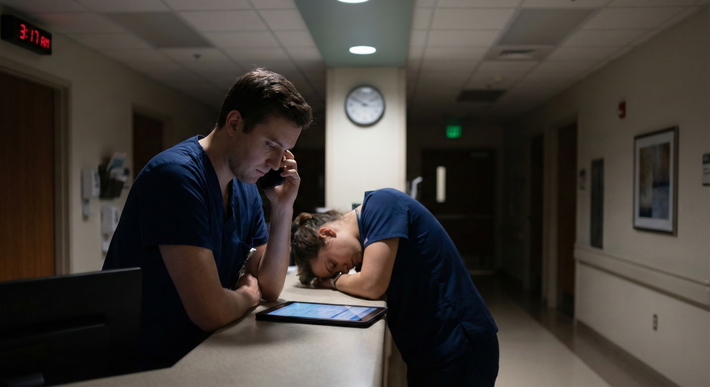
What happens if you’re on hour 23 of a call, your brain is mush, and you write the wrong order… and someone actually dies?
That’s the nightmare, right? Not just “I might look dumb,” but “I might literally kill someone because I’m exhausted and clueless and nobody catches it.”
You’re not crazy for thinking that. Every anxious pre-resident I’ve talked to circles back to the same quiet fear: What if I’m too tired to notice I’m doing something dangerous? And honestly, a lot of people will wave it off with, “Oh, you’ll be fine,” which is useless when you’re lying awake replaying worst-case scenarios.
So let’s talk about what really happens. How interns actually stay safe when they’re tired. Where people screw up. And what you can do so you’re scared but not paralyzed.
The uncomfortable truth: yes, tired interns can hurt people
Let me just say it out loud so we’re not dancing around it: yes, fatigue increases error. Yes, interns have made serious mistakes. I’ve seen an intern almost give 10x the dose of insulin. Someone else nearly sent a patient to the OR NPO… who wasn’t actually NPO. A sleepy cross-cover once mixed up two patients with similar names and almost ordered lasix on the wrong one.
You’re not inventing this risk. It’s real.
But here’s the part nobody emphasizes enough: hospitals are built assuming tired people will screw up. The whole system is designed around the fact that interns are:
- New
- Overwhelmed
- Sleep-deprived
The goal is not “never make a mistake.” That’s fantasy. The goal is: when you inevitably make mistakes, they are:
- Caught early
- Reversible
- Not fatal
So instead of asking, “How do I make sure I never screw up?” the better question is, “How do I make sure nothing horrible slips through when I do screw up?”
Because you will. Everyone does.
How the system actually protects you (even when you feel alone at 3 AM)
You know that horror-movie image in your head? You, alone in a dark hallway, code pager going off, everyone else ignoring you, and you’re somehow the final decision-maker on everything?
That’s not how this works.
Here’s the real structure most interns live inside:

| Step | Description |
|---|---|
| Step 1 | Intern |
| Step 2 | Senior Resident |
| Step 3 | Fellow or Chief |
| Step 4 | Attending |
| Step 5 | Nurses |
| Step 6 | Pharmacist |
| Step 7 | Consult Services |
You’re never actually the top of that pyramid.
There are several built-in “brakes” on your ability to make an unchecked fatal error:
Nursing
Nurses save residents all the time. They’ve seen a thousand new interns rotate through. They know when an order looks weird. They call. They question. They say things like:- “Doctor, are you sure you want that potassium IV push?”
- “This patient is allergic to that antibiotic in the chart—do you want to recheck?”
If you’re tired and miss something, there’s a good chance the nurse won’t. They’re your safety net, especially at night.
Pharmacy
For most meds, pharmacy screens your order before the drug even exists in real life. They flag:- Doses that are way off normal range
- Drug interactions
- Allergies
- Contraindications (like giving a nephrotoxic drug to someone in renal failure)
I’ve heard pharmacists say, “We don’t let residents kill people with vancomycin.” They’re not joking.
Senior residents and attendings
Even when it feels like “I’m alone,” you’re not actually alone. There’s always someone:- On site (senior)
- On call / at home but reachable (attending)
You’re expected to ask. Expected to escalate. The real red flag isn’t “intern asked for help too much,” it’s “intern never called, ever.”
Order entry systems & alarms
EMRs are annoying, but they’re also error filters. They’ll pop up:- “Dose exceeds recommended max”
- “Creatinine too high for this med”
- “This patient has a documented allergy to this drug”
Are they perfect? No. But you’re not hand-writing orders into the void with nobody watching.
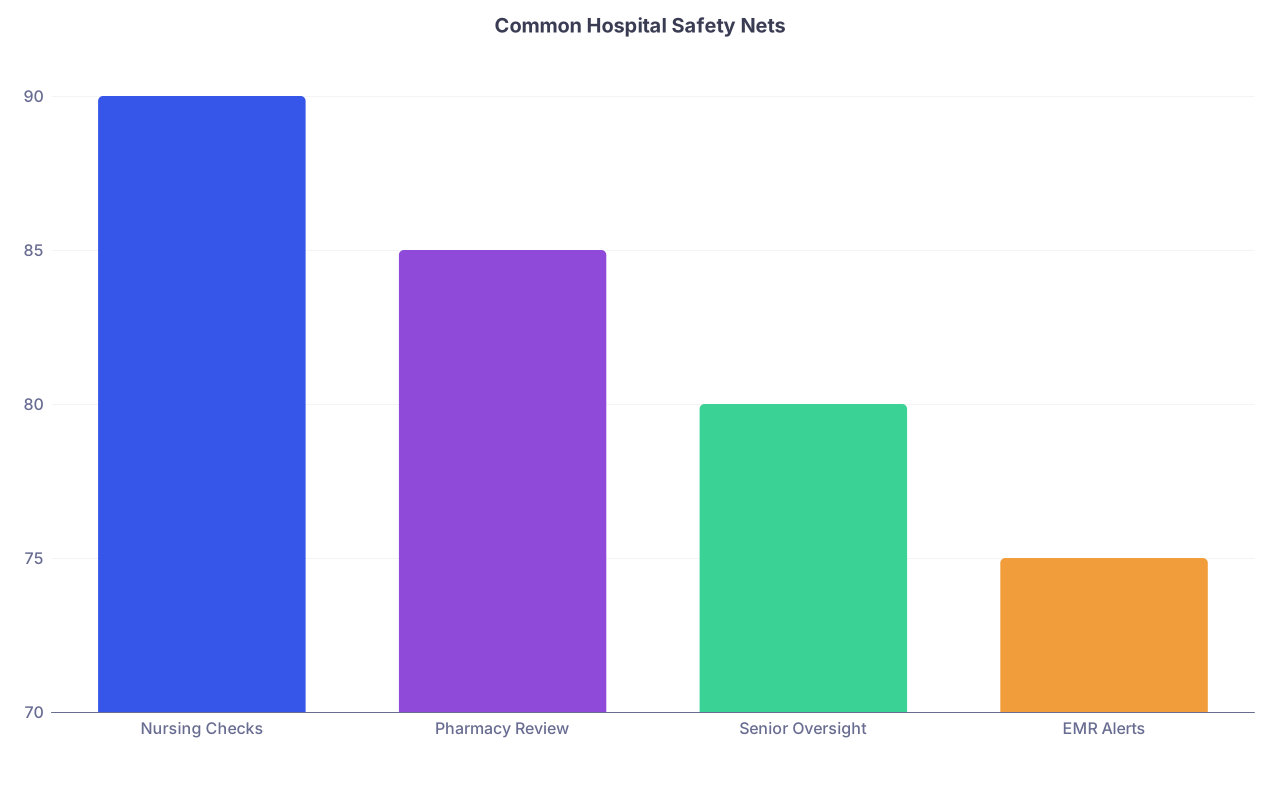
| Category | Value |
|---|---|
| Nursing Checks | 90 |
| Pharmacy Review | 85 |
| Senior Oversight | 80 |
| EMR Alerts | 75 |
That chart isn’t exact numbers from one study; it’s roughly what you see in real life: most near-misses get caught by multiple layers. You’re one piece of that, not the entire defense.
The mental traps that actually make you less safe
Here’s the paradox: the fear that “I might kill someone” can either make you safer… or more dangerous.
The healthy version of that fear sounds like: “I’m tired. I’m going to double-check and call my senior just in case.”
The toxic version sounds like: “I should know this. I don’t want to look stupid. I’ll just guess and hope.”
The worst mistakes from tired interns often come from:
- Pride: “I should be able to handle this alone by now.”
- Shame: “If I ask, they’ll think I’m incompetent.”
- Hurry: “I don’t want to bother them at 3 AM. They’re sleeping.”
- Numbness: “I’m too tired to care, I’ll just do what I did last time.”
The programs that scare me most are the ones where seniors sigh loudly when interns call at night. Or where attendings joke, “Figure it out, that’s how you learn.” That culture is unsafe.
You know what is safe? The intern who calls and says: “I’m probably overthinking this, but I want to run by this insulin dose with you.”
That intern is tired, anxious, and safe.
Concrete tactics interns use to stay safe when they’re exhausted
Let’s talk about what people actually do, not just vague “be careful” advice.
1. The “pause before you click” rule
Every tired intern I trust has some version of this: you never sign an order in a rush.
Before you hit “Sign” on anything that could truly harm someone (anticoagulation, insulin, potassium, opioids, pressors, chemo, transfusions), you:
- Say the med, dose, route, and patient name out loud to yourself
- Look at weight, creatinine, age, allergies
- Ask, “What’s the worst that happens if I’m wrong?”
If “worst thing” is mild discomfort? Fine.
If “worst thing” is “they stop breathing”? You slow. Down. And probably call someone.
2. Using checklists like a crutch (because they kind of are)
Surgeons have WHO checklists. Pilots have takeoff and landing checklists. Good interns have:
- Their own little note with preferred doses (e.g., standard heparin drip, insulin correction scales, etc.)
- Templates for common scenarios: chest pain, DKA, GI bleed, fever workup
You don’t reinvent the wheel at 4 AM. You read from the wheel.

3. Saying the quiet part out loud to nurses
The safest interns I know say things like:
- “Hey, I’m pretty wiped right now. If anything I order looks weird, can you please page me?”
- “This is a high-risk med. If you’re unsure about it at all, stop and call me or pharmacy.”
That’s not weakness. That’s practically risk management.
Nurses will 100% respect, “I’m new and tired, I want to be careful,” more than fake confidence.
4. Defaulting to “call senior” when your gut feels off
One of the best internal rules: If I’m arguing with myself about whether I should call, that means I should call.
Seniors would rather be woken up for something minor than find out in the morning that their intern sat on:
- New chest pain
- Big lab change (like potassium, sodium, hemoglobin)
- Weird mental status change
- Shortness of breath
- Anything involving anticoagulation/bleeding
If your brain is foggy, outsource your judgment. That’s what your senior is literally there for.
Why the horror stories feel bigger than they are
You’ve probably heard some version of: “There was this intern who gave the wrong dose and the patient died.” And your brain holds onto that at 3 AM, not the thousands of nights where nothing catastrophic happens.
Medicine loves scary stories. They’re like campfire tales. But here’s what those stories leave out:
- How many checks failed before that happened
- How many policies changed afterward
- How many similar errors are now automatically caught by the EMR or pharmacy
We over-remember the outliers. We under-notice the ordinary, boring reality:
Most of the time, fatigue + systems + humility = small mistakes, caught early, fixed.
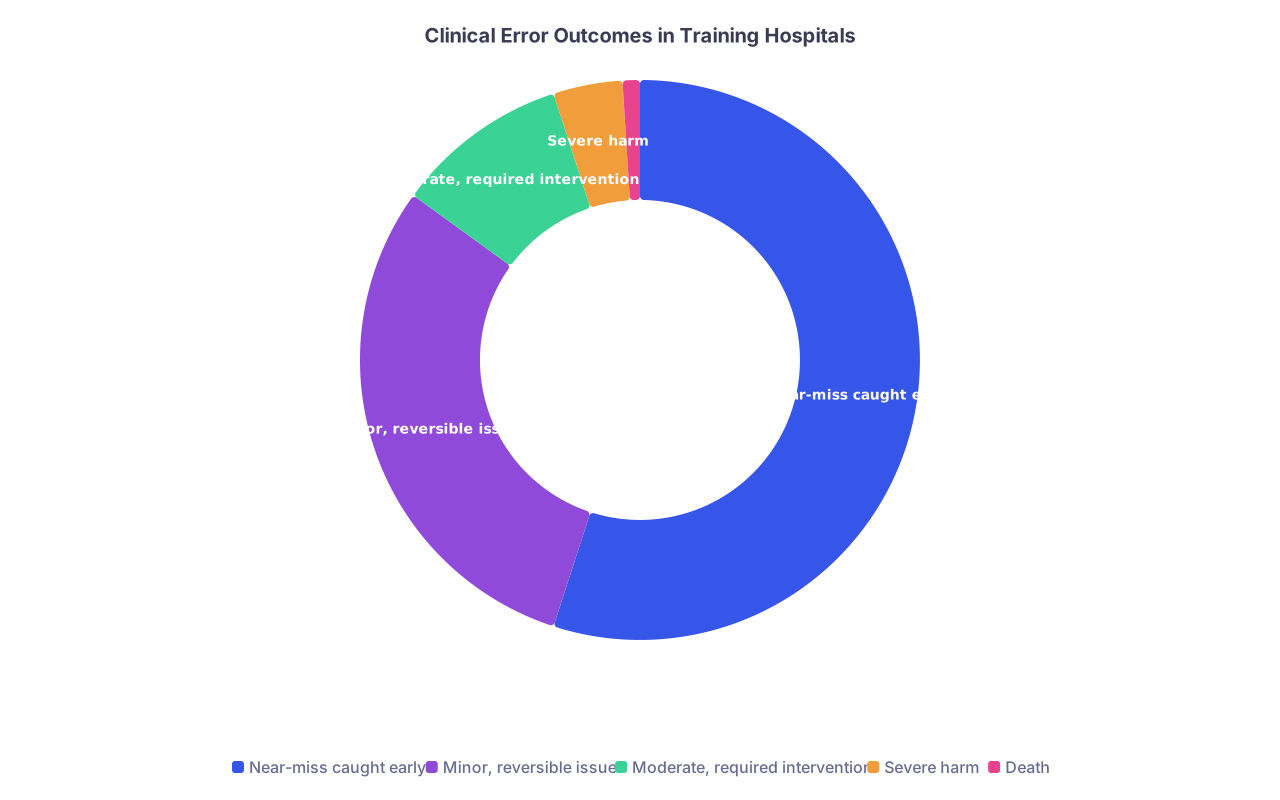
| Category | Value |
|---|---|
| Near-miss caught early | 55 |
| Minor, reversible issue | 30 |
| Moderate, required intervention | 10 |
| Severe harm | 4 |
| Death | 1 |
That distribution is roughly what you’ll see in big safety/QI talks: the vast majority are near-misses or minor. The truly catastrophic stuff is rare—and usually traceable to multiple layers failing, not just a tired intern.
What you can start doing before intern year
Your anxiety is trying to get ahead of the danger. That’s not all bad. Use it.
There are a few things you can start building now that will help when you’re exhausted later:
Get comfortable saying “I don’t know” out loud
On rotations, actually say it. “I don’t know that dose, can I look it up?” You’re wiring your brain to ask instead of bluff.Practice “thinking out loud” with supervision
When someone asks what you want to do for a patient, walk them through your logic. Seniors can then see where your thinking drifts when you’re tired.Learn your high-risk meds and scenarios
Every specialty has them:- IM: anticoagulation, insulin, electrolytes
- Surgery: fluids, opioids, anticoagulation around OR
- Neuro: blood pressure, sodium, anticoagulation (again)
You don’t need everything memorized, but you should know which things are dangerous enough to slow you down.
Watch how good residents use the system
Notice who constantly checks in with nurses, calls pharmacy, loops in seniors. Those people are building a net for themselves. Copy them.
| Scenario | Why Risky |
|---|---|
| Starting anticoagulation | Bleeding, strokes |
| Adjusting insulin | Hypoglycemia |
| Repleting potassium | Arrhythmias |
| Managing opioids | Respiratory depression |
| Transfusions | Reactions, volume overload |
These are the ones you absolutely do not rush through at 2 AM.
The “I’m too tired to be safe” moment
Here’s the scenario that scares people but nobody really talks about: what if you’re so wiped you know you’re unsafe?
Like you’re nodding off at the computer, rereading the same line 6 times, paging back to orders because you already forgot what you were doing.
I’ve seen interns hit that wall. Here’s what the safer ones do:
- Tell their senior: “I’m honestly not functioning well. I need a second set of eyes on my orders.”
- Ask the nurse to read back critical orders.
- Take a 10–15 minute nap the moment there’s a safe window. Not scrolling your phone. Actual eyes-closed, timer-set nap.
Ten minutes of real sleep beats 60 minutes of zombie-brain any day.

What they don’t do is pretend they’re fine, keep powering through orders solo, and stop double-checking.
You’re more dangerous when you’re trying to “be tough” than when you admit you’re wrecked.
The part you probably need to hear
If you’re reading this, already spiraling about hurting someone, that actually tells me something important: you’re exactly the sort of person programs trust with patients.
The people who scare me are not the ones asking “What if I hurt someone?”
It’s the ones saying “I’ll be fine, I can handle anything, I don’t need help.”
You will make mistakes. Some will be small. Some will bother you for days. You’ll replay them in the shower, in your car, before you sleep.
But between you, nursing, pharmacy, seniors, attendings, and EMR, the odds that your isolated, tired-brain mistake turns into some irreparable, career-defining catastrophe? Very, very low.
Not zero. This isn’t a Disney movie. But low—especially if you lean on the system instead of trying to out-muscle your exhaustion.

| Stage | Activity | Score |
|---|---|---|
| Start of Shift | Review sickest patients | 4 |
| Start of Shift | Clarify escalation plan | 3 |
| Middle of Night | Double check high risk orders | 5 |
| Middle of Night | Call senior with concerns | 4 |
| End of Shift | Signout clearly | 5 |
| End of Shift | Reflect on near misses | 3 |
FAQ (the things you’re probably still worrying about)
1. What if I make a mistake that harms someone and I can’t forgive myself?
You will make mistakes that sting. Some might cause harm. The question isn’t “Will I feel okay about it?” It’s, “What do I do with that guilt?” The good residents I’ve seen do three things: they’re honest about what happened, they participate in the root-cause analysis or debrief, and they change their habits so it’s harder to repeat. Over time, that guilt doesn’t vanish, but it turns into a kind of internal guardrail. If you’re someone who worries about this now, you’re also someone who will take those lessons seriously instead of shrugging them off.
2. Are there residents who actually got in serious legal trouble as interns?
It’s rare, and almost never about a single innocent mistake by an overwhelmed intern who tried to do the right thing. The cases that go really bad usually involve patterns: not documenting, ignoring nurses, not responding to pages, lying or covering up errors, or clearly reckless behavior. You’re panicking about pulling up Lexicomp too slowly, not blowing off a crashing patient. Those are not the same category.
3. Will my program actually support me if I’m struggling with fatigue and anxiety?
Some will. Some honestly won’t. That’s the ugly truth. But even in less supportive programs, you still have allies: nurses, co-interns, the one senior who actually remembers what it was like, the pharmacist who teaches you instead of judging you. You’re allowed to say, “I’m overwhelmed and I want to be safe—can you help me double-check this?” You’d be surprised how many people are relieved someone finally said it.
4. What’s the single most important habit for staying safe as a tired intern?
If I had to pick one: never be ashamed to ask for help. That one thing—paging your senior, calling pharmacy, clarifying with nurses, admitting you’re not sure—prevents more disasters than any fancy EMR alert. If something feels off, if you’re dosing something scary, if you’re just too tired to think straight, your default should be: pause, ask, verify. That instinct will save more patients—and honestly, save you—than any amount of raw knowledge.
Key things to hold onto:
You will be tired. You will make mistakes. But you won’t be alone, and you’re surrounded by people and systems designed to catch you when you slip. If you keep your humility, ask for help before you need it, and slow down for the dangerous stuff, you can be scared and still be safe.