
It’s 3:27 a.m. Your pager just went off for the fourth time in ten minutes. The cross-cover list is a blur of names. You’re still half-thinking about the admission you barely finished, the note you didn’t sign, the discharge summary you forgot to send. Your co-intern seems fine, somehow. Calm. You’re wondering if you picked the wrong specialty. Or if you just shouldn’t be here at all.
And the thought creeps in: What if I just can’t keep up as an intern? What if this is me failing, in real time?
Let me say this bluntly: almost everyone feels like this at some point. The dangerous part isn’t that you’re overwhelmed. The dangerous part is when you start telling yourself that being overwhelmed means you’re inherently not good enough.
It doesn’t.
The Intern Brain Melt: Why Everything Feels Like Too Much
There’s this weird expectation in residency that you’ll go from med student to functioning doctor in about three orientation days and a pizza meet-and-greet.
It’s ridiculous.
You’re expected to:
- Learn an entire new EMR
- Understand a hospital’s exact workflow and politics
- See more patients than you’ve ever seen
- Handle pages, admits, discharges, consults
- Present on rounds without sounding clueless
- Document perfectly enough to satisfy billing, attendings, and risk management
…while also trying not to kill anyone.
Your brain is doing three jobs at once: learning medicine, learning systems, and managing panic. That “I can’t keep up” feeling? A lot of the time, that’s not incompetence. It’s simple cognitive overload.
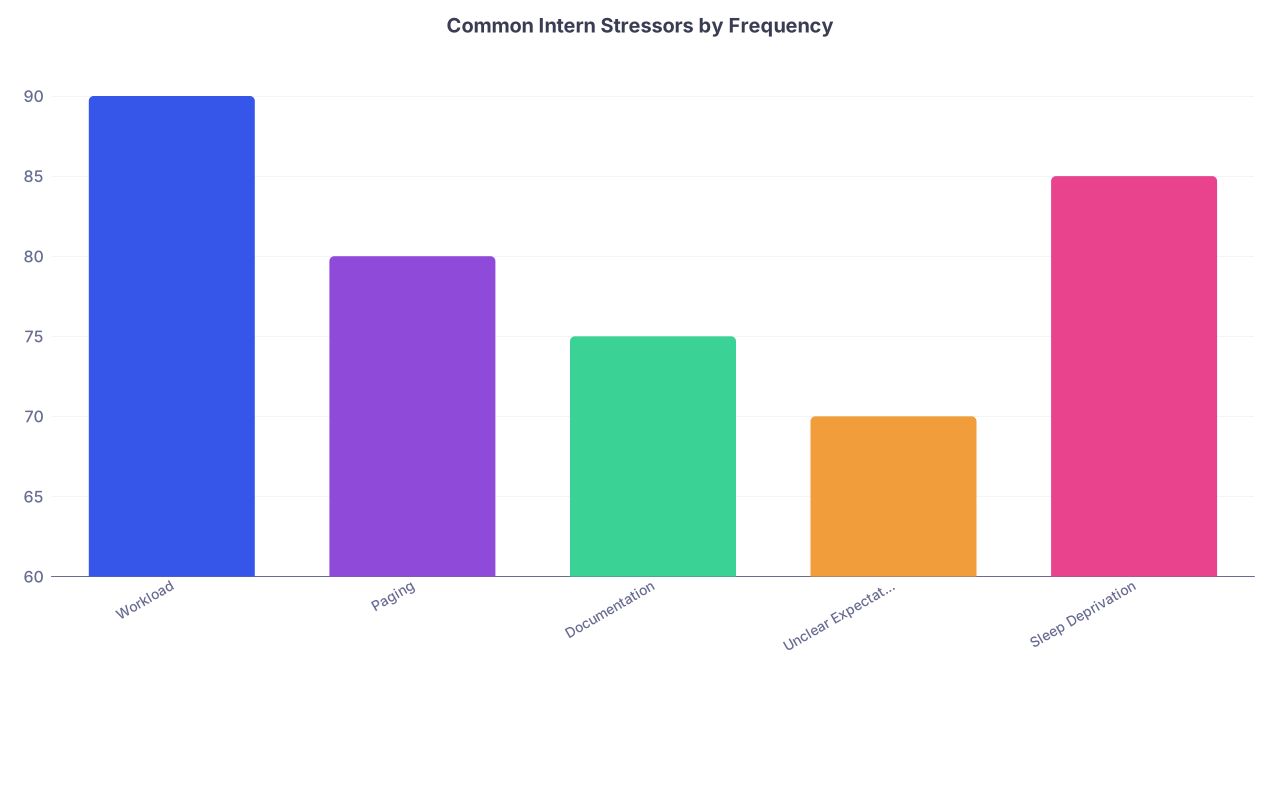
| Category | Value |
|---|---|
| Workload | 90 |
| Paging | 80 |
| Documentation | 75 |
| Unclear Expectations | 70 |
| Sleep Deprivation | 85 |
I’ve watched really strong interns look like they’re drowning the first month. I’ve also watched average interns look weirdly “fine” because they were given more support, clearer expectations, or just got luckier with rotations.
So, no, feeling behind does not automatically mean you’re a bad intern. It usually means the demands are higher than your current bandwidth and no one has helped you adjust that gap yet.
Is It Overload or Actual Failure? How To Tell the Difference
Your brain, especially at 2 a.m., loves to make a leap: “I’m overwhelmed” → “I’m failing” → “I’m not cut out for this” → “I’m going to hurt someone” → “I’m a fraud and everyone knows.”
Let’s slow that down.
Here’s what usually points to overload, not “I shouldn’t be a doctor”:
- You’re constantly rushing, but when things are explained, they make sense.
- You forget tasks, but when someone reminds you, you can do them correctly.
- You feel panicked, but your medical reasoning is mostly sound when you have a second to think.
- Feedback is more about speed, organization, or prioritization than “you don’t know anything.”
- You leave late, but your notes and orders are accurate, just slow.
Versus true red-flag patterns that need active intervention (still not “you’re a failure,” but “this needs serious support”):
- Repeated major patient safety errors with clear patterns (wrong patient, wrong med, missing critical labs) even after direct feedback and extra help.
- You literally can’t explain your reasoning for decisions, even with time and guidance.
- You’re blowing off feedback, arguing every point, or refusing to ask for help when you’re lost.
- You stop caring whether you get things right at all.
Most worried people are on the first list. The ones who truly struggle and risk dismissal are usually not the ones lying awake worrying about it. The very fact that you’re scared and reflective already puts you in a better category than you think.

Concrete Signs You’re Overloaded, Not Broken
Let’s get really specific. Because vague reassurance is useless when your attending just snapped at you for missing a lab and you feel like garbage.
You’re probably dealing with overload, not fundamental inability, if:
1. Your days feel like chaos, but you improve when someone structures your work
You struggle when you’re left totally on your own with 12 tasks screaming at you. But the second a senior says, “Okay, start with patients 1 and 2, write your notes in this order, then check labs, then call this consult,” suddenly things feel do-able.
That means your executive function is strained, not that your brain is empty. Organization is trainable. No one enters residency with a fully formed “how to run a list of 12 patients and 4 admits” operating system.
2. You’re making “I have too much in my head” mistakes
You forget to sign an order. You miss a non-urgent lab. You don’t follow up on a consult note as fast as you should. None of that is ideal, but it’s very common intern brain. It’s the kind of pattern that improves with checklists, better task management, and repetition.
This is very different from, say, repeatedly not recognizing shock, ignoring a troponin of 12, or not understanding why a potassium of 2.5 matters. One is overload. The other is knowledge gap plus unsafe judgment.
3. Feedback is about pace, not total incompetence
If your attending says, “You’re doing fine, but you need to pick up the pace” or “Your notes are thorough, but they’re too long” or “Medically you’re solid, we just need you to move faster” — that’s overload.
If it was “You don’t seem to understand basic anatomy” or “You repeatedly ignore dangerous symptoms,” that would be very different. Most interns never hear that kind of thing.
4. You do better when you’ve slept
People underestimate this. If after a golden weekend you suddenly feel more human, remember more things, and can process information again? That’s not failure. That’s sleep deprivation brain. Which is… residency.
Your performance tanking when you’re post-call is miserable, but it’s not a moral issue. It’s physiology.
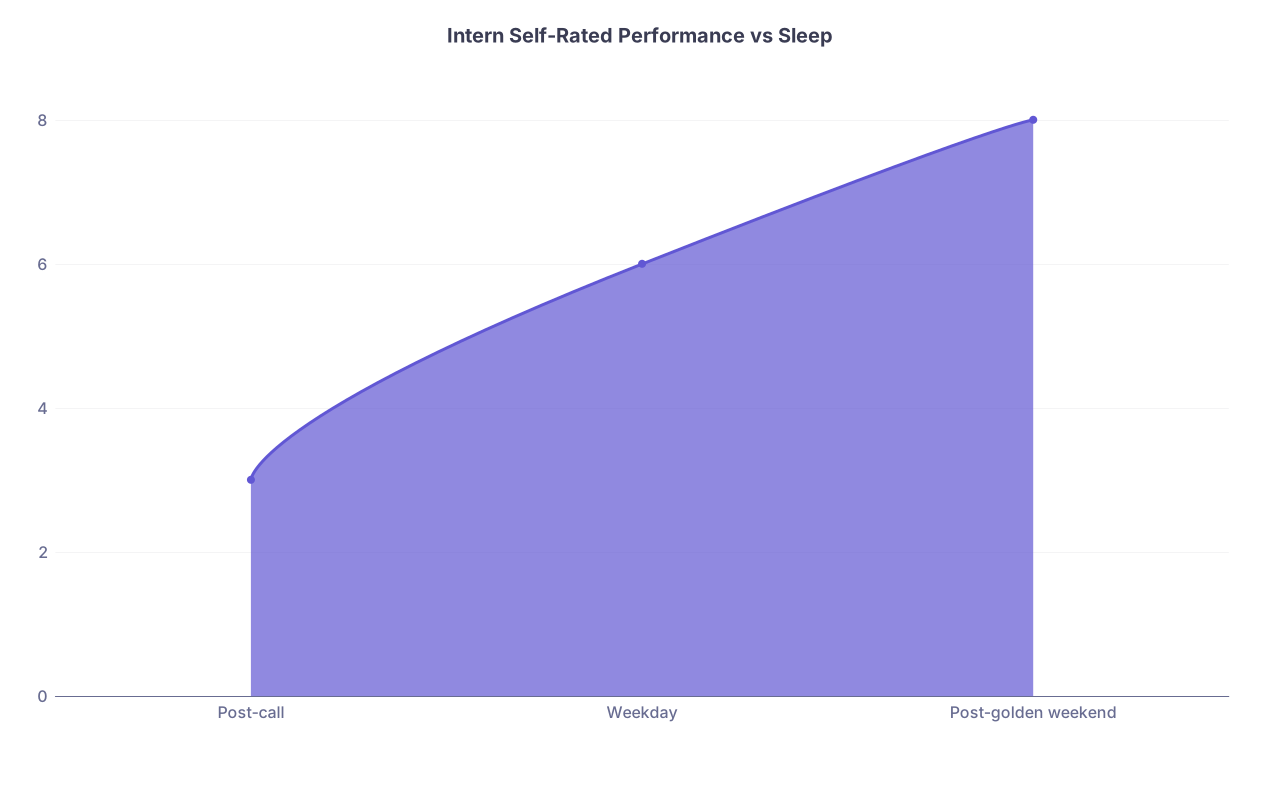
| Category | Value |
|---|---|
| Post-call | 3 |
| Weekday | 6 |
| Post-golden weekend | 8 |
How Much Struggle Is “Normal” Early in Intern Year?
You’re not crazy to wonder where the line is. Programs love to say “Everyone struggles,” but that phrase covers a lot of ground.
Here’s the stuff I’ve seen over and over again in interns who ended up totally fine:
- Crying in the bathroom or stairwell at least once in July or August.
- Staying 1–2 hours late regularly the first couple rotations.
- Needing seniors to double-check almost everything the first few weeks.
- Getting pages for basic things and feeling stupid (Tylenol dosing, bowel regimens).
- Being told you’re “too detailed” in notes early on because you haven’t yet learned what to leave out.
- Feeling like everyone else “gets it” while you’re faking it. Spoiler: they’re also faking it.
People don’t talk about it openly, but the first 2–3 months of intern year are basically survival mode for a lot of smart, capable people.
Where I get more concerned is when:
- Multiple attendings across different rotations say the same specific, serious thing (like “unsafe judgment” or “doesn’t take feedback”).
- You consistently don’t improve at all in the same area despite clearly trying and being given support.
- You’re so burnt out or depressed that you literally stop trying, stop reading, stop caring, or start thinking about hurting yourself.
Those are not “you’re a failure” signs; they’re “you need serious help and protection ASAP” signs.

When It’s the System, Not You
Here’s the piece everyone pretends doesn’t exist: some programs and rotations are simply unsafe and unreasonable.
Insane caps. Constant extra admissions. Attendings who think “sink or swim” is a personality-building strategy. No protected time to write notes. No real teaching. Chronic understaffing. Seniors who are too overwhelmed themselves to help you.
That environment will make anyone feel like a failure.
| Rotation Pattern | What It Often Means |
|---|---|
| Everyone stays 2+ hours late | System/workload issue |
| Multiple interns crying often | Toxic culture or expectations |
| Constant rule-bending on caps | Unsafe staffing |
| No one has time to teach | Structural, not personal |
| High turnover of residents | Program-level dysfunction |
If every intern on your service is drowning, that’s not a “you” problem. That’s a design problem. You’re just the one internalizing it.
Ask yourself honestly:
- Are other interns also struggling to finish on time?
- Do seniors say, “Yeah, this rotation is brutal for everyone”?
- Do chiefs quietly admit, “Yeah, this month is awful. Just get through it”?
If the answer is yes, don’t let your brain interpret your suffering as uniquely diagnostic of your ability. You’re in a bad storm. Even strong swimmers choke on water in a hurricane.
What You Can Actually Do When You Feel Like You’re Falling Behind
You don’t just want, “It’ll be okay.” You want, “What the hell do I do tomorrow when I walk into the hospital and feel like this again?”
So, practical things.
1. Name it out loud to someone safe
Not “I’m a failure.” That’s too global and dramatic to work with. But:
“I feel like I can’t keep up, and I’m worried I’m missing things.”
Say that to a co-intern, trusted senior, or chief. If they’re half decent, you’ll probably hear something like, “Yeah, that’s how I felt on nights” or “Let’s look at how you’re organizing your day.”
Their reaction will tell you a lot. If they seem surprised and say, “Your work has been fine,” believe them more than your 3 a.m. brain.
2. Ask for micro-level feedback, not “Am I failing?”
“Am I doing okay?” is a bad question. It invites vague reassurance or vague criticism.
Try:
- “Is there anything you see that I should do differently on rounds?”
- “What’s one thing I could change to make my notes more efficient?”
- “Am I prioritizing tasks in a logical order, or would you do it differently?”
Specific questions get specific answers. If the worst you’re hearing is “chart faster, talk less on rounds, be more concise,” your doom brain is exaggerating.
3. Build stupidly simple safety nets
If your brain is in overload, it will drop balls. So give it guardrails.
- A tiny checklist on your sign-out sheet: DVT ppx, bowel regimen, code status, daily weight, discharge meds.
- A page log: who paged, time, what they needed, and whether you did it.
- A standard template you use for notes and H&Ps so you’re not reinventing the wheel every time.
Over time, this feels childish. Early on, it’s literally how people keep patients safe while their brain is half-melted.
4. Watch for the internal narrative that’s killing you
You can be tired and overwhelmed without adding, “…because I’m defective.” That extra part is optional, but our brains love to tack it on.
Pay attention when your thoughts jump straight from “I missed that lab” to “I’m not cut out for medicine.” There’s a giant logical gap there. No one got fired because they had a learning curve as an intern.

| Step | Description |
|---|---|
| Step 1 | Made a mistake |
| Step 2 | Thought - I am a failure |
| Step 3 | Thought - I am overloaded |
| Step 4 | Ask for help |
| Step 5 | Adjust systems |
| Step 6 | Anxiety and paralysis |
You don’t have to magically become confident. Just question the automatic “this proves I’m terrible” story a little bit.
5. If you’re truly worried about your competence, involve someone early
If you’ve had serious feedback, or you’re scared because you made a major error, hiding from it makes everything worse. Chief residents exist for this. Program leadership exists for this.
You can say, “I want to be safe, and I’m worried about X. Can we talk about a plan for support?”
That could look like:
- More direct supervision for a bit
- Pairing with a stronger senior
- Short-term mental health support or time off if you’re burnt to ash
- Extra teaching or simulation for specific skill gaps
Asking for help early is what good doctors do. The arrogant, avoidant ones are the ones who crash and burn.

When You Start Thinking “Maybe I Should Quit”
This thought shows up more than people admit. You’re in deep, you’re exhausted, you’re comparing yourself to the golden child resident who seems to discharge eight patients before breakfast. Quitting starts to sound like the only way to make the anxiety stop.
Before you decide you’re done:
- Ask yourself: do I hate medicine, or do I hate this particular rotation/schedule/culture?
- Imagine yourself as a PGY-3 instead of an intern. Does any part of that picture feel okay, or even good?
- Check whether what you’re feeling is more like “I’m broken” or “I’m burned out and empty.”
A lot of interns who almost quit in July are totally functional by December. The skill curve is ugly early on. There are people who change specialties or leave medicine, yes. But most of the people lying awake worried about it at 3 a.m. eventually figure it out with time and support.
You don’t have to decide your entire future while you’re on your 7th consecutive call shift.
FAQs
1. What if I’m the slowest intern on my team?
Then you’re the slowest intern. That’s it. Every team has a “fastest” and a “slowest” — that’s how ranking works. Being the slowest doesn’t mean you’re unsafe or unfixable. It means you have more obvious growth edges.
What matters is: are you improving week to week? Are seniors and attendings saying, “You’re getting better”? If yes, stop turning “I’m slower” into “I’m a disaster.” The intern who is slow but careful and receptive to feedback is often better long-term than the fast one who cuts corners.
2. How do I know if my program is actually worried about me?
They’ll tell you. Not in vague passing comments, but in actual meetings. Words like “remediation,” “concerns about clinical judgment,” or “we need to make a formal plan” are your sign that things are more serious.
If all you’ve heard is “you need to speed up,” “be more concise,” or “you seem anxious,” that’s very standard intern feedback. If you haven’t been pulled aside for a formal talk, your program is almost certainly not secretly plotting your removal.
3. What if I already made a serious mistake — does that mean I shouldn’t be a doctor?
No. It means you’re a doctor. Everyone who practices long enough makes a serious mistake. The real question is: did you learn from it, own it, and change your behavior so it doesn’t happen again?
If a bad outcome or near-miss is haunting you, talk to someone about it — a mentor, chief, therapist, anyone with actual perspective. Interns often inflate one awful moment into a complete verdict on their worth. It isn’t. It’s a terrible event that deserves reflection and support, not a guillotine.
4. Is it normal to feel like I’m pretending to be a doctor?
Yes. Honestly, it’d be weirder if you didn’t feel that way at least sometimes. You went from being a supervised student to writing actual orders and notes with legal and clinical weight. Of course your brain is like, “Wait, they’re letting me do this?”
The imposter syndrome usually fades as your pattern-recognition and repetition grow. You’ll wake up one day and realize you handled an admission or cross-cover issue without feeling like you were faking it. That day does come — but it doesn’t arrive in July.
If you remember nothing else, remember this: feeling overloaded is not the same as being a failure. Intern year is built to stretch you right up to — and sometimes past — what feels tolerable. That’s not a verdict on your worth. It’s a badly designed rite of passage.
You’re allowed to struggle. You’re allowed to ask for help. And you’re allowed to believe that being overwhelmed right now says a lot more about the system you’re in than it does about your potential as a physician.