
The culture of “just suck it up and work” is dangerous—and sometimes, it is flat-out reportable.
If you’re an intern and your work hours are routinely unsafe or out of compliance, you are not being “soft.” You are being put at risk, and so are your patients. And there is a right way and a wrong way to handle this.
I’m going to walk you through the right way.
Step 1: Get Clear On What Actually Counts As a Violation
Before you say a word to anyone, you need to know what you’re talking about. “I feel overworked” is not the same as “my program is violating ACGME duty hour rules.”
Here’s the short version of the current ACGME duty hour standards for residents (including interns). If your specialty has a few nuances, fine—but these are the core rules everywhere in the U.S.
| Rule Type | Standard |
|---|---|
| Weekly limit | ≤ 80 hours per week, averaged over 4 weeks |
| Maximum shift length | 24 hours + up to 4 hours for transition of care |
| Days off | 1 day in 7, free of all clinical duties (avg 4 wks) |
| Time off between shifts | 10 hours between duty periods (goal) |
| In-house call frequency | No more often than every 3rd night (avg 4 wks) |
Interpretation that actually matches reality:
- “80 hours” is not “I hit 81 once.” It’s average over 4 weeks. Programs sometimes push right up to that edge. Some go way over and tell you to under-report.
- “24 + 4” means you shouldn’t be still actively admitting, running a list, or being the de facto primary at hour 28. Those last 4 hours are for wrap-up, notes, and handoff, not more admits.
- “1 day off in 7” means no rounding, no remote charting, no “just log in to sign some orders.” If they’re counting a “post-call day” that ends at 2 pm as a full day off, that’s shady.
- The “10 hours off” rule often gets abused with “you’re technically off at 7 pm,” then codes and admissions keep you until 10 pm, and you’re scheduled back at 6 am.
So step one: Compare what’s actually happening to these rules. No feelings. Just facts.
Step 2: Start Quietly Documenting—Right Now
If you even think you might later need to report, start a log today. Not tomorrow. Today.
This is what I’ve seen work:
Create a simple private log (not on a hospital computer, not on a shared drive):
- A note app on your phone
- A personal Google Sheet with a non-hospital account
- A small notebook you keep in your bag
Log 4 things for each shift:
- Date
- Scheduled shift (e.g., “ICU 7a–7p”)
- Actual in/out times (when you really arrived and really left)
- What made it excessive if it was: “Two overnight admits 5–6a, stayed until 10:30a finishing notes and transfer”
You are not writing an essay. You’re building a timeline.
Do this for at least 2–4 weeks if possible. If there’s a truly egregious situation (day 30 in a row with no day off, or 36-hour stretches), log it that day in detail.
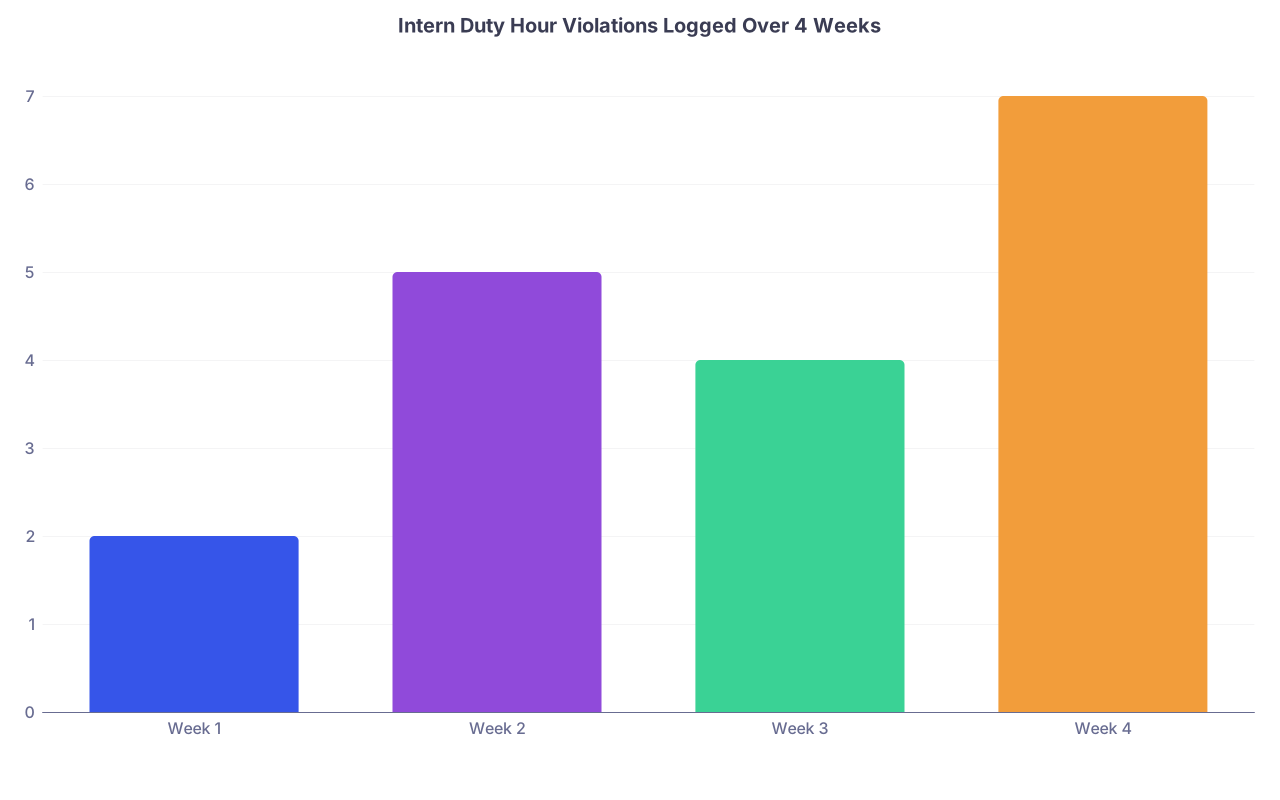
| Category | Value |
|---|---|
| Week 1 | 2 |
| Week 2 | 5 |
| Week 3 | 4 |
| Week 4 | 7 |
Why this matters:
- When you later say “we’ve been over 80 hours consistently,” people will ask, “how do you know?”
- If your co-residents get scared and suddenly go quiet, you still have your data.
- If leadership tries the classic “these are isolated incidents,” you can show a pattern.
Step 3: Pressure-Test Your Interpretation With One Trusted Person
Before you escalate, sanity-check your read of the situation with someone who’s not in your exact power chain.
Pick carefully. Options, ranked:
- A senior resident you trust, ideally on a different rotation or service (less tied to your current attending).
- A chief resident known to actually protect residents, not just carry admin’s water.
- A recent grad from your program who’s still around and not dependent on the PD anymore.
What you say:
- “Hey, I want your honest read on something. I’ve been tracking my hours for the last few weeks. Can I run this by you and see if this is normal for this program or if it’s out of line?”
- Show them your log.
- Ask very direct questions: “Would you consider this a duty hour violation pattern?” “Is this something people have raised before?”
Listen for these red-flag responses:
- “Yeah, this is terrible, but we all did it. Just get through intern year.”
Translation: The culture is entrenched. They’re not going to help you. - “Do not write this down anywhere. Just under-report. You’ll make the program look bad.”
Translation: They are more worried about optics than safety. - “We’ve tried bringing this up. Nothing changes. The PD gets mad.”
Translation: You’ll need to bypass normal channels or accept nothing will change.
If even your hardened PGY-3 admits, “Yeah, this isn’t okay,” you’re not imagining anything.
Step 4: Decide Your Real Objective
You have to be honest with yourself here. Are you:
- Trying to fix a bad month on a single rotation?
- Trying to fix a systemic, program-wide pattern?
- Trying to protect yourself from being blamed later if something goes wrong?
- Or are you burned out, at the edge, and just trying to survive?
These are different goals. The strategy changes depending on which applies.
If this is a single rogue attending/service:
- A quieter, local fix might work.
- Example: One surgical attending who refuses to let interns leave post-call until 6 pm.
If this is systemic:
- Everybody is over 80 hours most weeks.
- Every ICU month breaks the 24+4 rule.
- Days off are theoretical.
Then you have to accept: light-touch “hey this is rough” feedback is unlikely to fix it. Programs that are fine breaking rules only change when they think they’ll lose accreditation or their reputation.
Step 5: Try Local, Low-Risk Channels First (If They’re Not Completely Corrupt)
You start small for two reasons: safety and paper trail.
Option A: Anonymous or semi-anonymous within the program
Check what actually exists:
- Anonymous duty hour reporting in your residency software (New Innovations, MedHub, whatever)
- Anonymous resident surveys (often through GME office)
- Chief resident feedback forms
If your program encourages you to “just adjust your hours so they fit” when you log a violation, understand: that’s falsification. It is also exactly what the ACGME hates.
Still, try:
- Log a few duty hour violations honestly in the official system.
- Don’t round down. If you left at 9:40 pm, don’t write 9:00 to keep it under 80.
- Keep doing it consistently, not just once.
Then watch:
- Does anyone reach out and say, “Hey, we’re seeing violation patterns—what’s happening?”
- Do chiefs or admin tell you to “be careful what you put in the system”?
- Does the culture turn toward “just fixed it” instead of “this is a problem”?
If everyone’s clearly scared of honest reporting, that’s data.
Option B: Direct but protected conversation with the right person
If you have even one semi-decent leader, use them.
Reasonable targets:
- A chief resident who has actually changed things before (not the fake “we’ll look into it” type).
- An associate program director you’ve seen advocate for residents.
- The residency program coordinator sometimes knows which doors to knock on quietly.
Script:
- “I want to talk about duty hours on [rotation]. I’ve tracked my hours. I’m not asking for special treatment; I’m asking if this is acceptable by ACGME standards, because I don’t think it is.”
- Show them your log. Calmly. No drama, no “I’m dying.”
- End with: “What’s the appropriate way to address this?”
Watch their reaction closely.
If their first concern is “Please don’t document this anywhere” instead of “We need to fix this,” you have your answer.
Step 6: Know Your Real Risks Before You Escalate
You’re not wrong to be thinking: “Are they going to blacklist me if I report?”
Here’s the honest breakdown:
What they can’t officially do
- They can’t punish you for reporting duty hour violations. Retaliation is explicitly forbidden by ACGME.
- They can’t change your evaluation and say “poor performance” because you logged honest hours—at least not without risk.
What they might try anyway
- Subtle retaliation:
- “Unprofessional” comments on evals
- Suddenly “concerns about your resilience”
- Excluding you from opportunities
- Social retaliation:
- Attendings labeling you “difficult”
- Co-residents worrying you’ll “get the program in trouble”
That’s why you log carefully, speak factually, and avoid going in alone if you can. This is also why the next step exists.
Step 7: When and How To Involve GME or the ACGME
If local efforts fail, or the problem is clearly systemic, you escalate.
There are three main external levers:
- Institutional GME office (Designated Institutional Official, DIO)
- Anonymous ACGME Resident/Fellow Survey (once a year)
- Direct complaint to ACGME
Start with GME (inside your hospital, outside your program)
Every ACGME-accredited institution has a GME office and a DIO. Their job is to ensure programs meet standards.
Look up:
- “[Your hospital] GME office”
- “Designated Institutional Official [hospital name]”
You’ll often find:
- An email
- A phone number
- Sometimes an anonymous online form
How to approach:
- Request a meeting with the DIO or GME representative and say, “I want to discuss recurring duty hour concerns in [program], and I want to understand protections available for residents who report.”
Bring your documentation.
Be specific:
- “Over the last 4 weeks, I worked 90–95 hours per week on average on [rotation].”
- “Interns are routinely still admitting at hour 25–28 of call.”
- “Post-call days often extend past 4 pm with active patient care.”
What you want from them:
- An institutional record you raised the issue.
- Clarification of anti-retaliation policies.
- Ideally, they investigate the program.
The ACGME Resident/Fellow Survey
Every year, you’ll get an ACGME survey link. Many residents treat it like spam and click anything. That’s a mistake.
Those duty hour questions? They’re not decorative. If many residents say “we’re not compliant,” ACGME pays attention.
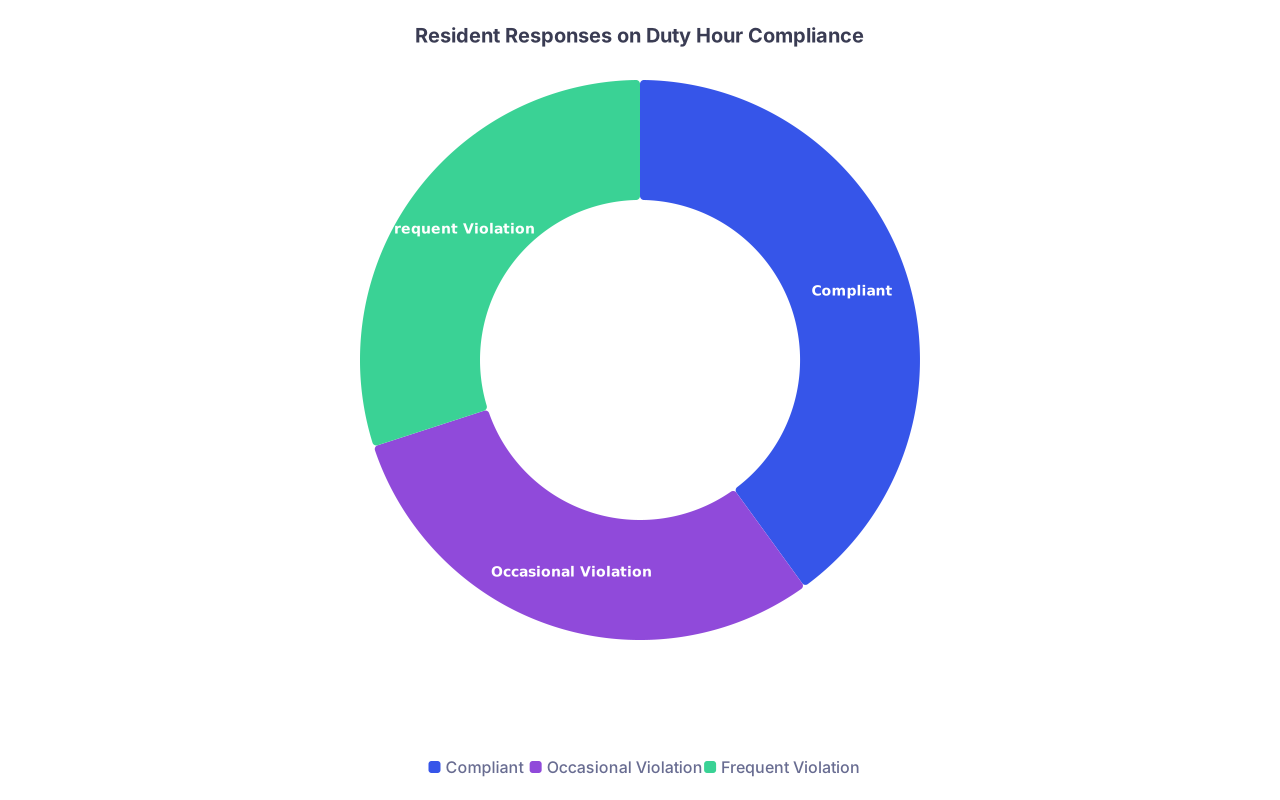
| Category | Value |
|---|---|
| Compliant | 40 |
| Occasional Violation | 30 |
| Frequent Violation | 30 |
What to do:
- Answer honestly. No “protect the program.”
- Coordinate quietly with a few trusted residents: “We’re all seeing this—please don’t lie on the survey.”
- Document that you answered accurately (screenshot, saved confirmation) if you’re especially worried.
Direct ACGME Complaint
This is the nuclear option, and sometimes it’s necessary.
What you need to know:
- ACGME has a mechanism for residents to file complaints and can investigate programs.
- They claim to protect confidentiality. Still, in a small program, it might be obvious who reported.
When to consider this:
- You’ve tried local channels. Nothing changed.
- The entire program is noncompliant and unsafe.
- You’re seeing dangerous patient care consequences (near-misses, actual harm).
If you go this route:
- Be clinical and precise in your description.
- Include patterns, not just one painful call.
- Mention if residents are being pressured to under-report hours.
Step 8: Protect Yourself While You Push Back
You’re still an intern. You still need to graduate. So while you’re pushing back, you have to protect your own career.
Practical self-protection moves:
Keep copies of everything.
- Personal log of hours.
- Any emails where you raised concerns (forwarded to your private email).
- Notes from meetings with chiefs, PD, GME.
Avoid emotional blow-ups.
Yelling at an attending at 2 am about duty hours will be remembered. Not in your favor.Use calm, factual language.
- “I’ve logged X violations over Y weeks.”
- “This appears noncompliant with ACGME duty hour policies.”
Preserve your evaluations.
Continue to do your job well. You don’t want “struggling performance” to be the narrative they use to distract from duty hour issues.Know your escape hatches.
If the program is toxic enough, transferring may be the right answer. Not easy, but absolutely better than grinding yourself into depression or major medical error.
Step 9: Decide Your Line: When Is It Too Much?
You need a personal boundary. “If X continues, I will do Y.” Because otherwise you’ll just marinate in resentment and exhaustion indefinitely.
Reasonable lines to set:
- “If I average >90 hours/week for more than 2 consecutive months and nothing changes after I raise it, I’ll go to GME.”
- “If I’m being pressured to falsify duty hours, I’ll document it and file a formal complaint.”
- “If my mental health or physical health deteriorates to [specific point], I will step back—even if that means leave of absence.”

| Step | Description |
|---|---|
| Step 1 | Notice unsafe hours |
| Step 2 | Document hours for several weeks |
| Step 3 | Discuss with trusted senior or chief |
| Step 4 | Continue monitoring |
| Step 5 | Report via internal duty hour system |
| Step 6 | Meet with GME or DIO |
| Step 7 | Consider ACGME complaint or transfer |
| Step 8 | Improves? |
| Step 9 | Response? |
| Step 10 | Still unsafe? |
Pick your line. Write it down. Tell at least one trusted person. Otherwise, programs with bad cultures will grind your standards down slowly.
Step 10: Mental Health and Morality in the Middle of All This
Let’s not pretend this is just a policy puzzle. This stuff eats at you.
You’re exhausted, making decisions for sick patients, and part of you is asking: “If I keep quiet and something bad happens, is that on me?”
Here’s my stance:
You are not responsible for fixing an entire broken system by yourself as an intern. You are responsible for doing your job as safely as the structure allows, speaking honestly when asked, and not actively lying to cover up unsafe practices.
Do what you reasonably can:
- Take your post-call days seriously. Don’t let guilt drag you back in.
- Use sick days if you’re truly unsafe to work. Yes, even as an intern. “But who will take care of the patients?” is the system’s problem, not yours alone.
- Get actual help if you’re sliding into burnout, depression, or worse. Talk to someone outside the program if you don’t trust in-house wellness.

You’re not weak for wanting to sleep. You’re not entitled for wanting a day off. You’re not disloyal for refusing to falsify hours.
You are exactly the kind of doctor patients should want.
A Quick Example Scenario (So You Can See This in Practice)
Let’s run a realistic intern story:
You’re a PGY-1 on inpatient medicine. Schedule says “6a–6p + Q4 call.” In reality:
- Most days you arrive at 5:30 and leave at 8:30.
- Call days run from 6a one day to 10a two days later (28 hours), and you still admit patients after 7a.
- You haven’t had a true day off in 3 weeks—every “day off” has involved charting or required meetings.
You:
- Start logging all in/out times for a full month.
- Quietly compare logs with a co-intern—they’re seeing the same thing.
- You both start honestly reporting duty hours in the system. You log multiple >80-hour weeks, >24+4, and lack of days off.
- A chief emails: “Please be mindful of how you log hours; ACGME sees this and it reflects on the program.”
- You request a meeting:
- “We’re not manipulating the system. These are our real hours. We’re asking how the program plans to address this.”
- Chiefs deflect: “This is just how this rotation is. Everyone has done it.”
At this point, you decide:
- Local channels failed.
- The culture is openly encouraging under-reporting.
You then:
- Schedule a confidential meeting with the GME office/DIO.
- Bring your documented hours and the chief’s email.
- Say: “I want to continue my training here, but I need to know how the institution plans to address these ongoing duty hour violations and how I’m protected from retaliation for reporting them honestly.”
That’s how an adult, professional escalation looks. Not a rant. A record.
FAQ (Exactly 3 Questions)
1. Will reporting unsafe work hours ruin my chances at a fellowship?
Not by itself. Programs do not put “reported us to ACGME” in your letters, and they’d be stupid to create an obvious retaliation trail. What does hurt fellowship chances is a pattern of poor evaluations, unprofessional behavior, or remediations. So while you report, you still need to perform clinically and behave professionally. If your program turns obviously hostile or starts documenting bogus “attitude” issues, that’s when you involve GME, document everything, and—if needed—start exploring transfer or external mentorship to protect your narrative.
2. What if my co-residents beg me not to report because they’re afraid the program will punish everyone?
This is common. People will say, “If ACGME comes, they’ll cut our electives,” or “We’ll lose flexibility.” That’s fear talking, and sometimes it’s leadership’s unofficial line. You have to decide whether keeping everyone “comfortable” in a broken system is worth the ongoing risk to patient safety and your own health. If everyone lies on surveys and logs, there is zero external pressure to change. You can explain your reasoning, but you’re not obligated to participate in falsifying conditions that are unsafe.
3. What if the problem is a single rotation, not the whole program—is it worth reporting?
Yes, but you may not need to go all the way to ACGME. For a single abusive rotation (e.g., one ICU or surgical team that routinely breaks 24+4), detailed documentation plus a targeted conversation with chiefs or the PD can be enough. Frame it as: “This specific rotation appears out of compliance with duty hour standards; can we restructure call or staffing?” If leadership is receptive and changes schedules or caps, a formal complaint may be unnecessary. If they shrug and say, “That’s just how [rotation] is,” and it keeps happening every year, then it does become a program-level issue—and yes, that’s eventually worth formal reporting.
Key points to walk away with:
- Know the actual duty hour rules and document your real hours—feelings don’t move systems, evidence does.
- Try internal channels first, but don’t let anyone bully you into falsifying your hours to “protect the program.”
- If the system stays unsafe, use GME and, when needed, ACGME—not impulsively, but deliberately and with a paper trail.