
The system that schedules you for clinic right after a 28‑hour call is broken. You still have to survive it.
You’re not here for philosophy; you’re here because it’s 6:15 a.m., your eyes burn, you signed out your last cross‑cover patient, and your schedule says: “Clinic 8:00–12:00.” You’re wrecked. You’re also technically “on the hook” to show up.
Here’s exactly what to do—before, during, and after those post‑call clinic days—so you don’t drown, don’t get written up, and don’t accidentally harm a patient.
1. First Reality Check: Know Your Rights and Your Actual Risk
Before tactics, you need the frame.
There are three overlapping truths here:
- Duty hour rules exist, and on paper they protect you.
- Programs frequently bend reality to “fit” those rules.
- You’re the one whose name is on the note if something goes wrong.
Most interns never bother to learn the basic rules. That’s a mistake.
| Rule Area | Typical ACGME Standard |
|---|---|
| Weekly hours | ≤ 80 hrs/week averaged over 4 weeks |
| Shift length (inpt) | ≤ 24 hrs continuous + up to 4 hrs wrap |
| Days off | 1 day off in 7, averaged over 4 weeks |
| Transitions | Must prevent negative impact on safety |
Post‑call clinic sits in a gray zone: the “max 24+4 hours” is for continuous in‑house clinical duty. Many services argue that if you signed out the pager at 7 and clinic starts at 8, that’s a “new day.” On paper. Not in your brain.
Here’s the line I want you to draw in your head:
- Is this situation unsafe for me?
- Is this situation unsafe for patients?
Your behavior changes depending on which side you’re on.
If you’re just exhausted but functional: you’re going. You’re planning, protecting your margin, and minimizing harm.
If you’re beyond functioning (nodding off during sign‑out, can’t track a simple history, genuinely dizzy) you’re not being “weak.” You’re impaired. And that becomes a safety problem, not a work ethic problem.
Hold that distinction. We’ll use it.
2. What to Do the Night Before Call (Yes, Before)
The only way to “win” a post‑call clinic day is to start before call even begins. If you’re reading this the night before a call shift with clinic post‑call, here’s how you play it.
A. Look at your clinic schedule right now
Open your EMR, pull up your template for the post‑call clinic.
You’re looking for:
- How many patients are booked?
- What kinds of visits? New vs follow‑up vs procedures.
- Double‑booked slots or “urgent add‑ons.”
If your schedule is slammed with 16 patients and 3 are complex new patients, that’s a red flag.
What to do now (the night before):
Email or message your clinic chief / clinic director and your senior or chief resident:
Keep it short, factual, no whining.
Example:
“Hi Dr. Shah and Dr. Nguyen,
I’m on 28‑hour call on wards tomorrow (7a–11a the following day) and scheduled for continuity clinic 8a–12p post‑call. I just noticed I have 14 patients, including 4 new complex patients and a procedure. Given I’ll be post‑call, I’m concerned about being able to safely and effectively see this volume.Is it possible to reduce the template (convert some to telehealth, reschedule non‑urgent follow‑ups, or shift one of the new patients to a non‑post‑call day)? Happy to prioritize which are most appropriate to keep.
Thanks,
[Your Name]”You’re documenting that you tried to make this safer before it became a crisis.
If your program has a clinic nurse manager or scheduler:
- Message them too. Ask directly:
“Can we move non‑urgent follow‑ups from Thursday 8–10 a.m. to another clinic session? I’ll be post‑call that morning.”
- Message them too. Ask directly:
Do not expect miracles. But even cutting 2–3 patients makes a difference.
B. Decide your personal “red line”
Before call starts, decide what will make you say: “I can’t safely do clinic.”
Examples:
- If you didn’t sleep at all overnight
- If you got pulled into a code at 5:30 a.m. and are still shaking
- If you’re physically symptomatic: nausea, tunnel vision, micro‑sleeping
Write that line down in your notes app. When you’re delirious post‑call, you’ll be tempted to move the goalposts. Do not.
3. Morning of: You Just Finished Call. Now What?
This is the critical 30–60 minutes between sign‑out and clinic. Here’s the sequence.
Step 1: Quick self‑assessment (5–10 minutes)
Do not just zombie‑walk to clinic.
Ask yourself:
- Did I get at least 1–2 hours of actual sleep?
- Can I coherently present a patient without losing my place?
- Am I safe to drive? (If the answer is no, you’re not safe to see patients either.)
If you’re clearly below functional: skip ahead to the “I cannot safely do clinic” section below.
If you’re exhausted but you can still think, proceed.
Step 2: Communicate with the right people early
Do this before your clinic session starts.
Two messages (could be pages, secure chat, or email depending on your system):
To your clinic preceptor / attending for that session:
“Good morning Dr. Lopez, I just signed out from a 28‑hr call on wards and am heading to clinic. I’m pretty tired and may be slower than usual. I’ll plan to prioritize safety and may need extra help with complex decisions today.”
To your senior or chief resident (if they oversee clinic):
“FYI I’m heading to clinic post‑call. I’m feeling quite tired but safe to work. If clinic volume is very high, I may need help adjusting schedule.”
You’ve now created a paper trail and decreased the odds someone interprets your slowness as incompetence instead of fatigue.
Step 3: Triage your own risk
Walking to clinic, make three decisions:
- What’s your max number of patients you can safely see today? (Pick a number.)
- What’s your threshold for asking your attending to take over a patient?
- What cognitive shortcuts will you avoid no matter how tired you are? (Example: never adjusting insulin dosing without double‑checking previous regimen and recent sugars.)
You’re not just tired; you’re operating with reduced working memory and slower processing. Accept that and plan around it.
4. During Clinic: How to Function Without Hurting People
Post‑call clinic is not the time to “be efficient” or “impress.” It’s survival plus safety.
A. Reset expectations with your preceptor at the start
When you arrive:
Be on time or a few minutes early if humanly possible. That buys you goodwill.
Quick, direct conversation in person:
“I’m post‑call from wards and pretty wiped. I want to prioritize safety today. Can we flag any complex new patients for you to co‑see earlier, and maybe limit the number I see independently?”
Most attendings get it. The ones who don’t will reveal themselves quickly.
B. Ruthless visit triage (within the rules)
With the help of your nurse/MA/front desk, look at your schedule and sort visits roughly into:
- Must happen today (urgent issues, med management, no‑show risk)
- Could be telehealth or quick check‑in
- Could be rescheduled safely
Then act:
- Ask staff to convert simple lab follow‑ups or stable chronic disease checks to telehealth or a quick phone call, if your clinic allows.
- Ask if any no‑show‑prone patients have already flaked multiple times; you’re not betting your alert cognitive hours on them.
This is where having messaged the night before helps—someone may already have made changes.
C. How to run each visit when your brain is slow
You need a stripped‑down, fatigue‑proof approach to each patient.
Use this skeleton:
Start with one question:
“What’s the main thing you want to make sure we address today?”
Write it down immediately.Limit yourself:
For complex patients, commit to tackling 1–2 problems well rather than 6 problems poorly.
It’s okay to say:“You brought up several important issues. Since I’m short on time today, let’s focus on your breathing and your blood pressure, and I’ll schedule you back soon to address the rest properly.”
Use structured templates and checklists ruthlessly:
- For chest pain, open your clinic’s chest pain template.
- For diabetes follow‑up, use the diabetes smart set.
Templated thinking protects you from missing big stuff when you’re tired.
Double‑document orders and meds:
- When you enter a med, read the final order out loud to yourself.
- Confirm doses with the patient:
“So you’ll be taking 5 mg once daily in the morning. What will that look like in your routine?”
Don’t rely on memory:
- If you postpone a task (“I’ll order that lab after we talk”), put a to‑do in the EMR immediately. Tired brains forget.
D. Know when to escalate in real time
During a visit, red flags for “I should not own this alone right now”:
- You’re reading the same paragraph of the chart three times and still not tracking it.
- You’re debating between two management options and can’t articulate pros/cons clearly.
- You realize you’re shortcutting (e.g., prescribing antibiotics without really confirming the diagnosis).
In those moments, use a standard line:
“I’d like to review your case with my supervising physician to make sure we make the safest decision today. I’ll step out for a few minutes and come back with a plan.”
Then actually go get your attending. Do not play hero.
5. When You’re Too Impaired to Safely Do Clinic
Sometimes you will cross that red line you set earlier. No sleep. Headache. Micro‑sleeping in sign‑out. Shaky hands after a night of codes.
Here is the sequence when that happens.
Step 1: Document your state for yourself
Jot down in your phone or a quick email to yourself:
- How much sleep you got
- What happened in the last 2–3 hours (codes, rapid responses, ED admits)
- Your symptoms (dizzy, can’t focus, almost fell asleep during sign‑out)
Not a novel. Just 3–5 bullet points. This protects you later.
Step 2: Call the right person, not 10 people
The hierarchy usually looks like:
- Chief resident or service senior
- Clinic director / attending preceptor
- Program director (if it escalates)
Call or page your chief or senior first. Example script:
“Hi Dr. Patel, this is [Your Name]. I just finished 28‑hour call on wards and I’m scheduled for clinic from 8–12. I got essentially no sleep overnight. I’m having trouble keeping my eyes open and I actually nodded off during sign‑out. I don’t feel safe seeing patients in clinic right now. Can you help figure out how to handle coverage or rescheduling?”
Key things you did there:
- You stated objective facts.
- You explicitly said the word “safe.”
- You asked for help solving the system problem, not “permission” to be tired.
If they blow you off with “Everyone’s tired, just go to clinic” and you truly feel impaired, escalate:
“I understand that everyone is tired after call, but I’m at the point where I feel I might make unsafe decisions for patients. I’d like to speak with [clinic director/PD] about this so we can find a safe option.”
Put the ball squarely in the “patient safety” court, not “I’m soft” court.
Step 3: Do not drive home if you’re too tired for clinic
If you successfully get excused from clinic because you’re dangerously tired, do not then jump in your car and drive home half‑asleep.
Call a partner, friend, co‑resident, or use a rideshare. Many hospitals also have vouchers or policies for post‑call transportation; ask the GME office about this ahead of time if your hospital is big enough to care about liability.
6. After Clinic: Protect Yourself and Fix What You Can
The day ends. You survived. Now you do three small but important things.
A. Quick debrief with yourself
On your way home or that evening, ask:
- Did I feel borderline unsafe at any point?
- Did I miss anything important that I later caught?
- Were there patterns—certain visit types that were just too much post‑call?
Write down 2–3 takeaways. This is how you get better at predicting when you’ll need help next time.
B. Send a brief, factual email if things were unreasonable
If your post‑call clinic was truly over the line (16 patients, no coverage, you were hallucinating from sleep deprivation), send a short email to your chief and optionally to the clinic director or program director.
Keep it dry, not emotional:
“Hi Drs. Smith and Lee,
I wanted to document today’s post‑call clinic experience. I was on 28‑hr in‑house call on the MICU from Wednesday 7 a.m. to Thursday 11 a.m. I had minimal sleep overnight. I was then scheduled for continuity clinic from 8 a.m. to 12 p.m. the same day, with 15 patients booked including 5 new complex patients.
I completed the session but felt my fatigue meaningfully impacted my ability to work efficiently and potentially safely. I raised concerns verbally this morning with Dr. Lopez.
I’d appreciate consideration of adjusting post‑call clinic templates or building in more flexibility on days following heavy overnight call, to support both patient safety and resident wellness.
Best,
[Your Name]”
You’re not whining. You’re creating a record. Programs care about what’s written when ACGME comes around.
C. Build your informal safety net
Long term, your best protection is relationships:
- The MA who will quietly block a slot when you’re wrecked.
- The attending who will say, “I’ll take that new CHF patient; you stick to follow‑ups today.”
- The chief who proactively lightens post‑call clinics.
Be decent to these people on your better days. Follow through. Help others when you’re the one who’s rested.
7. Pre‑Emptive Strategies: Making Future Post‑Call Clinics Less Awful
You’re not going to change the system in one email. But you can make your personal life safer and slightly less brutal.
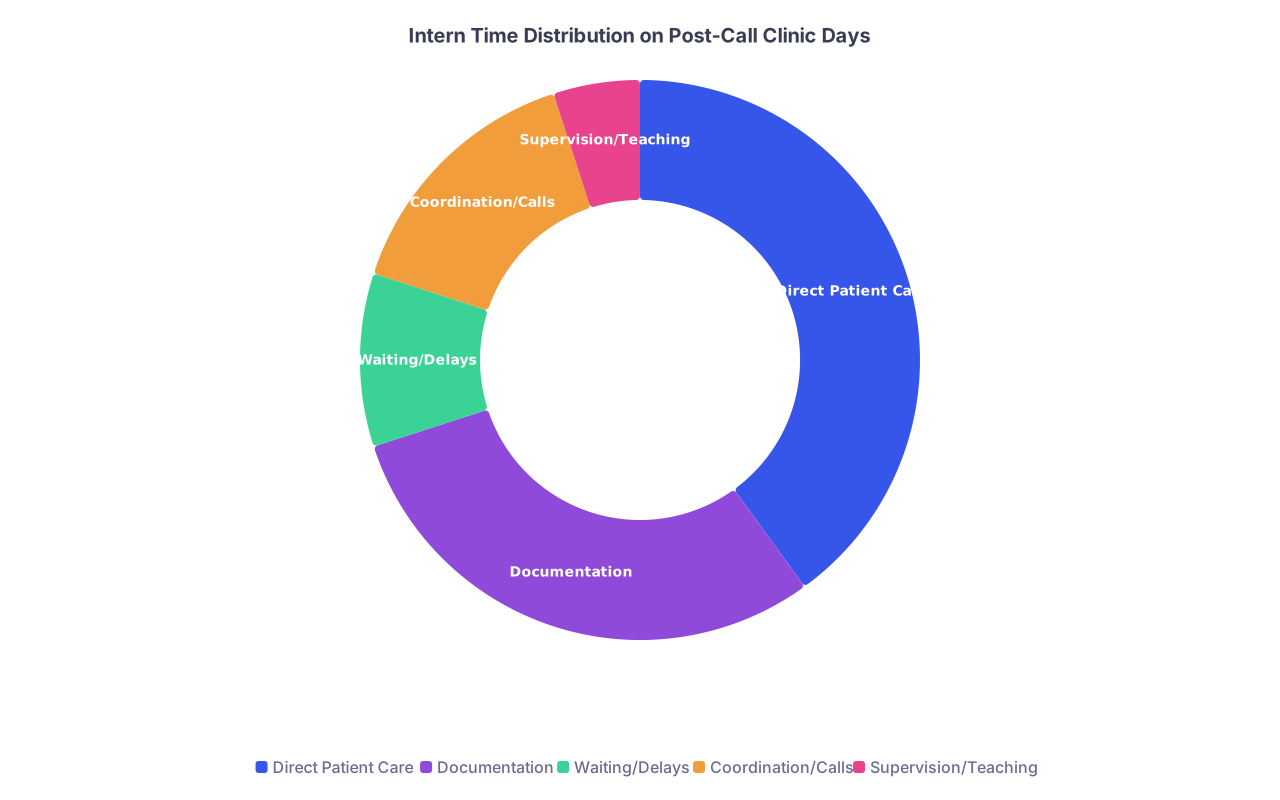
| Category | Value |
|---|---|
| Direct Patient Care | 40 |
| Documentation | 30 |
| Waiting/Delays | 10 |
| Coordination/Calls | 15 |
| Supervision/Teaching | 5 |
A. Template management
At the start of the year:
- Identify which clinic sessions are often post‑call for you.
- Ask your clinic leadership to pre‑limit those templates.
Simple script:
“I’ve noticed Thursday morning clinic is often post‑call from wards. To keep things safe, would it be possible to cap those sessions at X patients or avoid booking new complex patients on those days?”
Some clinics already do this. Many don’t until someone asks.
B. Use data
Keep a simple log for a few months:
- Date
- Service you were on
- Whether you had post‑call clinic
- How many patients you saw
- How safe/effective you felt (1–5)
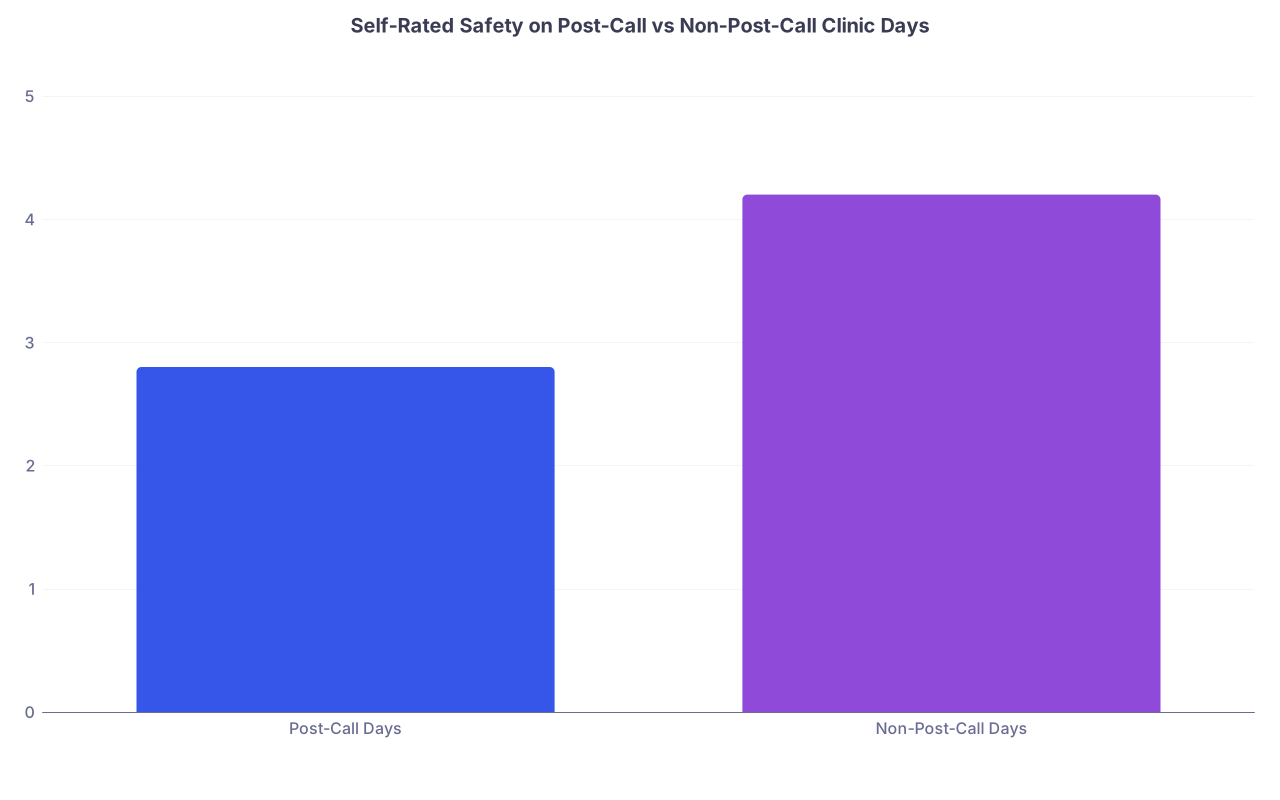
| Category | Value |
|---|---|
| Post-Call Days | 2.8 |
| Non-Post-Call Days | 4.2 |
After you have some data, you can go to your chief or PD with something more powerful than “This feels bad.”
C. Learn what’s actually negotiable
Every program has “soft spots” where things are more flexible than advertised:
- Some allow residents to trade clinic sessions.
- Some quietly move one or two patients to the attending’s column when you’re wrecked.
- Some have “swing” residents who can pick up overflow.
Your job is to learn those levers. Ask senior residents privately:
“What do you actually do when you’re crushed post‑call and your clinic is full?”
Listen to real answers, not the handbook.
FAQ (Exactly 3 Questions)
1. Can I get in trouble for refusing to go to clinic post‑call if I’m too exhausted?
Yes, you can get pushback—anything from annoyed comments to formal “professionalism” concerns—depending on your program culture. But if you’re truly impaired (no sleep, micro‑sleeping, can’t think straight) your first duty is patient safety, not optics. Protect yourself by: documenting your state, using clear “safety” language when you call your chief/PD, and proposing alternatives (rescheduling, coverage) instead of just saying “I’m not coming.” If your refusal is grounded in legitimate impairment and you handle it professionally, you may get friction, but you’re on solid ethical ground.
2. What if my attending acts annoyed or says, “We all did this when we were interns, you’ll be fine”?
You ignore the guilt trip and focus on competence. A simple response: “I understand this is common. I just want to make sure I’m making safe decisions for patients today, and I know my limits when I’m this fatigued. I’ll need closer supervision and may be slower.” Then practice what you said: ask more questions, get more case reviews, seek help with complex decisions. If the attending continues to minimize your fatigue, document the experience later in an email to your chief or PD—factual, not emotional. Long term, look for attendings who respect safety signals and lean on them when assignments are flexible.
3. How do I avoid looking “weak” while still advocating for myself?
You don’t make it about your feelings; you make it about performance and patient safety. Show up on time when you can. Work hard on non‑post‑call days. Be prepared, know your patients, read. Then, when you say, “Today I’m too exhausted to safely handle a full panel of complex patients,” people are more likely to believe you. Use concrete language: “I got zero sleep, almost fell asleep during sign‑out, and I’m having trouble tracking simple histories.” Suggest solutions: reduce volume, shift complex patients, add supervision. That’s not weakness. That’s professionalism under bad system design.
Key points:
- Decide before each call what “too impaired to safely do clinic” means for you, and stick to that line.
- When you do go to clinic post‑call, aggressively simplify: fewer problems per visit, more supervision, zero heroics.
- Document unsafe patterns and speak up early and factually; systems only change when someone forces them to look in the mirror.