
7 Boundary Errors New Interns Make That Destroy Work–Life Balance
What do you think will protect your patients more: answering every message instantly, or still having a functioning brain on day 20 of nights?
Most new interns get this wrong. Badly.
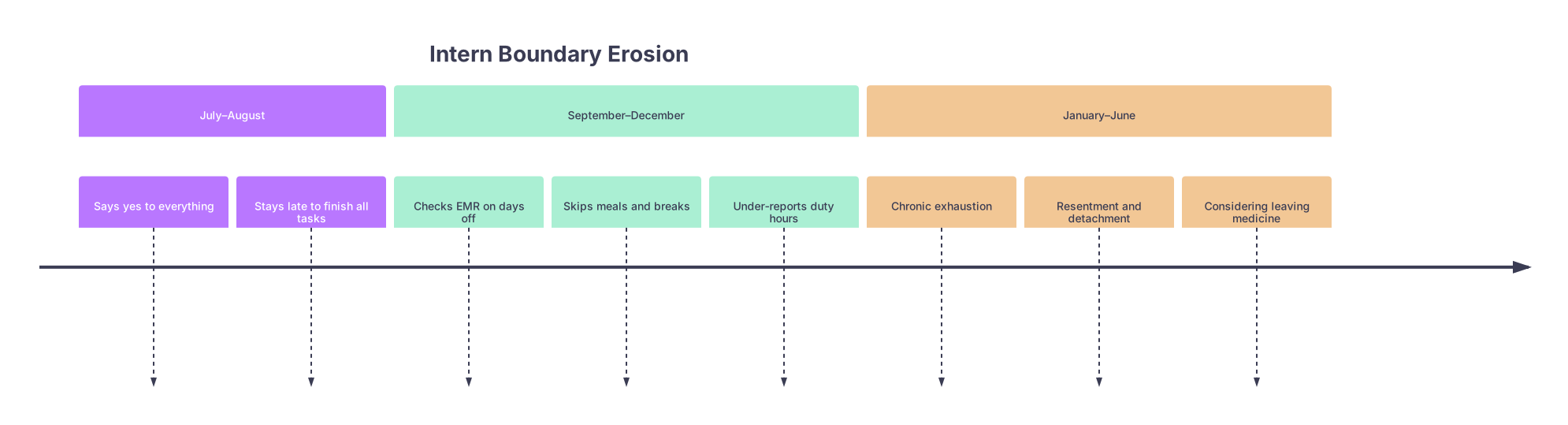
They walk into residency convinced that “good interns” say yes to everything, stay late without question, and check Epic on their day off “just to keep up.” Then they’re shocked when they’re burned out by October, resentful by January, and seriously questioning medicine by the end of PGY-1.
Let me be blunt: the system will not set boundaries for you. If you do not draw the line, most places will step right over it. Not because everyone’s evil, but because the work is endless and you look eager and available.
Here are seven boundary errors I’ve watched new interns make over and over—and how to avoid torching your work–life balance in the process.
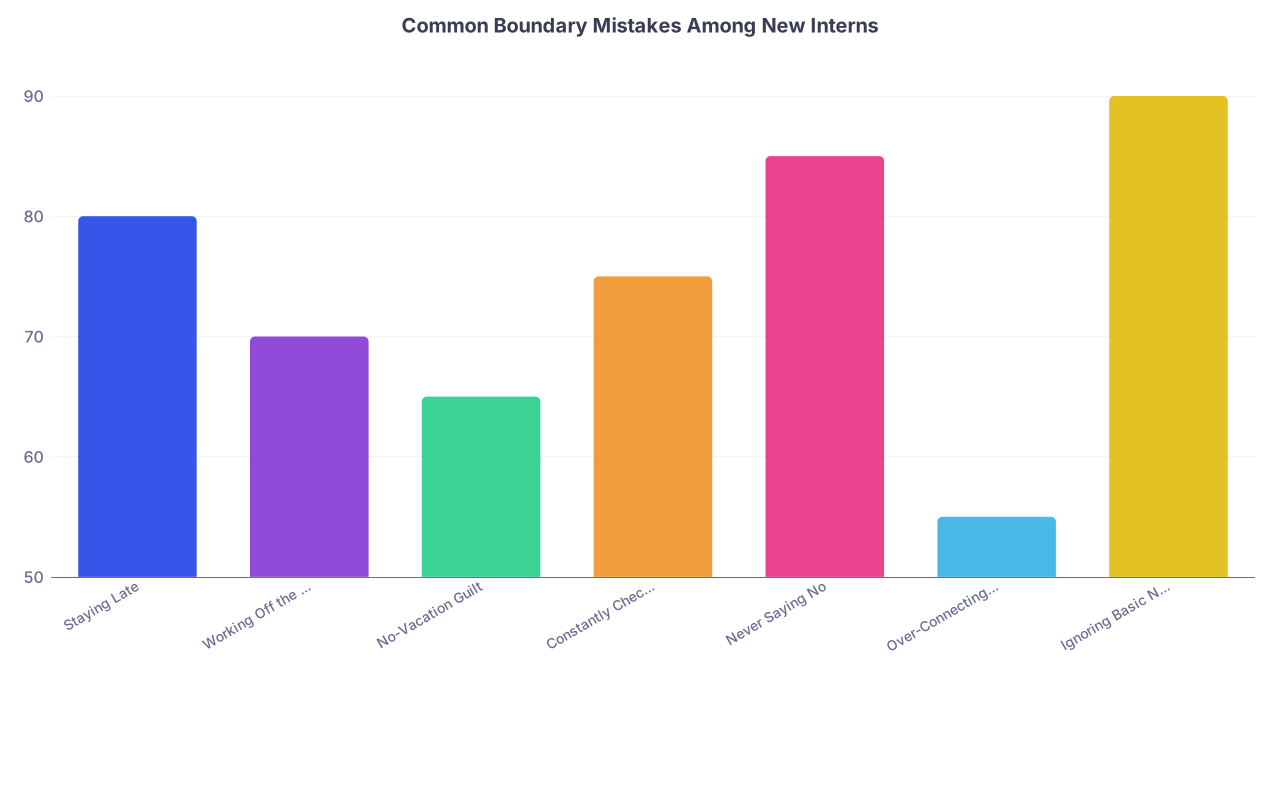
| Category | Value |
|---|---|
| Staying Late | 80 |
| Working Off the Clock | 70 |
| No-Vacation Guilt | 65 |
| Constantly Checking EMR | 75 |
| Never Saying No | 85 |
| Over-Connecting with Patients | 55 |
| Ignoring Basic Needs | 90 |
1. Treating “Stay Until Everything Is Done” As A Moral Obligation
The fastest way to ruin your life as an intern is to believe you must finish every single task before you’re “allowed” to sign out.
You know the script:
- “I’ll just put in those three extra orders before I go.”
- “I can’t leave my co-intern with that note.”
- “This discharge summary will only take 10 minutes.”
Those “ten minutes” magically become an extra hour. Every night. Five nights a week.
Here’s the ugly truth: medicine is an infinite to-do list. There will always be more you could do. If you tie your self-worth to finishing everything, you will never feel done—and you’ll train everyone around you to expect martyrdom.
The mistake is confusing good care with endless availability.
You need a hard mental shift: your duty is to provide safe, competent patient care within the structure of your shift and your duty hours—not to personally complete every micro-task at the expense of your health.
How to avoid this:
- Learn what genuinely must be done before sign-out vs what can be safely handed off. If you’re not sure, ask a senior: “It’s 6:45, I still have X and Y—what’s priority before I leave?”
- Use a written sign-out list that actually works. Don’t keep it in your head.
- Accept that some notes will be finished tomorrow. A late but accurate note is better than a 10 p.m. exhausted mess.
If you routinely stay late because “there’s too much to do,” that’s not you being noble. That’s a system and boundary problem that needs to be named and addressed.
2. Saying Yes To Everything Because You’re Afraid of Looking Weak
This one’s deadly.
You’re new. You’re being evaluated. You don’t want to be the “lazy intern.” So you say yes to:
- Extra admissions that technically could be distributed
- Last-minute coverage requests “just this once”
- Taking on more procedures when your list is already exploding
- Extra committee or QI work “because it’ll look good”
Then suddenly you’re the person everyone calls. Because you always say yes. People confuse your fear of saying no with bottomless capacity.
Let me be clear: constantly saying yes does not make you look strong. It makes you look like someone who can be overloaded without complaint. People will use that, even if they like you.
Healthy boundary: You are allowed to say no when saying yes hurts your patients, your team, or your own safety.
Examples of where new interns screw this up:
- Agreeing to cover post-call “because no one else can” when you’re barely awake
- Taking on an additional difficult family meeting at 6:30 p.m. on a 28-patient day
- Accepting “just one more” admission when you’re already maxed
A better play:
- “My list is at 15 with 4 active workups. If you need me to take this admission, something else will be delayed. Can we redistribute or get backup?”
- “I’ve been here 14 hours and I’m not thinking clearly. It’s not safe for me to stay longer—who can take over?”
You will hate saying this the first time. Do it anyway. The alternative is quietly crumbling while everyone thinks you’re fine because you never speak up.
3. Letting Your Phone, Pager, and EMR Invade Every Off-Hour
If your “day off” includes:
- Checking the EMR “just to see how my sick patient is doing”
- Responding to non-urgent messages because “it’s quicker if I just answer now”
- Answering random consult texts from a resident who forgot you’re not on
You do not have a day off. You have unpaid, undocumented shadow call.
I’ve seen interns brag that they “round on my patients from home” on their golden weekend. It’s not admirable. It’s boundary collapse dressed up as dedication.
You’re training your brain to never truly leave work. That chronic, low-level vigilance keeps your stress hormones humming all the time. No wonder you can’t sleep.
You need hard rules around off time:
- When you are not on call, your work email and EMR stay closed. No “quick peeks.” You’re not on.
- Turn off or silence work group chats when you are post-call or off, unless they are explicitly call-related and you’re on.
- If attendings or seniors routinely text you on your off days for non-urgent things, you say, “I’m off today—will address when I’m back on tomorrow.”
Will some people think you’re “less dedicated” than the intern who replies 24/7? Maybe. Will you still be functional in February? Much more likely.

4. Confusing Being Caring With Being Available 24/7 To Patients and Families
New interns with big hearts fall into this trap constantly.
You tell a patient, “You can call anytime; I’ll always pick up.”
You give out personal contact info.
You stay an extra hour to talk through non-urgent issues that could be handled tomorrow.
You answer MyChart messages at 11 p.m. because the patient “seems anxious.”
Your intention is good. The effect is terrible—for you and, eventually, for them.
Why? Because you’re building an unrealistic expectation: that one overextended intern can meet all emotional and medical needs, at any hour, personally. You can’t. When you inevitably fail, they feel abandoned, and you feel guilty.
Healthy boundaries actually protect both sides.
Examples of boundary errors here:
- Promising a specific outcome or timeline you do not control (“I’ll get your CT moved up today” when radiology is slammed)
- Telling families you’ll “call with every update” instead of setting specific times
- Taking on long emotional counseling sessions during a 12-patient cross-cover night shift
Better scripts:
- “During the day, I’m your main doctor. At night, there’s another doctor who covers my patients and can handle urgent issues.”
- “I’m in the hospital until around 6. I’ll plan to update you once this afternoon, and if anything big changes before then, we’ll call.”
- “You’ve brought up a lot of important concerns. I want to give these enough time. I’m going to write these down and schedule a longer conversation tomorrow when I can focus fully.”
You are still caring. You’re just not sacrificing your last scraps of sanity to prove it.
5. Letting Guilt Erase Your Legal Rights: Duty Hours, Days Off, and Vacation
Duty hours violations aren’t just abstract rules for accreditation. They exist because too many residents crashed cars driving home after 28+ hour shifts and made terrible errors while half-asleep.
If you treat these protections as “suggestions” instead of boundaries, you’re playing a dangerous game.
Typical rookie mistakes:
- Not logging duty hours accurately because “I don’t want to get the program in trouble”
- Volunteering to skip your golden weekend to “help the team,” then not getting real compensation
- Taking “paper days off” where you’re technically off the schedule but still answering a constant stream of questions
Here’s the line: your program is obligated to follow duty hour rules. You are not a hero for helping them appear compliant while actually blowing past every limit.
If you’re working 90-hour weeks but logging 80 because “everyone does it,” you’re enabling a system that will burn you and the interns after you.
Practical boundary moves:
- Log your hours honestly. If you’re constantly over, that is your PD’s problem to solve, not your private shame.
- If your “day off” ends up being a pseudo-workday, email the chief: “I ended up working X hours on my off day due to Y. How can we adjust so I have a true day off this week?”
- Protect your vacation. Don’t do “just a bit of work” on vacation. That includes “helping out” with a few notes or covering a half-day clinic.
If you don’t enforce these lines early, people will assume you don’t need rest. They’re wrong. And you’ll prove it the hard way.
| Area | Unhealthy Pattern | Healthy Boundary |
|---|---|---|
| End of shift | Staying 1–2 hours late most days | Leaving on time most days, rare late exceptions |
| Off days | Checking EMR/MyChart repeatedly | EMR closed; only check when on call |
| Saying no | Always agreeing to extra tasks | Declining when unsafe or overwhelming |
| Duty hours | Under-reporting to “protect program” | Honest logging and raising persistent overages |
| Patient access | Sharing personal contact, 24/7 availability | Clear daytime vs night coverage expectations |
| Physical needs | Skipping meals, bathroom, water routinely | Small non-negotiable breaks most days |
6. Sacrificing Basic Human Needs Like They’re Optional
Here’s the quiet boundary violation almost every intern commits: they decide their body’s needs are negotiable.
Skipping meals “because I’m too busy.”
Not drinking water for an entire 12-hour shift.
Not going to the bathroom for hours.
Sacrificing all sleep “just this week” to study, then repeating that cycle constantly.
Everyone tells you “self-care is important,” but then you watch your seniors eat granola bars at 4 p.m. as their first “meal.” So you think, “This is just what we do.”
No. This is what burned-out people do when they have stopped seeing themselves as human.
Here’s the boundary you’re violating: the one between “I am a human with a body” and “I’m a disembodied productivity unit in scrubs.”
You can’t think clearly at 3 a.m. when you haven’t eaten since 10 a.m. That’s not you being weak. That’s physiology.
Minimum non-negotiables (and if you resist these, that’s your red flag):
- Pee. At least every 4–6 hours. You are not a hostage.
- Eat something with actual calories by early afternoon. Does not need to be perfect. It does need to exist.
- Drink water. Coffee is not water. You know this.
- Protect a baseline sleep window most nights. You won’t always get it. But if you haven’t slept more than 4 hours/night for a week, something is very wrong.
This isn’t “wellness fluff.” Poor hydration, no food, and chronic sleep deprivation lead to crappy orders, missed details, and snappy interactions. Your patients pay for your martyrdom too.
7. Allowing Residency to Erase Every Non-Medical Part of You
The final, slower boundary error: you let residency swallow your identity.
Early on, you tell yourself, “It’s just this month.” You drop:
- Hobbies
- Exercise
- Friends outside medicine
- Any creative outlet
- Religious or spiritual practices
- Even basic life maintenance
By winter, every conversation you have is about work. Every thought loop is about work. Every free hour is spent either recovering from work or dreading the next shift.
Externally, you look like a “dedicated resident.” Internally, you’re hollow.
The mistake is thinking you’ll “add life back in later.” That’s not how it works. You’re building habits and identity right now. If your entire sense of self becomes “intern who is always available,” it’s very hard to undo that in PGY-2.
You need boundaries around your time and your self:
- At least one small, recurring thing each week that is not medicine and is non-negotiable unless you’re literally on call. A weekly phone call with a friend. A 20-minute run Sunday morning. A sketchbook session. Something.
- Relationships outside medicine that don’t revolve around your call schedule. Yes, you are busy. No, you are not the only person in the world who works hard.
- Clear times where you do not talk about work. Explicitly. “For the next 30 minutes, no medicine talk.”
Here’s the test: If someone asks, “What do you like to do outside of medicine?” and your mind goes blank, that’s not a personality quirk. That’s a boundary problem.
The Hidden Cost Of Never Setting Boundaries
Hospital culture quietly rewards boundary violations:
- The intern who answers every message instantly is “amazing”
- The one who never leaves early post-call is “so dedicated”
- The one who comes in sick is “a team player”
You know who rarely gets named? The ones who:
- Hand off cleanly
- Take their days off
- Say no when they’re overloaded
- Leave on time most days
But here’s who actually survives this career: those second people.
You don’t get a medal for destroying your body and mind in PGY-1. You just get more work piled on you, because you’ve shown you’ll tolerate it.
The residents I’ve seen flame out hardest were often the ones everyone praised the loudest in July: always available, always saying yes, always online. By March they were angry, exhausted, and questioning if they’d chosen the wrong profession.
Don’t become that cautionary tale.
One Concrete Step To Take Today
Do this right now: choose one boundary you will actually enforce this week.
Not five. One.
Pick from:
- “I will not check the EMR or MyChart on my day off.”
- “I will leave within 30 minutes of sign-out on at least 3 shifts this week, even if small tasks remain that can be handed off.”
- “I will eat something substantial before 2 p.m. every workday this week.”
- “I will say no to at least one non-essential extra request that would extend my day by more than 30 minutes.”
- “I will honestly log my duty hours for the next 7 days.”
Write it down. Tell one co-intern or friend. Then protect that one boundary like it’s your patient’s potassium that’s 2.2.
Because here’s the part nobody told you in orientation: your work–life balance isn’t going to be handed to you by your program. It exists only if you refuse to make these boundary mistakes, over and over, until they become your new normal.