
The most dangerous word for a new intern is not “code.” It is “yes.”
You are about to enter the most overcommitted year of your life. The trap most new interns fall into is simple and seductive: saying “yes” to everything because they think it proves they are hardworking, team‑oriented, and grateful to be there. Instead, it just proves they are easy to overload.
Let me be blunt. Chronic overcommitting will not make you look impressive. It will make you look disorganized, unsafe, and eventually burned out. Your seniors, attendings, and nurses have seen this movie before. The over‑eager intern who always volunteers. It rarely ends well.
This is the “Yes to Everything” error. Avoid it, or it will own you.
The Psychology Behind the “Yes to Everything” Trap
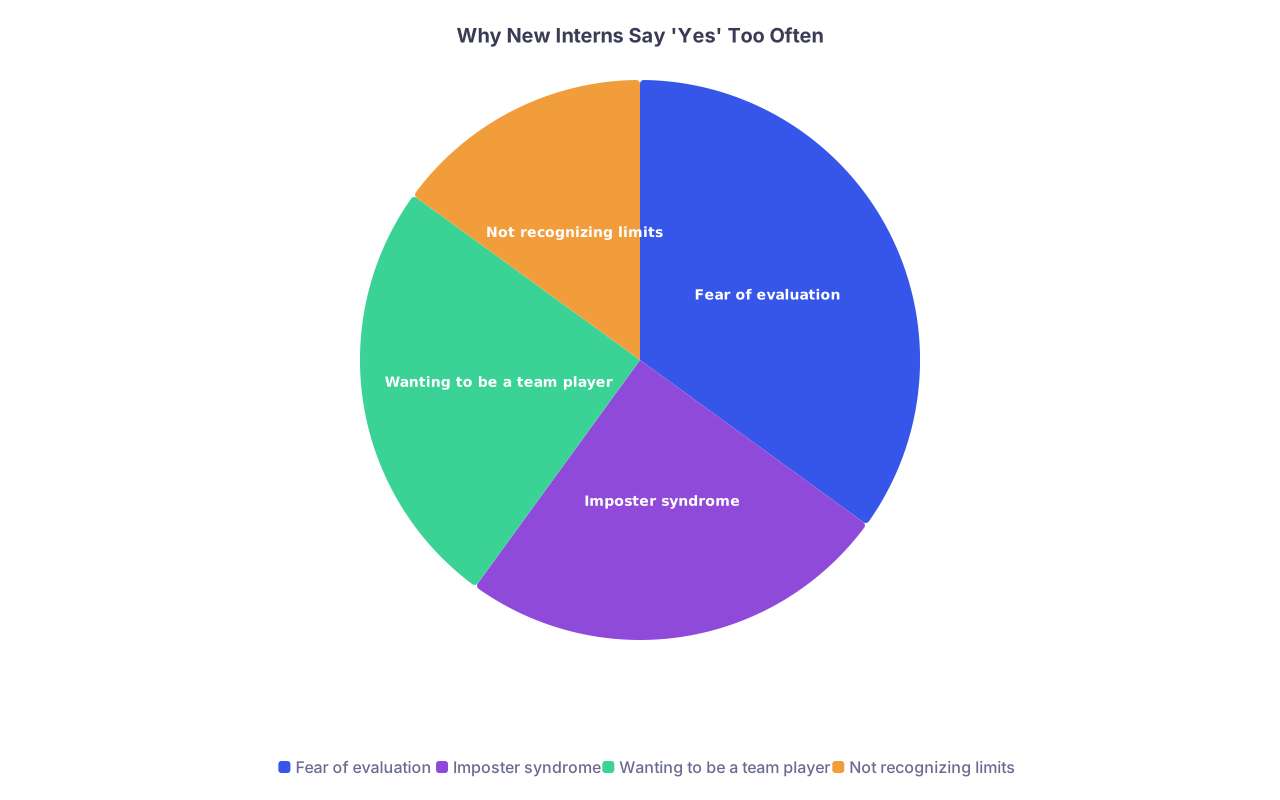
| Category | Value |
|---|---|
| Fear of evaluation | 35 |
| Imposter syndrome | 25 |
| Wanting to be a team player | 25 |
| Not recognizing limits | 15 |
You will not start internship as a blank slate. You bring years of habits from pre‑med, med school, and the match process. Most of those habits push you toward overcommitting.
Here is what is quietly driving the “yes” reflex:
Fear of being labeled “lazy”
You spent years being rewarded for doing more: more research, more leadership, more volunteering. Now you hear horror stories about “that intern” everyone thought was lazy or unreliable. Your brain connects the dots: saying “no” = being that intern.Imposter syndrome
You are surrounded by people who seem smarter, faster, more confident. So you think, “If I do more, maybe I’ll prove I belong here.” That mindset is gasoline on the overcommitment fire.Unclear expectations
No one hands you a clean document that says: “This is the exact scope of what’s expected from an intern.” Instead, you get vague phrases: “be a team player,” “own your patients,” “go above and beyond.” Translation in your anxious intern brain: never say no.Power dynamics
You are at the bottom of the food chain. The person asking for something is often a senior, attending, fellow, or nurse with years of experience. Saying “yes” feels automatic. Saying “no” feels like career suicide.The culture problem
In some programs, the “hero” intern is glorified. The one who “never complains,” stays late, and “just gets it done.” What no one says out loud: those interns are often the ones making the quiet, serious mistakes.
The longer you let these forces drive your decisions, the faster you drift into unmanageable territory. And medicine does not forgive unmanageable.
How the “Yes to Everything” Error Actually Shows Up
Overcommitting does not announce itself with a neon sign. It creeps in through normal, daily interactions until you are buried.
The small, constant “sure, I’ll do it”
You will hear:
- “Can you add this patient to your list? Just for today.”
- “Can you put in those admission orders? I’ve got to run to a procedure.”
- “Hey, can you staff that extra consult? It should be quick.”
- “Can you call radiology about all of these scans?”
You say yes. Because it feels small. Because each one, alone, is reasonable.
What you do not see is cumulative load. By 3 a.m., those little requests have built into a mass of charting undone, orders delayed, callbacks forgotten, sign‑outs rushed.
The silent backlog
Here is the dangerous pattern I have seen dozens of times:
- Intern agrees to do “one more” thing before finishing notes.
- Another page comes in. Then another.
- They keep saying yes. Their checklist multiplies.
- They start cutting corners: template notes, incomplete documentation, delayed follow‑up.
- At sign‑out, they realize they cannot cleanly track what was actually done.
Nothing looks catastrophic. Until it is.
Overtime as identity
Some interns decide the solution is simple: just work more.
They start staying an extra hour. Then two. Then “just finishing something” off the clock on post‑call days. They stop eating. Their breaks vanish. They treat duty hour rules as a bureaucratic annoyance instead of a safety net.
Inside their head, a script runs: “I am the hardworking one. I stay until it is finished.”
Everyone else? They see someone who cannot complete tasks in a reasonable time, who may be dangerous with fatigue, and who is normalizing unsafe expectations for the rest of the team.
Why Overcommitting Makes You Worse, Not Better

The biggest lie you will tell yourself is, “If I say yes to everything, I will learn more and be seen as competent.”
No. You will just distribute your attention so widely that everything suffers.
Cognitive overload = clinical mistakes
Your working memory is not infinite. When you overload it:
- You mis‑hear orders on the phone.
- You forget to reconcile meds.
- You fail to notice that creatinine has doubled since admission.
- You discharge someone who still has abnormal vitals because you skimmed instead of read.
I have watched an overcommitted intern say yes to “just one more” admission, then forget to reorder a critical home med. That omission landed the patient in the ICU 24 hours later. They were not lazy. They were overextended.
Reliability matters more than enthusiasm
Attendings do not remember you as “the eager intern who said yes to everything.” They remember:
- Did things get done correctly?
- Did I have to double‑check your work?
- Could I trust you with patient care without babysitting you?
An intern who calmly says, “I cannot safely take on a third new admission right now; I am still stabilizing two sick patients” will be trusted more than the intern who nods along to everything and then leaves a wake of half‑finished tasks.
Overcommitting kills real learning
When you are constantly in emergency mode, you do not learn. You survive.
You skim notes. You autopilot through daily assessments. You do not have time to read about your patients, ask good questions on rounds, or watch that procedure you actually care about.
Paradoxically, saying “no” to the extra non‑essential stuff sometimes is what creates space for the deeper, meaningful learning that makes you a better physician in the long run.
Concrete Red Flags: How To Know You’re Already Overcommitted
| Situation | Overcommitted Response | Healthy Response |
|---|---|---|
| New consult request at 5:30 pm | Automatically agrees despite backlog | Briefly reviews current tasks before accepting |
| Staying late | Routinely 1–2 hours late finishing basics | Occasional late stays for true acuity |
| Pages during note writing | Drops everything for every page | Triage and batch responses when appropriate |
| Teaching invites | Says yes to all talks, sessions | Selectively attends high-yield ones |
| Email/committee asks | Joins multiple projects in July | Defers most until later in the year |
If you are seeing three or more of these, you are in the danger zone:
- You regularly finish notes after the end of your shift for non‑emergent reasons.
- You feel a low‑grade panic when more than two tasks are pending.
- You avoid asking for help because you are afraid someone will finally notice how behind you are.
- Nurses are paging you multiple times to follow up on the same request because it keeps falling through.
- You are “always busy,” but still not quite sure where your time went.
- You have not eaten a real meal on call in weeks, just random graham crackers and coffee.
- You are starting to hide or downplay misses instead of bringing them up early.
None of these make you a bad resident. They make you an overcommitted one. That is fixable—if you stop pretending it is fine.
How To Say “No” Without Burning Bridges (Or Your Evaluation)
This is where interns panic. You know you need to say “no” sometimes, but you are terrified of sounding difficult. Fine. Then do it with structure and clarity.
Principle 1: Replace “no” with “what’s safest?”
You are never just saying “no.” You are choosing the safest priority. Frame it that way.
Example with a senior:
“Right now I am admitting a hypotensive sepsis patient and still need to finalize pressor orders. If I take a second admission at the same time, I am worried I will not manage either safely. Would it be better if I stabilize this one and then pick up the next, or should we split them?”
You are not refusing work. You are naming risk.
Example with a nurse:
“I am currently at the bedside of a patient with new chest pain and actively evaluating them. I can call about the diet order right after that. If it is urgent for safety, let me know and I will change the order of what I am doing.”
Again, not “no.” Just honest triage.
Principle 2: Offer one concrete alternative
People tolerate boundaries better if you give them a clear path forward.
Instead of: “I cannot do that.”
Try: “I will not be able to safely get to that in the next 30 minutes. Would you prefer I hand it off to the night float, or can it wait until then?”
You are not stonewalling. You are forcing a real decision about timing and ownership.
Principle 3: Use your senior as a shield early
Your senior’s actual job is to help with load‑balancing. Many interns forget this and suffer in silence.
You can say:
“I have three tasks pending that I consider time‑sensitive: follow up the CT PE, call family about the new ICU transfer, and see the ED chest pain consult. I am comfortable doing all, but not at the same time. Can you help me prioritize what must happen before sign‑out?”
Now your senior sees your load, your thinking, and can re‑assign if necessary. You do not earn bonus points for hiding how slammed you are. You just increase the chance of something falling apart.
Practical Tactics To Avoid Overcommitment From Day One

| Step | Description |
|---|---|
| Step 1 | New task arrives |
| Step 2 | Do now |
| Step 3 | Add to priority list |
| Step 4 | Schedule for later or delegate |
| Step 5 | Communicate expectations |
| Step 6 | Emergent risk? |
| Step 7 | Time-sensitive today? |
You do not need a personality transplant. You need a system.
1. Run all new requests through a 3‑question filter
When something new lands on your plate, mentally ask:
- Will someone be harmed if this waits?
- Does it absolutely have to be done by me?
- Does it absolutely have to be done right now?
If the answer to all three is “no,” it does not get to jump the line.
Example: A nurse pages about changing a diet from regular to cardiac on a stable patient while you are admitting a GI bleed. That answer is:
No, no, and no. It can wait until the bleed is stabilized.
2. Keep a written, visible task list. Always.
Not in your head. Not “I’ll remember.” You will not.
Use:
- A folded index card
- A pocket notebook
- A running tasks note in the EMR (if your system allows it)
Sort into three categories:
- Now (urgent and important)
- Today (important, not emergent)
- When possible (nice‑to‑do, low‑risk delays)
When someone asks you to add something, you can literally look at the list and respond based on reality, not anxiety.
3. Batch “small” tasks
The classic intern mistake: interrupting yourself every 2 minutes to answer non‑urgent pages. That turns your brain into mush.
Instead:
- Scan pages for anything clearly critical (new chest pain, acute change in vitals, uncontrolled pain, abnormal labs that can harm quickly). Respond now.
- Group all non‑urgent calls (diet changes, routine renewals, “family wants an update at some point today”) and hit them in 10–15‑minute blocks.
You stop letting every minor request blow up your focus on the sick patients.
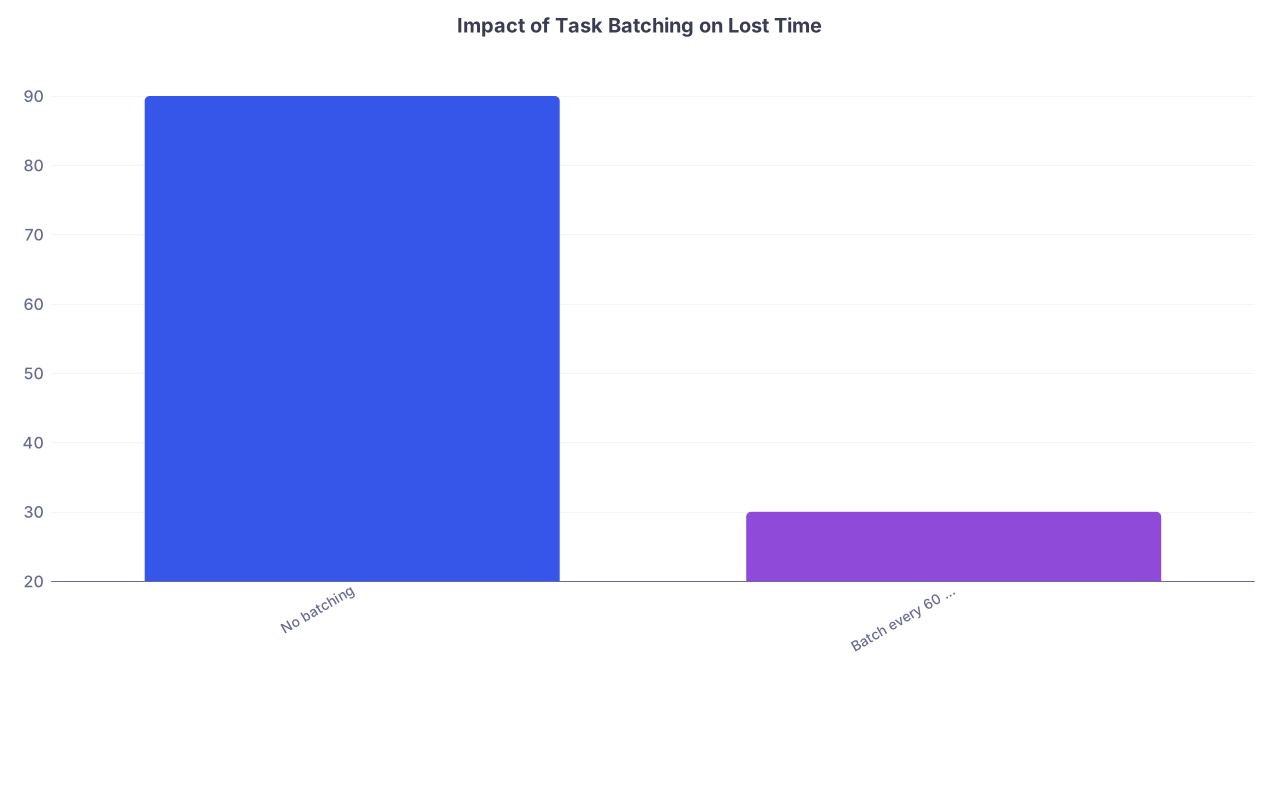
| Category | Value |
|---|---|
| No batching | 90 |
| Batch every 60 min | 30 |
(Those values roughly match what residents often report: up to an hour of “lost” time per shift just from constant interruption.)
4. Put hard limits on extra curriculars early
This is where ambitious new interns get destroyed: research, QI projects, committees, teaching, leadership roles.
July and August are not for joining five projects. They are for learning to be a safe intern.
Reasonable rule:
Nothing that adds extra regular meetings or deliverables before October. If someone approaches you:
“I appreciate the opportunity. Right now I am focusing on being solid clinically. Can we revisit this in October once I have a better sense of my workload?”
You will not lose your career by deferring a QI project for three months. You might lose your sanity if you do not.
5. Guard protected time like a hawk
If your program gives:
- Protected didactics
- Wellness half days
- Scheduled teaching time
Do not be the intern who “volunteers” to skip it constantly so you can “help the team.” You are teaching your seniors that your protected time is negotiable. It is not.
If clinical issues genuinely threaten that time, your senior or attending should be the one to decide and communicate that. Not you quietly sacrificing your own development.
Managing Guilt: The Hidden Driver of Overcommitment

You will feel guilty when you say no. That is fine. Feel it. Do not let it run the show.
Here is what you will tell yourself when the guilt flares:
- “I am not here to prove I can suffer. I am here to prove I can be safe.”
- “My duty is to my current patients, not to every possible task anyone thinks of.”
- “Saying yes to one thing is saying no to something else—often basic safety or rest.”
You are not lazy for protecting your limits. You are dangerous if you ignore them.
And remember this: the people who quietly resent you for not always saying “yes” are usually the same ones who will disappear when you are drowning. Catering to them is not worth it.
How This Actually Makes You Look Better, Not Worse
Here is what attendings and seniors actually respect:
- The intern who knows their capacity and speaks up early.
- The intern who finishes what they commit to, accurately, reliably.
- The intern who asks for help before things explode, not after.
- The intern whose documentation is clean, orders make sense, and who can explain their plan without fumbling.
That person is not the “yes to everything” intern. It is the intern who says:
“I can do X and Y today. If we want Z done too, I will need help or something else has to come off my plate.”
You will look organized. Mature. Safe. That is who people want next to them at 3 a.m.
Quick Recap: The Minimum You Must Remember
- Overcommitting does not show you are strong. It shows you are unsafe.
- Saying “yes” to everything guarantees worse patient care and worse learning.
- Your job as an intern is not to absorb endless work—it is to do a reasonable amount of work correctly and safely, every time.
Protect your capacity now, before the year trains you into habits you will spend the rest of residency trying to undo.