

The way most interns end their day is wrong. They stagger out when the last task is done, brain fried, trusting that somehow tomorrow will sort itself out. That is exactly how you wake up already behind.
You need a shutdown routine. Not a vibe. A protocol.
What follows is a 15‑minute, step‑by‑step end‑of‑day workflow you can run on medicine, surgery, ICU, even outpatient. I used it as an intern, taught it to my juniors, and watched the ones who stuck to it have fewer “oh crap” moments the next morning.
You are not going to control residency. But you can control the last 15 minutes of your day. And that is where tomorrow’s chaos either shrinks or multiplies.
The Non‑Negotiable Rule: Always Buy Tomorrow 15 Minutes
Before we get into steps, commit to this rule:
You do not leave (or sign out mentally on night float) until you run your 15‑minute workflow. Every day.
You would not walk out in the middle of a code. Treat your future self with the same level of respect. These 15 minutes:
- Prevent dropped tasks.
- Shorten your pre‑round chaos.
- Improve your sign‑out safety.
- Make you look like you have your act together. Because you will.
You will be tempted to skip it on “easy” days. Do not. The habit is more important than the content. The days that feel easy are often the ones hiding landmines for tomorrow.
The 15-Minute End-of-Day Workflow: Overview
Here is the structure. We will break each part down with scripts and examples.
| Phase | Duration | Focus |
|---|---|---|
| 1. Clear the Deck | 3–4 min | Loose ends and pages |
| 2. Triage Tomorrow | 4–5 min | Sort tasks into tiers |
| 3. Build Your First Hour | 4–5 min | Concrete morning plan |
| 4. Tighten Sign-Out | 2–3 min | Hand-off and shutdown |
You can run this on paper, in a notes app, or in whatever monstrosity of an EHR your hospital uses. I will assume you have:
- A patient list (printed or electronic).
- Somewhere to write tomorrow’s task list (not your brain).
- A sign‑out template or note.
Phase 1: Clear the Deck (3–4 minutes)
Goal: End the day with no “mystery tasks” floating in your head or hiding in the chart.
This is where interns usually fail. They do not close loops. They just leave.
Step 1: Quick Task Scan per Patient (2–3 minutes)
Pull up your list. For each patient, ask yourself three questions:
- What did I do today that is still pending a result or action?
- What did the attending/fellow say they wanted “later” that I never circled back to?
- What did I promise the patient or family I would follow up on?
Go fast. 10–20 seconds per patient.
Typical things you will catch:
- Labs ordered late that you forgot to check.
- A CT “for tomorrow morning” that never actually got ordered.
- A consultant note you did not recheck after they rounded late.
- A “We’ll update you this evening” conversation you never had.
For each item:
- If it must be done now → do it or hand it off explicitly in sign‑out.
- If it can safely wait until tomorrow → add it to tomorrow’s task list under that patient’s name.
Do not write “labs.” Write “Check AM BMP – trend creatinine after contrast” or “Follow up ESR/CRP for possible temporal arteritis.”
If you are using paper, a simple format works:
- Mr. Jones – check PM K, replete if <4
- Ms. Lee – call daughter with culture results
- Mr. Patel – confirm CT abd/pelvis actually scheduled
Step 2: Quick Page and Inbox Sweep (1 minute)
Last 24 hours of residency for many interns? Death by ignored messages.
Before you mentally sign off:
- Check:
- Pages you ignored when you were in a room.
- EHR in‑basket / “results” / “clinical messages.”
- Any random texts or secure messages from nurses or consultants.
Your rule:
- Anything urgent → address now or hand to night cross‑cover clearly.
- Anything non‑urgent but clinically relevant → move to tomorrow’s list.
- Anything admin (scheduling, education emails) → star/flag for a non‑clinical block, not on your patient list.
The point of Phase 1 is simple: there should be nothing left that only exists in your working memory. It is either:
- Done.
- Handed off.
- On a list.
If it is nowhere, it will bite you.
Phase 2: Triage Tomorrow (4–5 minutes)
Now you have a rough pile of “tomorrow things.” Right now they are chaos. You are going to turn them into a structured plan.
Think of this phase like sorting emergency room patients. Everything cannot be stat.
Step 3: Classify Tasks Into Three Tiers
Take your list and mark each item:
- A – Must happen before attending rounds
- B – Must happen before noon
- C – Anytime before sign‑out
If you force yourself to label each item, you will quickly see what is fantasy. You cannot have 15 “A” tasks and still pre‑round on four new admissions. That is the point.
Examples:
Tier A (Pre‑round Critical)
- Check overnight vitals and I/Os on unstable CHF patient.
- Review AM labs on DKA and adjust insulin drip.
- Pre‑round-focused exam on post‑op day 1 patient expected to crash.
- Review new imaging that will completely change today’s plan.
Tier B (Morning / Pre‑Noon)
- Call daughter with biopsy results.
- Place discharge orders for the “definitely going home” patient.
- Reassess antibiotic plan after ID note comes in.
Tier C (Afternoon / Low‑Acuity)
- Write disability paperwork.
- Fill out that education module HR keeps emailing about.
- Update problem list formatting.
Be honest. If your attending expects a discharge summary before 10 am, that is not Tier C just because you do not feel like writing it.
Step 4: Attach Time and Place
Now, take each Tier A/B task and quickly decide:
- Where will I do this? (workroom, bedside, computer in ICU)
- How long will it realistically take? (5 minutes? 20?)
Write it next to the task:
- [A] Pre‑round exam on ICU pt in 4 – 10 min at bedside
- [A] Review AM labs for all – 10 min at computer
- [B] Call daughter about path – 5–10 min from workroom
- [B] Discharge orders Ms. K – 15 min at computer
Reality check: if your pre‑round block is 60 minutes and your “A” list already hits 70 minutes of work, something has to move or be simplified (see next phase).
The whole point is to see conflicts now, not at 7:10 am when your attending is already in the hallway.
Phase 3: Build Your First Hour (4–5 minutes)
This is where tomorrow’s chaos actually shrinks. You will script your first hour so that when you walk in, you just execute. Not think.
Step 5: Draft a Micro-Schedule for 7–8 AM (or Your First Hour)
Take your Tier A tasks and lay them into a literal 60‑minute block.
For example, on a medicine ward month:
- 06:45–07:00 – Arrive, log in, print list, scan vitals/overnight events on all.
- 07:00–07:10 – Review AM labs, flag critical ones, note who needs repletion.
- 07:10–07:25 – Pre‑round quickly on sickest 2–3 patients.
- 07:25–07:35 – Pre‑round on anticipated discharge patient (confirm stable).
- 07:35–07:45 – Enter stat med changes (K repletion, IVF changes).
- 07:45–08:00 – Review imaging if already resulted, update one‑liner for each patient.
Is this always perfect? No. Things blow up. Patient codes. ED calls with a new train wreck. Fine. But you start from structure instead of chaos.
On surgery, it may look more like:
- 05:30–05:40 – Vitals/labs review for all post‑ops.
- 05:40–06:10 – Hit rooms in order of sickest or farthest from OR.
- 06:10–06:20 – Enter stat orders, pain control updates, drains/I&O issues.
- 06:20–06:30 – Rapid chart update, print new lists for the team.
You are designing an assembly line. Not winging it.
Step 6: Pre-Write Shortcuts and Templates
If you want to feel like you fast‑forwarded a year in efficiency, do this:
Before you leave, pre‑write anything you safely can:
- Discharge summaries for the “guaranteed” discharges. Leave placeholders to tweak vitals and physical exam.
- Note templates:
- A skeleton for your progress notes with smart phrases and key fields.
- A standard structure for common scenarios (CHF exacerbation, COPD flare, post‑op day 1, etc.).
- Common orders:
- DKA drip adjustments template.
- Bowel regimens.
- Standard post‑op pain regimen.
I used to leave “progress note shells” in the chart with yesterday’s template copied forward but clearly marked and updated in the morning. That way I was never starting from a blank page.
You do this work when your brain is tired but the stakes are low. It buys back prime brain time tomorrow morning.
Phase 4: Tighten Sign-Out (2–3 minutes)
Sloppy sign‑out is the root cause of half the overnight disasters that come back to haunt you. The last part of your workflow is to make your sign‑out sharp and anticipatory, not a rambling story.
Step 7: Update the “If-Then” Section for Each Patient
Your sign‑out should not just be “Nice old lady, admitted for pneumonia, on ceftriaxone.” That is background. The useful part is:
- What could go wrong?
- What should the night person do if it does?
For each patient, add 1–3 lines max:
- “If SBP < 90 on two readings → 500 mL LR bolus, recheck in 30 min, call cross‑cover if still low.”
- “If K < 3.5 on AM labs → already placed order set ‘hypokalemia mild’ to use as guide.”
- “If chest pain → EKG + trop, but she has baseline atypical angina and is DNR/DNI – do not call rapid unless hypotensive.”
Write as if you are trying to prevent a 3 am panic call. Because you are.
On high‑risk patients, be explicit about goals of care:
- “DNR/DNI, OK for pressors and ICU transfer.”
- “Family meeting planned tomorrow at 3 pm – please do not initiate new invasive procedures overnight unless emergent.”
Most programs use some kind of standard sign‑out framework (I‑PASS or a variation). Your 15‑minute workflow is when you actually fill the critical parts in, on purpose, not just dictate a rushed monologue on the way to the elevator.
Step 8: Close Your Own Loop: Mental Shutdown
Last piece. You treat yourself like one of your patients. Clear plan, clear boundaries.
Do three things:
Write down your top 2 priorities for tomorrow.
Not ten. Two.- “Stabilize Mrs. C’s CHF – diuresis and plan for echo.”
- “Get Mr. F discharged; fix the SNF fiasco.”
Decide when you will check into work mentally.
Example:- “I am off at 7 pm. I will not open Epic again until 6:30 am tomorrow.” Sounds soft. It is not. Without this, residency eats every remaining brain cell.
Physically log out and clear your space.
Throw away old lists.
Close your charts.
Leave your workstation in a state that does not scream “intern meltdown.”
You want tomorrow‑you to walk in and see order, not yesterday’s chaos fossilized on the desk.
How This Looks In Real Life (Intern Scenarios)
Let me walk through a couple of actual patterns I have seen.
Scenario 1: Medicine Intern with 12 Patients and 2 Expected Discharges
4:45 pm. You are on call tomorrow. You are tired.
Phase 1 – Clear the Deck
- Scan list.
- Remember the attending wanted an ESR/CRP “if fever persists.” Fever persisted; labs never ordered → order them now, mention in sign‑out.
- ID consult note came in at 3:53 pm and you never read it → scan, see antibiotic change recommended; you enter order now and add “check AM creatinine” to tomorrow list.
- You promised to call Mr. L’s son about the CT chest. CT is back; call now or hand off explicitly if it is late.
Phase 2 – Triage
Your “tomorrow” list:
- Review AM labs, especially creatinine on vanco patient.
- Pre‑round focused exam on two sick CHF patients.
- Confirm both discharges – check SNF bed and home oxygen delivery.
- Follow up ESR/CRP.
- Call path for final biopsy read.
- Write discharge summaries x2.
You label:
- A: AM labs and exam on sick CHF patients. Confirm discharge stability.
- B: Call SNF, finalize discharge meds, write discharge summaries.
- C: ESR/CRP review, biopsy call (unless time‑sensitive), maybe afternoon.
Phase 3 – First Hour
You plan:
- 06:45–06:55 – Print list, overnight vitals review.
- 06:55–07:05 – AM labs review, flag K/Cr.
- 07:05–07:20 – Pre‑round on CHF patient A and B.
- 07:20–07:30 – Pre‑round on both planned discharges.
- 07:30–07:45 – Enter immediate orders (diuretics, med changes).
- 07:45–08:00 – Update your one‑liners, create shells for progress notes.
Before leaving you:
- Start both discharge summaries, leaving “day of discharge exam” to fill in.
- Load your CHF and pneumonia note templates.
Phase 4 – Sign-Out
You write on the cross‑cover list:
- CHF pt A: “If increasing O2 need or RR > 24 → get stat CXR and page me if before 7 pm / night float afterwards. DNR/DNI but OK for BiPAP.”
- Discharge pt: “Going to SNF in am if stable; if any overnight event requiring O2 > 4 L or falls, probably delay discharge.”
You leave. No open loops in your brain.
Scenario 2: Surgery Intern Post-Call with a New ICU Admit
You are exhausted, but your surgical ICU patient is tenuous.
Phase 1 – Clear Deck
- Quick scan: confirm ICU admit orders are all in.
- Check pacu nurse messages, clear any text/page backlog.
- Add to tomorrow list: “Check morning ABG, review vent settings with fellow.”
Phase 2 – Triage
“A” tasks for tomorrow:
- Pre‑round on ICU admit first.
- Labs/vitals for all post‑ops.
- Check drains on the two highest‑risk abdominal cases.
“B” tasks:
- Remove Foley on POD#1 per protocol.
- Start DVT ppx on two low‑risk patients.
- Call family of ICU patient with overnight update.
Phase 3 – First Hour
- 05:15–05:25 – ICU vitals/labs/vent review.
- 05:25–05:35 – ICU bedside exam.
- 05:35–06:00 – Hit post‑op rooms in rank order of risk.
- 06:00–06:15 – Orders (Foleys out, ppx, pain).
- 06:15–06:30 – Quick chart note updates.
Phase 4 – Sign-Out
For ICU patient:
- “If MAP < 60 despite current pressor dose, titrate per protocol up to X; if > X, call fellow.”
- “If acute drop in urine output < 0.3 mL/kg/h → check bladder scan, discuss with fellow.”
You are not hoping the night resident “figures it out.” You are giving them a mini‑playbook.
Tools and Shortcuts That Make This Workflow Faster
You do not need fancy apps. But a few tools help.

1. A One-Page Daily Dashboard
Create a simple single‑page layout you use every day. Paper or digital.
Sections:
- Top: Date, rotation, your pager.
- Left column: Patient names with 2–3 bullet lines each for tasks.
- Right column: “Tomorrow A / B / C” boxes.
- Bottom: “Top 2 Priorities for Tomorrow.”
You can literally photocopy this template and use it daily.
2. Smart Text and Shortcuts in the EHR
Invest one evening setting up:
- A sign‑out smart phrase with fields:
- “If then” section.
- Code status and goals of care.
- Pending tests.
- Note templates for:
- Medicine progress note.
- Surgical post‑op check.
- ICU daily note.
Then, in your end‑of‑day workflow, you are just populating fields instead of making everything from scratch.
3. An Alarm or Calendar Block
On busy rotations, your brain will not spontaneously remember to start your 15‑minute workflow. It will wander toward the door.
Set:
- A 15‑minute calendar block before expected sign‑out labeled “Shutdown – 15 min.”
- Or a recurring phone alarm at, say, 4:45 pm.
When it goes off, you stop mindlessly scrolling in Epic and run the protocol.
What This 15-Minute Workflow Actually Changes
Let me be blunt: this is not about feeling “organized.” It is about survival and performance.
You will:
Miss fewer things.
Labs. Scan results. Family calls. All the stuff that gets you quietly judged by seniors and attendings.Look calmer than you are.
When you walk in with a clear first‑hour plan, you stop broadcasting “lost intern” energy. Attendings trust you more. They give you more responsibility. That compounds.Handle bad days better.
When the ED dumps three admits on you at 7:30 am, your measured chaos does not turn into full detonation. You can drop lower‑tier tasks consciously because you actually know what they are.Sleep better.
You are not lying in bed thinking, “Did I order that MRI? Did I tell them about the biopsy?” You know exactly what is unfinished and when you plan to do it.
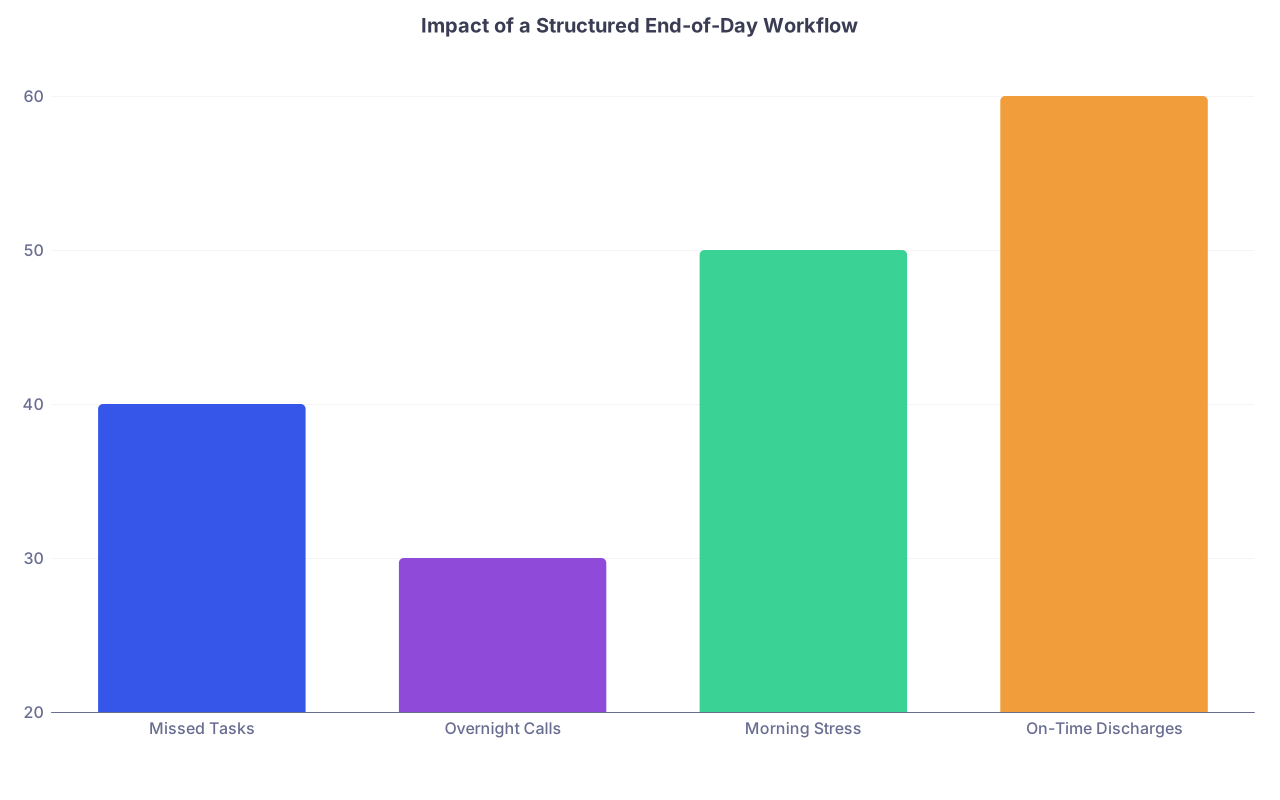
| Category | Value |
|---|---|
| Missed Tasks | 40 |
| Overnight Calls | 30 |
| Morning Stress | 50 |
| On-Time Discharges | 60 |
(Interpret that as this: interns who use a structured shutdown see fewer missed tasks, fewer unnecessary overnight calls, less perceived morning stress, and more on‑time discharges. I have seen versions of this repeatedly across teams.)
How to Start Using This Tomorrow
You do not need to implement this perfectly. Start with a sloppy version and refine.
Day 1–2:
- Do Phase 1 and Phase 4 only.
Clear the deck and tighten sign‑out.
Day 3–5:
- Add Phase 2 – triage into A/B/C.
Start seeing your task load realistically.
Week 2:
- Add Phase 3 – build the first hour.
That is when you feel the real difference.
You will tweak timing. On some rotations the “15 minutes” will be 10. On others, it will creep to 20. That is fine. The structure is the value.
Two Warnings Before You Try This
Your seniors may not do this. Do not copy them.
The PGY‑3 who looks casual at 5 pm? They have internalized half this workflow over years. They are running it in their head. You are not there yet. Use training wheels.You will be tempted to check charts all evening. Do not.
The point of a clear shutdown is to stop half‑working all night. Unless you are on an in‑house call shift, once you are done and handed off, you are off. Respect the boundary.
The Bottom Line
Three things to remember:
- Tomorrow’s chaos is built today. End each day with a deliberate 15‑minute shutdown: clear the deck, triage tasks, script your first hour, and tighten sign‑out.
- Structure beats heroics. You cannot out‑hustle disorganization. A simple, repeatable workflow will make you look and perform like a much more experienced resident.
- Protect your future self. Everything you park in a clear system tonight is one less thing your half‑awake brain has to juggle at 6:45 am.
Run this protocol for two weeks straight. If your mornings are not noticeably less chaotic, you can throw it away. But I have not seen that happen yet.


