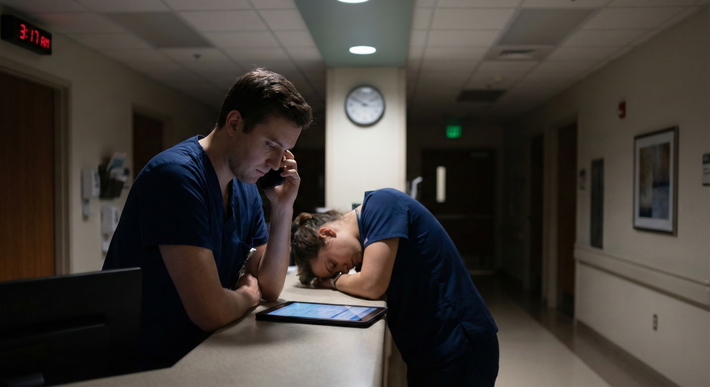
Most interns waste half their cross-cover night redoing work they already did. That is a systems problem, not a stamina problem.
You do not fix cross-cover misery with more caffeine or more “efficiency.” You fix it with structured notes that make your 7 pm brain and your 3 am brain work together instead of against each other.
Let me show you how.
Why Your Cross-Cover Nights Feel Chaotic
You are not actually dealing with “too many pages.”
You are dealing with:
- The same problems resurfacing because the last plan was vague.
- You not remembering what you were thinking 3 hours ago.
- Nurses calling again because the note was useless.
- Day teams wasting time tomorrow morning trying to decode your overnight logic.
The common pattern I see in interns:
- 7:15 pm: You get sign-out on 25–40 patients. You jot scattered notes on a scrap of paper.
- 8:30 pm: First page about “patient short of breath.” You have no idea if this is new, expected, or already addressed.
- 11:45 pm: Labs result that you ordered earlier. You cannot recall why you ordered them or what you were going to do with them.
- 4:00 am: “FYI Na 128 → 126” with no prior plan documented. Now you are re-thinking the whole hyponatremia workup from scratch, half-asleep.
The fix is boring and brutally effective: standardized, structured cross-cover notes that you use the same way every night.
Not some fancy template that lives in your head. A concrete, repeatable system that:
- Shrinks cognitive load.
- Makes your plans executable.
- Lets anyone reading at 3 am or 7 am see exactly what happened and what was supposed to happen.
The Core Tool: A Cross-Cover Note Template That Actually Works
Forget paragraph-style rambling. Your cross-cover notes should be short, structured, and aimed at one thing: preventing rework.
Use some version of this skeleton for every patient you are actively managing overnight.
Core Cross-Cover Note Structure (one-liner + problem-based plan)
1. One-liner (context)
Format: Age / sex / key diagnoses / admission reason / hospital day / code status
Example:68F with CHF, CKD3, and COPD, admitted for decompensated heart failure, HD3, DNR/DNI.
2. Active Overnight Problems (problem-by-problem)
For each problem, use a consistent micro-template:
- Problem:
- Baseline / context:
- What happened tonight:
- Exam / data:
- Assessment:
- Plan:
- Contingency (“if–then”):
Example for dyspnea:
- Problem: Dyspnea / suspected volume overload
- Baseline / context: On 2 L O2 at baseline, admission for HF exacerbation, on IV furosemide 40 mg BID, last echo EF 25%.
- What happened tonight: 9:45 pm – RN paged for increased SOB, O2 2→4 L to keep sat >92%.
- Exam / data: Mildly increased work of breathing, bibasilar crackles, trace LE edema, BP 110/65, HR 96, no chest pain. CXR: pulm vascular congestion.
- Assessment: Likely ongoing volume overload; VS stable; low suspicion for PE or ACS at this time.
- Plan: Give additional IV furosemide 40 mg x1 now, repeat BMP at 2 am, strict I/O; goal net –1 to –1.5 L by morning.
- Contingency: If SBP < 90, call admitting team senior; if O2 requirement >6 L or new chest pain / tachycardia >120, call RRT and ICU fellow.
Notice what this gives you:
- Enough context so you are not reinventing the wheel with every page.
- Clear actions.
- Clear thresholds for escalation.
You are writing not just “what you did” but “what Future You and day team should do next.” That is the whole game.
Step-by-Step: How to Structure Your Whole Night Around These Notes
Here is the actual workflow I teach interns who are drowning on cross-cover.
Step 1: Fix Your Sign-out Capture (7–8 pm)
Most interns lose the night right here.
You must convert chaotic verbal sign-out into structured, readable information.
Use a simple skeleton for every sign-out patient:
- One-liner (as above)
- Three key items:
- Big overnight risks
- Active tasks
- Code status / goals of care
Example from sign-out:
- Risk: “He desats when he rolls; trend O2 needs”
- Tasks: “Recheck BMP at 10 pm, call if K >5.5 or Cr jumps”
- Code: “Full code, but family is conflicted”
Convert that into a quick written or electronic stub that you can later expand into a full note if you get called.
You do not need a full note yet. You need a consistent snapshot.
Step 2: Only Build Full Notes for Patients Who Actually Generate Work
Key time-saver: you do not pre-write detailed plans for every patient on your list. You upgrade from a stub to a full cross-cover note only when:
- You get paged about that patient, or
- The sign-out already warns you there is a >50% chance of overnight issues (e.g., new GI bleed, borderline oxygen).
So your system looks like this:
- All cross-cover patients: have a sign-out stub in your brain or list.
- Subset with actual activity: get a structured cross-cover note.
This alone cuts your time dramatically.
Step 3: Convert Every Touch Into a Structured Problem Note (Real-Time)
Every time you respond to a page:
- Open the chart.
- Skim last progress note and sign-out.
- Add or update the relevant problem in your cross-cover note.
Do not just free-type “RN called, gave Tylenol.” That is useless. Instead:
Example: Fever
- Problem: Fever in neutropenic patient
- Baseline / context: 54M with AML, ANC 200 on chemo, on prophylactic levofloxacin. No prior fevers this admission.
- What happened tonight: 11:10 pm – T 38.6, HR 112, BP 98/60, O2 94% RA, asymptomatic.
- Exam / data: No focal symptoms, lungs clear, abdomen soft, port site clean.
- Assessment: Neutropenic fever. Hemodynamically borderline but stable.
- Plan:
- Drew blood cultures x2 sets (port + peripheral), UA, CXR.
- Started cefepime 2 g IV q8h now.
- Added lactate and CMP.
- Contingency: If SBP <90, repeated lactate >2, or increased O2 requirement, call heme-onc fellow and consider transfer to higher level of care.
Now if you get paged again or hand off at 6:30 am, you are not re-triaging from scratch.
Step 4: Use “If–Then” Logic Aggressively
The most underused tool in intern notes: explicit contingencies.
Your future self and the nurses are forced to improvise when you skip this. So problems bounce back to you repeatedly.
For any unstable or evolving issue, write:
- A primary plan (do this now).
- A contingency plan (if X happens, do Y or call Z).
Examples:
- Hypertension: “If SBP > 180 after labetalol 10 mg IV x1, may repeat x1 after 30 minutes; if still >180 or neurologic changes, call neuro / stroke team.”
- Pain: “If pain >7/10 after oxycodone 5 mg, may give additional 5 mg in 2 hours; page cross-cover if requiring >3 PRN doses overnight.”
- Hypoglycemia: “If BG <70, administer 25 g D50 and recheck in 15 minutes; if recurrent hypoglycemia or BG <50, hold all insulin and page cross-cover.”
This is what stops rework at 1 am, 3 am, 5 am for the same issue.
Step 5: Time-Stamp and Bundle Follow-up Tasks
Huge source of rework: you order labs / imaging and do not bundle the follow-up logic into your note.
Your rule:
Every lab or imaging order overnight must live in a note box that says:
- Why you ordered it,
- When it is coming back,
- What will happen depending on the result.
Example:
- Problem: AKI on CKD
- Baseline / context: Cr 1.6 baseline, up to 2.3 this afternoon after IV contrast.
- What happened tonight: 9 pm BMP: Cr 2.6 (up from 2.3), BUN 40, K 5.0, good urine output, BP 118/72.
- Assessment: Likely contrast-induced nephropathy, currently non-oliguric, hemodynamically stable.
- Plan:
- Hold lisinopril and furosemide overnight.
- Gentle IV fluids: LR 75 mL/hr x8 hours.
- Repeat BMP at 4 am.
- Contingency:
- If K ≥5.5 or Cr >3.0, call renal fellow and primary senior.
- If decreasing UOP (<0.5 mL/kg/hr), notify cross-cover.
If you get the 4 am BMP result, you know exactly what you were planning. No reinvention. No wandering through UpToDate at dawn.
Step 6: Protect Handoff with a Morning Wrap-Up Block
Last 20–30 minutes of your shift:
- You are not still placing orders.
- You are cleaning and clarifying your record.
Your goals:
- Every patient you touched has a structured cross-cover note.
- Every “follow-up needed” is visible and tagged for the day team.
Create a simple “handoff block” in your note for each active patient:
Overnight summary (1–2 lines)
“Two episodes of dyspnea, likely volume overload; given extra 40 mg IV Lasix, net –1.2 L, now sat 95% on 3 L NC.”Outstanding items for day team
- “Please review 4 am BMP (pending at sign-out).”
- “Consider adjusting diuretic regimen if still overloaded.”
- “Patient expressed interest in revisiting code status with team.”
This saves the day team from hunting through results and trying to guess what you did and why. And it saves you from annoyed texts at 8:30 am when you are off the clock.
Example: A Full, Efficient Cross-Cover Note
Here is what a complete but lean cross-cover note could look like when you combine everything.
Patient:72M with COPD, HTN, and CAD, admitted for COPD exacerbation, HD2, Full Code.
Overnight Cross-Cover Note (Intern – 01:45)
Problem 1: Dyspnea / COPD exacerbation
- Baseline / context: At baseline on 2 L NC at home. On this admission: methylpred 40 mg IV q12h, duonebs q4, antibiotics started yesterday (ceftriaxone + azithro).
- What happened tonight: 12:30 am RN paged for increased SOB, sat 88% on 3 L → 92% on 4 L.
- Exam / data: Speaking in short phrases, moderate work of breathing with accessory muscles, diffuse wheezes, no crackles, no LE edema. BP 135/78, HR 104, RR 24. CXR unchanged from yesterday (hyperinflated, no infiltrate). ABG on 3 L earlier today: 7.36/55/70.
- Assessment: Worsening COPD exacerbation without clear new trigger; no evidence of volume overload or new infection; hemodynamically stable.
- Plan:
- Increased duonebs to q2h PRN overnight.
- One-time IV methylpred 60 mg now (discuss adjustment of steroid regimen with day team).
- Maintain O2 for sat 88–92%.
- Contingency:
- If sat <88% despite 5–6 L or new confusion / lethargy, call RRT, get repeat ABG, discuss with ICU.
Problem 2: Hypertension
- Baseline / context: Home meds: amlodipine 10, lisinopril 20. Blood pressures on floor mostly 140–150s.
- What happened tonight: BP up to 190/95 at 1:10 am; asymptomatic, no chest pain, no neuro deficits.
- Exam / data: Repeat manual BP 182/92. HR 90, no acute neuro changes.
- Assessment: Asymptomatic hypertension likely pain / anxiety related. No signs of hypertensive emergency.
- Plan:
- Gave labetalol 10 mg IV x1.
- Recheck BP in 30–45 minutes.
- Contingency:
- If SBP remains >180 despite 2 doses or any neuro changes / chest pain, page cross-cover senior and consider rapid response.
Overnight summary for day team:
Dyspnea worsened but appears consistent with COPD exacerbation; increased nebs, gave extra steroid dose, remains on 4 L with sat 90–92%. Brief hypertension episode managed with labetalol. Please reassess steroid regimen and keep an eye on O2 needs.
That is tight, actionable, and does not require a detective to interpret.
System-Level Tricks to Prevent All-Night Rework
1. Standardize Your Problem Headers
Make your life easier by using predictable labels. For example:
- “Dyspnea / HF”
- “Dyspnea / COPD”
- “Fever / neutropenia”
- “AKI on CKD”
- “Delirium / agitation”
- “Pain control”
- “Electrolytes – hyponatremia”
- “Glycemic control”
When you skim your own note or your list, you immediately know what is going on.
2. Use Quick Abbreviations That Still Make Sense at 4 am
Some shorthand I see that actually helps:
- “BL:” → baseline
- “TNT:” → tonight
- “A/P:” → assessment/plan
- “If→Then:” → contingency
Example short version when you are slammed:
- Dyspnea / HF
- BL: HFpEF, on home lasix 40 PO, here on IV 40 BID.
- TNT: ↑SOB, sat 90% on 4 L, crackles, mild edema.
- A/P: Likely still wet, BP stable. Extra IV lasix 40 x1, f/u I/O + BMP 4 am.
- If→Then: SBP <90 or O2 >6 L → RRT/ICU.
As long as it is understandable by another human, it is fine. Lazy is “SOB, gave Lasix.” That is how you guarantee rework.
3. Build Micro-Templates for Common Overnight Issues
You will see the same 10 problems over and over. Make mini-templates (even if just in a text snippet tool or in a note on your phone you retype from memory):
- Fever
- Chest pain
- Dyspnea
- Hypotension
- Hypertension
- Hypoglycemia / hyperglycemia
- Pain
- Delirium / agitation
- Electrolytes (Na, K)
- Urinary retention
For each, have:
- Minimum history / context you will always include
- Minimum exam / data
- Basic rule-out thinking
- Default contingency triggers for escalation
You can still individualize. But you stop starting from a blank page.
4. Use a Simple Tracking List for “Awaiting Results”
One of the nastiest ways rework happens: you forget to check labs / imaging you ordered at midnight.
Solution: a tiny, structured “Results to Check” list with columns:
| Time Ordered | Patient / Problem | Test | Check By | If Abnormal Then |
|---|---|---|---|---|
| 22:00 | Mr X – AKI | BMP | 04:00 | Call renal if K ≥5.5 |
| 23:30 | Ms Y – Fever | Lactate | 02:00 | Call ICU if >2.0 |
| 01:00 | Mr Z – CP | Troponin | 04:00 | Page cards if positive |
You integrate this with your cross-cover note, so there is always a link from the test back to the problem and contingency.
5. Know When to Stop Documenting and Just Call for Help
Documentation does not replace judgment.
If:
- You are worried about airway, breathing, circulation, mental status, or sepsis.
- You are thinking about calling an RRT / code / upgrading level of care.
You act first. You document after.
Your cross-cover note in these cases:
- Can be brief.
- Must capture the essentials and the plan and who you spoke with.
Example:
- Problem: Hypotension / possible sepsis
- TNT: 2 am – SBP 78/40, HR 120, febrile T 38.9.
- Action: Called RRT, gave 1 L LR bolus, started norepinephrine per ICU, transferred to MICU.
- Discussion: Case discussed with ICU fellow Dr. Smith and primary team senior Dr. Lee by phone.
Done. No novel needed.
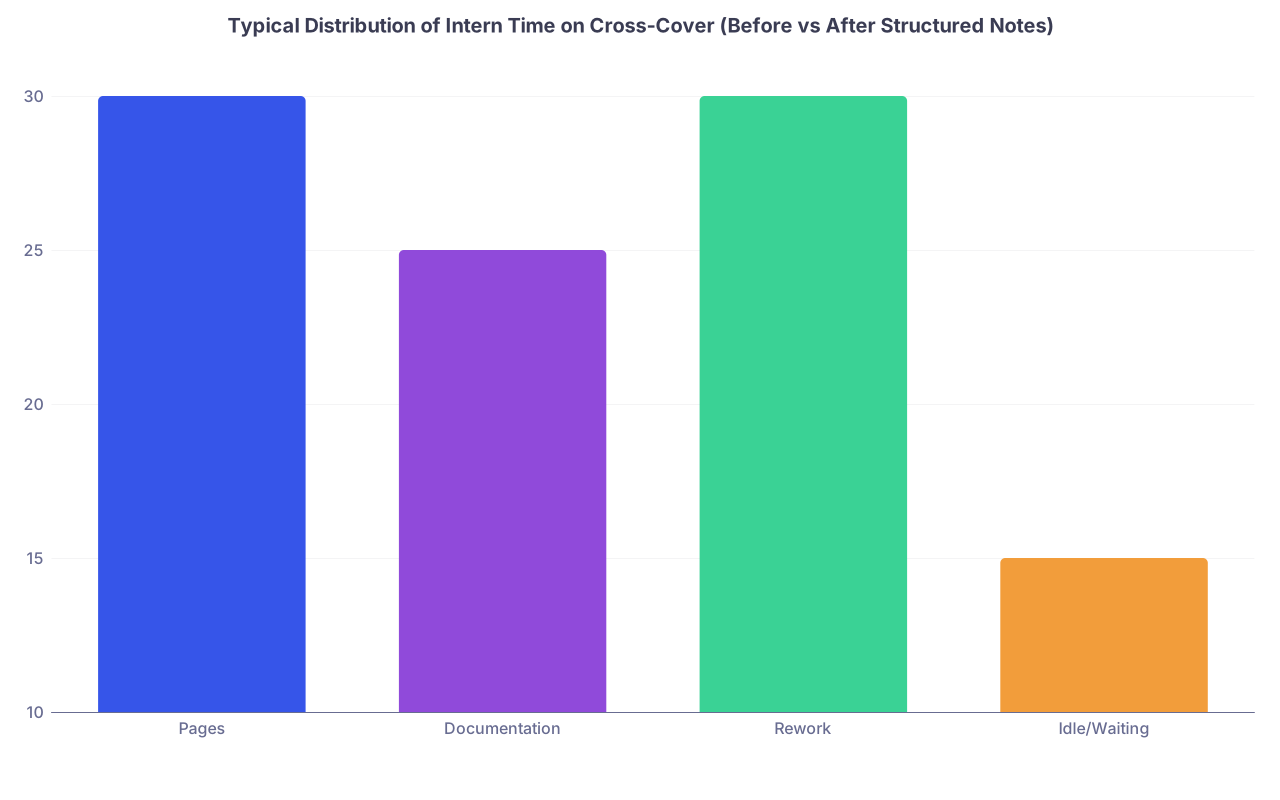
| Category | Value |
|---|---|
| Pages | 30 |
| Documentation | 25 |
| Rework | 30 |
| Idle/Waiting | 15 |
(Above: Example “before” pattern — a big chunk is wasted on rework that structured notes directly cut down.)
How This Makes Your Life Better (Very Directly)
This is not just an “EMR optimization” exercise. It changes your night in practical ways:
- Fewer repeat pages on the same issue because the nurse has clear thresholds and orders.
- Much faster mental reboot when you get re-paged, because context is already there.
- Cleaner morning sign-out that makes your seniors and attendings trust you.
- Less guilt and anxiety rereading your notes later, because your logic is visible and defensible.
- Better learning – you see your own reasoning laid out, and seniors can actually give targeted feedback.
This is how you transition from “I survived the night” to “I actually controlled the night.”

| Step | Description |
|---|---|
| Step 1 | Receive Sign-out |
| Step 2 | Create Stub for Each Patient |
| Step 3 | Get First Page |
| Step 4 | Open Chart + Stub |
| Step 5 | Assess Patient |
| Step 6 | Update Structured Problem Note |
| Step 7 | Write Orders + If Then Plan |
| Step 8 | Document Briefly |
| Step 9 | Add to Results To Check List |
| Step 10 | Next Page |
| Step 11 | Pre-Dawn Wrap-up |
| Step 12 | Clean Handoff to Day Team |
| Step 13 | Need Orders or Contingency? |
FAQs
1. This sounds like more documentation. Won’t it slow me down?
It feels slower the first 2–3 nights while you build the habit. After that, it speeds you up because you stop starting from scratch with each page. You trade 30–60 seconds of structured note-writing for 10–15 minutes of re-assessing the same issue multiple times through the night, plus confused morning sign-out. Every senior I know who does this consistently finishes their note work earlier than the ones who “wing it.”
2. What if my EMR makes it hard to build these templates?
You do not need formal EMR templates. You can use:
- Dot phrases / smart phrases with your problem skeleton.
- A scratchpad or “personal” note where you keep your mini-templates and copy-paste.
- Even a folded sheet of paper in your pocket with the structure you want to follow.
The structure matters more than the tool. Once you know the pattern—Problem / Baseline / What Happened / Exam-Data / Assessment / Plan / Contingency—you can reproduce it anywhere.
3. How detailed should I be for minor issues like sleep meds or Tylenol?
Use proportional effort. For straightforward low-risk issues, a compact version is fine:
“Problem: Insomnia in stable pt. TNT: RN call 1 am, pt unable to sleep, no CP/SOB. A/P: Melatonin 5 mg now, can repeat x1. If still unable to sleep, defer further meds to day team given age/fall risk.”
Goal is clarity and a traceable plan, not maximal detail. Save your full structure for things that can spiral: respiratory status, blood pressure, fevers, delirium, chest pain, AKI, electrolytes.
4. How do I get my co-interns and seniors to buy into using structured cross-cover notes?
You do not need them to formally “buy in.” Just start doing it yourself. People notice when:
- Your handoffs are cleaner.
- Your patients have fewer overnight misadventures.
- You are less frazzled on post-call rounds.
If you want to spread it, share your most effective dot phrases and one or two example notes on your team chat or at sign-out, and frame it as: “This made my cross-cover nights much less miserable.” Residents adopt systems that reduce pain. Structured notes do exactly that.
Key points to walk away with:
- Structure beats stamina on cross-cover. Use a consistent problem-based template that captures context, actions, and clear contingencies.
- Turn every significant overnight touch into a brief, structured problem note that your 3 am brain and the 7 am team can actually use.
- Protect the last 20–30 minutes of your shift for cleanup and explicit handoff, so your work carries through the night and does not boomerang back as rework.