
Your paging response is either saving you time or slowly killing your sanity. There is no middle ground.
First-year interns waste an absurd amount of time stumbling through the same ten types of pages over and over. Same questions. Same problems. Different room numbers. You do not need more “clinical reasoning frameworks.” You need scripts. Clear, fast, safe response patterns you can run half-asleep at 03:00.
This is that toolkit.
Use this as:
- A mental checklist when the pager goes off.
- A starting point for dot phrases or personal templates.
- Training wheels that you gradually internalize.
You will eventually modify everything I write here to match your institution, your attendings, your EMR. Good. You should. But start with a structured approach instead of reinventing the wheel at 2 a.m.
Core Paging Principles You Use Every Time
Before we hit specific scripts, you need the universal skeleton.
Every page, no matter what, goes through the same 4-step filter in your head:
- Safety
- Signal vs noise
- Structured response
- Close the loop
If you learn that pattern, you stop freezing and start executing.
The 4-Step Universal Pager Script
When the pager goes off, you do this:
Look at the page and classify it.
Silently ask: “Is this EMERGENT, URGENT, or ROUTINE?”- EMERGENT: “Unresponsive”, “not breathing”, “HR 30”, “systolic 60”, “seizure”, “new chest pain / stroke symptoms”.
- URGENT: “BP 190/110”, “new fever 39.5”, “blood sugar 30”, “suicidal statements”.
- ROUTINE: “needs laxative”, “patient wants sleep med”, “family has questions”, “IV infiltrated”.
If emergent → move. You do not call back and think. You walk or run to the room while calling the nurse.
Call back with a structure.
Nurse says problem. You respond with a fixed pattern:- Clarify key vitals and trend.
- Clarify key symptoms.
- Clarify key interventions already tried.
- Decide: “see now at bedside” vs “place order and see later” vs “address on rounds”.
Use a condition-specific micro-script (rest of this article).
Close the loop.
- Say exactly what you will do.
- Say when you will be there (if going).
- Repeat any orders back.
Example phrase that prevents chaos:
“Ok, here is what we will do: I am placing IV labetalol 10 mg now, please recheck BP in 15 minutes and page me if systolic is still above 180. I will come see the patient within 10 minutes. Does that work?”
Sounds basic. But I have watched this exact structure separate calm interns from flailing ones.
Script 1: “The Patient Is More Short of Breath”
This is one of the top 3 pages you will get on medicine, surgery, ICU step-down… everywhere.
Your job: sort “they are going to crash” from “they feel more dyspneic lying flat after dinner.”
Step 1 – On the phone: Quick risk sort
Ask the nurse, systematically:
- “What are the current vitals?”
HR, BP, RR, SpO₂, temp. - “What were they an hour ago? Any trend?”
- “Is the patient on baseline oxygen? Has it increased?”
- “What are you seeing? Work of breathing?”
(Use real words: accessory muscles, speaking in full sentences, tripodting, confusion.) - “Any new chest pain, cough, wheeze, fever, hemoptysis, anxiety?”
Red flags that mean “get there now”:
- SpO₂ < 90% on baseline oxygen.
- RR > 30.
- New confusion or inability to speak full sentences.
- New hypotension or tachycardia.
- Nurse sounds worried. Do not ignore that.
If any of those:
“Put the patient on a non-rebreather / bump O₂ as needed for now. I am coming to the bedside right now.”
Step 2 – At bedside: Run your SOB mini-ABC
You want a fast, reproducible pattern:
Look:
- Color (cyanosis, pallor)
- Position (tripod, sitting bolt upright)
- Any monitor values already there
A – Airway
- Can they talk? Voice normal? Gurgling/stridor?
B – Breathing
- Rate, accessory muscles, wheeze, crackles, absent breath sounds, asymmetry.
- Check SpO₂ and compare to baseline.
C – Circulation
- BP, HR, perfusion, JVD, edema; consider chest pain.
D – Devices
- Is the oxygen actually on and connected? Any kinked tubing?
(You will feel dumb the first time the fix is “turn the O₂ on,” but it happens to everyone.)
- Is the oxygen actually on and connected? Any kinked tubing?
Step 3 – Quick front-line interventions
You are not solving pathophysiology in 3 minutes. You are stabilizing:
Examples:
- Suspected pulmonary edema in CHF patient:
- Sit them upright.
- O₂ to maintain SpO₂ > 92% (or their target).
- Consider IV furosemide (check BP, renal function, attendings’ usual preferences).
- COPD/asthma patient with wheeze:
- Start or repeat nebulized bronchodilators (duonebs).
- Steroids if not already on.
- Possible PE / unexplained SOB:
- O₂.
- Bedside exam for DVT signs, pleuritic pain, tachycardia.
- If unstable → call senior / rapid response immediately.
Step 4 – Escalate early, not late
You do not get points for “I tried everything alone for 90 minutes while the patient slowly crashed.”
Call your senior early if:
- Two or more red flags.
- You are considering a rapid response or ICU transfer.
- You are uncomfortable. Period.
Script 2: “The Blood Pressure Is Really High/Low”
These pages scare interns more than they should and not enough when they should.
A. High Blood Pressure (e.g., 190/100, 210/110)
On the phone, ask:
- “Is the patient having symptoms?”
Headache, chest pain, SOB, neuro changes, vision changes. - “What was their BP trend today?”
- “Are they due for their scheduled anti-hypertensives? Have they received them?”
- “Manual recheck or automatic only?” (Bad automatic BP cuffs lie all the time.)
If:
- Asymptomatic.
- SBP < 180–190 and similar to their usual.
- Missed PO meds.
Then this is rarely an emergency.
Action pattern:
- Confirm missing meds → give scheduled PO medication.
- Consider one-time oral agent if mildly above goal and safe (per your service norms).
- Ask for:
- Manual recheck in 30–60 minutes.
- Callback if still above your threshold (e.g., >180).
If:
- SBP > 200 or DBP > 120 with symptoms (chest pain, neuro changes, SOB, AKI).
- Or rapidly climbing BPs.
You treat it as potentially urgent:
- Go to bedside.
- Full neuro exam, chest exam.
- EKG, labs if needed, check for end-organ damage.
- Consider IV anti-hypertensive (labetalol, hydralazine, etc. based on context and local practice) after talking to senior/attending if you are not sure.
B. Low Blood Pressure (e.g., 80/40, 70/30)
This is more dangerous and needs a sharper script.
On the phone, say:
- “What is the current BP and HR? Manual or automatic?”
- “What was it earlier? Any trend?”
- “How is their mental status?”
- “Any new symptoms – chest pain, SOB, bleeding, dark stools, vomiting, fever?”
- “How much have they urinated recently? Any recent med changes (opiates, antihypertensives, diuretics)?”
If SBP < 90 or MAP < 60 and not known chronic low BP → go to bedside. No debate.
At bedside:
- Confirm vitals manually.
- ABC quick screen.
- Look for:
- Signs of sepsis: fever, source of infection, warm/cool extremities.
- Bleeding: surgical sites, drains, melena, hematemesis.
- Volume depletion: dry mucous membranes, poor intake, diuretics.
- Cardiogenic signs: chest pain, crackles, JVD.
Initial interventions:
- Put patient supine, legs slightly elevated if tolerated.
- Consider fluid bolus if no obvious overload (e.g., 500–1000 mL NS or LR depending on protocol).
- If you suspect bleeding or septic shock → call rapid response / ICU early.
Say clearly to nurse:
“I am ordering a 500 mL LR bolus stat. If SBP remains < 90 after the bolus or mental status worsens, please call me immediately and we will escalate.”
Script 3: “The Patient Has Chest Pain”
This one terrifies people for good reason.
Your job: separate “probably musculoskeletal/anxiety” from “miss this and you ruin someone’s life.”
On the phone:
Ask some version of OPQRST fast:
- Onset: “When did it start?”
- Provocation: “Worse with movement, palpation, breathing?”
- Quality: “Pressure, sharp, burning?”
- Radiation: “To arm, jaw, back?”
- Severity and time course.
Also:
- “Current vitals?”
- “Any SOB, diaphoresis, nausea, lightheadedness, syncope?”
- “Cardiac history?”
If anything smells ischemic (pressure-like, exertional, classic radiation, risk factors, abnormal vitals), you say:
“Please get an EKG now and keep the patient on the monitor. I am coming to the bedside now.”
At bedside:
- Quick ABC.
- Review EKG yourself (and with someone more senior if any doubt).
- Compare to prior EKG if available.
- Get:
- Troponin (per protocol).
- Maybe CXR if differential broader (PE, pneumothorax, pneumonia, aortic dissection suspicion).
Initial measures if you suspect ACS (per your hospital protocol and contraindications):
- O₂ if SpO₂ < 90–92%.
- Sublingual nitroglycerin if SBP OK and no contraindication.
- Aspirin if they have not already received and no contraindication.
Call your senior and probably the attending. This is not an “I will handle it quietly” page.
Script 4: “The Patient Has a Fever” (Or “Is Shaking, Looks Febrile”)
Fever pages are where interns either:
- Overreact to everything.
- Or ignore sepsis until it is a code.
You need a middle path.
On the phone:
- “What is the temp, and how was it measured?”
(Oral vs axillary vs bladder.) - “What are other vitals – HR, BP, RR, SpO₂?”
- “Any new symptoms? Cough, SOB, dysuria, wound changes, abdominal pain, diarrhea, confusion?”
- “Any central lines, Foley, wounds, recent procedures?”
- “How does the patient look to you?” (I take nurses’ gestalt seriously.)
If:
- Temp < 38.5, no other symptoms, vitals otherwise OK, and patient is on therapy that commonly causes low-grade fevers (e.g., post-op day 1, known pneumonia on antibiotics).
You can:
- Order antipyretic (e.g., acetaminophen).
- Ask for repeat vitals in 1–2 hours.
- Plan to see on rounds if stable.
If:
- Temp ≥ 38.5–39.
- Or any concerning vitals (tachycardia, hypotension, tachypnea).
- Or immunocompromised patient.
Then you should:
- See the patient.
- Full exam: lungs, abdomen, surgical sites, lines, Foley, skin.
Baseline workup script (adapt per team/hospital norms):
- CBC with diff.
- BMP.
- Blood cultures (peripheral ± line).
- Urinalysis ± culture.
- CXR if respiratory symptoms or unclear source.
- Lactate if you are at all worried about sepsis.
Empiric antibiotics:
- Depends on institutional guidelines, but you should at least know your go-to regimen for:
- Suspected pneumonia.
- Suspected UTI / pyelo.
- Suspected intra-abdominal source.
- Suspected line infection.
Say clearly: “I am ordering blood cultures, urine studies, and CXR, plus starting ceftriaxone now. Please page me if systolic BP drops below 90, RR rises above 24, or patient becomes more confused.”
Script 5: “The Patient’s Blood Sugar Is Very High/Very Low”
You will get more nonsense glucose pages than you thought humanly possible.
A. Hypoglycemia (the one that can hurt fast)
On the phone, ask:
- “What is the current glucose?”
- “Is the patient symptomatic – confusion, sweating, tremors, seizures, unresponsive?”
- “Can they take PO safely?” (Swallowing status.)
If BG < 70:
- If they are symptomatic or unable to take PO:
- “Give D50 IV now” (or the preferred hospital protocol).
- If no IV: glucagon IM while getting IV access.
- If they are alert and can take PO:
- “Give 15–20 g oral glucose” (juice, glucose tabs), recheck in 15 minutes.
You go to bedside for:
- BG < 50.
- Any altered mental status.
- Recurrent hypoglycemia.
Then you:
- Figure out cause: recent insulin, sulfonylureas, NPO status, poor intake, sepsis, renal failure.
- Adjust insulin orders or hold as needed.
- Consider dextrose-containing fluids in recurrent hypoglycemia.
B. Hyperglycemia
On the phone:
- “What is the BG?”
- “Any symptoms – polyuria, polydipsia, N/V, abdominal pain, confusion?”
- “Any recent insulin doses? Missed doses?”
Patterns:
BG 200–300, asymptomatic, on sliding scale:
→ Usually routine; adjust sliding scale or give correction dose. Can be addressed without rush.BG > 350–400, especially with symptoms or in type 1 diabetic:
You think about DKA/HHS.
At bedside if concerned:
- Check vitals, mental status.
- Check for Kussmaul respirations, dehydration.
- Order:
- BMP (for AG, bicarbonate).
- Serum/urine ketones if suspect DKA.
- Possibly VBG.
If they look sick or meet DKA criteria → this is not a solo intern project. Call senior/ICU.
Script 6: “The Patient Is Agitated / Confused / Pulling Lines”
This one burns time and brain cells. Also gets you hurt if mishandled.
On phone:
- “Is the patient a known dementia or baseline confused?”
- “Any new meds? Pain meds, benzos, anticholinergics, steroids?”
- “Any recent procedures?”
- “Are they actively a danger to self/others? Have they hit anyone?”
If they are:
- Hitting staff.
- Trying to get out of bed unassisted.
- Pulling critical lines/tubes.
You go. Now.
At bedside, use the BEDS mnemonic (my version):
B – Brain:
- Check orientation, attention (months of year backwards).
- Look for focal deficits.
- Consider stroke if sudden change.
E – Environment:
- Is it noisy, dark, no clock, no glasses/hearing aids?
D – Drugs & Disease:
- Review MAR for new meds.
- Check oxygenation, infection signs, constipation/urinary retention.
S – Safety:
- Is a sitter present?
- Bed at lowest level, rails as allowed.
Initial actions (non-pharmacological first):
- Reorient calmly.
- Get family on phone if possible.
- Fix reversible discomforts: pain, urinary retention, constipation, hypoxia.
Pharmacologic:
- Use institutional delirium protocols.
- Avoid benzos unless specific indication (e.g., alcohol withdrawal) – they often make delirium worse.
- Low-dose antipsychotics if needed and safe: document clearly.
If they are suicidal, threatening harm, or psychotic:
- Follow hospital policy on suicide precautions.
- Involve psych early.
Script 7: “The Patient Needs Pain / Nausea / Sleep Meds”
These can eat you alive one 2 mg morphine at a time. You need a default framework or you will write random orders all night and over-sedate people.
Pain
On phone:
- “What is their current pain score and where is the pain?”
- “What have they received in the last 4–6 hours?”
- “Any changes in vital signs (RR, BP, HR) with the pain?”
Framework:
- Mild (1–3/10): non-opioids first (APAP, NSAIDs if safe).
- Moderate (4–6/10): scheduled non-opioid + PRN low-dose opioid.
- Severe (7–10/10): consider scheduled plus PRN breakthrough.
When called overnight for more pain meds:
- Check what is already ordered. Often they have PRNs that are not being used.
- You can:
- Clarify parameters (“okay to give oxy 5 mg q4h PRN up to X mg per 24h”).
- Add rescue (e.g., IV dose) if just out of surgery or clearly undertreated.
Always think:
- Age.
- Renal/hepatic function.
- Concomitant sedating meds.
And say: “If RR drops below X or sedation increases (difficult to arouse), please hold the opioid and page me.”
Nausea
On phone:
- “Any vomiting? How many episodes? Any abdominal pain or distension?”
- “Last bowel movement?”
- “Any chance of obstruction? Recent surgery?”
If no red flags (severe abdominal pain, rigid abdomen, vitals unstable):
- Order antiemetic: ondansetron, prochlorperazine, etc., per your norms.
- Consider PO vs IV/IM depending on severity and PO tolerance.
If frequent vomiting, abdominal pain, or distension:
- You need to see them, examine, possibly get imaging, check labs.
Sleep
Night float kryptonite.
Default rule:
Do not reflexively give strong sedatives to every “I cannot sleep” page at 2 a.m.
On phone:
- “Did the patient sleep at all last night?”
- “Any history of obstructive sleep apnea or prior home sleep meds?”
- “Any current opioids or benzos ordered?”
Safer options to consider:
- Melatonin first if appropriate and not already tried.
- Low-dose trazodone or another agent per attending preference, with clear hold parameters.
Avoid:
- Stacking benzos with opioids in older or medically complex patients.
- High-dose anything in someone with borderline respiratory status.
Script 8: “The Patient Pulled Out the IV / Needs a New Line”
Sounds trivial. Eats time. Especially on surgery or heme-onc.
Your goals:
- Avoid walking to bedside for what nursing can do.
- Recognize when you need to place something more advanced.
On phone:
- “Is this a peripheral IV or central line?”
- “Do they currently have any other access?”
- “Do they require continuous critical meds (pressors, chemo, hypertonic solutions)?”
- “Can someone from nursing/phlebotomy attempt a new peripheral IV?”
If:
- Routine patient on floor, no pressors, multiple peripheral options.
You can often say: “Please attempt a new peripheral IV. If you are unable after X attempts, page me and we can discuss ultrasound-guided line or consult IV team.”
If:
- On pressors or critical drips.
- Recurrent access failure.
- On TPN/chemo.
This might be:
- Your cue for an ultrasound-guided peripheral.
- A PICC consult.
- Or a central venous line (in ICU-level context, with senior help).
Script 9: Rapid Response / “Patient Looks Bad, Come Now”
You will get one of these. If you do not, you just have not been an intern long enough.
When someone says “patient looks bad,” you do not argue on the phone. You go.
On the way there
Two jobs:
- Mentally load your primary ABC code script.
- Call your senior if a rapid response is called or you suspect you will need them.
At bedside – Your default:
Announce yourself:
“Hi, I am the intern from X team. What happened?”
(While you are already looking at the patient.)ABCD:
- Airway: open? obstructed?
- Breathing: RR, pattern, SpO₂, chest movement.
- Circulation: palpate pulses, look at monitor, check extremity perfusion.
- Disability: mental status, pupils.
Ask nurse for:
- Latest vitals.
- Blood sugar.
- Any recent meds or events.
Start simple supports:
- O₂.
- Positioning.
- IV access.
- Fluids if hypotensive and no contraindication.
You are not alone here. Rapid teams, seniors, respiratory therapists show up. Your value is quick, structured info and orders, not being a hero.
Turning These Scripts Into Real Speed
Reading this is useless if it stays abstract. You need to operationalize it.
1. Build Dot Phrases / Templates
In your EMR, create:
[.sobpage](https://residencyadvisor.com/resources/intern-year-survival/how-to-batch-process-orders-notes-and-calls-on-a-heavy-admit-night)
Containing mini-checklist: vitals, O₂, history pieces, exam bullets, interventions, response to treatment..feverpage,.bpalert,.chestpainnote, etc.
This does two things:
- Forces you to think systematically.
- Documents that you thought systematically, which saves you when someone questions care later.
| Template Name | Primary Use Case |
|---|---|
| .sobpage | New or worsening dyspnea |
| .bpalert | Hypotension or hypertension |
| .feverpage | New fever or sepsis concern |
| .cpalert | New chest pain evaluation |
| .hypogly | Hypoglycemia episode |
2. Create Your Own “If-Then” Cheat Sheet
On your phone (locked, HIPAA-safe, no identifiers), keep a tiny text file:
- “If SOB and SpO₂ < 90 on baseline → increase O₂, go to bedside, ABC, consider diuresis/bronchodilators, call senior if no quick response.”
- “If fever > 38.5 + tachycardia → bedside + labs + cultures + consider empiric antibiotics.”
- “If SBP < 90 → bedside + fluid bolus unless contraindicated + assess for source + early senior call.”
That file becomes your real-time brain while your real brain is tired.
3. Practice Out Loud
This sounds stupid. It is not.
In downtime, say your phone scripts out loud to yourself or a co-intern:
- “Hi, this is Dr. X, the intern on Y team. I saw you paged about Mr. Smith’s blood pressure. Can you tell me current vitals, trend over the last few readings, any symptoms, and whether they received their scheduled meds?”
You want that to roll off your tongue without thinking.

Visual: How Often You Actually Use These Scripts
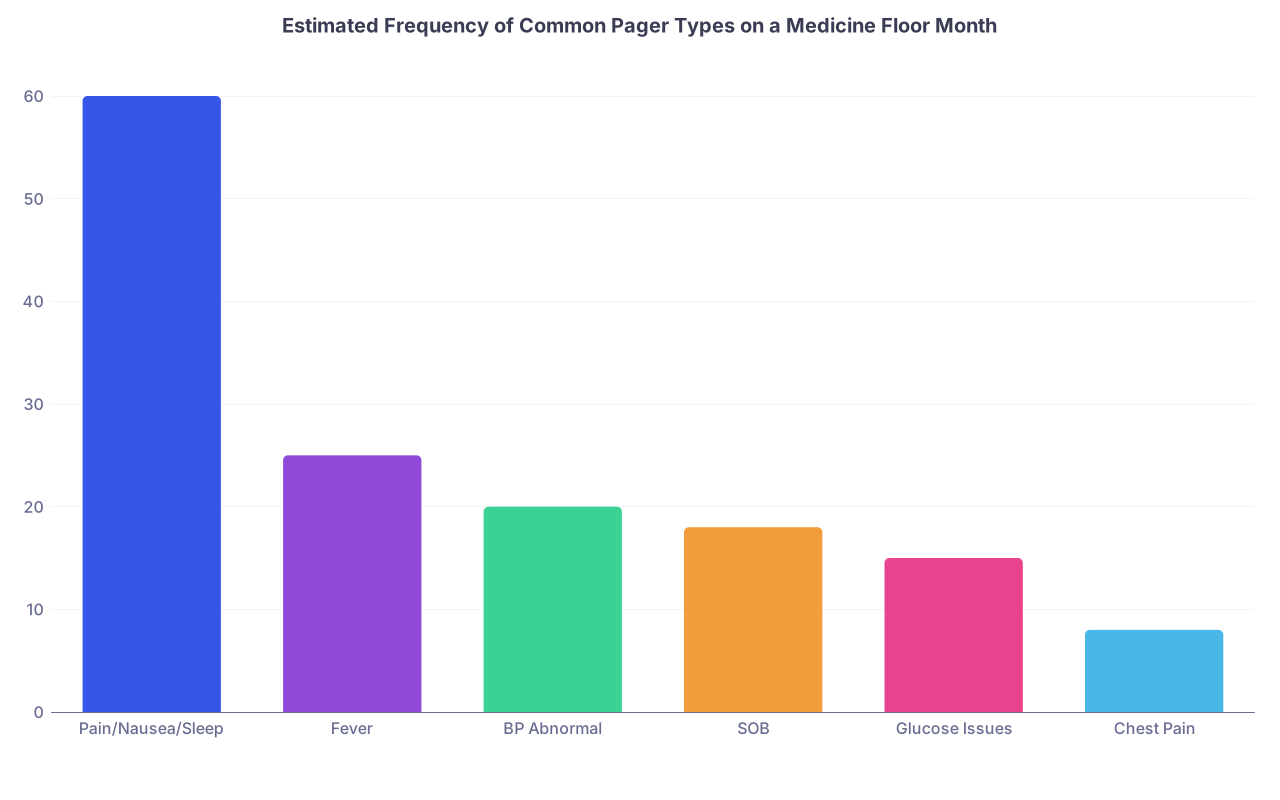
| Category | Value |
|---|---|
| Pain/Nausea/Sleep | 60 |
| Fever | 25 |
| BP Abnormal | 20 |
| SOB | 18 |
| Glucose Issues | 15 |
| Chest Pain | 8 |
How This Changes Your Nights
Outcome if you do not systematize pages:
- You feel constantly behind.
- You reinvent the wheel with each call.
- You inevitably miss something important once your fatigue wins.
Outcome if you do:
- You answer calls faster.
- You see patterns early.
- You free up mental bandwidth for the genuinely weird cases.
One more point no one tells you:
Your nurses will respect you more when you respond with structure.
“I hear you. For new SOB, I need vitals, O₂ needs, and what you are seeing at the bedside in terms of work of breathing. Then I will decide if I am coming immediately or in the next few minutes.”
That sounds like someone who knows what they are doing, even if you still feel like you do not.

| Step | Description |
|---|---|
| Step 1 | Pager goes off |
| Step 2 | Run to bedside and call nurse |
| Step 3 | Call nurse for structured info |
| Step 4 | Use condition script |
| Step 5 | Place orders and document |
| Step 6 | Close loop with nurse |
| Step 7 | Emergent words? |
| Step 8 | Red flags present |

Two Advanced Moves That Separate Strong Interns
1. Anticipatory Orders
Smart interns reduce future pages by thinking one step ahead.
Examples:
- Post-op patient with known nausea risk → schedule antiemetics and have PRN options.
- CHF patient getting big diuresis day 1 → write holding parameters for BP and creatinine.
- Known brittle diabetic → tighter glucose orders, clear hypoglycemia protocol.
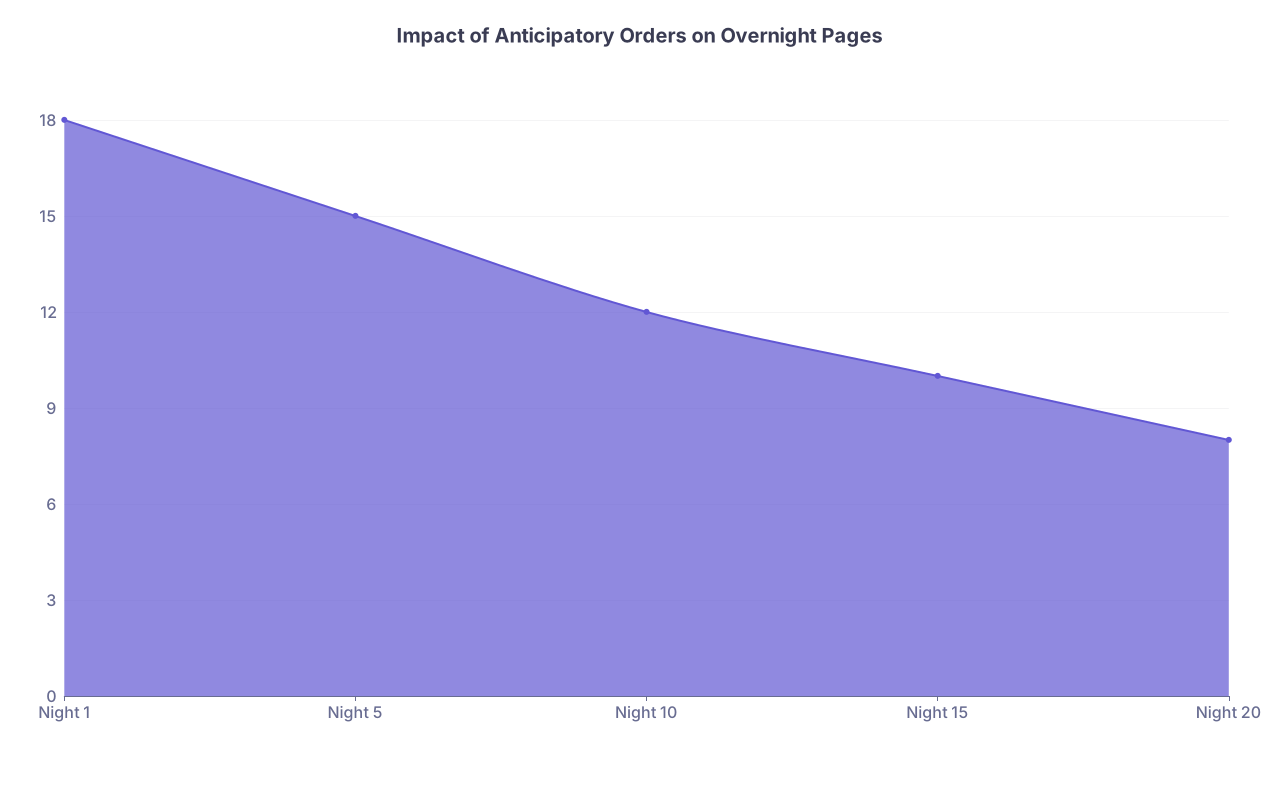
| Category | Value |
|---|---|
| Night 1 | 18 |
| Night 5 | 15 |
| Night 10 | 12 |
| Night 15 | 10 |
| Night 20 | 8 |
You will literally watch your pager quiet down over the month if you do this well.
2. Debrief With Seniors
Once or twice a week on a call month, grab your senior:
“Can I run three pages by you and see how you’d have handled them?”
Pick:
- One you felt good about.
- One that went sideways.
- One you are unsure about.
They will give you tiny tweaks that make your scripts sharper. Do this for two rotations and you will be noticeably ahead of your class.

The Bottom Line
Three points to walk away with:
- Use structure, not vibes. Every page runs through the same 4-step filter: safety, clarify, apply script, close the loop.
- Rely on simple, repeatable scripts. For SOB, BP, fever, chest pain, glucose, agitation, and comfort meds, your responses should be nearly identical each time, with only minor adjustments.
- Turn scripts into tools. Build dot phrases, anticipatory orders, and a small personal “if-then” cheat sheet. That is how you turn chaos into a manageable system instead of surviving on adrenaline.