
You are not paid to be a hero. You are paid to know when you are out of your depth and call for help fast.
The interns who get in trouble are not the ones who ask “too many” questions. They are the ones who waited twenty minutes too long to pick up the phone. I have watched careers damaged over one bad night where someone tried to “handle it” alone.
You are going to feel that tension all year:
- “I should know this.”
- “I do not want to wake them.”
- “What if they think I am incompetent?”
Let me be blunt: your senior would rather be mildly annoyed at 2:00 a.m. than explaining to the program director at 9:00 a.m. why a patient crashed without anyone calling them.
Here is the practical decision tree and the exact words to use so you stop guessing.
Step 1: The Core Rule – The “Would I Be Upset?” Test
Your default rule as an intern should be aggressive: when in doubt, call.
A good mental shortcut:
- If this patient deteriorated and you had not called your senior, would they be justifiably angry?
- If the chart is reviewed tomorrow, would it be obvious that you should have escalated?
If yes, you call. Every time.
To tighten this up, there are three categories that should trigger an almost automatic page:
- Unstable / potentially unstable
- Uncertain / outside your competence
- Systems / logistics beyond your authority
We will build a usable decision tree from these, but first, hard lines.
Step 2: The Non‑Negotiables – Always Call
If you remember nothing else from this article, remember this list. These are non‑negotiable reasons to call your senior immediately, day or night.
1. Airway / Breathing
Always escalate if:
- New or worsening respiratory distress
- O2 sat ≤ 90% on any oxygen, or a sudden drop > 5–10% from baseline
- New need for:
- Non‑rebreather
- High‑flow nasal cannula
- BiPAP / CPAP
- Concern for:
- Airway obstruction
- Aspiration
- Stridor
- Rapidly progressing wheeze or bronchospasm
Your sequence:
- Call nursing / RT to bedside.
- Place patient on monitor.
- Apply oxygen per protocol.
- Call rapid response or code if they look bad.
- Page your senior immediately, not “after I see how they do.”
2. Hemodynamics
Call for:
- SBP < 90 OR MAP < 65 (unless clearly baseline and pre‑discussed)
- New tachycardia > 130, bradycardia < 40
- Chest pain, new concerning EKG changes, or suspected ACS
- Suspected sepsis, especially:
- Lactate ≥ 2
- Escalating oxygen
- Hypotension or mental status changes
3. Neuro Changes
Call for:
- Any new focal neuro deficit (weakness, facial droop, slurred speech, vision changes)
- Suspected stroke or TIA
- New or worsening confusion, agitation, or unresponsiveness
- New seizure or status epilepticus
- Post‑tPA, post‑thrombectomy issues
4. Bleeding / Acute Events
Call for:
- Hematemesis, melena, hematochezia
- Retroperitoneal or suspected internal bleeding
- Post‑procedure bleeding beyond minimal expectations
- Any trauma or fall with concern for head injury, anticoagulated patient, or significant mechanism
5. You Are Being Asked to Break a Rule
Call for:
- Nurses asking for orders outside your comfort or authority:
- “Can you just bump the pressors?”
- “Can you sign this chemo order, the fellow is off?”
- Consultants or attendings pressuring you into something you are not authorized for:
- “Just transfer them to ICU and I’ll see them later.”
- “Go ahead and consent them for this high‑risk procedure.”
If it feels like it should involve someone more senior, you are right.
Step 3: A Real Decision Tree You Can Use Tonight
Memorize this flow. Or scribble it on an index card and tape it behind your badge.

| Step | Description |
|---|---|
| Step 1 | Notice a problem |
| Step 2 | Call rapid response or code as needed |
| Step 3 | Page senior immediately |
| Step 4 | Implement plan and reassess |
| Step 5 | Document and update senior on rounds |
| Step 6 | Is patient unstable or at risk of rapid decline |
| Step 7 | Is issue outside my knowledge or comfort |
| Step 8 | Do I have a clear safe plan |
| Step 9 | Worsening or no improvement |
Breakdown in words:
Is the patient crashing or clearly unstable?
- Yes → Activate rapid response / code as appropriate and simultaneously get your senior involved.
- No → Go to 2.
Is this beyond your training or comfort?
If you are thinking:- “I have never really managed this before.”
- “I kind of remember this from Step 2 but not in real life.”
- “I am guessing the dose.” → You page. You are too early in training to freelance high‑risk medicine.
Do you have a clear, evidence‑based, institution‑consistent plan you would defend tomorrow?
- If no → Page.
- If yes → Implement, reassess in a tight timeframe (20–60 minutes). If no improvement or if anything worsens → Page.
This is conservative by design. You are not a second‑year yet. That is the point.
Step 4: The “Question Bank” – Common Situations and What To Do
Here is where interns usually freeze: the grey zones. The annoying “okay but what about…” cases that fill your nights.

Scenario 1: “The nurse says the BP is 88/50. Patient looks okay.”
What you do:
- Go see the patient. Always.
- Confirm:
- Repeat manual BP.
- HR, RR, O2 sat.
- Mental status, urine output, extremity warmth, cap refill.
- Check:
- Recent trends in vitals.
- Home meds and scheduled antihypertensives.
- Fluid status, recent diuretics, bleeding risk.
When to page:
- If this is not baseline AND:
- MAP < 65 or SBP < 90 sustained.
- They look altered, clammy, or oliguric.
- You are considering:
- A fluid bolus beyond standard protocol.
- Holding/restarting critical meds.
- Starting any vasoactive agent.
Sample page:
“Hi Dr. Smith, this is Dr. Jones, the intern on Med A. I am calling about Mr. Brown in 431. He is a 72‑year‑old with HFpEF and CKD. His BP dropped to 88/50, repeated manually at 90/52, HR 104, sat 95% on 2L. He is mentating well, lungs clear, JVP mid‑neck, skin warm, urine output borderline. He received his home lisinopril and carvedilol 2 hours ago. I held further antihypertensives and got labs. I am considering a small fluid bolus but am concerned given his heart failure. I would like your input on next steps.”
That is professional, focused, and shows you actually assessed the patient.
Scenario 2: “New chest pain on the floor”
You do not “watch and wait” with chest pain. Ever.
Checklist:
- STAT vitals, O2, EKG, troponin, brief focused history.
- Ask:
- Character, onset, radiation, associated symptoms.
- Similar prior episodes.
- Known CAD, recent stress test, stents.
When to page:
For basically any new chest pain in a hospitalized adult that is not clearly musculoskeletal and benign. The downside of calling is minor. The downside of missing ACS is catastrophic.
You can page while the nurse is getting the EKG. You do not have to have the full workup completed to make the call.
Scenario 3: “The sodium is 118. Lab just called.”
Acute significant lab derangements are classic intern traps. You think, “But the patient looks fine; I’ll read up and handle it.” Do not.
You page your senior for:
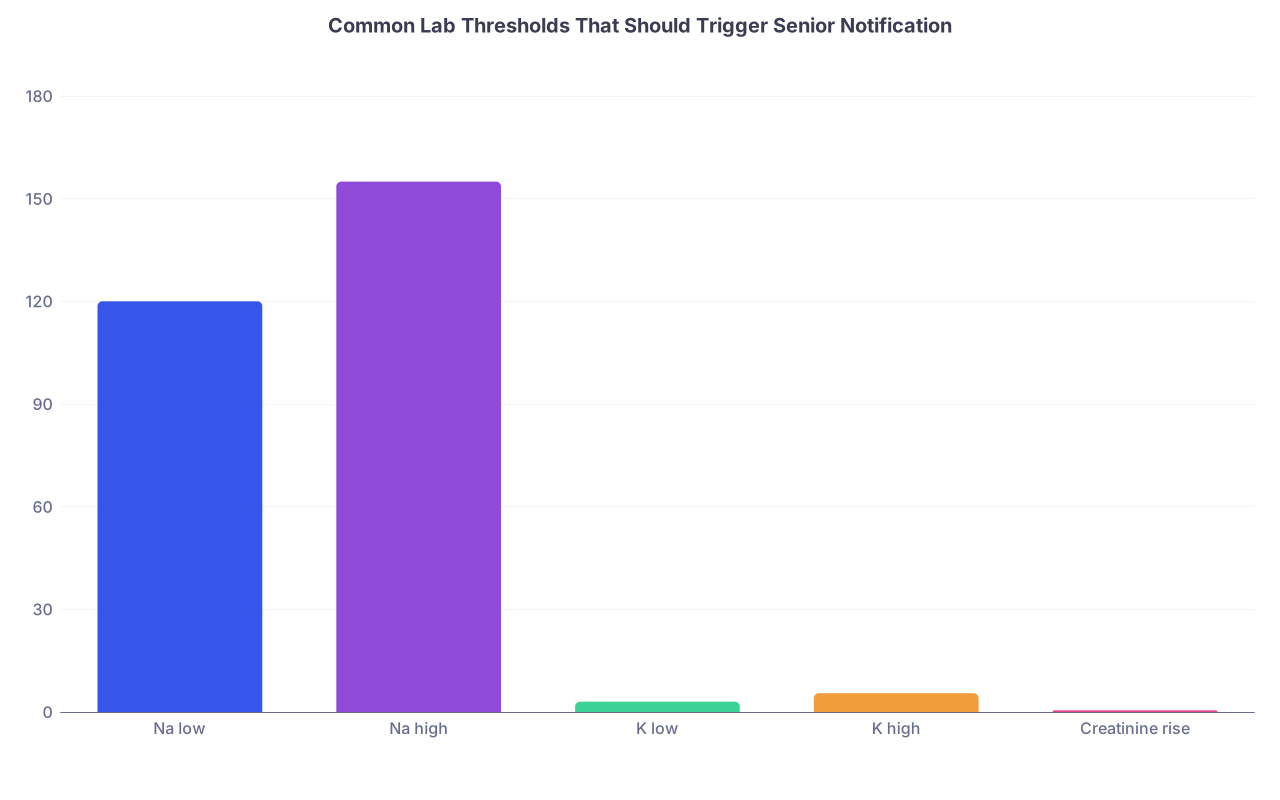
- Na < 120 or > 155
- K < 3.0 or ≥ 5.5 (or any EKG changes)
- Ca, Mg, or Phos seriously out of range, especially if symptomatic
- New creatinine jump > 0.5–1.0 or > 50% from baseline
- Troponin elevations that were not planned or explained
| Category | Value |
|---|---|
| Na low | 120 |
| Na high | 155 |
| K low | 3 |
| K high | 5.5 |
| Creatinine rise | 0.5 |
When you call, your job is:
- Provide context: baseline values, chronicity, symptoms.
- Show you have checked the chart: recent meds, diuretics, IV fluids.
You do not need a perfect plan. You need to not be alone with a sodium of 118.
Scenario 4: “Family upset, threatening to complain”
You will be tempted to “smooth it over” alone. Do not make yourself the shield for system failures.
Call your senior when:
- A family member is yelling, threatening to call the administrator, lawyer, or media.
- There is a serious miscommunication:
- They believe they were promised a procedure, discharge, or treatment that is not happening.
- Bad news needs to be delivered beyond your level:
- New malignancy.
- Poor prognosis shift.
- Withdrawal of care discussions, code status changes.
Your senior (and often the attending) should be part of these conversations. If you walk into a room and think, “This could blow up,” page.
Scenario 5: “Cross‑cover stuff: Can you order sleep meds / pain meds / more insulin?”
Cross‑cover is where people get lulled into bad habits.
General rules:
- Non‑critical symptom relief with low‑risk meds (melatonin, low‑dose trazodone, PRN acetaminophen) – you can usually handle with standard doses if this is consistent with unit norms and patient comorbidities.
- Escalating opioids, IV opioids, or benzos in someone you do not know → very cautious. If you are even slightly uneasy, page.
- Insulin changes:
- Subtle tweaks to sliding scale in a stable, non‑ICU patient might be okay.
- Big changes in basal / bolus regimen, DKA, HHS concern → page.
If the request could cause respiratory depression, hypotension, or hypoglycemia overnight, your threshold for calling should be low.
Step 5: How to Call – The Exact Structure
Most interns are not actually afraid of calling. They are afraid of sounding disorganized or stupid.
So use a standard structure: Name – Role – Patient – One‑Line – Situation – Your Ask.
You can think of this as SBAR, but less clunky and more conversational.
Skeleton script
- Intro
- “Hi Dr. Smith, this is Dr. Jones, the intern on Med A.”
- Who / where
- “I am calling about Ms. Garcia in 512B.”
- One‑liner
- “She is a 64‑year‑old with COPD and CHF, admitted for pneumonia.”
- Current situation
- “Over the last hour, her oxygen needs have increased from 2L to 5L, and her sats are now 89–90% with RR 28. Her BP is 102/60, HR 110, she is slightly more dyspneic, but mentating okay.
- What you did / know
- “I examined her, lungs with more crackles on the right, no wheezes. I ordered a stat CXR and ABG, labs are pending. I have her up to 5L and RT is on the way.”
- Your ask
- “I am concerned she is worsening and I would like you to see her with me now to help decide on escalation, including whether she needs ICU.”
You sound competent, even if you are terrified.
| Type | Example |
|---|---|
| Bad | "Hi, your patient is not doing well. What do you want me to do?" |
| Good | "Hi, this is Dr. Lee, intern on Night Float. Calling about Mr. Patel in 634, 58-year-old with cirrhosis admitted for GI bleed. His BP has dropped from 110/70 to 88/54 over 30 minutes, HR 118, mentating but lightheaded. I examined him, abdomen is distended but soft, no fresh hematemesis, melena continues. I held his beta blocker, started a liter of LR, and rechecked his Hgb which dropped from 8.2 to 7.1. I am concerned he is still bleeding and would like your help at bedside and to discuss ICU transfer." |
You do not need that perfect every time, but that is the target.
Step 6: When Not to Call in the Middle of the Night
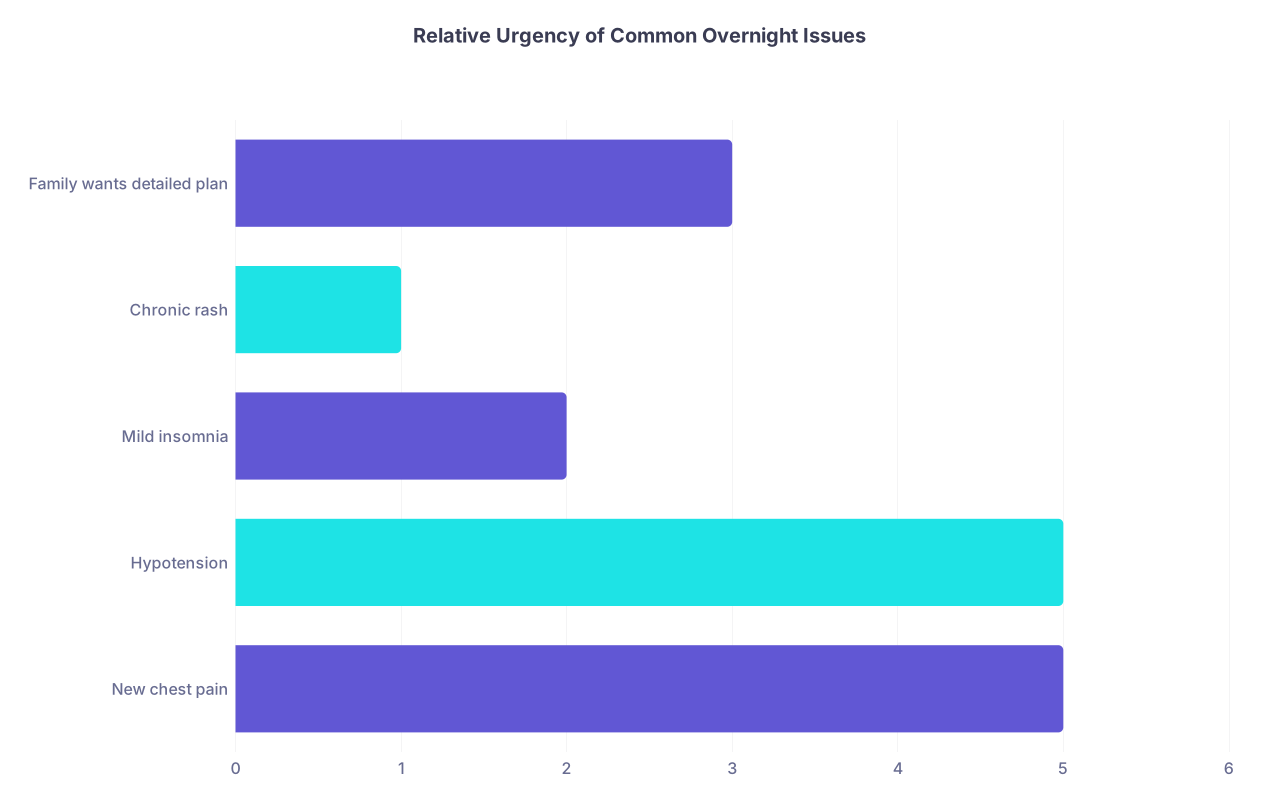
You should not wake your senior for every annoyance. There are issues that can wait if you are sure they are:
- Low‑risk.
- Not time‑sensitive.
- Clearly not impacting immediate safety.
Things that usually can wait for rounds:
- Stable chronic pain management tweaks where the patient is comfortable enough to sleep.
- Discharge planning questions when discharge is planned for tomorrow or later.
- Long‑standing minor issues (e.g., chronic rash, outpatient referral questions).
- Non‑urgent documentation or note‑clarification questions.
| Category | Value |
|---|---|
| New chest pain | 5 |
| Hypotension | 5 |
| Mild insomnia | 2 |
| Chronic rash | 1 |
| Family wants detailed plan | 3 |
Scale: 1 = can wait for rounds, 5 = page now.
Borderline example:
- Family wants a “detailed plan for tomorrow” at 2 a.m.
- You can:
- Provide a basic outline.
- Set expectations: “We will discuss full plans with the attending during rounds.”
- If they escalate (“We want to speak to the person in charge now”), that crosses back into senior territory.
- You can:
Your filter:
Will harm occur if this waits 4–6 hours? If “no,” and you truly believe it, document the concern and bring it up on rounds.
Step 7: Managing the Emotional Side – Fear, Shame, and “Looking Dumb”
Let me say this outright: if your senior shames you for calling, that is their failure, not yours.
But it still hurts. And if you get burned once, you will hesitate next time. That is how disasters happen. So you need a mental buffer.
Reframe how you see paging
- Every page is risk management, not a performance review.
- Your job is not to be impressive. Your job is to be safe.
- Good programs track failure to call much more harshly than “called too much.”
I have seen interns who called “too often” become outstanding seniors. They develop judgment. I have also seen interns who under‑called end up on remediation.
What to do after a tense interaction
If your senior snaps:
- Stay calm in the moment: focus on the patient, not your ego.
- After the dust settles, consider:
- Debriefing briefly: “Was this something you would have wanted me to handle differently next time?”
- Asking a trusted upper‑level or chief if your threshold is appropriate.
You are allowed to learn. First year as an intern is not a final exam. It is the start.

Step 8: Using the System Around You – Nurses, RT, and Rapid Response
Your senior is not your only lifeline.
Nurses
When an experienced nurse says, “I am worried about this patient,” believe them. Even if the vitals look okay. That should raise your index of suspicion dramatically and move you toward paging.
Respiratory Therapy (RT)
For any respiratory change worse than “slightly more short of breath,” get RT involved early. They will help you decide if the patient is okay to remain on the floor.
Rapid Response Team (RRT)
This is underused by anxious interns and overused by people who never leave their chair.
Use RRT when:
- You think the patient might imminently need higher level of care.
- You have done the initial ABCs but the patient is not stabilizing.
- Vitals are grossly abnormal and you do not see a quick fix.
Do not delay RRT while you try three more interventions alone. Call RRT and page your senior in parallel. No one will fault you for overcalling RRT for a truly concerning patient.

| Step | Description |
|---|---|
| Step 1 | Notice concerning change |
| Step 2 | Go to bedside |
| Step 3 | Assess ABCs and vitals |
| Step 4 | Call Rapid Response |
| Step 5 | Page senior immediately |
| Step 6 | Stabilize and reassess |
| Step 7 | Monitor closely and update on rounds |
| Step 8 | Severely abnormal or rapidly worsening |
| Step 9 | Still concerning or unclear |
Step 9: Building Your Own Thresholds Over Time
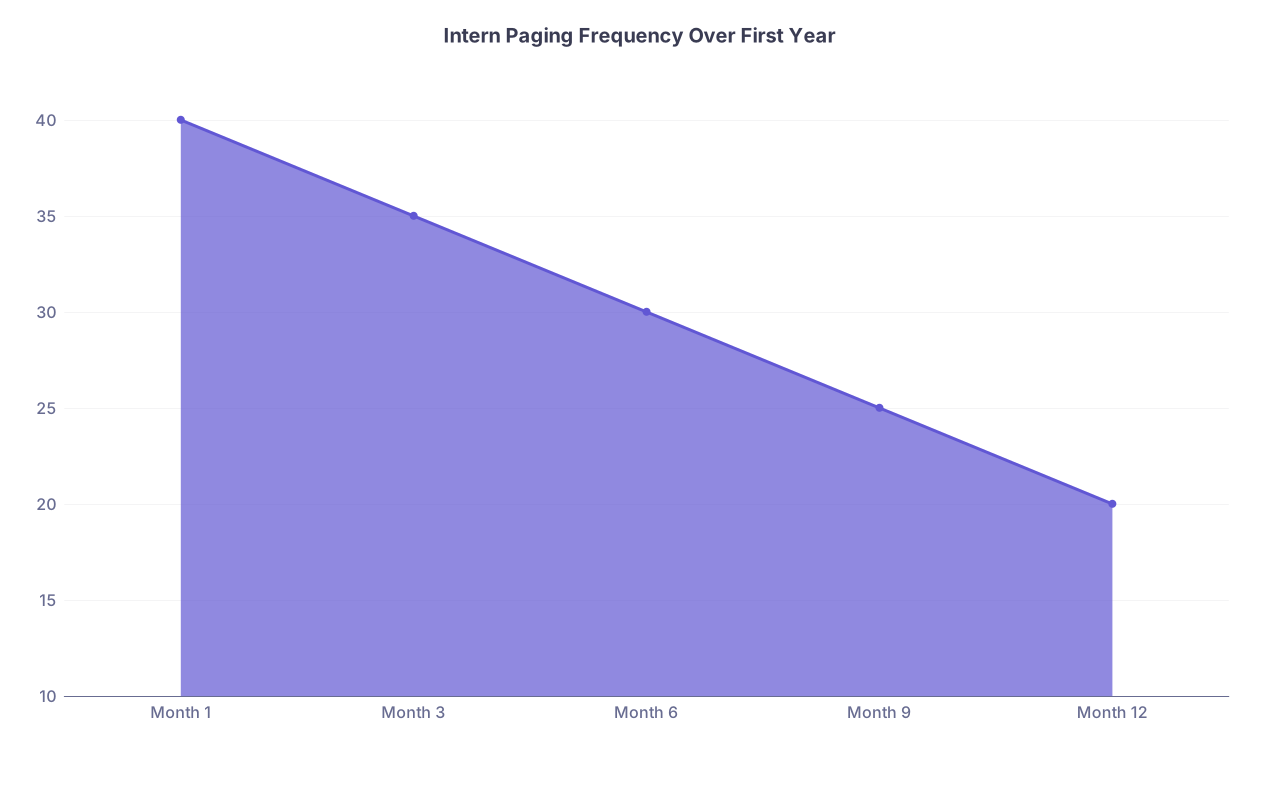
The goal is not that you call for every minor variation forever. Over the first 6–12 months, your job is to observe how your seniors react and refine your internal triggers.
Here is how you do that deliberately:
After a major overnight issue, debrief briefly the next day.
- “Last night I called about X; was that an appropriate time to get you involved?”
- “If I see this again, is there anything you would expect me to try before calling?”
Track patterns.
- If three different seniors all say, “Yeah, I wanted to know about that,” then you mark that as a reliable threshold.
- If seniors consistently tell you, “You can probably handle that like this next time,” incorporate that.
Notice the “Oh God I Wish You Had Called” moments.
- These usually occur in M&M or informal case reviews.
- Mentally bookmark the features that should have triggered earlier escalation.
| Category | Value |
|---|---|
| Month 1 | 40 |
| Month 3 | 35 |
| Month 6 | 30 |
| Month 9 | 25 |
| Month 12 | 20 |
You want a pattern roughly like that line: high early, then gradually decreasing as your competence and comfort grow. If you are calling less over time but feeling more anxious, that is a red flag. You might be suppressing your instincts to avoid “bothering” people. Fix that.
Step 10: A Quick “Pre‑Page” Checklist
Right before you hit “call,” run these 7 checks. It will make your pages sharper and your seniors happier:
Have I seen the patient?
If possible, yes. Do not be the intern calling from the computer without laying eyes on them.Do I have the most recent vitals in front of me?
Write them down: BP, HR, RR, O2 sat, temp.Do I know why they are admitted and their key comorbidities?
One‑liner ready.Have I done an immediate ABC safety check?
- Airway patent?
- Breathing: sat, RR, work of breathing.
- Circulation: BP, HR, color, mentation.
Have I done the obvious low‑risk interventions?
- O2 increase per protocol?
- Positioning?
- IV access?
- Basic labs ordered if clearly indicated?
Have I thought of 1–2 possible diagnoses?
Not a full differential. Just enough to show you are thinking.Can I articulate what I want from my senior?
- “Come to bedside now.”
- “Help decide ICU vs floor.”
- “Approve this med / dose.”
- “Talk to family with me.”
If you can check those boxes, you are not “bothering” anyone. You are doing exactly what an intern should do.

Your Next Step – Build Your Personal Call Script Today
Do not wait for your first 3 a.m. crisis to figure this out.
Right now:
- Open a notes app or grab an index card.
- Write down:
- Your intro script (name, role, usual rotation).
- A template for vitals and one‑liner.
- Three phrases:
- “I am concerned because…”
- “I have done X, Y, Z so far.”
- “I would like your help with…”
Then put that card in your pocket or badge holder.
Tonight, when something feels off and your gut says, “Maybe I should call,” pull that card out, run the checklist, and make the call.