
You are not drowning because there is too much work. You are drowning because you do not have a ruthless system to sort that work.
Intern year does not reward the “hardest worker.” It rewards the one with the cleanest triage system. I have watched sharp interns crash by 10 a.m. because they tried to do everything in the order it appeared. I have also watched average interns look like superheroes because they used a simple, disciplined protocol for every single task.
This is that protocol.
You will not eliminate chaos. You will control it just enough to keep patients safe, finish your notes, and get out close to on time most days. That is the bar.
Step 1: Stop the Mental Free‑For‑All
If your “system” is keeping everything in your head and scrolling your pager:
That is not a system. That is a failure mode.
You need a single, visible, external task list for the day. Paper or digital. I do not care. I care that it is one place and you stick to it.
Here is the structure I recommend:
| Category | Examples |
|---|---|
| STAT / Now | Hypotension, severe pain, chest pain |
| High Priority | New consults, critical labs |
| Medium | Routine orders, med rec |
| Low / Later | Non-urgent paperwork, scheduling |
| Admin / Notes | Notes, discharge summaries |
Use either:
- A folded sheet in your pocket with columns
- A notes app with bolded category headings
- A simple Excel/Sheets file if your hospital computers are decent
Every task that hits you goes immediately somewhere on that list. Not mentally. Physically.
The rule:
If it is not on the list, it does not exist.
Step 2: Classify Every Task in 10 Seconds Using 2 Questions
You do not have time for a complicated priority matrix. You have time for two questions:
- How bad is the outcome if I delay this by 1–2 hours?
- How long will this actually take?
That is it. Severity and time.
Use this 4‑box mental model:
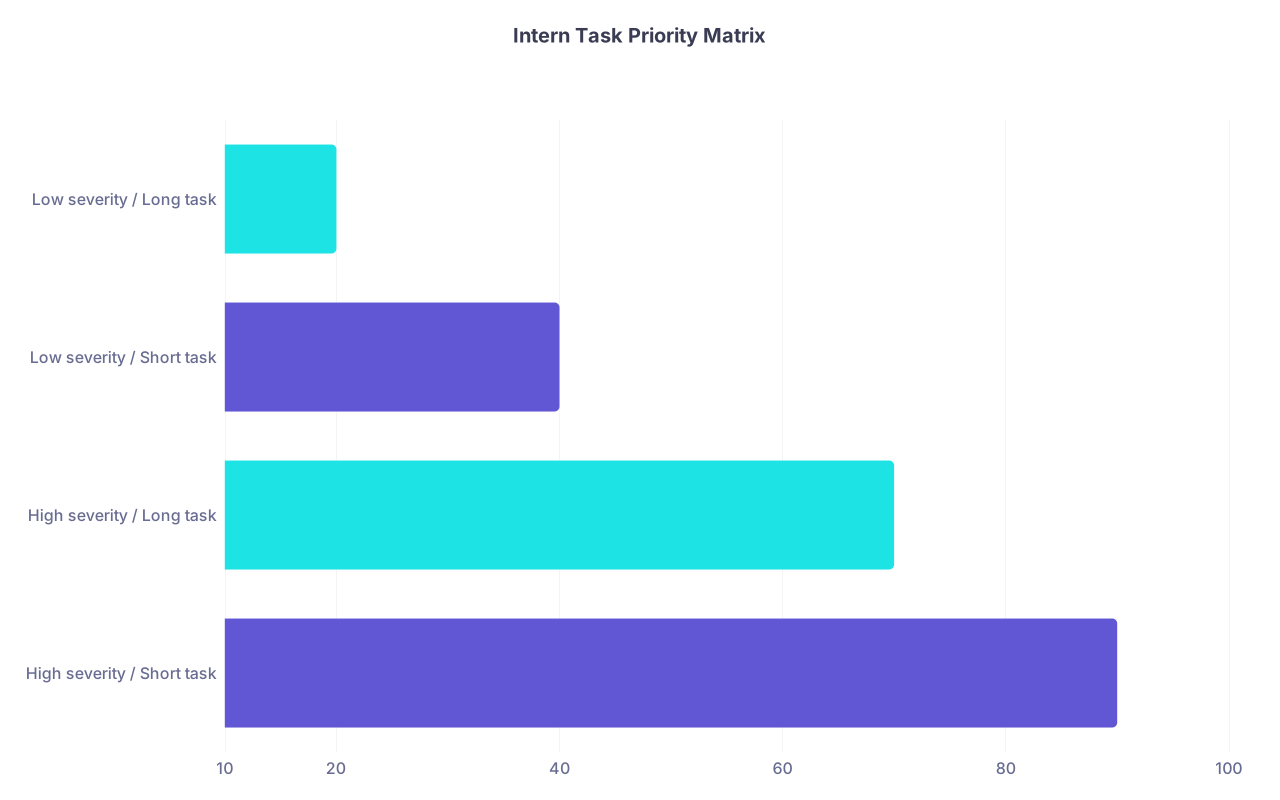
| Category | Value |
|---|---|
| High severity / Short task | 90 |
| High severity / Long task | 70 |
| Low severity / Short task | 40 |
| Low severity / Long task | 20 |
Interpretation (numbers just to visualize ranking):
- High severity / Short task → Do first
- High severity / Long task → Chunk and start early
- Low severity / Short task → Batch later
- Low severity / Long task → Protect time blocks
Translate that into real intern language:
High severity examples (can hurt someone if delayed):
- “BP 74/40 in 12B”
- “O2 sat 82% on 4 L”
- “K is 2.7 on your patient”
- “New chest pain on your post‑op”
- “Confused patient pulled out central line”
Low severity examples (annoying if delayed, rarely harmful):
- “Can you send a PT/OT order?”
- “Family wants an update when you have a minute”
- “Can you renew the diet order?”
- “We need disability paperwork filled out”
- “Can you re‑print the prescription?”
Now add the time dimension:
- Short tasks (≤3 minutes):
- Single order
- Quick call to RT
- Simple pain regimen tweak
- Approving a consult
- Long tasks (>3–5 minutes):
- Full note
- Transfer or discharge summary
- Complex workup order set
- Goals‑of‑care family meeting
When something hits you, you answer the two questions and immediately:
- Write it under the right priority section
- Mark S (short) or L (long) next to it
Example entry:
STAT / Now
- 12B hypotensive, check bedside and fluids – S
- 14C new chest pain, eval + EKG/trop – L
High priority
- K 2.9, replete IV + recheck – S
- New consult: GI bleed – L
You have just turned noise into a plan.
Step 3: Use a Standard Response Protocol for Every Page
Most interns waste 30–60 minutes a day because their response to pages is random. You need a script.
Here is the 4‑step protocol I used and teach:
- Look at the pager message and your list.
- Decide category (STAT, High, Medium, Low) + S/L.
- Respond with one of three moves:
- Handle now
- Acknowledge + schedule
- Delegate / redirect
- Document on your task list within 30 seconds.
Concrete examples:
Example 1: Truly urgent page
“BP 78/40, HR 120, pt feels dizzy”
- Category: STAT / High severity, unknown length
- Response:
- Call back immediately: “This sounds urgent, I am coming now. Please put patient on monitor and get a manual BP.”
- Walk there now. Do not finish your current note.
- On your way, scan: sepsis? bleed? med effect?
You do not log this one first. You run. Log after you stabilize them.
Example 2: Medium urgency, short task
“Can you change the diet to NPO? Pt going to IR in 2 hours.”
- Category: Medium, short
- Response:
- If you are not in the middle of an exam or code:
- Open chart → change diet → confirm
- Mark as done on list
- If you are, call back:
- “I am with a sick patient. I will place this in 15 minutes unless it becomes urgent.”
- If you are not in the middle of an exam or code:
Example 3: Low urgency, long task
“We need disability forms for Mr. X before discharge.”
- Category: Low, long
- Response:
- “Understood. I will work on those after rounds this afternoon.”
- Put under Low / Later – L
- Block a time (for example, 4:30–5:00) to do forms for all patients at once
Step 4: Build a Default Daily Flow That Protects Your Brain
Your problem is not only too many tasks. It is switching costs. Jumping from note to order to page to discharge to social call. That fragmentation burns hours.
You need a default “day template” that you deviate from only for real emergencies.
Here is a practical intern template for a typical ward day:

| Step | Description |
|---|---|
| Step 1 | Arrive and Pre-round |
| Step 2 | 7 -30 Safety Scan |
| Step 3 | 8-11 Rounds Focus |
| Step 4 | 11-12 High Priority Tasks |
| Step 5 | 12-13 Lunch + Quick Tasks |
| Step 6 | 13-15 Notes + Discharges |
| Step 7 | 15-17 Batch Low Priority |
| Step 8 | 17-? Clean Up and Sign Out |
Breakdown:
1. Pre‑round (usually 6:00–7:30)
- Look at vitals, labs, overnight events
- Make a pre‑list of:
- People you are worried about
- Must‑do orders after rounds
- Do not start notes. You will rewrite them anyway.
2. 7:30–8:00 “Safety scan”
Quick task sweep:
- Any high‑severity labs?
- Any RN pages from overnight not addressed?
- Any consult notes that change today’s plan?
This is your first triage. Mark STAT / High tasks clearly.
3. 8:00–11:00 Rounding
During rounds:
- Do not try to complete every order on the spot. You will fall behind and miss key decisions.
- Instead, on each patient:
- Circle or mark 1–2 truly urgent orders to do immediately after that patient (for example, start heparin, increase O2, STAT CT)
- Everything else goes to your list with H/M/L
Your goal: stay mentally present on rounds, collect tasks, and avoid getting derailed by a single complex order set.
4. 11:00–12:00: High‑priority power hour
Rounds are done or winding down. Now you:
- Hit all STAT / High severity + S tasks first:
- Electrolyte repletion
- Time‑sensitive consult orders
- Imaging that changes same‑day management
- Start 1–2 High / L tasks that affect disposition:
- Discharge orders for patients definitely leaving
- Transfer orders out of ICU or step‑down
Guard this hour. Shut your door (if you are lucky enough to have one). Put headphones in. Say, “I will call you back in 20 minutes” to low‑urgency pages.
5. 12:00–13:00: Lunch + quick wins
You are useless if you are hypoglycemic and angry.
- Eat something. Even 10 minutes.
- While eating, clear some Medium / S and Low / S tasks:
- Simple med changes
- PT/OT orders
- Diet changes
- DME orders
You are basically skimming the easy surface tasks.
6. 13:00–15:00: Notes + discharges block
This is prime cognitive time. Use it for longer work:
- Discharge summaries for patients definitely going
- Core progress notes for your sickest or most complex patients
- “Long” phone calls: family updates that need detail
Phone strategy here:
- Let calls go unanswered for a couple of minutes while you finish a paragraph.
- Then do a 5–10 minute “call back coil”: return 3–4 pages, triage again.
7. 15:00–17:00: Batch the rest
What is left:
- Remaining notes
- Disability / FMLA paperwork
- Requests from social work / case management
- Non‑urgent medication clarifications
Do these in clusters: all forms together, all calls together, all odds‑and‑ends orders together.
8. 17:00–Sign‑out: Clean up and close loops
- Quick scan of your list: what is truly unsafe to leave undone?
- Tighten plans on unstable patients
- Update covering resident on “watch items” and pending results
You are not done “when everything is done.” You are done when:
- All high‑severity issues are managed or clearly handed off
- Discharges and critical notes are complete
- The rest is safely deferable
Step 5: Use a Standard “Micro‑Huddle” for Overload Moments
At some point you will be behind on:
- Notes
- Pages
- Discharges
- Sleep
All at once. Fine.
The mistake is to keep stumbling forward blindly. You need a 3‑minute reset protocol.
When you feel flooded:
Stop for 60 seconds.
- Step away from the computer.
- Pull your task list out.
Do a ruthless re‑triage.
- Put a star ★ next to:
- Anything that alters hemodynamics, breathing, bleeding, mental status
- Anything that impacts today’s discharge or ICU transfer
- Put a minus – next to:
- Things that can safely be done by night float or tomorrow without changing outcomes
- Put a star ★ next to:
Decide your next 45 minutes.
Write down literally:- “Next 45 min:
- Replete K on 4 pts ★
- Finish 2 discharge summaries ★
- Call cardiology about Mr. Y echo ★”
- “Next 45 min:
Tell someone.
- “I am behind, here is my plan for the next hour.”
- If your senior looks at that and says, “No, do this instead,” good. You just got free triage help.
This micro‑huddle saves you from the default intern behavior: randomly clicking between charts and doing half of six tasks.
Step 6: Scripts for Saying “Not Now” Without Being a Jerk
You overload yourself because you say “yes” to everything in real time.
You need three scripts. Memorize them.
Script 1: For low‑urgency, non‑clinical asks
“Can you call the pharmacy about my med refill from last week?”
Use:
“Right now I am working through urgent patient care tasks. I will be able to get to this later this afternoon. If this becomes urgent before then, please let the nurse know and they can page me again.”
You just:
- Validated
- Set a timeline
- Preserved your triage
Script 2: For competing priorities
Nurse: “Can you come explain the plan to the family now? They are upset.”
Response:
“I am currently managing a critically ill patient. I do want to talk with the family and will aim to be there around 3 p.m. If their concern is something that affects immediate safety, let me know and I will reprioritize.”
If your senior hears this and says “No, go now,” then you go now. But you did not silently absorb an unspoken reprioritization.
Script 3: For cross‑coverage nonsense
Consult service: “Can you put in this non‑urgent med change for our patient?”
“Right now I am cross covering multiple teams and focusing on acute issues. If this is non‑urgent, can your daytime team place it tomorrow? If you think it affects safety tonight, let me know and I can try to fit it in.”
You are not a 24/7 order clerk. You are there to keep people alive and reasonably stable overnight.
Step 7: Common Failure Modes and How to Fix Them
I have watched dozens of interns repeat the same mistakes. You do not need to.
Failure 1: The “do it when I remember” intern
Symptom: constantly saying “Oh, I forgot to…” at 3 p.m.
Fix:
- Every time a task pops into your head (“I need to check that troponin”), you stop and write it down on the list. Even mid‑sentence.
- Carry a pen everywhere. No pen = unsafe clinician.
Failure 2: The chronic note‑procrastinator
Symptom: Finishing notes at 7–8 p.m. daily, even on calm days.
Fix:
- Hard rule: first full note must be started by 1 p.m., not after “things quiet down.”
- Use note templates aggressively.
- Dictate when possible.
- Notes are not literature. They are tools. Stop rewriting.
Failure 3: The pager slave
Symptom: drops everything instantly for every page, constantly.
Fix:
- Batch callbacks:
- If you get 3 non‑STAT pages while finishing orders, finish the single high‑priority order, then call back all 3.
- Use a 5–10 minute delay for non‑urgent pages. That alone cuts your switching cost in half.
Failure 4: The martyr who never escalates
Symptom: drowning quietly, leaving late, making small but risky mistakes.
Fix:
- New rule: if you feel more than 30 minutes behind on high‑severity tasks, you must tell your senior.
Exact phrase:
“I have 4 high‑priority tasks and I am about 30–45 minutes behind. Here is my list. Can you help me decide what to drop or who can help?”
Good seniors would rather hear that at 2 p.m. than learn at 6 p.m. that something critical was missed.
Step 8: Build a Simple Visual System To See Your Workload
You are less anxious when you can see the load instead of vaguely feeling crushed by it.
I like a quick visual count at midday and mid‑afternoon:
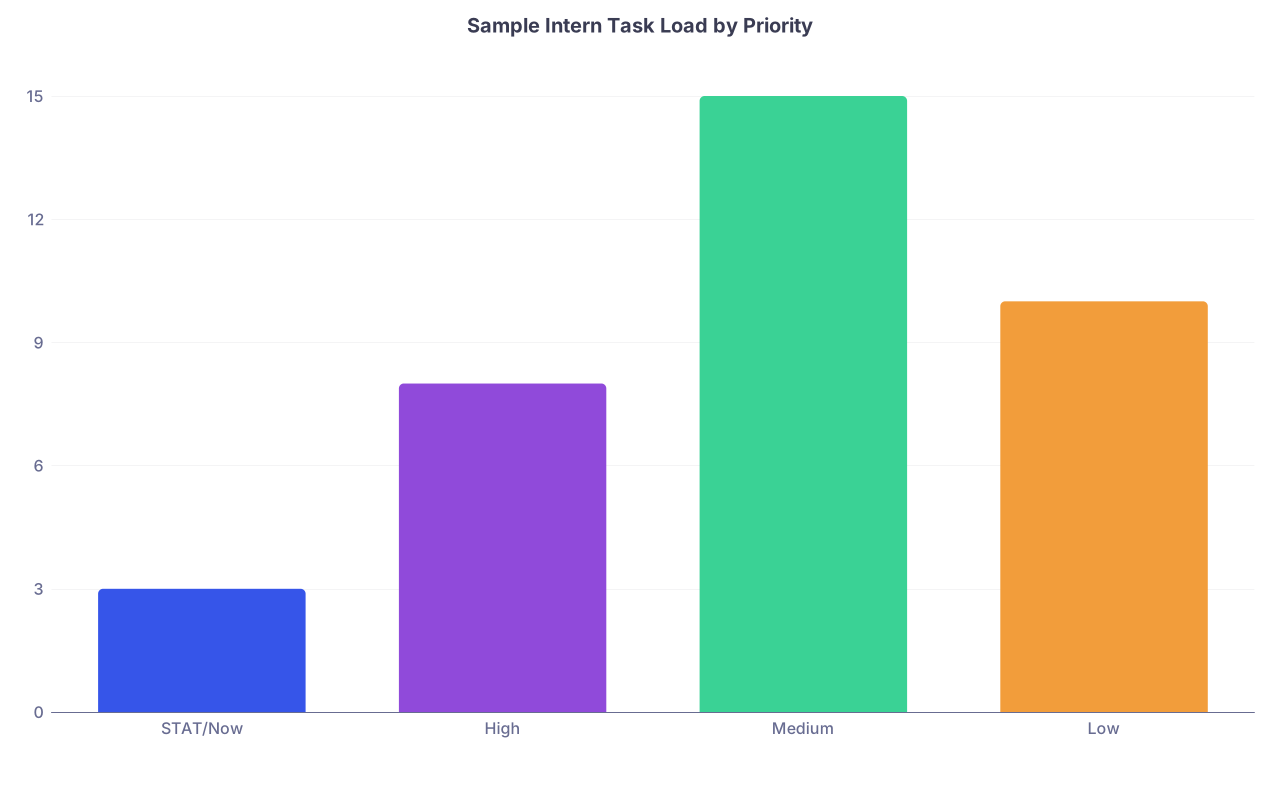
| Category | Value |
|---|---|
| STAT/Now | 3 |
| High | 8 |
| Medium | 15 |
| Low | 10 |
If your bar for High is exploding and Medium/Low are growing vines, you either:
- Need to escalate for help
- Need to shrink “High” by redefining what truly qualifies
A few benchmarks:
- More than 5 active high‑priority tasks at once? Dangerous. Re‑triage and escalate.
- More than 3 active STAT tasks? You need another body in the mix (senior, fellow, second intern).
- A backlog of >20 Medium/Low tasks? Time to:
- Batch what you can
- Hand off explicitly at sign‑out
- Drop non‑essential nonsense
You are not in charge of making everyone’s life convenient. You are in charge of safe care and reasonable progress.
Step 9: A 5‑Minute End‑of‑Day Review That Makes Tomorrow Better
Most interns repeat the same chaos every day because they never review the system itself.
Before you sign out (or right after, while you are waiting for your ride):
Look at your task list:
- What categories were overflowing today?
- What sort of tasks you kept pushing until late?
Ask 3 questions:
- What did I do today that was actually unnecessary?
- What should have been delegated or delayed?
- What one thing could I have done earlier that would have saved me 30 minutes?
Make a tiny rule for tomorrow:
- “I will start discharge orders before lunch on any likely dispo.”
- “I will not do bedside teaching in the middle of my high‑priority power hour.”
- “I will batch paperwork at 4 p.m. instead of sprinkling it all day.”
These micro‑adjustments compound over weeks.
FAQs
1. How do I balance being thorough with being fast when overloaded?
You do not sacrifice thoroughness on safety‑critical tasks. You sacrifice perfection on everything else. That means:
- Tight, focused exams instead of full ROS on stable patients
- Problem‑based notes instead of sprawling narratives
- Using standard order sets and templates instead of custom‑building every regimen
If you feel forced to cut corners on safety because of speed, that is a systems issue. Tell your senior and your program leadership. Quietly suffering helps no one.
2. What if my senior seems disorganized and does not help with triage?
Then you need to be more structured than your senior. Present them with a clear list:
- “Here are my tasks, star means safety‑critical, circle means dispo‑critical. What should I do first, and is there anything you or the team can take?”
Most seniors respond well to concrete data. If they shrug and say “just do your best,” you still follow your protocol. And you document serious overload situations via email or your program’s feedback system. Leadership cannot fix patterns they do not know about.
3. How do I handle guilt about leaving tasks for night float?
You are not supposed to clear the entire universe before you go home. You are supposed to:
- Complete or hand off all safety‑critical issues
- Complete or hand off key disposition tasks
- Communicate clearly what remains and why it can wait
If a task is truly non‑urgent and night float has capacity, it is appropriate to hand it off. If your backlog is routinely gigantic, that is a sign you need to refine your triage system, not that you should stay 3 extra hours unpaid every night.
Open your current patient list—today, not tomorrow. Draw four headings: STAT / Now, High, Medium, Low. Rewrite every active task under one of those headings, mark them S or L, and choose your next three tasks on purpose. That one act will change how the rest of your shift feels.