If your pre-rounds are taking more than 45 minutes, you are not “being thorough.” You are being inefficient.
Harsh, but accurate. I have watched excellent interns burn out by October because their mornings were chaos: wandering from room to room, checking vitals three different ways, rewriting the same HPI in their head, starting progress notes from scratch at 9:15. Then wondering why they never left before 7 p.m.
Pre-rounds are not about looking busy. They are about extracting exactly the information you need, in a repeatable way, fast. You can pre-round on 8–12 patients in 45 minutes. Consistently. Without cutting corners on safety.
Here is a concrete, step-by-step 45‑minute morning playbook you can start using tomorrow.
The Non‑Negotiable Rule: Pre‑Rounds Start Before You Touch a Patient Door
Your worst enemy is “room 401, let’s just see what’s going on.” You walk in with no plan, get a vague story, then go back to the computer to check things you should have known beforehand. That is how 45 minutes becomes 90.
Pre‑rounds start at the workstation. Not at the bedside.
Your sequence every single morning:
- Log in
- Pull list
- Run a systematized data sweep
- Then walk
No improvisation. No “I’ll just check that later.” You build a ritual so strong you can do it half asleep on your 6th call day.
The 45‑Minute Playbook: Exact Timeline
This is the backbone. We will break down each piece after.
| Block | Time (min) | Focus |
|---|---|---|
| 1 | 0–5 | List setup & overnight scan |
| 2 | 5–20 | Chart data sweep (all patients) |
| 3 | 20–40 | Bedside hits (targeted, fast) |
| 4 | 40–45 | Quick note skeletons & to-do list |
If you are covering 8–10 patients, this is realistic. If you have 16+, the structure still applies; you just tighten the bedside portion and prioritize who absolutely needs you in person before attending rounds.
Block 1 (0–5 min): List Setup and Overnight Triage
You sit down. Badge in. Computer boots. Do not open your email. Do not check group chats. You have one job.
Step 1: Build a clean, prioritized list (2–3 min)
- Open your EHR patient list.
- Confirm:
- All your assigned patients are on the list.
- New admissions from overnight are on your list.
- Discharges from yesterday removed (or marked).
- Sort by location or attending, depending on your system. Usually:
- Location order (e.g., 4E, 4W, 5E) aligns with how you will physically walk the unit.
- Or by “sickest first” if your team always starts there.
Pro tip: Use flags/columns in your EHR:
- Star or mark “new overnight” and “ICU step-downs.”
- Add a “needs attending update” or “family meeting today” flag.
Step 2: Overnight events rapid scan (2–3 min)
You are not doing full chart review yet. Just asking: “Who crashed, and who changed direction?”
For each patient, quickly check:
Nurse overnight note / significant events
- Did anyone require:
- Rapid response
- New oxygen requirement
- New pressor (if ICU)
- Pain crises
- Fevers with blood cultures drawn
- Did anyone require:
New orders placed overnight
- New antibiotics
- New CT/US/MRI orders
- New restraints, 1:1 sitter, or safety orders
You are hunting for red flags. The point is to know immediately:
- Who is no longer “stable and boring.”
- Who might be getting discharged vs. clearly not.
If you see:
- “RRT for hypotension at 0300, now back to baseline”
They go on your “see first” list.
Block 2 (5–20 min): Chart Data Sweep – The 8‑Point System
This is where most interns waste time. They jump in and out of different tabs randomly. Labs → notes → imaging → meds → back to labs. You need a fixed sequence.
My recommended 8‑point chart sweep for each patient:
- Vitals & trends
- Intake/output & weight
- Labs
- Microbiology
- Imaging & studies
- Medications
- Active problems & consultant notes
- Disposition trajectory
You spend about 1.5–2 minutes per patient on this. With 8–10 patients, that fits your 15 minutes.
Let’s break it down once in detail; then you apply it identically to everyone.
1. Vitals & trends (20–30 seconds)
Look at the last 24 hours in a single view if possible.
- Temperature curve:
- New fever spikes?
- Febrile overnight after you stopped antibiotics? That matters.
- BP:
- Any MAP <65?
- Systolic in the 80s or 90s for a patient who was 130s?
- HR:
- Sustained tachycardia or new bradycardia.
- O2:
- New oxygen requirement
- Increasing liters
- Room air → 4 L overnight? That changes your morning.
You answer in your head:
“Is this patient more stable, less stable, or the same as yesterday?”
2. I/O and weight (20–30 seconds)
Check:
- 24‑hour net I/O (if meaningful for that patient)
- Daily weight for heart failure / nephro / cirrhosis patients
Ask:
- “Are we meeting our goal? Net neg 1–2 L? Maintaining euvolemia?”
- “Is this guy getting diuresed or drowning?”
If there’s no I/O data and it actually matters, you already know a nursing ask for rounds: “We need accurate I/Os and daily weights on 510B.”
3. Labs (30–40 seconds)
Do this systematically:
- Sort by “new since yesterday afternoon”
- Focus on:
- CBC: WBC shifts, Hgb drop, platelets
- BMP: K, Na, Cr, BUN, bicarb
- LFTs and INR if relevant
- Troponin, BNP, others depending on problem list
Ask quickly:
- “Better, worse, or unchanged?”
- “Does today’s lab require immediate action?”
- K 6.2? Call now. Do not wait to “round on them.”
- Hgb 6.8? Start thinking transfusion, check for bleeding events.
Do not scroll aimlessly through the entire hospitalization. You care about:
- Yesterday vs. today.
- Anything new overnight.
- Trends that support or contradict your anticipated plan.
4. Microbiology (10–20 seconds)
Look for:
- New blood cultures, urine cultures, sputum cultures.
- Preliminary vs. final results.
- New positive findings:
- “BCx: GPC in clusters” – that matters a lot more than “respiratory panel negative.”
This immediately affects:
- Your antibiotic plan.
- Whether you can de‑escalate or must escalate.
5. Imaging & studies (10–20 seconds)
Check:
- Any new results since yesterday:
- CT, MRI, ultrasound, echo, stress test, cath, etc.
- Any pending high‑impact studies:
- “CTPE ordered overnight, pending” – you need to track this actively.
You do not have to re‑read every final CT head from 3 days ago. Skim the impression, make sure you know the latest key findings, and move on.
6. Medications (20–30 seconds)
Hit the MAR (medication administration record) or equivalent:
- Did they actually receive:
- Antibiotics as scheduled?
- Anticoagulation (any held doses)?
- Pain meds (how often)?
- Any new PRNs used heavily overnight?
- PRN IV hydromorphone x5 in 8 hours? That matters more than “pain 7/10.”
- Any held critical meds?
- “Lisinopril held for hypotension” – may explain vitals.
This gives you a sense of:
- Control: are we giving what we think we are?
- Clues: frequent PRN uses point toward uncontrolled symptoms.
7. Active problems & consultant notes (30–40 seconds)
Focused scan:
- Check:
- Overnight resident or cross‑cover notes
- New consult notes (Cards, ID, GI, etc.)
- ICU notes if recent transfer
You are looking for:
- Changes in assessment or plan from other teams.
- New recommendations you need to act on this morning.
Do not fully re‑read every note. Scan for headers like “Recommendations” or “Impression.”
8. Disposition trajectory (10–20 seconds)
Ask yourself, explicitly:
- “Is this person:
- Discharge‑ready today?
- Discharge‑ready in 24–48 hours?
- Clearly not going anywhere soon?”
Tag them mentally:
- “Possible dispo today”
- “Likely later this week”
- “Nowhere near ready”
This single step makes you look organized on rounds and helps set expectations with attendings and case management.
Block 3 (20–40 min): Bedside Hits – How to Spend 1–3 Minutes per Patient
Now you go see them. But your job is not to do a full H&P on each person. It is to confirm your chart‑derived picture, pick up new symptoms, do targeted exams, and build trust. Quickly.
Your mindset:
- “I know 80% of what I need from the chart. I am here to get the critical 20% that only the bedside can give.”
Who you see first
Priority order (approximate):
Anyone who:
- Had a rapid
- Is on pressors/continuous infusions (ICU)
- Worsened O2 requirements
- New chest pain, neuro changes, or sepsis flags
New admissions from overnight
Patients potentially going home today
Everyone else
You do not wander by room number. You follow acuity and dispo strategy.

| Step | Description |
|---|---|
| Step 1 | Start bedside rounds |
| Step 2 | See unstable first |
| Step 3 | See new admits |
| Step 4 | See dispo candidates |
| Step 5 | See remaining patients |
| Step 6 | Any unstable overnight? |
| Step 7 | New admissions? |
| Step 8 | Possible discharge today? |
Your 3‑Part Bedside Script (per patient)
You are aiming for 1–3 minutes:
Quick connection & orientation (20–30 seconds)
- Knock, sanitize, enter.
- “Good morning, I am Dr. X, the intern on your team. Just checking on you before we all come by together.”
- This reminds them who you are and sets expectations.
Targeted questions (30–60 seconds) You are not recreating yesterday’s ROS. You are asking delta questions:
- “How is your breathing compared to yesterday?”
- “Any chest pain, dizziness, or new weakness?”
- “How was your pain overnight with the current meds?”
- “Any fevers, chills, nausea, or vomiting?”
- “Were you able to eat or get out of bed at all?”
Adjust by problem:
- Heart failure: dyspnea, orthopnea, edema, weight gain.
- Post‑op: pain control, mobility, bowel function, fevers.
- Infectious: fevers, chills, source‑specific symptoms.
Focused exam (30–90 seconds)
You do not have time to redo a full head‑to‑toe on 12 people every morning. Hit the systems that matter for that patient:
- Vitals: glancing at monitor; if abnormal, confirm yourself.
- Cardiac: listen if relevant (HF, chest pain, new arrhythmia).
- Lungs: always if there is any pulmonary or fluid concern.
- Abdomen: post‑op, GI bleed, pain, liver disease.
- Extremities: edema, pulses if vascular issue.
- Neuro: focal deficits, mental status, orientation.
If the exam is stable and not central to today’s decision‑making, do not overdo it. You are checking for:
- “Same, better, or worse?”
- “Any exam finding that contradicts my planned story?”
What you say before you leave (15–20 seconds)
Always:
- “We will be coming back as a team around [time window]. Is there anything specific you want us to talk about then?”
- Make a quick note (mental or on your list): “wants dispo timing,” “concerned about pain,” “family update remote.”
This makes you look prepared in front of your attending and actually improves rounds: you know what the patient cares about.
Block 4 (40–45 min): Note Skeletons and To‑Do List
You do not have time to chart everything before attending rounds. But you have time to set yourself up for a fast documentation sprint afterward.
Step 1: Build note skeletons (2–3 minutes)
For each patient:
- Open your progress note template.
- Pre‑populate:
- Date and patient info.
- Overnight events: 1–2 bullets.
- Brief “subjective” placeholder:
- “Feels better/worse, main symptom.”
- Current vitals/lab trends (just the key deltas).
You are not writing complete paragraphs. You are laying out:
- “Overnight: no acute events / febrile to 38.4, BCx sent”
- “This AM: reports improved SOB / still 8/10 pain”
You will refine this after rounds with your attending’s plan. But now your documentation has a backbone.
Step 2: Make a tight task list (2–3 minutes)
On paper, in your pocket notebook, or in your EHR “task” column:
Break down your to‑do items by timing:
URGENT (before rounds if needed):
- “Recheck K 6.2 – call cross‑cover to start hyperK protocol now”
- “Confirm CTPE status for 402B”
ROUND‑DEPENDENT (discuss with attending):
- “Propose de‑escalating cefepime to ceftriaxone if cultures negative”
- “Ask about discharge home vs SNF for 510A”
POST‑ROUNDS EXECUTION:
- “Order PT/OT”
- “Update family by phone”
- “Schedule outpatient cardiology follow‑up”
This 5‑minute investment saves you 30 minutes of “what was I supposed to do next?” later.
Templates and Shortcuts That Cut Your Time in Half
You cannot run efficient pre‑rounds if every day is built from scratch. You need templates. Both in your head and in the EHR.
1. Standardized “Morning Snapshot” checklist
On a sticky note near your workstation or in your pocket:
- Vitals trend?
- I/O & weight?
- Labs delta?
- Micro & imaging updates?
- Med changes / PRN use?
- Consultant recs?
- Dispo plan?
Use the same order every time. Do not improvise. Your brain learns the pattern and speeds up.
2. Problem‑based mental archetypes
For common problems, know the 3–4 things you always check first. For example:
Heart failure patient
- Weight
- I/O net
- Oxygen requirement
- Cr, BNP (if trended), electrolytes
Sepsis/bacteremia
- Temp/WBC trend
- Lactate
- Culture results
- Current antibiotics and time to de‑escalation
Post‑op surgical patient
- Pain control & use of PRNs
- Vitals (tachycardia, fever)
- Wound/drain output
- Bowel function, ambulation
You do not need to re‑decide what to look at every day. You simply plug that patient into the right archetype.
3. EHR order sets and note templates
If you are not using these, you are crippling yourself:
Build:
- A general medicine progress note template.
- A post‑op check template.
- A discharge note skeleton.
Include:
- Section headers
- Common phrases you modify (“hemodynamically stable,” “pain moderately controlled with current regimen,” etc.)
- Autopopulated vitals/labs section if your EHR allows.
The goal is to reduce cognitive load. You should be thinking about the medicine, not about how to format a ROS.
Avoiding the Biggest Time‑Wasters Interns Fall Into
I have watched this play out dozens of times.
Time‑Waster 1: Re‑reading the entire chart every morning
You do not need to scroll through every progress note since admission. The attending does not have time for that either.
Fix:
- Only scan:
- Yesterday’s note (if you did not write it)
- New notes from overnight or consultants
- Recent high‑impact imaging reports
Time‑Waster 2: Doing complete H&P‑style exams on everyone
You are not billing for a brand new consultation each morning. You are following up.
Fix:
- Ask, “What physical findings today will change my management?”
- Target your exam to active problems and potential disposition decisions.
Time‑Waster 3: Writing complete notes before team rounds
You will rewrite them anyway once your attending changes the plan.
Fix:
- Skeleton now. Flesh out after.
- Use quick text phrases or macros to drop in standard structures.
Time‑Waster 4: Trying to solve complex management questions alone before rounds
You are not graded on how many independent management decisions you make at 6:30 a.m. without backup. You are graded on safety and efficiency.
Fix:
- Identify issues.
- Bring them with a proposal to rounds:
- “K is 6.2, no EKG change yet, I would start calcium, insulin, and recheck in 1–2 hours — do you agree?”
- If it is emergent, treat now and then inform.
Adapting the Playbook for Different Services
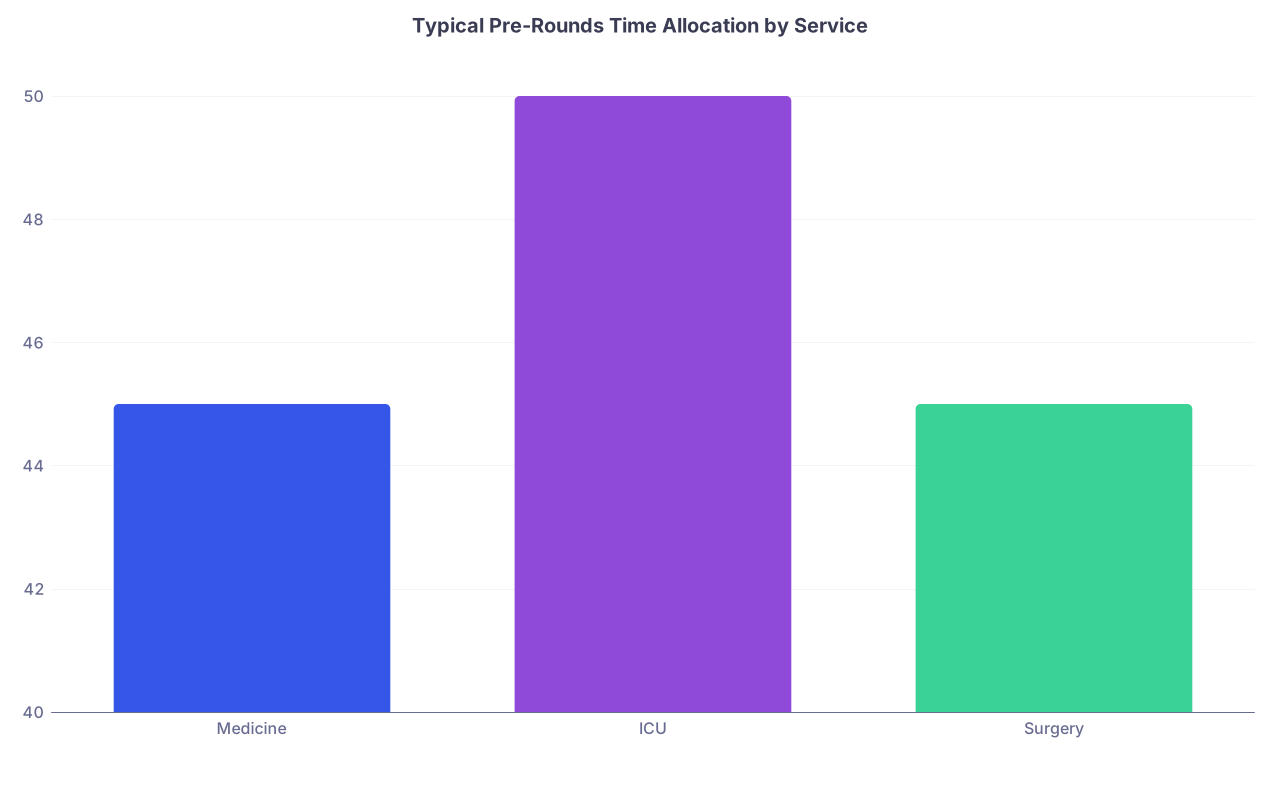
Pre‑rounding on a general medicine floor is not the same as on the ICU or surgery. But the skeleton stays similar.
Medicine floor (8–12 patients)
- 15 minutes chart
- 20 minutes bedside
- 10 minutes documentation skeleton + to‑do list
Focus:
- Trends (vitals, labs)
- Med reconciliation
- Dispo planning
ICU (6–10 sicker patients)
- 20–25 minutes chart (more data per patient)
- 15–20 minutes bedside (focused but more detailed exam)
Focus:
- Vent settings
- Pressor doses and drips
- Organ support (CRRT, lines, drains)
Surgery (10–20 post‑ops)
- 10 minutes quick chart scan (vitals, outputs, labs)
- 25 minutes high‑speed bedside checks
- 10 minutes skeleton notes
Focus:
- Pain, mobility, wound, drains, bowel function
- Complication screening (fever, tachycardia, hypotension)
| Category | Value |
|---|---|
| Medicine | 45 |
| ICU | 50 |
| Surgery | 45 |
Communication: The Invisible Efficiency Multiplier
You can run the cleanest solo pre‑rounds in the world and still waste time if you do not communicate well with nurses and seniors.
1. Brief nursing touchpoints
If you see something concerning in the chart (e.g., trend toward hypotension), but bedside exam is okay:
- Grab the nurse for 20 seconds:
- “He was borderline low overnight. If his SBP drops below 90 again, please page me immediately.”
This prevents surprises at 8:30 right as rounds start.
2. Sync with your senior before full team rounds
A 2‑minute huddle:
- “Ms. J in 410:
- Diuresed net –2 L, less SOB, Cr stable.
- I think we can continue current dose and maybe plan for discharge tomorrow.”
- “Mr. K in 415:
- New fever overnight, WBC up, blood cultures drawn, cefepime started.
- I am concerned he might have line sepsis; we should discuss imaging and line removal.”
This makes your senior’s life easier and your team more decisive on rounds.
Building the Habit: How to Make This Automatic in 2 Weeks
You will not be perfect on day one. But you can be dramatically better in 10–14 days if you treat this like learning a procedure.
Week 1: Rigid structure, slower pace
- Use a written checklist for the 8‑point chart review.
- Time yourself:
- How long per patient for chart?
- How long per patient at bedside?
- Aim for consistency, not speed at first.
Week 2: Remove the training wheels
- Try to internalize the steps so you are not reading off paper.
- Tighten your questions at the bedside.
- Start building note skeletons more quickly.
By the end of week 2, you should be able to:
- Walk in with a clear mental model for each patient.
- Anticipate your attending’s first 2–3 questions.
- Finish pre‑rounds on time without sprinting.

How to Know You Are Doing It Right
You are running efficient pre‑rounds when:
You are not surprised by major events on attending rounds.
(“Oh, he was febrile to 39 overnight? I didn’t see that.” is a fail.)Your presentation sounds like:
- “Overnight, no acute events. This morning, patient reports improved dyspnea, lungs are clearer, weight down 1.2 kg, net –1.8 L, Cr stable. I would continue current diuresis and start formal discharge planning.”
You can answer:
- “What is this patient’s likely discharge day?” for each person.
You are consistently done with pre‑rounds and basic skeleton notes before the attending shows up.
If that is not happening yet, you do not need to work “harder.” You need tighter structure.
One Last Point: Efficiency Is Not Neglect
Some interns hear “45‑minute pre‑rounds” and think “cutting corners” or “unsafe.” That is lazy thinking.
Efficient pre‑rounds are:
- Focused on changes and trends, not re‑documenting what you already know.
- Structured to catch deterioration quickly, not stumble onto it.
- Designed so you have enough bandwidth later in the day to:
- Call families
- Sit with a dying patient’s relative
- Double‑check a complex med reconciliation
Chaos wastes time. And it hurts patients. Structure frees you to be more human where it actually matters.
Your Action Step for Tomorrow Morning
Tonight, before you crash, do this:
Write down the 8‑point chart review on an index card:
- Vitals
- I/O & weight
- Labs
- Micro
- Imaging
- Meds
- Notes/consults
- Dispo
Put that card in your work bag or white coat pocket.
Tomorrow morning, when you sit down to pre‑round, follow that card for every patient before you see anyone in person. No improvising. No skipping steps.
Then time yourself from login to last bedside check. See how close you are to 45 minutes.
Do that for 5 weekdays in a row. You will not just feel “more efficient.” You will feel in control.