
You Trusted the School Calendar, Now ERAS Is Gone: A Warning Scenario
Here's the scenario I've watched play out too many times. An international medical school publishes its academic calendar late, again. Clinical blocks shift by two weeks. The registrar's office says transcripts will be ready "after the exam board meets," which is vaguely "sometime in August." Your letter writers are on summer rotation schedules. Then September hits. ERAS opens. And you're sitting there with half an application because you trusted a calendar that was never built for ERAS in the first place.
Don't assume your school's posted schedule is ERAS-compatible. It isn't. It was never designed to be. Your school's calendar serves internal academic requirements, exam schedules, faculty availability, institutional accreditation cycles. ERAS operates on a rigid, unforgiving national timeline that doesn't care whether your registrar is on vacation.
The most common failure points hit like dominoes: transcript verification delays when credentialing offices operate on local cycles, letter-of-recommendation bottlenecks when faculty can't access the portal or won't commit to dates, personal statement drafting time lost to administrative firefighting, and experiences you can't certify because the supervising physician left the institution.
This article gives you a protective, step-by-step deadline insurance plan. I'll show you red flags to watch for right now, before they cost you a match cycle.
The Core Mistake: Letting the International School Calendar Drive Your ERAS Timeline
Let me be blunt. Your school's internal calendar and ERAS processing reality are two completely different systems pretending to coexist. When you let the school calendar drive your ERAS timeline, you're handing control of your residency future to an administrative office that doesn't answer to NRMP.
Here's the structural problem. International schools operate differently. Transcript issuance systems vary wildly, some produce official transcripts only after full board approval, which can take weeks. Letter portals at your institution may not integrate with ERAS, meaning faculty have to navigate an unfamiliar system under time pressure. Registrar offices operate on cutoff dates tied to local academic terms, not US residency cycles.
This creates four "deadline risk" categories you need to understand:
- You can't submit at all because verified documents haven't arrived.
- Your application is incomplete or incorrect because you rushed to meet the deadline with whatever you had.
- Your letters are late or never uploaded because faculty missed portal instructions or assumed someone else would handle it.
- Your experiences are unverified or inaccurate because supervisors are unreachable or records are archived.
Here's the protective rule I want you to internalize: always build a buffer. Assume 2-4 weeks of administrative drag for transcripts and credential verification. Assume at least 1-2 weeks for LoR uploads after the faculty member has actually written the letter. These aren't pessimistic estimates, they're realistic ones based on what actually happens at international schools.
First 48 Hours: Triage Like a Safety Protocol (Do Not Wait)
If you're reading this and realizing your timeline is already shaky, the clock starts now. Not tomorrow. Not after you finish your rotation. Now.
Step 1: Identify your exact ERAS phase status. Where are you in the process? Has ERAS opened for you? Have you requested letters? Is your transcript ready? Document every missing item on a single page. Don't keep it in your head, write it down.
Step 2: Contact the right people today. That means the registrar or exams office for transcript timelines. Your ERAS letter authors for submission commitments. Any credentialing or verification office at your institution. When you contact them, request written confirmation of timelines. Not verbal promises. Written. An email that says "transcripts will be issued by [date]" is worth ten conversations that end with "we'll try."
Step 3: Create an evidence checklist. What's actually blocking you? Are you missing a transcript? A verified credential? A letter upload? Or is it just internal approvals that haven't moved? Be specific. "Everything is delayed" is not a checklist item. "MSPE not signed by dean as of [date]" is.
Step 4: Set a communications escalation plan. Who gets emailed today? Who gets a follow-up in 48 hours? When do you escalate to department leadership or the dean's office? Write this down too. If you don't define the escalation path now, you'll hesitate later, and hesitation costs weeks.

Build a Backward Plan: Your ERAS Timeline Must Outrun Your School's Delays
Here's the method that actually works. Stop planning forward from your school's calendar. Start planning backward from ERAS deadlines.
Take the hard ERAS submission date. Subtract time for transcript and LoR processing, the real time, not the promised time. Then subtract time for you to review, correct, and finalize everything. What's left is your internal readiness deadline, and it's probably weeks earlier than you think.
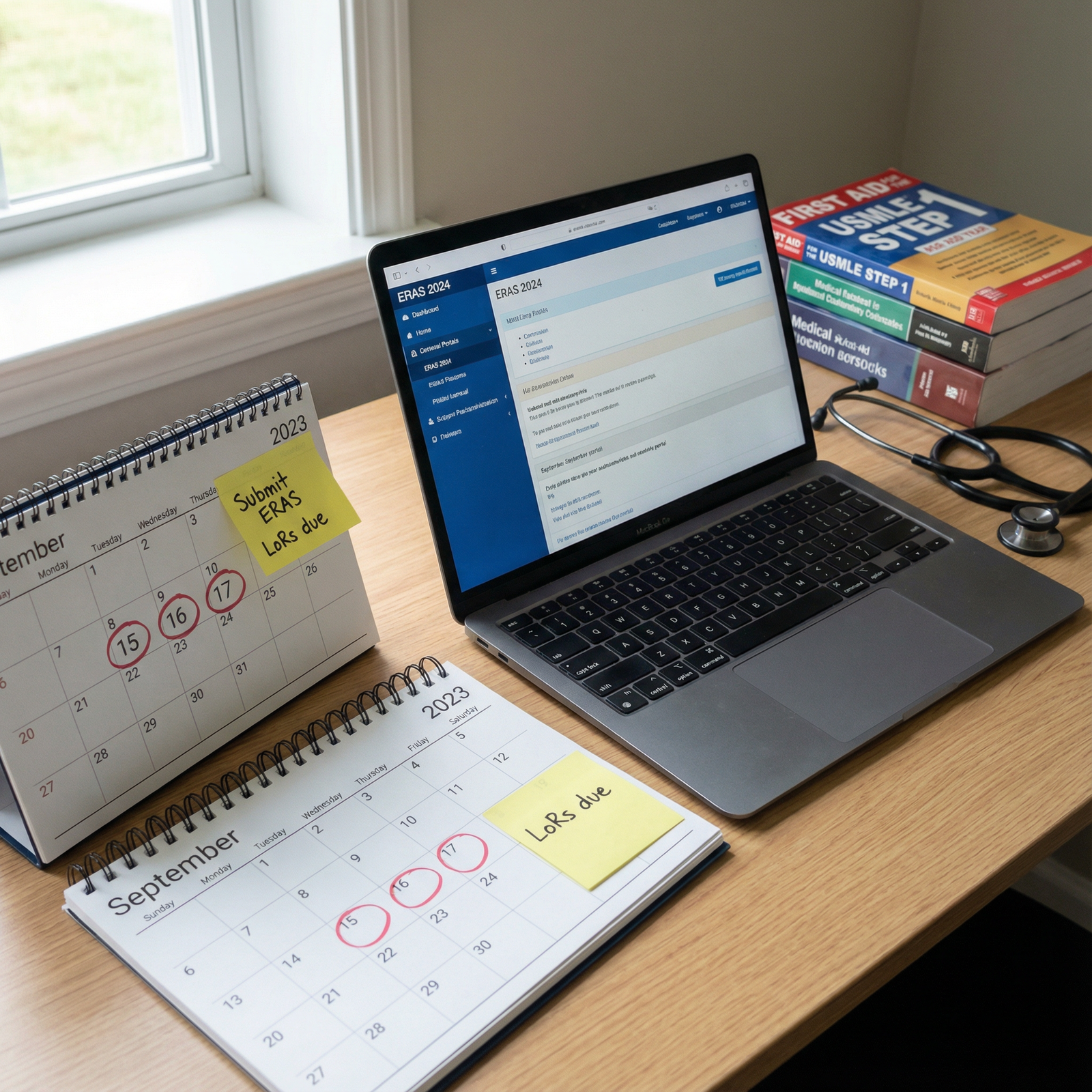
Let me give you a concrete example. If ERAS opens September 6 and you want to submit by September 15:
- Subtract 1 week for final submission review and corrections.
- Subtract 2-4 weeks for transcript verification and credentialing.
- Subtract 1-2 weeks for LoR uploads after authors write them.
- Subtract 2-3 weeks for authors to actually write the letters after you request them.
That puts your internal start date somewhere in mid-July. Not September. July.
Use a "minimum viable submission" approach. Target earlier internal readiness milestones so that if something breaks, and something always breaks, you still have a complete application ready to go. Your personal statement should be in final review when ERAS opens, not in first draft. Your CV and activities should be locked. Your letter authors should have already confirmed and ideally already uploaded.
Buffer schedule template:
- 8-10 weeks before submission: Personal statement final draft complete. CV/activities finalized. Letter authors confirmed with agreed timelines.
- 6-8 weeks before submission: Letter requests formally submitted through ERAS. Transcript requests submitted to registrar. Credentialing verification initiated.
- 3-4 weeks before submission: Follow up on all outstanding items. Verify letter uploads. Confirm transcript delivery.
- 1 week before submission: Final review window. No new content. Only corrections.
Protect yourself from last-minute edits. Plan a final submission review window 5-7 days before your target date. During this window, you're not writing, you're checking. Names, dates, titles, consistency. That's it.
Letters of Recommendation: The Hidden Deadline Trap (And How to Stop It)
LoRs destroy more international applications than any other single factor. I've seen it repeatedly. Faculty availability is unpredictable. Institutional sign-off requirements add layers of delay. Portal submission processes confuse everyone, faculty included.
The mistake almost everyone makes: requesting letters late and assuming "we'll upload later." Later never comes. Or it comes after the deadline.
Here's what you do instead. The moment ERAS windows open for letter requests, you're in motion. Confirm your letter authors. Confirm the format and portal requirements. Submit the formal requests immediately.
Protective LoR workflow:
- Choose backup letter writers. For every primary author, have a backup. If your first choice goes silent for two weeks, you switch. Don't wait until it's too late.
- Supply each author a brag sheet. Include competency themes you want highlighted, key rotations where you worked with them, measurable achievements, and specific patient encounters or projects. Make it easy for them to write a strong letter quickly.
- Track status weekly. Create a simple tracker: requested, drafted, signed, uploaded. Check it every week. Follow up politely but persistently.
Red flags that should trigger immediate action:
- Faculty responds with "I'll submit when I can." That's not a timeline. Press for a date or find another writer.
- Unclear submission responsibility. Who's actually uploading, the faculty member, a department admin, or a committee? Get this clarified in writing.
- Missing unique identifiers needed for ERAS upload. If your author doesn't have the right information, the letter can't be attached to your application. Verify this early.
Transcripts, Certification, and Verification: When the Registrar Slows You Down
International transcript and verification processes are a minefield. Grading formats differ from US systems. Issuance happens only after exam boards convene, which may not align with ERAS timelines. Credential offices operate on local academic cycles, not US residency deadlines.
Protect yourself by verifying early. Ask specifically: what version of the transcript is required for ERAS? How should it be issued, official sealed copy, certified copy, electronic transmission? Is translation required? Notarization? Don't discover these requirements three weeks before the deadline.
Clarify responsibility boundaries. Who submits directly to the ERAS platform? Who provides the document package to you? These are different tasks. The mistake I see constantly: students assuming ERAS will "pull it later" from their school. ERAS doesn't pull anything. You or your school submit, or it doesn't exist.
Red flags from the registrar or credentialing office:
- "We don't do that for residency applications." Then find out who does, immediately.
- Credentialing requires signatures from people who are currently unavailable. Identify this now, not in August.
- Estimated turnaround times are vague. "A few weeks" is not an answer. Get a specific date or escalate.
- The office has no familiarity with ERAS requirements. This is common at international schools and means you'll need to educate them, gently but firmly.
Personal Statement & Activities: Don't Let Calendar Chaos Ruin Your Story
Missing ERAS deadlines isn't just administrative. It's narrative. When you're forced to rewrite your personal statement during a crisis because transcripts are late and you're panicking, your story suffers. Programs can tell.
Protect a consistent narrative by mapping your experiences to themes early: clinical growth, research, leadership, service. Write your activity descriptions while rotations are fresh. Update them incrementally rather than reconstructing everything in a single desperate weekend.
A common error that's easy to prevent: changing activity descriptions repeatedly without a final integrity check. You tweak one section, forget to update a corresponding detail in your personal statement, and suddenly your application contradicts itself. Inconsistencies across sections are visible to program directors and they raise questions about attention to detail.
Quality gate checklist before you lock your narrative:
- Clarity: Does each paragraph have a purpose? Cut filler.
- Specificity: Are you naming what you actually did, or hiding behind vague language?
- Alignment: Does your story fit your target specialty? A personal statement that could work for any specialty works for none.
- Evidence of impact: Did you include measurable outcomes, specific patient interactions, or concrete results?
If You're Already Late: Damage Control That Still Helps (Reality-Based Options)
Let's be real. If you're reading this and already behind, panic won't help. The mistake to avoid now is panic-based rework, rewriting everything, changing your strategy, second-guessing your specialty choice. Don't do that. Focus on what can still be improved quickly and credibly.
Practical options when you're behind:
- Submit as complete as possible. A slightly delayed but complete application beats an on-time incomplete one. But know the real cutoff, programs start reviewing at different times.
- Request urgent letter submission. Email your authors directly, acknowledge the urgency honestly, and ask if they can upload within 48 hours. Follow up with the department admin if needed.
- Send transcripts immediately with documented proof of submission. If the registrar can't deliver to ERAS directly, get the sealed copy in your hands and ship it overnight.
- Reduce downstream harm. If you're applying late, adjust your program selection. Broaden your list. Don't make last-minute content changes that create mismatches between your personal statement and activities.
Keep a paper trail for everything. Emails, screenshots, confirmation numbers, dates. If verification goes sideways or a program asks why something is delayed, you need documentation, not memory.
Red Flags Checklist: When Your School's Process Puts You at Risk
Here's your direct, protective checklist. If any of these are true right now, you're at risk:
- Transcript issuance date is unknown or unconfirmed. Dangerous because without it, your entire timeline is fiction.
- Faculty won't commit to a letter submission timeline. Dangerous because letters are the single most common failure point for international applicants.
- LoR submission method is unclear. Who's uploading? Through what portal? With what identifiers? Unclear means late.
- No credential office contact or the contact is unresponsive. Dangerous because credentialing is the bottleneck you can't bypass alone.
- Your school has no ERAS liaison or designated support person. Dangerous because you're navigating a US system without institutional knowledge.
- Registrar turnaround estimates are vague. "A few weeks" means they don't know. Assume the worst.
Required escalation threshold: if a risk remains unresolved after 48-72 hours of your initial contact, escalate. Email a higher institutional contact, program director, department admin, credentialing lead, dean's office. Be polite but clear about what you need and why.
The protective principle: assume delay until you have written confirmation and a realistic completion date. If it's not in writing, it doesn't exist.

Closing: Create Your ERAS Deadline Firewall, Start Today
Today is the day. Not when your school posts its "next update." Not when the registrar gets back to you. Today.
- Confirm your ERAS milestone status, where are you right now, exactly?
- Contact your registrar and credentialing office with specific questions and request written timelines.
- Lock your letter authors with confirmed submission dates and backup writers identified.
- Draft your personal statement and activities now, not when the deadline is looming.
- Schedule a final review window 5-7 days before your target submission date.
One more mistake to avoid: making assumptions. If it's not confirmed in writing, it's not real. A faculty member who said "sure, I'll write it" in the hallway hasn't committed to anything. A registrar who said "we should be able to do that" hasn't delivered anything.
You can still submit strong and on time. But only if you act immediately with a structured plan. Build your firewall today.