

Most U.S. residency faculty barely trust letters from their own institution. So you can imagine what happens when they see a LOR from a hospital in another country they’ve never heard of.
Let me walk you through what actually goes through an attending’s head when they open “Letter of Recommendation – International Medical Graduate” on ERAS. Because the fantasy version you hear on forums—“a strong letter is a strong letter anywhere”—is not how selection meetings work.
What Really Happens When They See an IMG Letter
Here’s the part nobody tells you: for many faculty, the first filter is not what the letter says. It’s who wrote it and where it’s from.
I’ve sat in meetings where a PD scrolls through an IMG’s application and literally says, “Okay, what do we have from U.S. people? Anything from here or nearby?” International letters get mentally sorted into three buckets within seconds:
- Well-known institution / well-known name
- Unknown institution / unknown name
- International superstar / U.S.-connected hybrid
Let me spell out how each bucket actually plays out.
Bucket 1: “We Know This Place/Person” (The Golden Ticket)
If your letter is from, say, Aga Khan University, All India Institute of Medical Sciences, Charité, or a major UK teaching hospital, there’s recognition. Not universal, but enough that someone on the committee usually goes, “Oh, that’s a strong place.”
Even better if the writer is a name the PD or faculty recognize from publications, conferences, or past residents.
What happens in the room:
- The letter is read more slowly.
- Language like “top 5% of students I have worked with in the last decade” actually lands.
- Caveats about being international decrease.
- If their prior resident from that school performed well, your stock rises immediately.
This is why you see clusters of residents from particular foreign schools at certain U.S. programs. Once a program has had two or three excellent IMGs from the same school (and the same “type” of letter writer), they start trusting those letters more quickly.
Bucket 2: “No Idea Who This Is” (Default Skepticism)
Now the harsh reality.
For the majority of IMGs from non-famous schools, the faculty have never heard of your university, your hospital, or your letter writer. They’re not going to Google every one. They don’t have time.
So they do this mental shortcut:
- Treat the letter as “likely inflated”
- Look for red flags more than strengths
- Downgrade superlatives (“outstanding,” “excellent,” “superb”) as baseline, not exceptional
- Ask: “Do we have any U.S.-based letters for this applicant?”
That sounds unfair. It is. But it’s how high-volume selection works when people have 1–2 minutes per applicant on first pass.
Bucket 3: The Hybrid / Connector Letter
This is the letter from the international school, but the writer is U.S.-trained, U.S.-boarded, or has a known link to the U.S. system. Looks like:
“Consultant in Internal Medicine, Trained at Cleveland Clinic, ABIM-certified” or
“Professor of Surgery, Visiting Faculty at [U.S. university]”
These letters get treated very differently. Because now the faculty reading it think, “This person understands U.S.-style evaluation and expectations.” It’s halfway to a U.S. letter in their heads.
That’s a powerful upgrade.
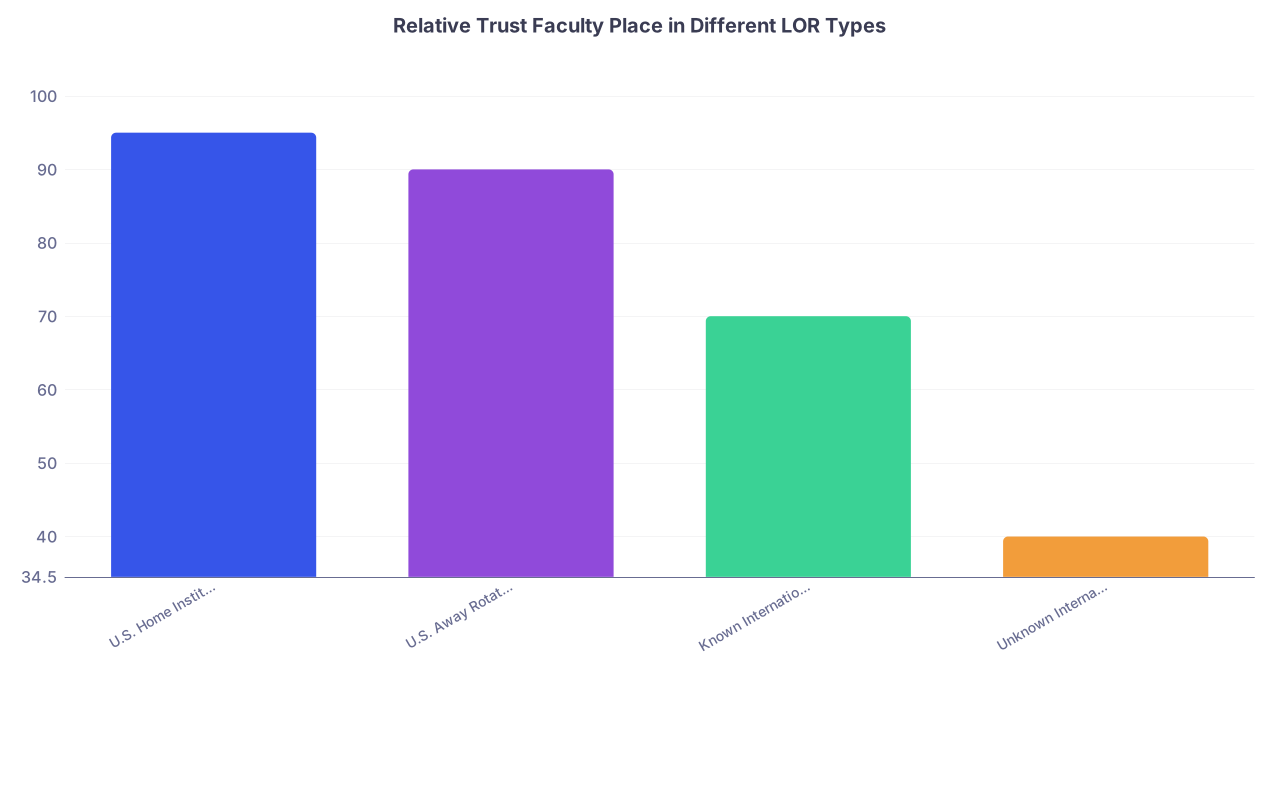
| Category | Value |
|---|---|
| U.S. Home Institution | 95 |
| U.S. Away Rotation | 90 |
| Known International Center | 70 |
| Unknown International Program | 40 |
These numbers are not official statistics. They’re reality as felt in committee rooms: how much weight people instinctively put on each type of letter.
What Faculty Actually Look For in IMG LORs (Beyond the Letterhead)
Once they decide a letter deserves real attention, they’re not reading the way you think they are.
They’re scanning. Fast. And they’re hunting for specific signals.
1. Concrete Behaviors vs. Empty Praise
Programs are drowning in adjectives: “hardworking,” “dedicated,” “compassionate,” “very smart.” Everyone has these.
What stands out to faculty are specific behaviors that map onto residency performance:
- “She independently managed 10–15 complex inpatients overnight and knew the details cold on morning rounds.”
- “He regularly stayed after hours to follow up on results and update families without being prompted.”
- “I trusted her to present at our departmental morbidity and mortality conference, and she handled challenging questions from consultants professionally.”
Generic: tossed in the “everyone says this” bucket.
Concrete: that’s when someone on the committee looks up and says, “Okay, that’s real.”
2. Level of Comparison
The single most important line in many strong letters is the comparison statement. U.S. faculty know this game. Some international writers do, some don’t.
There’s a huge difference between:
- “One of the best students I’ve supervised.”
vs. - “One of the top 5 medical students I have worked with in the last 10 years.”
When faculty read IMG letters, they’re asking: “Compared to whom?”
If the letter gives an explicit comparison group (last 5 years, last 10 years, top 10%), that carries genuine weight. If it’s just “one of the best,” they usually discount it.
3. Evidence of U.S.-Relevant Skills
This is where many international letters fail. They describe excellence, but not in a way that U.S. residency cares about.
Residency faculty want to know:
- Can you work in a system with high volume and high acuity?
- Can you communicate with patients clearly and respectfully?
- Do you own your patients and follow through?
- Are you safe? Do you know your limits and ask for help?
Phrases that land well from IMG letters:
- “He consistently arrived early having pre-read all charts and had an organized assessment and plan.”
- “She communicated complex diagnoses to low-literacy patients in a way they could understand, as observed in multiple clinic encounters.”
- “He escalated care appropriately when out of his depth, rather than attempting procedures beyond his level.”
That last point—knowing when not to cowboy something—is massive. Especially for specialties like surgery or emergency medicine that are nervous about unsupervised “experience” abroad.
4. Red Flags Hidden in Polite Language
You’re used to reading letters as if everything positive is literal. Faculty are used to decoding hedged language. They’ve seen hundreds.
Problem phrases in IMG LORs:
- “With further training, she has potential to be a strong physician.” → Not ready now.
- “He was never late and always dressed professionally.” → That’s the best they could say. Ominous.
- “She completed all tasks assigned to her.” → Low ceiling. No initiative.
- “He did not have any major professionalism issues.” → There were minor ones.
On the flip side, what they love seeing:
- “I would rank her in the top 5% of trainees I have ever worked with.”
- “I would be genuinely thrilled to have him as a resident in our own program if that were possible.”
- “I have no reservations recommending her for a demanding residency program in the United States.”
Those are unambiguous. That’s what you’re aiming to get your writers to say.
| Letter Phrase | How Faculty Often Read It |
|---|---|
| “Hardworking and punctual” | Baseline; nothing special to highlight |
| “Completed all assigned tasks” | Minimal initiative; did the minimum |
| “Will do well with further training” | Not ready now; borderline performance |
| “Top 10% of students in the last 5 years” | Strong, meaningful endorsement |
| “I would gladly take them in our own residency” | Very strong; high confidence |
Why U.S. LORs Still Trump Everything for IMGs
Let me be blunt. A mediocre U.S. clinical letter from a mid-tier hospital often carries more weight than a glowing letter from an unknown international program.
Not because you’re less capable. Because faculty know how to interpret the U.S. letter writer’s context. They know what “average” means there.
This is the behind-the-scenes hierarchy most IMGs never get told:
- U.S. letter from the same specialty, same institution you’re applying to
- U.S. letter from academic program in same specialty
- U.S. letter from any reputable clinical setting
- Letter from well-known international academic center, U.S.-connected writer
- Letter from well-known international center, local writer
- Letter from unknown international program
You don’t have to like that list. But if you ignore it, you handicap yourself.
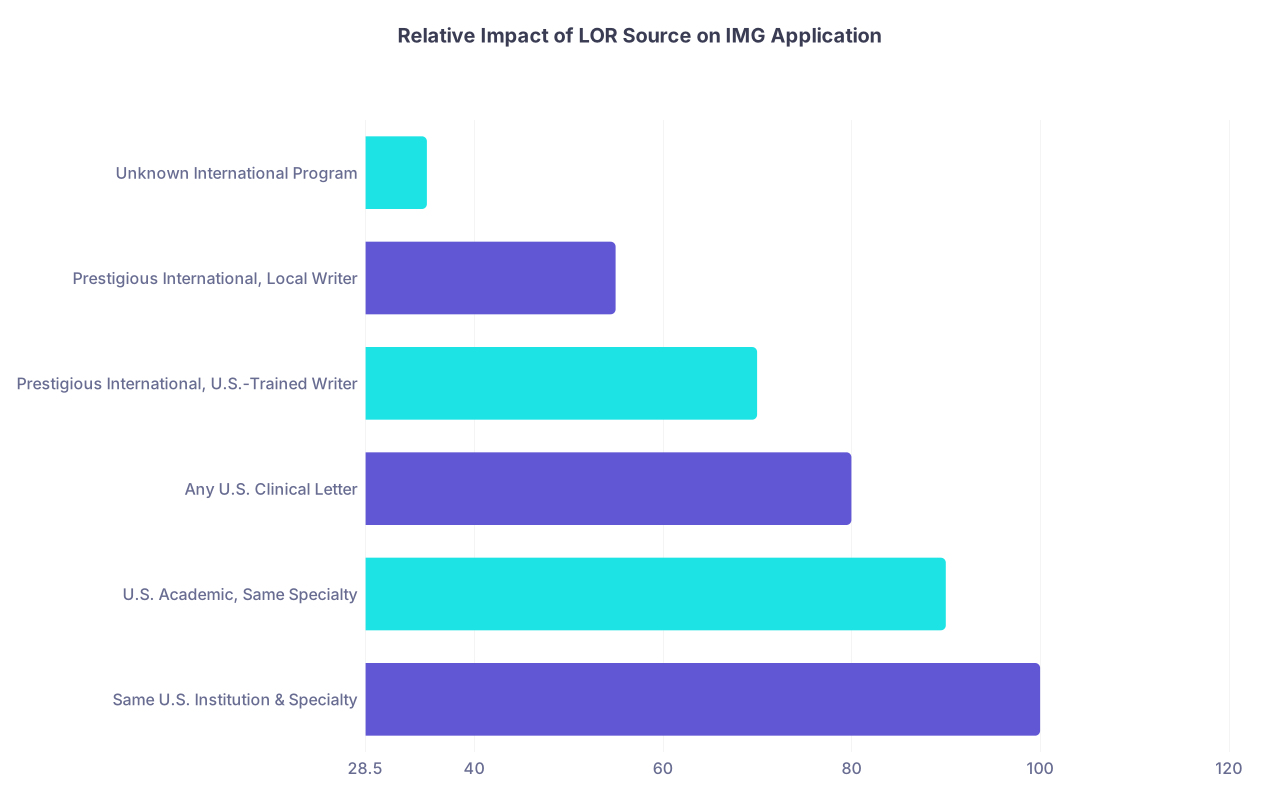
| Category | Value |
|---|---|
| Same U.S. Institution & Specialty | 100 |
| U.S. Academic, Same Specialty | 90 |
| Any U.S. Clinical Letter | 80 |
| Prestigious International, U.S.-Trained Writer | 70 |
| Prestigious International, Local Writer | 55 |
| Unknown International Program | 35 |
How to Engineer Better Letters from Abroad
You can’t change where you went to medical school. You can absolutely change how your letters are written.
The strongest IMG applicants I’ve seen did not leave their letters to chance. They quietly engineered them.
Step 1: Choose Writers Strategically, Not Emotionally
Stop asking for letters from whoever “likes you” the most. Your best friend attending with no academic title and no U.S. exposure might write a heartfelt letter that carries very little weight.
Your priority order should be:
- Faculty who trained in the U.S., UK, or other well-known systems
- Department heads / program directors / academic leadership
- People who regularly supervise students who match to the U.S.
- Only then, anyone else who knows you well
And yes, that might mean doing extra work on their service, volunteering for research, or spending time you don’t feel you have. Welcome to the real game.
Step 2: Give Them Raw Material They Can Use
Here’s what top-performing IMGs quietly do: they hand their letter writers a concise “brag sheet” and often a draft skeleton.
Not a full fake letter—that backfires if it sounds nothing like the writer. But clear bullets:
- 3–5 concrete clinical examples: a complex case, an extra responsibility you took on, a time you taught others.
- Any teaching, leadership, or QI/research you did under them.
- Your specific career goal (“applying to internal medicine, aiming for academic hospitalist career”).
You’re not “bothering” them. You’re making their life easier. Busy attendings recycle phrases. If you put real substance in front of them, they’re more likely to build from that.
Step 3: Educate Them (Subtly) on What U.S. Programs Look For
Most international faculty have never seen a U.S. residency selection meeting. They don’t know what lands.
You can say something like:
“For U.S. residency, it’s helpful if the letter includes how I compare to my peers, specific examples of my clinical performance, and whether you’d recommend me for a demanding training program in the U.S.”
That’s diplomatic code for:
“Please include a comparison statement, specifics, and an explicit endorsement.”
Some will ignore this. The smart ones appreciate it.
Step 4: Stack Your Letters Intentionally
If you’re allowed four LORs, and you’re an IMG, a strong strategy often looks like:
- 2–3 U.S. clinical letters in your specialty or close to it
- 1–2 international letters from the strongest, most credible voices at your home institution
If your school has weak name recognition, you don’t want all four letters from there. You want your home letters to confirm that “Yes, they were excellent here too,” not to be your only evidence.

| Step | Description |
|---|---|
| Step 1 | Start LOR Planning |
| Step 2 | Prioritize U.S. Supervisors |
| Step 3 | Identify U.S.-Trained Faculty at Home |
| Step 4 | Request 2-3 U.S. Letters |
| Step 5 | Request Letters from U.S.-Trained or Senior Faculty |
| Step 6 | Add 1-2 Strong Home Institution Letters |
| Step 7 | Provide Brag Sheet and Guidance |
| Step 8 | Finalize LOR Set for ERAS |
| Step 9 | Any U.S. Clinical Experience? |
The Ugly Truth About Form Letters and Cultural Style
Another thing you won’t hear at info sessions: many IMG letters are written in a style that U.S. faculty immediately distrust.
Patterns that trigger suspicion:
- Overly formal, generic language: “It gives me immense pleasure to recommend this outstanding student who has been a great asset to our institution.” Sounds like every other one.
- No weaknesses mentioned, no nuance, pure praise.
- Identical phrases across multiple letters from the same institution. Committees do sometimes notice.
In some cultures, this is normal. You’re not supposed to say anything remotely negative. In U.S. selection culture, that reads as “I can’t tell if any of this is real.”
Contrast that with a U.S.-style strong letter that might say:
“Her only limitation at this stage is her tendency to take on too much; she occasionally stayed late to follow up on non-urgent issues. With guidance in prioritization, she will be an outstanding resident.”
See the difference? There’s a mild “weakness,” but it actually strengthens the letter. It sounds like someone who thought about you as a real person, not a template.
If your home institution churns out boilerplate letters, you need to compensate with at least one or two letters that sound different—ideally from a more internationally savvy faculty member.
How Premeds and Early Med Students Should Think About This
You’re in premed or early med school and think this is far away. It’s not. LOR quality is built years before you ask for it.
If you’re planning to attend an international medical school and aim for U.S. residency, here’s the real long game:
- Before you commit to a school, find out: how many grads matched to the U.S. in the last 3–5 years, and where. If that number is tiny or secret, you’ll be fighting uphill for both experiences and letters.
- Identify which departments and which attendings actually have U.S. ties. Those are your future letter writers. Rotate with them. Impress them. Stay in touch.
- Plan early for U.S. clinical exposure. Observerships are better than nothing, but hands-on electives where you can get letters—that’s gold.
You’re not just choosing a school. You’re choosing your future LOR ecosystem.
And that ecosystem matters more than any brochure cares to admit.
FAQs
1. Are international letters completely useless if I don’t have any U.S. experience?
No, but they’re limited. Programs will read them, but they’ll be cautious. If you have zero U.S. clinical letters, your international letters need to be unusually strong: specific, comparative, and ideally from well-known or U.S.-trained faculty. You should, in parallel, be planning ways to get any form of U.S. clinical exposure before you apply. Even a late, single U.S. rotation can change how your entire file is perceived.
2. Is it better to choose a writer who knows me well or a more senior, famous person who barely worked with me?
The ideal is both: someone senior who actually supervised you closely. If you have to choose, early on as an IMG I’d lean slightly toward the more credible title—as long as they can write more than a two-line “I endorse this student” note. A bland paragraph from a famous chair is useless. But a detailed, enthusiastic letter from a mid-level faculty member with U.S. training often beats a vague, generic one from the dean who never met you.
3. Should I ever write my own letter and have the faculty just sign it?
This happens. Faculty ask students to draft letters. From the program side, you can always smell the ones that were obviously written by the student. Overly polished, weirdly self-promoting, not matching the writer’s language style across other letters. It undermines trust. Better approach: draft a bullet-point summary and key examples, maybe a skeleton outline. Let the faculty member turn that into their own letter in their own words.
4. How many international letters vs. U.S. letters should I aim for as an IMG?
If you’re serious about matching in the U.S., you should be aiming for at least two strong U.S. clinical letters in your chosen specialty or close to it. The remaining one or two can be from your home institution, ideally from high-credibility, U.S.-aware faculty. Four out of four from an unknown international school is a tough sell, no matter how glowing they are. The balance should say: “They were excellent at home, and independent U.S. supervisors agree they function well in our system.”
Years from now, you’re not going to be obsessing over every adjective in those letters. You’ll be thinking about who actually knew you well enough to stake their reputation on you. Build those relationships early. The letters are just the paper trail.


