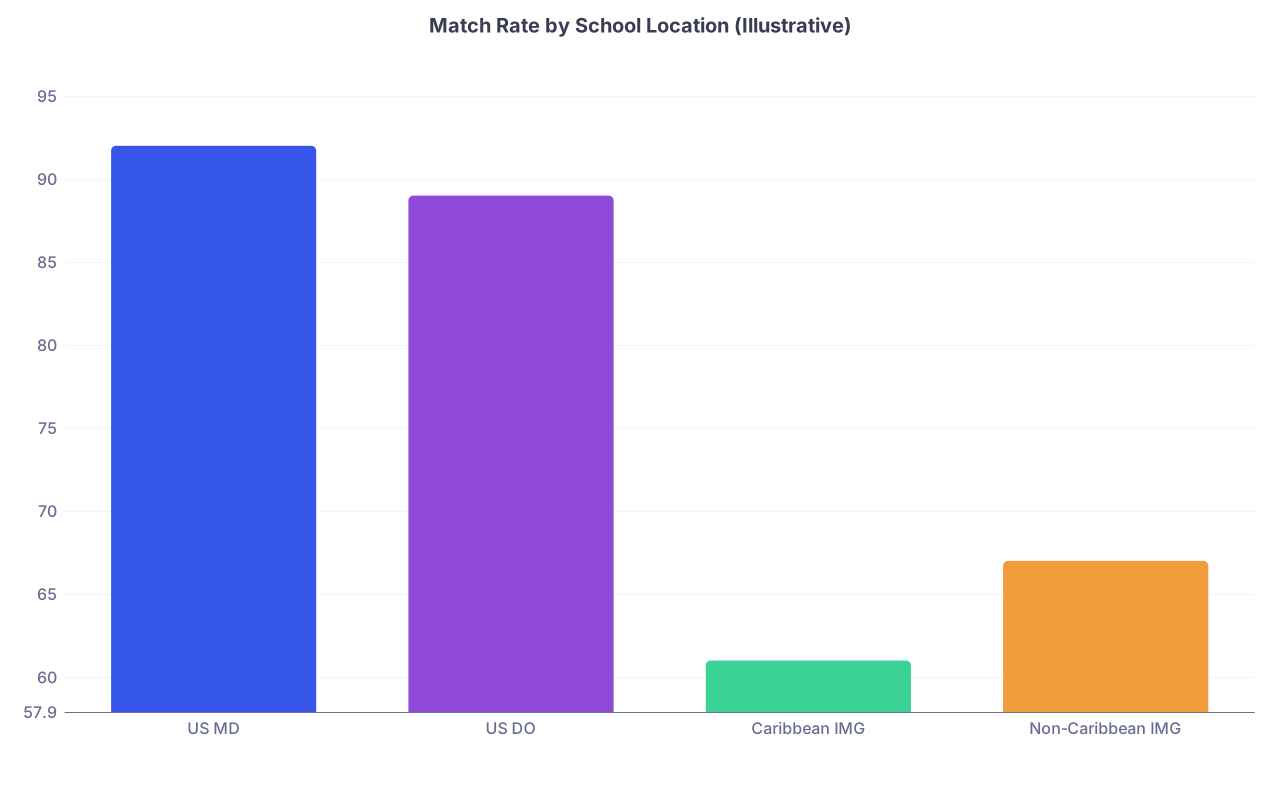
| Category | Value |
|---|---|
| US MD | 92 |
| US DO | 89 |
| Caribbean IMG | 61 |
| Non‑Caribbean IMG | 67 |
The romantic idea that “good doctors come from everywhere” collapses the moment you look at the match data by location. The country—and often the specific region—where you attend medical school strongly predicts which specialties you can realistically enter.
If you ignore that, you are not making a brave choice. You are making a statistically uninformed one.
I will walk through what the data show about how international medical school location shapes specialty options. Not anecdotes. Not recruitment brochures. Actual match outcomes, score distributions, visa bottlenecks, and program preference patterns.
1. The Baseline: Who Actually Matches, And Where
Start with the big picture. The NRMP (National Resident Matching Program) data in the United States are brutally clear: school location and graduate category shape your odds before anyone reads your personal statement.
The relevant groups for specialty choice:
- US MD seniors (LCME‑accredited schools in the US)
- US DO seniors (COCA‑accredited osteopathic schools)
- US citizen IMGs (Americans who went abroad for med school)
- Non‑US citizen IMGs (international students, international schools)
The precise percentages vary by year, but the pattern is highly stable. If you condense the last several match cycles into an “average year,” you get something like this:
| Applicant Type | Overall Match Rate (%) |
|---|---|
| US MD Seniors | 90–94 |
| US DO Seniors | 85–90 |
| US Citizen IMGs | 55–65 |
| Non‑US Citizen IMGs | 55–60 |
So before we even split by specialty, international school graduates are starting 25–35 percentage points behind US MD seniors.
Where does location come in?
Because “IMG” is a catch‑all. Inside that category, outcomes differ sharply by where you trained:
- Caribbean “offshore” schools (aimed at US/Canadian students): moderate match rates overall, but heavily skewed toward primary care and prelim positions.
- Europe/Asia/Latin America public universities: more variability; some regions and specific schools are well‑known and relatively favored, others are essentially invisible to US PDs.
- Home‑country match vs US match: a Russian or Indian graduate often has much higher odds matching in their own country than in the US. The direction you plan to practice matters.
Location determines three things that then drive specialty choice:
- Perception of school quality (name recognition, historical experience with alumni)
- Average exam scores and clinical preparation of its graduates
- Visa and regulatory friction between that country and your target residency market
Those three variables tether you to specific specialty probability bands whether you like it or not.
2. Competitive vs Non‑Competitive Specialties: Different Games
Look at the specialties where US MDs fight hardest: dermatology, plastic surgery, orthopedic surgery, ENT, neurosurgery, ophthalmology, radiation oncology, interventional radiology. Then look at the proportion of positions in those fields filled by IMGs.
The data do not support the “if you work hard enough, anything is possible” narrative for most international graduates.
An approximate breakdown using recent NRMP data patterns:
| Specialty | % of Positions Filled by IMGs |
|---|---|
| Internal Medicine (Categorical) | 40–45 |
| Family Medicine | 35–45 |
| Pediatrics | 20–30 |
| General Surgery (Categorical) | 15–20 |
| Orthopedic Surgery | 3–6 |
| Dermatology | 2–4 |
Now layer on where those IMGs trained. In highly competitive specialties:
- The majority of IMG slots are filled by non‑US IMGs from well‑known institutions (e.g., top Indian, Pakistani, German, or Brazilian schools; occasionally top Caribbean grads with exceptional profiles).
- “Mass market” offshore schools (large Caribbean programs with huge class sizes) contribute very few residents to these fields relative to their size. Their statistical output goes overwhelmingly into internal medicine, family medicine, psych, and prelim years.
The data show three tiers of specialty probability by location:
- US MD / top‑tier non‑US schools (home‑country stars): full specialty menu with high competitiveness possible (with strong scores and CV).
- Non‑US but reputable national university + strong exam performance: decent shot at mid‑competitive specialties (neurology, pathology, anesthesiology, some surgery) and strong odds in IM/FM/psych.
- High‑volume offshore Caribbean / lower‑visibility private schools: realistic odds concentrated in primary care and a subset of internal medicine subspecialty tracks via strong performance after matching.
You can fight those odds with perfect scores and research. But you cannot erase them.
3. Caribbean vs Non‑Caribbean IMGs: Same Label, Different Numbers
Lumping all foreign schools together hides a critical split: offshore Caribbean schools targeted at US/Canadian students vs everyone else.
The Caribbean pipeline is large and highly exposed to US match data because most of their graduates apply to US residencies. This makes it easier to see the effect of location and reputation.
A typical pattern (approximate, synthesized from NRMP + school‑reported stats):
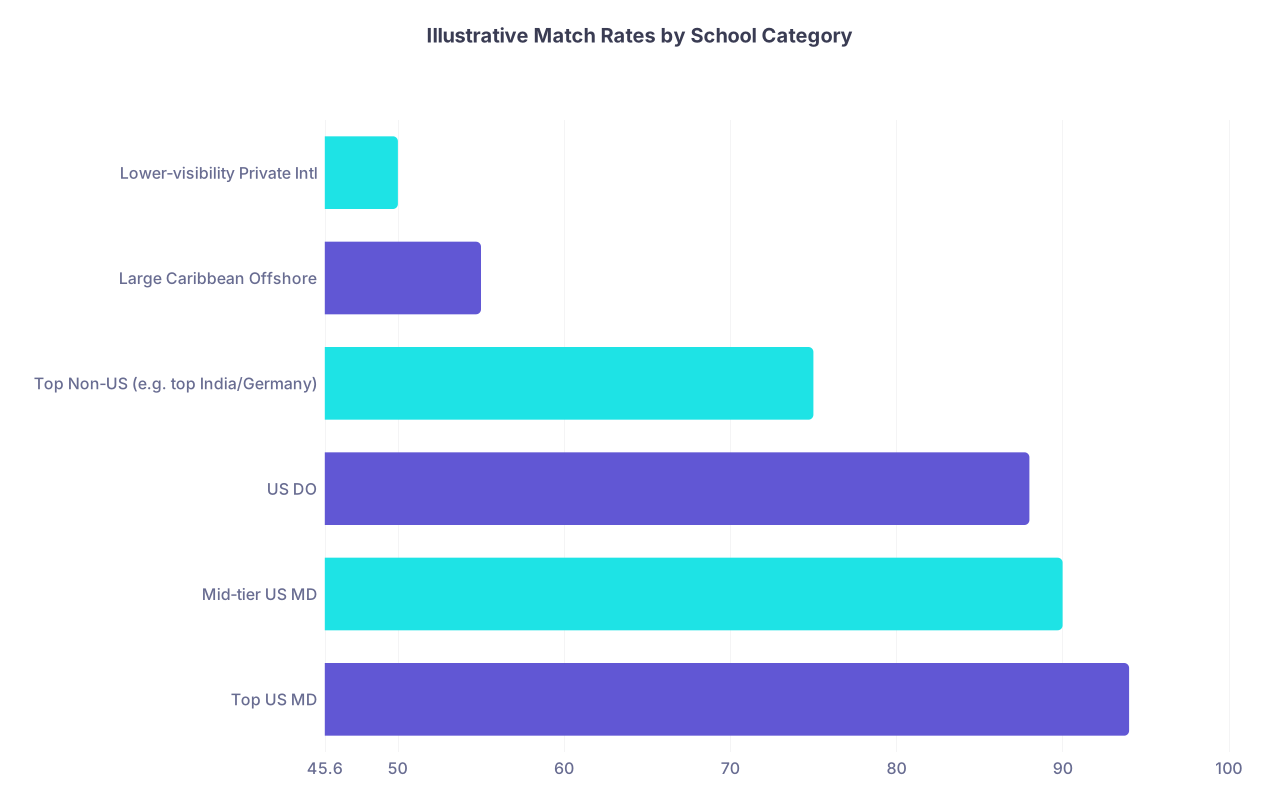
| Category | Value |
|---|---|
| Top US MD | 94 |
| Mid‑tier US MD | 90 |
| US DO | 88 |
| Top Non‑US (e.g. top India/Germany) | 75 |
| Large Caribbean Offshore | 55 |
| Lower‑visibility Private Intl | 50 |
What actually happens to many Caribbean graduates?
- Large entering classes (hundreds per year), but a substantial fraction do not even reach the point of being competitive applicants (fail Step exams, delayed graduation, remediation).
- Those who match cluster in:
- Internal Medicine (categorical + prelim)
- Family Medicine
- Psychiatry
- Pediatrics
- Transitional/prelim year slots that require a second match attempt for advanced specialties
Very small slices end up in neurosurgery, ortho, ENT, derm, plastics. When it happens, it is an outlier with Step scores in the absolute top percentiles, serious research, and usually strong US connections.
By contrast, a student at a relatively selective public university in Europe or Asia, with strong home‑country training and high USMLE scores, will often have a broader specialty menu. Program directors have learned, over time, that a “First Moscow State Medical University” or “All India Institute of Medical Sciences” or “Charité – Universitätsmedizin Berlin” graduate is not the same as “random private offshore school.”
Same IMG label on the NRMP report. Very different priors in the PD’s head.
4. USMLE / Exam Score Distributions by Location
Specialty choice is filtered heavily through standardized exam scores: USMLE Step 2 CK (and previously Step 1), MCCQE, PLAB, etc., depending on target country. Here is where location quietly shapes the achievable ceiling.
Multiple patterns show up in the data and in PD behavior:
US MD and top non‑US schools have:
- Higher median exam scores
- Lower first‑time failure rates
- Tighter distributions (fewer extreme low scores)
Caribbean offshore and lower‑visibility private schools show:
- Lower mean USMLE scores
- Higher failure and delay rates
- More attrition before graduation or before exams
This is not just “smarter students go to better schools.” The environment matters:
- Curriculum alignment with USMLE content.
- Availability of structured test prep.
- Clinical exposure in US teaching hospitals vs understaffed local placements.
- Peer environment: a cohort where “230+ is normal” vs “just pass somehow.”
Because competitive specialties often use cutoffs, even small shifts in the score distribution matter. A 10‑point drop in median Step 2 CK can reduce the number of applicants above a cut line by 50% or more.
You see that directly when you look at Step 2 CK means in competitive specialties, compared to the likely distribution of scores coming from some international locations.
Let us use illustrative but realistic numbers:
| Specialty / Group | Mean Step 2 CK |
|---|---|
| Dermatology Matched Applicants | ~255–260 |
| Orthopedic Surgery Matched | ~252–255 |
| General Surgery Matched | ~244–247 |
| Internal Medicine Matched (overall) | ~240–243 |
| US MD Seniors Overall | ~245 |
| US IMGs (Caribbean‑heavy) Overall | ~232–236 |
| Non‑US IMGs (mixed) Overall | ~238–240 |
If your school environment and prior academic history make a 255 Step 2 CK score very unlikely, your probability of matching dermatology or ortho is functionally close to zero. Not mathematically zero, but low enough that treating it as a realistic career plan is statistical self‑delusion.
Location matters because it changes that score distribution. Some international schools consistently produce graduates whose scores look like US MDs. Others simply do not.
5. Visa Status, Geography, and Specialty Bottlenecks
People ignore this until late in the game, then panic: visa status plus school location further reshapes specialty odds.
Program directors care about:
- Paperwork and processing delays
- Funding rules attached to certain visas
- Long‑term retention (will this person stay in the US?)
- GME cap and institutional reporting complexity
Consequences, by location and citizenship:
Non‑US citizen IMGs from any location
- Face steeper odds in highly competitive specialties.
- Are often informally de‑prioritized by programs that lack infrastructure or motivation to handle visas.
- Cluster more heavily in internal medicine, family medicine, psychiatry, and pediatrics.
US citizen IMGs (Caribbean, Europe, etc.)
- Remove the visa barrier.
- Still face the stigma / uncertainty of unfamiliar schools.
- Perform relatively better in match stats than non‑US citizen IMGs from the same schools.
Location–visa interaction
- Some regions have more established pipelines. For instance, programs with long‑standing links to certain Indian, Pakistani, or Middle Eastern universities are far more comfortable filling IM slots from those schools than taking a one‑off candidate from an unknown private Caribbean campus.
- A non‑US citizen from a top‑tier German or UK school with high scores can sometimes break into more competitive specialties because PDs know the school and can benchmark performance.
Many Caribbean offshore schools primarily cater to US citizens, which softens the visa penalty but not the specialty bias. A non‑US citizen from those same schools often sits in the hardest quadrant: lower‑prestige school + visa complexity.
The net effect: non‑US citizen + international location pushes you even harder toward specialties that historically accept large IMG proportions: internal medicine, family medicine, psych, peds, path, and sometimes anesthesia/neurology in selected programs.
6. How Location Skews Specialty Outcomes: Concrete Patterns
To see how location actually plays out in specialty distribution, look at the NRMP “Charting Outcomes in the Match” and “Results and Data” reports over multiple years, then mentally stratify IMGs by known school clusters.
The patterns I have seen repeatedly when talking with Caribbean and non‑US grads, and cross‑checking with program rosters:
Caribbean offshore schools
- 60–80%+ of successful matches concentrate in:
- Internal Medicine (categorical + prelim)
- Family Medicine
- Psychiatry
- Pediatrics
- Transitional/preliminary medicine/surgery
- Very few categorical general surgery, ortho, derm, ENT spots.
- 60–80%+ of successful matches concentrate in:
Reputable non‑US national universities (Europe/Asia/LatAm)
- More diversified specialty output:
- Internal Medicine, Family Medicine, Pediatrics remain core.
- Noticeable numbers in Anesthesiology, Neurology, Pathology, sometimes Radiology and General Surgery in institutions with IMG‑friendly histories.
- Competitive surgical subspecialties and derm still rare but not extinct.
- More diversified specialty output:
Top‑tier non‑US schools (true national flagships)
- Output closer to a mid‑tier US MD school in terms of range, for high‑scoring graduates with strong research.
- Alumni networks inside US programs matter. I have seen entire IM programs with 20–30% of staff from the same foreign university.
So the concept of “international medical school” is almost useless without location. The data force you to ask:
- Is this school in a country with a strong track record of placing grads into my target country’s residencies?
- Is this a high‑volume offshore program with weak residency diversification?
- Are its graduates clustered almost entirely in primary care?
If 80–90% of a school’s US matches are internal medicine and family medicine, the burden of proof is on you to explain why you will be the statistical exception in orthopedic surgery.
7. Strategic Planning: Aligning Location With Specialty Risk
You cannot control everything. But pretending location does not matter is the fastest path to regret. Here is how to think about this quantitatively before enrolling anywhere.
A. Estimate Your Specialty Risk Profile
Be honest about your academic trajectory:
- If your premed record is average (GPA < 3.5, modest standardized test history), your probability of becoming a top‑decile exam taker in a hyper‑competitive environment is low.
- If you have a track record of crushing standardized tests (e.g., >95th percentile SAT/ACT/MCAT) and competitive university performance, your ceiling is higher.
Map that to specialties:
- High‑risk aspirations: derm, plastic surgery, ortho, neurosurgery, ENT, ophthalmology, integrated vascular, integrated IR.
- Moderate: anesthesiology, EM, radiology, general surgery, urology, some subspecialties.
- Lower: internal medicine, family medicine, psych, peds, path, PM&R, neurology (relative, not “easy”).
If you are high‑risk (aiming for top specialties), then attending a school whose historical match list barely touches those specialties is a statistically poor gamble.
B. Look Up Real Match Lists by Location
Do not trust marketing slides with isolated success stories. Demand raw distributions.
For each school you are considering:
- Count how many graduates per year match into:
- Internal medicine / family medicine / psych / peds
- Surgery / anesthesiology / EM / radiology
- Very competitive subspecialties
- Look at 5+ years, not a single cherry‑picked year.
If a Caribbean or lesser‑known private international school has 200–400 graduates per class and produces 1–2 surgical subspecialty matches every few years, that is your denominator.
That means your probability of landing that outcome is probably well under 1–2% even under optimistic assumptions.
Contrast that with a mid‑tier US MD or a well‑known national European/Asian university that places a steady trickle into these fields every year.
C. Factor in Geography of Clinical Rotations
The physical location of your clinical training sites shapes how program directors perceive you:
Schools with US‑based core clerkships (accredited teaching hospitals, long‑standing affiliations) offer:
- US clinical letters of recommendation
- Familiar evaluation structures
- Easier away rotations in target programs
Schools where clinical years are:
- Fragmented electives bought at random US community hospitals
- Conducted primarily in a foreign health system with minimal US exposure
will handicap your application to competitive specialties that care about strong letters from known academic centers.
Caribbean schools vary here. A few have stronger US hospital affiliations. Many offer a patchwork of rotational sites with variable oversight. European and Asian public universities often have limited US rotation options, so you rely heavily on USMLE scores and research to cross the gap.
8. What the Data Ultimately Say About Location and Specialty
Strip away the motivational speeches. You end up with a few uncomfortably clear conclusions.
Location compresses or expands your specialty menu.
- US MD at a reasonably strong school: full menu, constrained mostly by your scores and effort.
- Reputable non‑US university: wide menu, but with some bias toward less competitive fields unless you excel.
- High‑volume offshore or lower‑visibility schools: narrow menu, strongly biased toward primary care and prelim positions.
Caribbean and similar offshore locations are not neutral substitutes for US schools.
- They are probability filters steering large cohorts into a small set of specialties.
- A few people break out. Their existence does not change the base rate.
Visa status and school country amplify or mitigate difficulty.
- Non‑US citizen + unfamiliar school + no strong US rotations = heavily biased toward a subset of IMG‑friendly specialties.
- US citizen + better‑known foreign school + strong scores → wider options.
Historical match lists are stronger predictors than any personal promise.
- Past five years of specialty outcomes by school and location are your best empirical guide.
- If your desired specialty is almost absent from those lists, you are likely overestimating your odds.
Compressed Takeaways
International medical school location is not just geography. It encodes reputation, exam performance patterns, visa issues, and clinical exposure. Those, in turn, dictate which specialties are actually available to you.
Caribbean and other offshore schools tend to produce match outcomes heavily concentrated in internal medicine, family medicine, psychiatry, and pediatrics. If you want a highly competitive specialty, and you choose these locations, you are betting against the data.
Use real match statistics by school and country—not marketing or anecdotes—to decide where to study. Align your chosen location with your realistic specialty risk profile, not your most optimistic fantasy.