
The popular narrative that “Caribbean equals low match chances and Europe equals safety” is statistically lazy. The data shows something more uncomfortable: where you go matters less than which type of school you choose and how you perform relative to your peers.
1. The hard numbers: how Caribbean and European IMGs actually match
Let me anchor this in real data, not forum mythology.
The main public dataset for international medical graduates (IMGs) is the NRMP and ECFMG match statistics for U.S. residency. They report:
- Total non–U.S. citizen IMGs
- Match rates for those who submit rank order lists (that is, actually compete in the Match)
- Breakdowns by USMLE Step performance and specialty
They do not publish “Caribbean vs Europe” tables. So we need to work with:
- Overall IMG match rates
- Known school-level outcomes (from big-name Caribbean schools and some European programs)
- Score distributions and specialty choices, which strongly drive match probabilities
Here is the baseline IMG view from recent NRMP cycles (rounded, non–U.S. citizen IMGs):
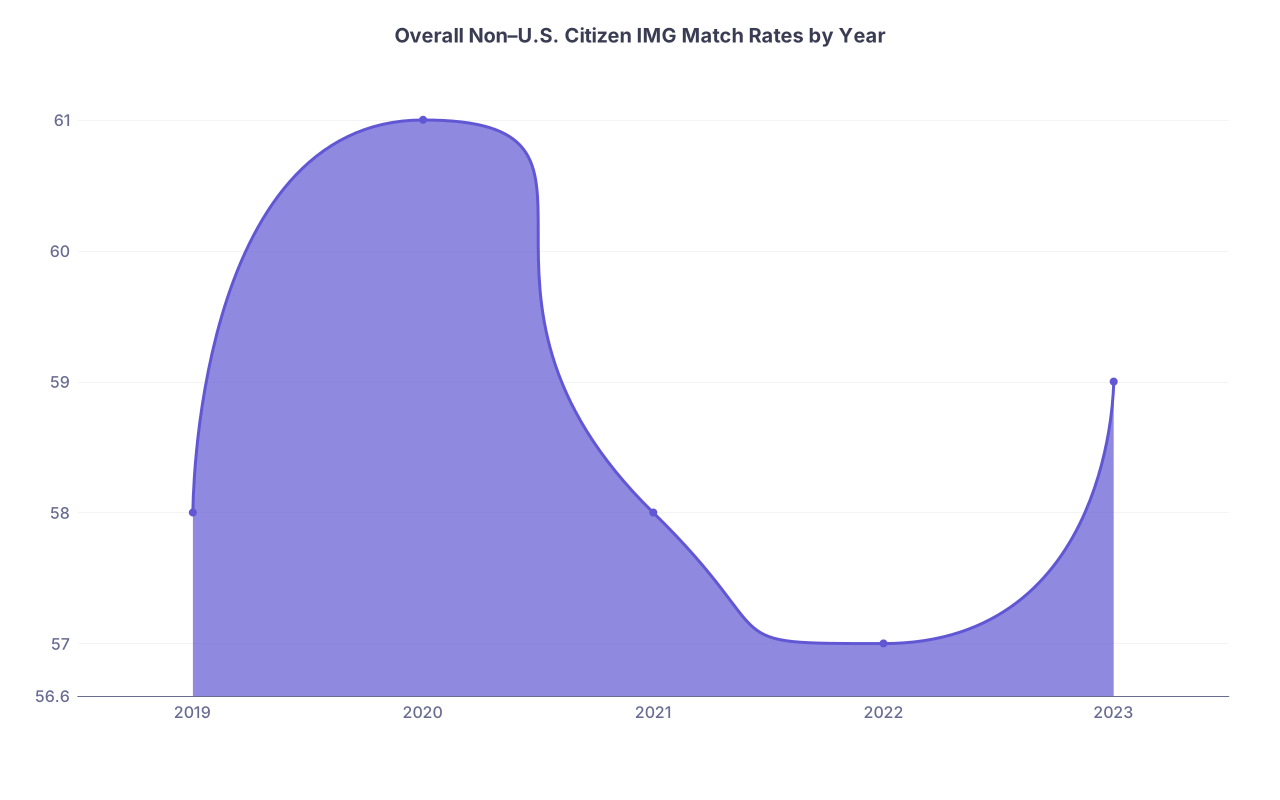
| Category | Value |
|---|---|
| 2019 | 58 |
| 2020 | 61 |
| 2021 | 58 |
| 2022 | 57 |
| 2023 | 59 |
You are typically looking at ~57–61% match rate for non–U.S. citizen IMGs who actually rank programs. That pool includes:
- Caribbean graduates (offshore and regional)
- European graduates
- Asian, Middle Eastern, Latin American, and others
So the Caribbean vs Europe question is really:
Given that the overall IMG average is about 60%, which group tends to sit above that line and which sits below?
The answer is:
- Graduates of a small set of structured, U.S.-oriented Caribbean schools trend near or slightly above the overall IMG average (in the mid-60% range for serious applicants).
- Graduates of low-tier, high-attrition Caribbean programs fall far below—often below 40%.
- Graduates from well-established European schools with strong clinical connections land roughly similar to higher-performing Caribbean schools, but with more self-navigation and variability.
To make this practical, we need to segment.
2. Segmenting by region and school type: the only comparison that makes sense
Lumping “Caribbean” into one number is statistically useless. There is a huge difference between, for example, a U.S.-facing, NBME-based curriculum with majority U.S. clinical rotations and a small island school with minimal admission screening and weak Step prep.
Same for Europe: English-language, EHEA-aligned, long-established faculties are not the same as a new private program with improvised English tracks.
For a U.S.-residency–oriented premed, here is the realistic segmentation that matters.
| Region & School Type | Approx. Match Outcome vs Overall IMG (~60%) |
|---|---|
| [Top 4–5 Caribbean (US-oriented, large, established)](https://residencyadvisor.com/resources/international-med-schools/do-only-top-ranked-caribbean-schools-match-in-the-us-nuanced-truths) | Around or slightly above IMG average |
| Mid-/low-tier Caribbean (high attrition) | Well below IMG average |
| Established Western/Northern Europe (English track) | Around IMG average (highly variable) |
| Eastern Europe / newer private schools (English track) | Slightly below to below IMG average |
These are directional, not official NRMP numbers, but they match what program directors and ECFMG advisors actually see:
- The major variance inside the Caribbean is quality and attrition.
- The major variance inside Europe is integration with U.S. exam culture and clinical exposure.
If you want a one-sentence heuristic:
“Strong Caribbean” vs “Strong Europe” is roughly a wash in raw match probability, but the Caribbean schools invest more in U.S.-style test prep and logistics; Europe invests more in broader medical training and less in being tailored to the U.S. system.
3. What the score data says: USMLE performance is the real driver
The match is not a single-variable problem; it is a conditional probability.
Once you control for exam performance, a lot of the “Caribbean vs Europe” signal evaporates.
For IMGs, the match data shows a striking pattern:
- Non–U.S. IMGs with strong Step 2 CK scores (let’s say ≥ 240) match at rates that can approach 75–80% in less competitive specialties.
- Those with scores around 220–230 hover close to the overall ~60%.
- Below ~215, the match rate slides sharply.
Let’s approximate the impact of Step 2 CK on non–U.S. IMG match odds (collapsed across regions):
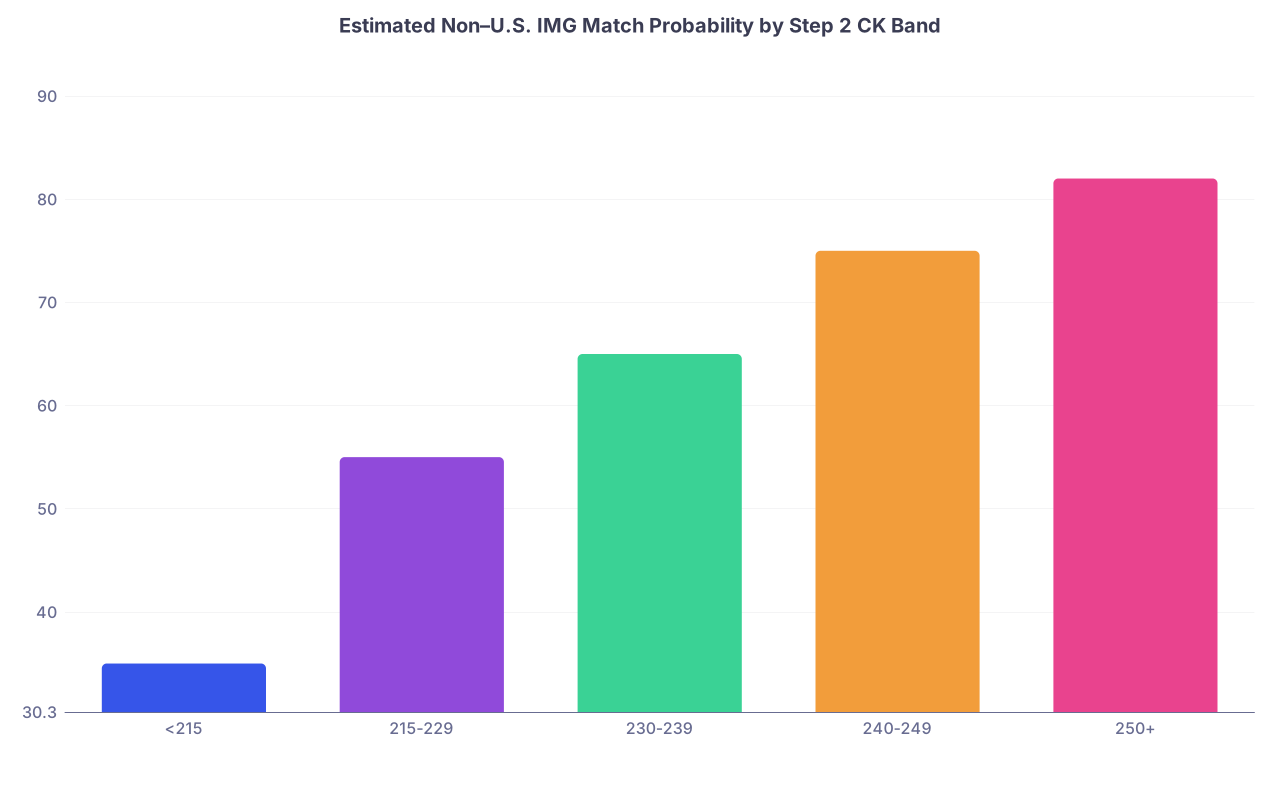
| Category | Value |
|---|---|
| <215 | 35 |
| 215-229 | 55 |
| 230-239 | 65 |
| 240-249 | 75 |
| 250+ | 82 |
These are reasonable approximations blending NRMP “Charting Outcomes” patterns with IMG-specific data.
Now overlay the Caribbean vs Europe question. The key metric is not the average score; it is the distribution:
- Some Caribbean schools cluster heavily in the lower bands (high fail rates, many students not even reaching Step 2, high attrition).
- The top Caribbean schools work aggressively to push students into 230+ territory: NBME-based exams, U.S. style question banks, mandatory shelf exams, etc.
- Many European schools are designed primarily for local or EU practice. The curriculum is thorough, but often misaligned with USMLE emphasis and timing. Students then self-study U.S. content late, producing a wide score spread.
The data-backed conclusion:
If you are likely to score 240+ regardless of environment (strong academic history, high discipline, strong English, test-taking skills), Europe vs top-tier Caribbean will not dramatically change your raw match probability. Your own performance dominates the equation.
If your risk of struggling with standardized tests is high, the choice of support system and exam alignment becomes critical—and here the top Caribbean schools often provide more U.S.-exam-specific structure than most European programs.
4. Caribbean islands: outcomes by “tier” rather than geography
You asked “by Caribbean island,” but the uncomfortable reality is: the island itself is statistically irrelevant; the school’s structure and filtering behavior are what matter.
The data that leaks out—via graduation stats, school disclosures, alumni match lists, and ECFMG certification numbers—shows three broad Caribbean categories.
4.1 High-structure, U.S.-oriented Caribbean schools
Characteristics I have seen repeatedly:
- Very high proportion of U.S. and Canadian students
- Admissions screening (GPA, MCAT, interviews) that actually rejects people
- NBME subject exams integrated in basic sciences and clinicals
- Majority of clinical rotations in the U.S. at reasonably solid affiliated hospitals
- Dedicated Step 1 / Step 2 CK coaching, NBME practice, and enforced readiness thresholds
These schools tend to:
- Have significant attrition early (students failing out or being counseled out)
- Show a more competitive cohort sitting for USMLE
- Achieve match outcomes roughly similar to the “good IMG” average, particularly in primary care specialties
So your probability tree looks like this:
- P(reach Match as a candidate) is lower, because some classmates never clear Step 1/2.
- P(match | reached Match) is higher than the raw overall Caribbean label suggests.
From a data-analytic view, they are filtering the distribution before it even reaches the match process.
4.2 Mid-tier/high-attrition Caribbean schools
This is where the statistics get ugly.
Common patterns:
- Broader or minimal admission screening
- Less rigorous internal testing or delayed consequence for failure
- Partial or weaker U.S. clinical networks, more electives than cores, sometimes last-minute scrambling for rotations
- Students often self-manage Step preparation with less institutional scaffolding
The result:
- Lower average USMLE scores
- Higher Step 1 fails
- Many students delayed or never ECFMG-certified
- Of those who get to the Match, a smaller fraction has competitive profiles
When applicants say “Caribbean schools have a 40% match rate,” they are frequently mixing the experiences from this group with the more structured schools.
4.3 Why you should ignore “island reputation” and drill into data
I have seen students obsess over which island is “better.” That is noise.
You want to pull data directly from each school:
- ECFMG certification counts over time
- Step 1/Step 2 CK pass rates and score distributions (if the school will share)
- Percentage of each entering class that actually reaches clinical years
- Genuine, verifiable match lists—names, specialties, programs
Once you have that, the island name loses importance. You are comparing pipelines, not beaches.
5. European programs: structure, strengths, and silent risks
Europe is more heterogeneous than the Caribbean in many ways. But for U.S.-bound IMGs, the English-language tracks dominate the discussion: Poland, Hungary, Czech Republic, Romania, Italy, Spain, Ireland, the UK (pre- and post-Brexit complications), and a few others.
5.1 Structural advantages
Data-wise, European schools offer:
- Usually lower attrition based purely on exam filtering for USMLE, since their primary endpoint is local license, not USMLE
- Longer, integrated programs (5–6 years) with early clinical exposure
- EU accreditation and local recognition, which gives some graduates a fallback to Europe rather than only the U.S.
However, from a U.S.-residency perspective, the issues are:
- USMLE is often optional or student-driven. That leads to highly variable preparation quality.
- Internal exams may not mimic USMLE style; good for general knowledge, not optimally tuned for high Step 2 CK scores.
- The timing between local exams, language requirements (for local patients), and USMLE windows gets messy. Students often cram USMLE content on top of local obligations.
5.2 What I actually see in the numbers and anecdotes
Among Europe-trained IMGs targeting the U.S.:
- A minority creates very strong applications: Step 2 CK ≥ 245, solid research, good letters, and match into IM, peds, anesthesia, sometimes even competitive specialties.
- A substantial chunk ends up with mid-220s and limited U.S. clinical exposure, matching more sparsely or needing multiple cycles.
- Another chunk never truly commits to the U.S. path and either stays in Europe or stalls.
The statistical consequence is similar to mid-to-upper Caribbean: those who behave like U.S.-oriented applicants can perform comparably to strong Caribbean grads; those who assume “a European degree guarantees respect” often hit a wall in U.S. recruiting.
Program directors care about:
- USMLE scores
- Clinical performance in U.S. hospitals
- Communication skills
- Visa issues
They do not give automatic extra credit for “Europe” vs “Caribbean.” If anything, some are more familiar with the big Caribbean names simply because they see more of them each year.
6. Specialty choice: where Caribbean vs Europe diverges slightly
The next layer of analysis is specialty targeting. Non–U.S. IMGs do not match evenly across all fields.
Common landing zones:
- Internal medicine
- Family medicine
- Pediatrics
- Psychiatry
- Occasionally neurology, pathology, and anesthesia
Caribbean schools with heavy U.S.-focused infrastructures tend to channel graduates strongly into primary care. Their advising and match lists heavily weight:
- Internal medicine (community and some university-affiliated)
- Family medicine
- Pediatrics and psychiatry at community or lower-tier academic programs
European grads, particularly those from more research-oriented or academically prominent schools, sometimes diversify a bit more into:
- Neurology, anesthesia, radiology in certain settings
- A mix of Europe vs U.S. plans, which reduces the apparent U.S. match rate because not all are aiming at the U.S. simultaneously
If you want a crude, directional comparison by specialty friendliness for non–U.S. IMGs:
| Specialty | Relative Difficulty for IMGs |
|---|---|
| Family Medicine | Lower |
| Internal Medicine | Lower–Moderate |
| Pediatrics | Lower–Moderate |
| Psychiatry | Moderate |
| Neurology | Moderate–High |
| Anesthesia | High |
For both Caribbean and Europe, aiming for dermatology, plastics, ortho, or ENT as a non–U.S. IMG is statistically near-zero. The school region does not rescue you from that reality.
7. Practical comparison: Caribbean vs Europe for a U.S.-focused applicant
Let us stop hand-waving and look at the decision from a data-informed angle. Assume you are a U.S./Canadian citizen or permanent resident aiming for U.S. residency.
7.1 Core probability drivers
Your eventual match probability is roughly a function of:
- Your baseline academic ability and test-taking performance
- The quality and structure of the school’s curriculum and clinical pipeline
- Your discipline in using resources (Qbanks, NBMEs, U.S. clinical rotations, research)
- Specialty choice and geographic flexibility
Region (Caribbean vs Europe) is a second-order variable.
What shifts more between Caribbean and Europe is:
- How much the environment forces you into a U.S.-aligned path (Caribbean)
- How much freedom and local integration you have (Europe), which can be a blessing or a trap
7.2 Scenario analysis
Let me sketch three common scenarios I see.
Student with middling stats, wants U.S., needs structure, weak at self-organization
- Data suggests they benefit from a school that forces Step preparation: NBME exams, enforced timelines, USMLE gating.
- That usually points to a top-tier Caribbean program rather than a European faculty that assumes local exam priorities.
Student with strong academics, high self-discipline, open to Europe and maybe EU practice, also considering U.S.
- They can exploit a European program, excel in both local and U.S. exams, and end up competitive in both systems.
- Their match probability in the U.S. will be driven much more by Step 2 CK > 245 and U.S. letters than by “Europe vs Caribbean” label.
Student chasing the easiest acceptance, not fully honest about their capacity to grind for 6–8 years
- These are the ones who boost the failure statistics in mid-/low-tier Caribbean schools and in weaker European tracks.
- Their true probability is: high risk of never reaching ECFMG certification, let alone a match.
8. Key trade-offs beyond raw match rates
Numbers are not the only data. You also have:
- Cost structure: Some Caribbean schools are extremely expensive, especially when you count living expenses on an island plus U.S. rotation costs. European tuition can be lower, but six years of living overseas plus travel adds up.
- Backup options: A recognized EU degree may allow practice within parts of Europe. A purely offshore Caribbean school may limit you to U.S./Canada plus a handful of other markets.
- Visa and citizenship: Non–U.S. citizens from Europe targeting the U.S. run into the same visa friction as Caribbean grads. For U.S. citizens, this is less relevant.
- Lifestyle and language: European schools may require local language proficiency for clinical years. That is another variable that can either enrich your experience or dilute your USMLE focus.
From a data analyst perspective, every one of those variables slightly modifies your probability of:
- Completing the degree
- Taking and passing USMLE on time
- Collecting strong U.S. clinical letters
- Interviewing broadly
- Matching at least somewhere acceptable
9. Bottom line: what the data actually supports
Summing up the evidence rather than the online noise:
- Overall, non–U.S. citizen IMGs match at around 57–61% when they participate in the Match. That is your baseline.
- Graduates from high-structure, U.S.-oriented Caribbean schools and from solid European English-language programs cluster around that baseline or slightly above, if they hit strong Step scores and target realistic specialties.
- The biggest statistical traps are low-tier, high-attrition Caribbean programs and weakly supported European tracks where students self-navigate USMLE too late or too loosely.
If you want a data-driven decision rule:
- Prioritize school quality, exam support, and transparency of outcomes.
- Assume your personal USMLE performance will move your match probability by ±30 percentage points, while the school region will probably move it by ±10–15 at most.
- Treat any school—Caribbean or European—that cannot show you clear numbers (ECFMG certifications, USMLE data, real match lists) as a high-risk bet.
FAQ (exactly 3 questions)
1. Are Caribbean IMGs statistically less likely to match than European IMGs?
Not in a clean, apples-to-apples way. Once you control for exam scores, school quality, and specialty choice, the gap narrows substantially. Strong students from top Caribbean programs and from solid European faculties with good USMLE prep have broadly similar match probabilities in primary care fields. The big differences show up when you look at lower-tier Caribbean schools with high attrition and weak exam prep; those drag the overall “Caribbean average” down.
2. Does the specific Caribbean island (St. Maarten vs Grenada vs Barbados) matter for match rates?
The island itself is a rounding error. What matters is the school’s admissions filtering, curriculum alignment with USMLE, clinical rotation network in the U.S., and track record of ECFMG certification and match outcomes. Two schools on the same island can have radically different results. Do not pick based on geography or branding alone; demand hard data.
3. If I want a competitive specialty, is Europe statistically better than the Caribbean?
For non–U.S. IMGs, “competitive specialty” and “better odds” rarely belong in the same sentence, regardless of region. The data shows that IMGs in fields like derm, ortho, plastics, and ENT are statistical outliers. Where Europe might help is indirect: some schools have more research infrastructure or academic connections that can support stronger CVs. But even then, your Step 2 CK score, U.S. clinical performance, and visa status will dominate. Region alone will not convert a low-probability specialty into a safe target.