
‘Any Caribbean School Is Fine’: What Long-Term Outcomes Actually Show
So someone told you, “If you don’t get into a U.S. MD or DO program, just go Caribbean. Any Caribbean school is fine. You’ll be a doctor anyway.”
You sure about that?
Because once you stop listening to desperate premed Reddit threads and start looking at actual data—NRMP reports, ECFMG stats, school disclosures—that statement falls apart fast.
Let me be blunt:
All Caribbean schools are not the same.
And “just go anywhere, you’ll figure it out” is how people end up with six-figure debt, no residency, and a degree that no one in the system is excited about.
You want to know what really happens 5–10 years down the line? Good. Let’s go there.
The Myth vs. the Reality: Caribbean Is Not One Thing
People talk about “Caribbean schools” like it’s a single monolithic option. It is not.
There’s a tiny cluster of relatively established schools. Then there’s everyone else—hundreds of small or newer operations with unstable accreditation, poor match outcomes, and high attrition.
| Tier | Examples (not endorsement) | Typical Characteristics |
|---|---|---|
| Older 'Big 4' style | St. George’s, Ross, AUC, Saba | Large class sizes, US-focused curriculum, some data on match outcomes |
| Mid-tier/Regional | Various island schools | Less transparent data, smaller affiliations, inconsistent match history |
| New/Unproven | Newer or very small schools | Minimal track record, weak or no U.S. clinical network, unknown outcomes |
Notice what’s missing from the marketing brochures: hard denominators.
You’ll see “Our 2024 match rate is 95%!” plastered in giant font.
You will not see: “Out of the 600 people who entered with you four years ago, only 230 actually made it to the point of applying to the Match.”
Those two numbers are not the same. At all.
“Any Caribbean school is fine” ignores three key realities:
- Entry is easy; exiting with a residency is not.
- The school’s name still matters in 2029 when you’re applying to fellowship.
- Long-term outcomes are wildly variable and often much worse than U.S. MD/DO averages.
What the Match Numbers Actually Show
Let’s talk outcomes, not hope.
Every year, the NRMP publishes data on Match rates by applicant type. U.S. MDs, U.S. DOs, U.S. citizen IMGs (which is what most Caribbean grads are), and non-U.S. IMGs.
The pattern is painfully consistent.
| Applicant Type | Match Rate (Approx Range) |
|---|---|
| U.S. MD Seniors | ~90–93% |
| [U.S. DO Seniors](https://residencyadvisor.com/resources/international-med-schools/is-an-international-md-always-worse-than-a-us-do-what-the-data-suggests) | ~85–90% |
| U.S. Citizen IMGs | ~55–65% |
| Non-U.S. Citizen IMGs | ~55–60% |
Now, look at that third row.
That’s where most Caribbean grads live: U.S. citizen IMGs.
So when someone tells you, “Yeah, just go Caribbean, you’ll match,” what they’re really saying—if they were honest—is:
“You’re probably flipping a coin on whether you match into any residency at all, even primary care, unless you’re in the top chunk of your class and you crush exams.”
And that’s not even evenly distributed. Graduates of the more established schools perform better than the long tail of others. In some of those smaller or newer schools, the effective rate of entering student → resident is far, far lower than the quoted “match rate.”
The Funnel Effect No One Talks About
Caribbean schools frequently use aggressive front-end acceptance:
- Lower GPA/MCAT thresholds
- Rolling admits
- Less selective interviews (if any)
Then the back end does the “weeding” you thought you escaped.
Students fail out.
Students repeat semesters.
Students get blocked from taking Step/Level exams until they hit some often-arbitrary internal threshold.
Students are “advised” not to apply to the Match because they’re not competitive enough.
By the time the school calculates its shiny “95% match” number, you’re no longer in the denominator.
So no, that number is not your personal probability of success.
Long-Term Outcomes: Not Just “Did You Match?”
Matching is only the first filter. Let’s zoom out:
- Where do you match?
- In what specialty?
- At what type of program?
- And what does that do to your career 10–20 years later?
If you’re dreaming about ortho, derm, plastics, neurosurgery, urology… stop. From the Caribbean, you’re playing on hard mode with a broken controller. Yes, there are rare unicorns who pull it off. That proves it is possible. It does not prove it is likely.
Most Caribbean grads who match end up in:
- Internal medicine (often community, not university)
- Family medicine
- Pediatrics
- Psychiatry
- Occasionally transitional year, prelim medicine/surgery
These are good, necessary fields. The issue is not prestige. The issue is choice. You are narrowing your option set before you even start.
Now add this: program directors still heavily prefer U.S. MD and DO students. Go read the NRMP Program Director Survey. “Type of medical school” is repeatedly ranked as an influential factor. Caribbean = red flag unless you overcompensate with:
- Very strong Step scores
- Strong U.S. letters from respected clinicians
- Clear evidence you can function in their system
You are always auditioning to prove “I am not the stereotype of the underprepared Caribbean grad who couldn’t get into a U.S. school for a reason.”
That gets exhausting.
Debt, Attrition, and the Dark Side of “Just Get In Somewhere”
Here’s the part that tends to get buried under glossy beach photos.
Tuition at many Caribbean schools equals or exceeds U.S. private med schools. Add in:
- International travel
- Living expenses on an island
- Extra semesters if you fall behind
- Limited access to some federal loans depending on the school’s eligibility
You can easily walk away with $300k–$400k+ in debt.
Now combine that with the attrition and match uncertainty. That is how you end up with people in their 30s, living in the U.S., not licensed to practice, paying massive loans on a degree that isn’t helping them earn physician income.
“Any Caribbean school is fine” completely ignores the worst-case scenario:
Not “you became a doctor but in a less fancy specialty,” but “you never became a doctor but still pay doctor-level debt.”
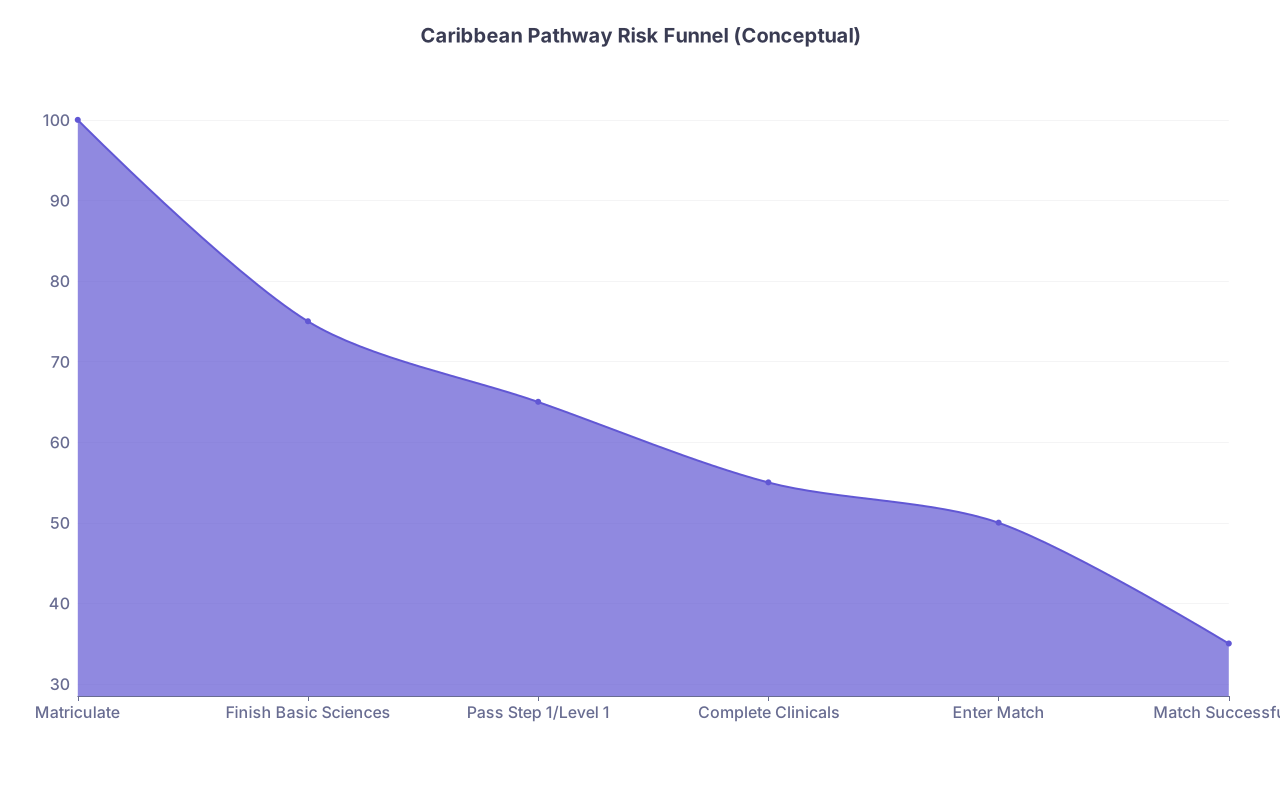
| Category | Value |
|---|---|
| Matriculate | 100 |
| Finish Basic Sciences | 75 |
| Pass Step 1/Level 1 | 65 |
| Complete Clinicals | 55 |
| Enter Match | 50 |
| Match Successfully | 35 |
Those numbers are illustrative, not exact, but they capture the pattern I’ve seen across cohorts: big inflow, much smaller outflow at the end with actual residency spots.
U.S. MD and DO schools also have attrition. But the funnel is much tighter; the system is built with the expectation that nearly everyone who starts will finish and match.
Caribbean schools? The business model is often closer to volume intake with selective survival.
Not All Caribbean Schools Are Equally Risky
Here’s where nuance matters. Saying “never go Caribbean” is as lazy as saying “any Caribbean school is fine.”
Some schools have:
- Long-standing relationships with U.S. hospitals for clinical rotations
- A decade+ of consistent match lists you can independently verify
- Established support for Step exams with track records to match
Others… exist mainly as a website, a small building, and a financial aid pipeline.
You want to distinguish between:
- A school that can name dozens of grads in U.S. residency programs each year, across multiple states, with verifiable outcomes
- A school that shows you glossy stock photos and vague promises, but no hard data across many years
If a school cannot give you:
- 5+ years of match lists with names and programs
- USMLE Step pass rate data with clear denominators
- Attrition/retention numbers (how many finish in 4–6 years versus how many start)
you should assume the worst until proven otherwise.
“Any Caribbean school is fine” erases these differences and treats your future like a scratch-off ticket.
False Equivalency: “A Doctor Is a Doctor”
You’ll hear this one a lot. Usually from people trying to make you feel better or from schools trying to close the sale.
Here’s the problem:
Within the system, a doctor is not just “a doctor.”
- Different states treat international grads differently for licensing and endorsement.
- Some hospital systems and academic institutions are heavily biased toward U.S. grads for faculty positions.
- Visa, credentialing, and board certification issues can get more complicated.
Even among physicians, pedigree still matters. It is not everything, but it is not nothing.
Will most patients know or care that you went to a Caribbean school? No. They barely know the difference between MD and DO.
Will program directors, hiring committees, and fellowship directors care? Often yes.
Pretending that all M.D. degrees are equal ignores the reality of gatekeepers you will face.
The Alternatives No One Wants to Talk About (Because They Require Patience)
The “just go Caribbean” crowd usually skips over the most rational options:
Reapply more strategically to U.S. MD/DO.
Fix the real issues: MCAT, GPA, clinical experience, timing. Spend another year or two building an actually competitive application.Consider osteopathic schools seriously.
U.S. DO schools have expanded seats and, for most IM, FM, peds, psych, and even some competitive fields, give you a far better residency probability than a random Caribbean school.Consider international paths with structured pipelines.
Certain non-Caribbean international schools (Ireland, UK, some in Israel, etc.) have more stable pathways and tighter control on class size and clinical placements. Still risky compared to U.S. MD/DO, but generally not the same as the lower-tier Caribbean churn.Consider that maybe medicine is not the only noble career.
Heresy, I know. But I’ve seen people cling so hard to “I must be an MD” that they ignore genuinely good alternatives: PA, NP (with caveats), clinical research, biotech, public health, data science in healthcare, etc.
The real choice is not “Caribbean vs no medicine ever.”
It’s “Caribbean now vs. do the hard, unsexy work to build a safer path—or deliberately choose a different but still meaningful career.”
When Caribbean Can Make Sense (If You’re Not Lying to Yourself)
There are situations where a carefully chosen Caribbean school is a rational bet:
- You’re older (mid–30s+), geographically flexible, and would be content with primary care or general internal medicine.
- You’ve already applied to U.S. MD/DO multiple times with a realistically optimized app.
- You understand the numbers, the risk, the debt, and you’re still willing to gamble—with eyes open.
- You’re choosing from the few established schools with demonstrable outcomes, not the random island you found in a sponsored ad.
That’s not madness. That’s a high-risk, potentially high-reward move made with full information.
But that is very different from: “I got a 498 on the MCAT and a 2.9 GPA, and this school said they’ll take me next month, so I guess it’s fine.”
No. That’s not a plan. That’s wishful thinking dressed as urgency.
How to Actually Judge a Caribbean School (If You Insist on Looking)
Skip the brochures. Ask for receipts.
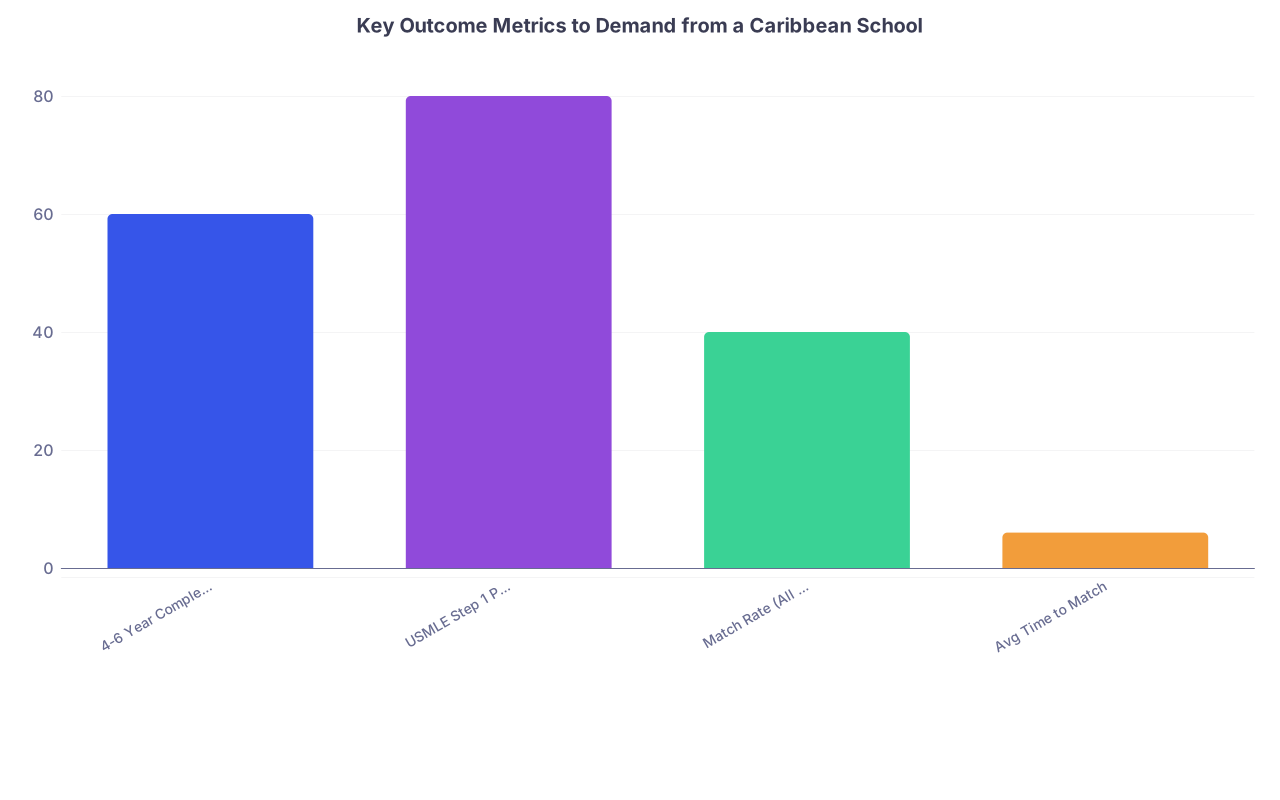
| Category | Value |
|---|---|
| 4-6 Year Completion % | 60 |
| USMLE Step 1 Pass % | 80 |
| Match Rate (All Matriculants) | 40 |
| Avg Time to Match | 6 |
Again, values here are illustrative, not specific, but these are the categories that matter:
- % of students who finish in 4–6 years relative to original matriculating class
- Step 1 and Step 2 pass rates with real denominators
- Match rates calculated from original entering cohorts, not just those who actually applied
- True list of where grads matched, not just “specialty categories”
If they dodge, give vague answers, or point you to glossy one-pagers instead of data, that’s your answer.
The Real Myth
The real myth is not “Caribbean schools are all bad.”
The real myth is “Your only job is to get into medical school, and after that, everything else will sort itself out.”
For U.S. MD and most DO programs, that’s almost true. The system is built around shepherding you from M1 to Match.
For Caribbean schools, your job has barely begun when you get the acceptance email. You’re signing up for:
- More self-directed planning
- Harsher skepticism from programs
- Higher financial risk
- Fewer second chances if anything goes wrong (Step failure, leaves of absence, family issues, health problems)
Years from now, you won’t remember the forum posts telling you “any Caribbean school is fine.”
You’ll remember whether you were honest with yourself about risk, whether you were patient enough to build a safer path, and whether you treated your future career like a serious investment instead of a spontaneous purchase.
You do not control everything in this process. But you control whether you walk into a high-risk pathway with clear eyes—or because someone told you it would “all work out” once you got an M.D. after your name.
Choose like the consequences are real. Because they are.
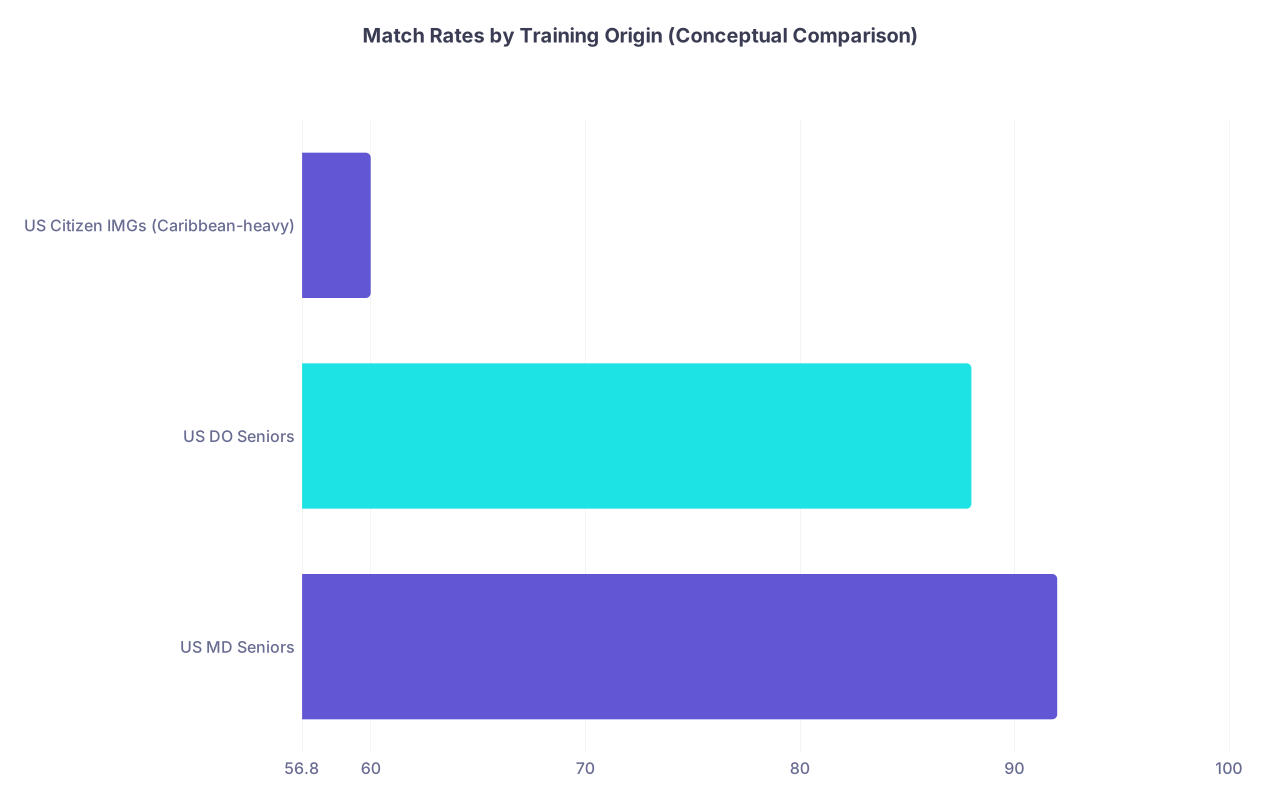
| Category | Value |
|---|---|
| US MD Seniors | 92 |
| US DO Seniors | 88 |
| US Citizen IMGs (Caribbean-heavy) | 60 |

| Step | Description |
|---|---|
| Step 1 | Premed with weak app |
| Step 2 | Strengthen GPA/MCAT, reapply US MD/DO |
| Step 3 | Select proven Caribbean school, accept higher risk |
| Step 4 | High debt + high failure risk |
| Step 5 | Other health careers or related fields |
| Step 6 | Improve & Reapply? |
| Step 7 | Consider Caribbean? |