Only top-ranked Caribbean schools match in the U.S.? That’s the story people like to tell. It’s also wrong, lazy, and dangerously incomplete.
The truth is harsher and more nuanced: a small number of Caribbean schools produce most of the successful U.S. matches, but “rank” isn’t what’s driving that. And yes—students from less-famous Caribbean schools do match into U.S. residencies every year. But they’re playing on hard mode. With fewer guardrails. And a much smaller margin for error.
If you’re premed or early in the process and you’re thinking “Caribbean backup,” you’re already being sold a myth.
Let’s dismantle it properly.
What People Think About Caribbean Schools vs What the Data Shows
The common narrative goes like this:
- “The Big 4 Caribbean schools match fine, everyone else doesn’t.”
- “If you go to X ‘top-tier’ island school, you’re basically like a U.S. grad.”
- “Match rates are similar if your scores are good.”
None of that survives contact with actual numbers.
Here’s what the evidence consistently shows across NRMP data, ECFMG statistics, and published school outcomes:
- U.S. MD > U.S. DO > Non-U.S. IMG (including Caribbean) in match probability. Every year. Every specialty.
- Among Caribbean schools, there’s a massive spread in:
- USMLE pass rates
- Match rates
- Type and location of residency (community vs big academic, competitive vs non-competitive)
- The term “top-ranked Caribbean schools” is mostly marketing. There is no official, standardized ranking system like U.S. News for these schools.
So the real question is not:
“Do only top-ranked Caribbean schools match?”
The real question is:
“What actually predicts whether a Caribbean student matches in the U.S.?”
Clue: It’s not a made-up “Tier 1” label in a brochure.
What Actually Predicts Matching as a Caribbean Grad
Let’s cut through the noise. The biggest determinants of whether a Caribbean grad matches in the U.S.:
- USMLE scores and first-time pass rates
- Clinical rotation quality and location (U.S.-based vs random)
- Citizenship (U.S. citizen IMGs do much better than non-U.S. IMGs)
- Specialty choice (and realism of that choice)
- Number and quality of programs applied to
- How many red flags piled up: repeats, exam failures, gaps, professionalism issues
School name does matter, but not in the magical way marketing suggests. It matters because it often correlates with:
- Better USMLE prep systems
- More established U.S. clinical affiliates
- More alumni in U.S. programs (network effect)
- More disciplined admissions screening (they filter out some people who were going to crash and burn)
That’s correlation, not pixie dust. You don’t match because the school is “top-ranked.” You match because the ecosystem around that school gives you a fighting chance—and you actually execute.
The “Top” Caribbean Schools: Why They Look So Good
People throw around “Big 3” or “Big 4” (usually referring to SGU, AUC, Ross, Saba, sometimes others). Are they different from smaller, newer, or no-name island schools? Yes. But again, for brutally practical reasons, not status points.
Here’s the pattern I’ve seen over and over:
Students from “Big 3–4” schools:
- Take USMLE Step 1/2 in large numbers
- Have structured prep, NBME use, academic support
- Rotate in U.S. hospitals where PDs actually know what that school is
- Often have older, non-traditional, or U.S.-citizen status, which helps in some programs
Students from lesser-known schools:
- Sometimes have shockingly low first-time USMLE pass rates
- Less consistent rotation quality, sometimes scattered observership-style experiences
- Fewer alumni in U.S. programs
- Programs see the school name and think, “I’ve never heard of this,” which is not ideal when you’re already in the most disadvantaged applicant category
Does that mean only the “top” schools match? No. It means they’ve constructed a pipeline that yields a much higher proportion of matchable graduates.
To make this concrete:
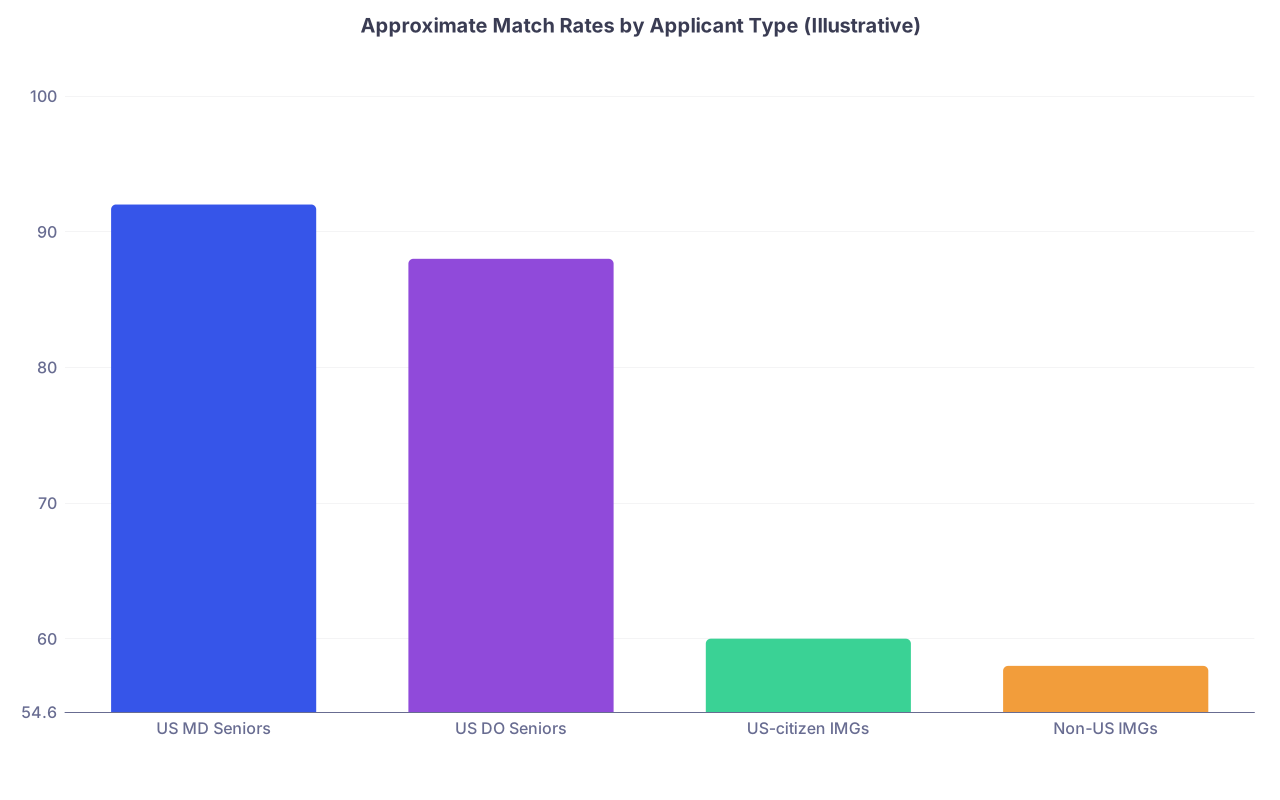
| Graduate Type | Approx. Overall Match Rate | Typical Specialty Outcome |
|---|---|---|
| U.S. MD senior | 90%+ | Wide range, many competitive |
| U.S. DO senior | ~85–90% | Broad range, some competitive |
| U.S.-citizen IMG | ~55–65% | Mostly primary care, prelim, IM |
| Non-U.S. IMG | ~55–60% | Similar, slightly lower odds |
| Lower-tier Caribbean (self-selected, strong) | Much lower, often <40% overall among all matriculants, but higher among those who pass exams | Mostly FM/IM/community programs |
These aren’t official numbers broken down by specific schools (those are conveniently opaque), but they’re consistent with NRMP and ECFMG aggregate data plus what residency PDs report privately.
The takeaway: Being at a more established Caribbean school improves your odds, but doesn’t flip you into “safe” territory. And being at a smaller school doesn’t doom you by definition—but it absolutely stacks the deck against you.
The Real Myth: “If You’re Strong, You’ll Match Anywhere”
Here’s the more seductive myth:
“If you’re a strong student and work hard, it doesn’t matter which Caribbean school you go to. You’ll match.”
That’s fiction.
A Caribbean grad with 250+ on Step 2, solid clinical evaluations, and decent letters will often match from any reasonably legitimate school. Yes. I’ve seen people from tiny island programs end up in internal medicine, psychiatry, pediatrics, even the occasional anesthesia or EM spot.
But you have to understand what “strong” actually means in this context:
- High USMLE scores relative to U.S. MD/DO averages, not just passing
- No exam failures, no repeats, no professionalism issues
- Clean timeline (no unexplained multi-year gaps)
- Coherent specialty choice (not chasing derm or ortho from an unknown offshore school)
- Aggressive, strategic application (80–150+ applications sometimes)
This is not “I’ll work hard once I get there.” This is “I will be top-tier in one of the most competitive exam ecosystems on earth, from a position of disadvantage.” Those are different promises.
How Much Does the Specific Caribbean School Name Matter?
Here’s where people want a clean answer: “Just tell me which Caribbean schools are safe.”
There is no safe.
But there is a hierarchy in PD minds. It tends to look like this:
- U.S. MD
- U.S. DO
- Well-known Caribbean/IMG producers with long track records
- Lesser-known Caribbean / newer offshore schools / schools with unstable histories
Program directors aren’t blindly ranking schools. They’re pattern-matching. Something like: “Over the past 10 years, when I interviewed or matched grads from X school, did they perform well? Did they pass their boards? Were they clinically sound? Did they fit the team?”
If a certain school consistently sends them competent residents who pass their in-training exams, they’re more open to that school. That’s why the “Big” schools look better—simply because they’ve placed thousands of alumni across U.S. programs.
This is also why some relatively obscure schools can still have a niche pattern of success with a few programs that trust them. It’s not public ranking. It’s local reputation.
Data Reality Check: Why Caribbean Match Rates Look “Okay” on Paper
You’ll see schools advertising “90% match rate!” in big friendly letters on their websites. Here’s the problem: almost nobody outside the school knows exactly how that number is calculated.
Common games:
- Only counting students who actually applied for the match that year (not those who dropped out, failed exams, or never qualified)
- Excluding people who didn’t secure a categorical spot and ended up in prelim limbo
- Counting SOAP placements as part of a shiny “match” statistic
- Using tiny denominators and not explaining that they’re reporting on a subset of survivors
Meanwhile, NRMP and ECFMG publish much more sobering aggregate numbers for IMGs as a group. That gap should tell you something.
| Category | Value |
|---|---|
| US MD Seniors | 92 |
| US DO Seniors | 88 |
| US-citizen IMGs | 60 |
| Non-US IMGs | 58 |
If a Caribbean school claims a 90%+ match rate, ask these questions like an adult, not a marketing victim:
- “90% of what exact denominator?”
- “Does that include grads who never passed Step 1 or Step 2?”
- “How many of your matriculants eventually match to categorical positions in the U.S.?”
- “What specialties and what kinds of programs (community vs academic, prelim vs categorical)?”
You’ll notice the numbers get slippery fast.
Specialty Choice: Where Caribbean Grads Actually Match
No, you’re not doing neurosurgery at Mass General from an offshore school. Could someone point to a unicorn case? Sure. But you don’t plan your future around lottery winners.
Where Caribbean grads reliably land, if they match:
- Internal medicine (especially community programs)
- Family medicine
- Pediatrics (community-heavy)
- Psychiatry (slowly getting more competitive, still some IMG presence)
- Transitional/preliminary year slots (which don’t always lead to a categorical spot later)
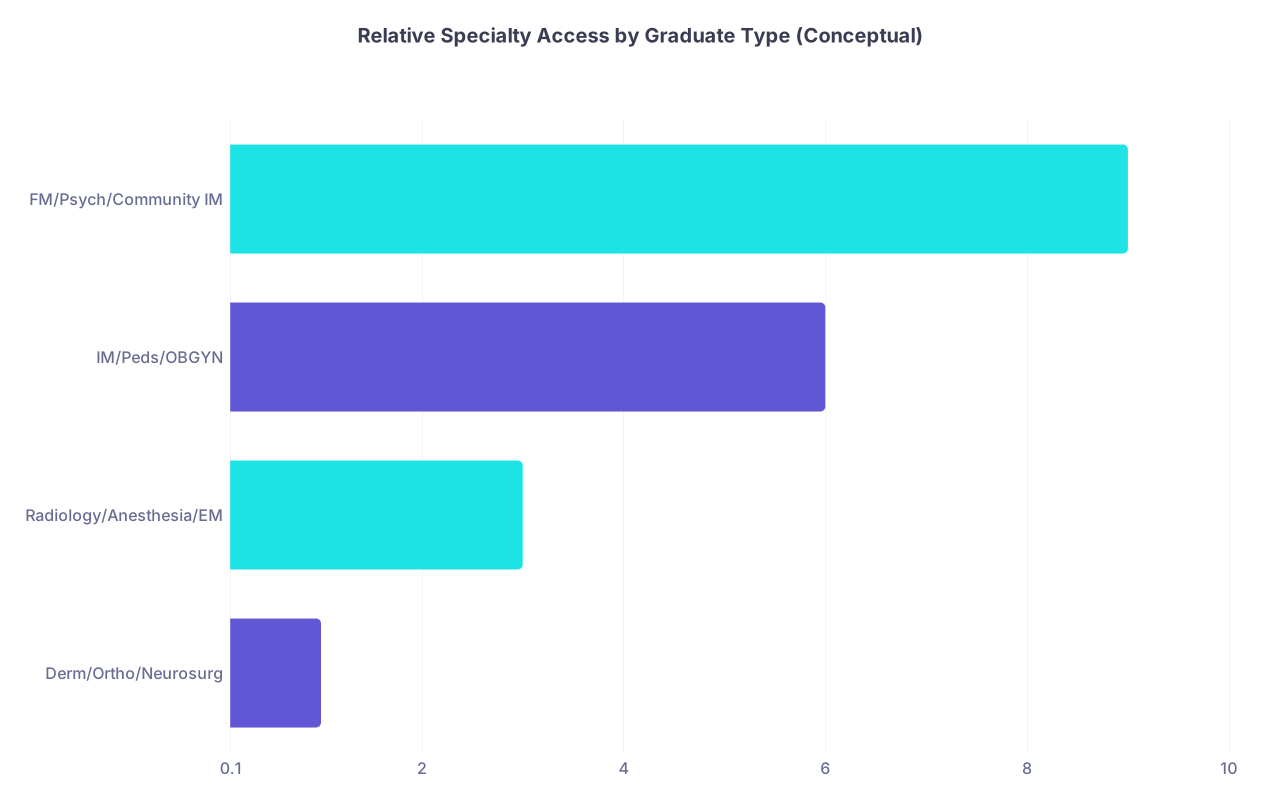
Here’s roughly how competitiveness interacts with your status:
| Category | Value |
|---|---|
| Derm/Ortho/Neurosurg | 1 |
| Radiology/Anesthesia/EM | 3 |
| IM/Peds/OBGYN | 6 |
| FM/Psych/Community IM | 9 |
Interpretation: the higher the bar, the more realistic for Caribbean grads. The ultra-competitive stuff is basically closed. The mid-tier fields are possible for the absolute strongest applicants with backing, timing, and luck. Primary care and community internal medicine remain the main lanes.
So when schools flash pictures of grads in white coats and talk vaguely about “matching across the U.S. in a range of specialties,” translate that to: mostly primary care and IM, mostly not at brand-name academic centers.
So, Is a Lesser-Known Caribbean School Ever Rational?
Sometimes. But only if you’re brutally honest.
It can be rational if:
- You’re a U.S. citizen or permanent resident (massively better odds than non-U.S. IMGs)
- You’ve already exhausted U.S. MD and DO pathways (multiple cycles, post-bac, SMPs, etc.)
- You understand there is a non-trivial chance you end up with an M.D. and no residency
- You’re aiming for primary care or internal medicine, not a hyper-competitive specialty
- You’re prepared to crush standardized exams and treat Step 2 like life-or-death
And then, if you are going Caribbean, it’s usually less insane to choose an established school with:
- Transparent, published USMLE pass rates
- Long-standing U.S. clinical site relationships
- A large alumni base in U.S. residency programs
- Serious academic support and remediation processes
Is it still a risk? Absolutely. But at least it’s a calculated one, not a blind leap based on “My cousin’s friend matched from School X, so I’ll be fine.”
Hard Truths Premeds Don’t Like to Hear
Let me be blunt:
- If you can still reasonably strengthen your application and get into a U.S. MD or DO program, do that instead.
- If your GPA/MCAT are weak because of poor habits, lack of discipline, or underestimating the grind, those problems do not magically disappear on an island.
- If you’re already rationalizing with “I’ll just go Caribbean and work hard,” you’re underestimating how brutal the attrition and exam pressure can be there.
The Caribbean is not a shortcut. It’s a back door that sometimes opens and often slams shut, and you don’t usually know which you’re approaching until you’re several years and six figures deep.
The Nuanced Truth: Not Just “Top-Ranked or Bust”
So, finally, the direct answer to the title:
Do only top-ranked Caribbean schools match in the U.S.?
No. That’s false.
Students from less-prominent Caribbean schools do match in the U.S. every year.
But here’s the part that actually matters for you:
- The overall odds are significantly better from the more established schools—but still nowhere near U.S. MD/DO levels.
- “Top-ranked” is a marketing term, not a guarantee. You should be looking at verifiable USMLE pass rates, clinical sites, and long-term outcomes, not brochure slogans.
- Your own performance, citizenship, specialty choice, and discipline matter more than the island’s “tier”—but the school ecosystem either amplifies or sabotages your efforts.
If you choose this route, you should be walking into it like a high-risk investment: eyes fully open, numbers in hand, and no delusion that a logo will save you.
Years from now, you won’t be thinking about whether your school’s website called itself “top-ranked.” You’ll be thinking about whether you gave yourself the best odds possible—or whether you let a sales pitch make the hardest decision of your career.