You are making a mistake if you think, “I will just get all my clinical experience once I’m abroad.”
That logic is exactly what gets international medical graduates burned later when they try to come back to the U.S.
You need a clinical exposure strategy before you ever set foot at an international medical school. Even if you cannot shadow a U.S. physician right now. Even if every clinic tells you “We do not allow undergrad shadowing because of HIPAA.” I have seen students in exactly that situation build a credible clinical portfolio that U.S. residency programs respect.
Here is how you fix your problem.
Step 1: Get Clear On What “Counts” As Clinical Exposure
You are not chasing “shadowing hours.” You are building evidence that you understand real patient care in the U.S. system.
Residency program directors care about three things related to your early clinical exposure:
- Proximity to patients
- Consistency over time
- Insight into the U.S. healthcare system
Shadowing is just one way to get there. Not the only way. Not even the best way.
What actually counts as meaningful clinical exposure?
Think of it as a spectrum from “weak” to “strong”:
Weak
- One‑day “doctor for a day” tours
- Unstructured sitting in the corner of an OR with no role
- Overseas mission trips where you primarily hand out vitamins and take photos
Moderate
- Traditional office‑based shadowing with limited interaction
- HIPAA‑safe hallway observing in U.S. hospitals
- Scribing virtually (no direct in‑person patient contact, but real clinical decision making)
Strong
- Consistent patient‑facing volunteering (ED, clinics, hospice, nursing homes)
- Medical assistant, EMT, patient care technician roles
- Longitudinal roles in community health or free clinics with real responsibility (within scope)
Your problem: you may not be able to get classic shadowing. That is fine. You can still stack strong experiences.
Step 2: Map the Constraints You Are Dealing With
Stop hand‑waving the obstacles. Name them. Then we can work around them.
Typical constraints premeds face before going abroad:
- Hospitals and private practices refuse shadowing (“Liability. HIPAA. No.”)
- You have limited time (school + work)
- You do not know who to contact or how to ask properly
- You may be an international student in the U.S. with work limitations
- You might live in a smaller town with fewer teaching hospitals
You will not beat these with one email and a smile. You beat them with role substitution: if door A (shadowing) is locked, you go through doors B, C, and D (volunteering, clinical jobs, structured programs).
Step 3: Replace Shadowing With These U.S.‑Based Roles
If you cannot get shadowing, you need formal roles that are built to handle non‑licensed people around patients. Let’s go through the most realistic options and how to secure them.
| Role Type | Patient Contact | Training Needed | Paid/Volunteer |
|---|---|---|---|
| Hospital Volunteer | Indirect–Direct | Short in-house | Volunteer |
| Scribe | Indirect | On-the-job | Paid |
| CNA/PCT | Direct | Cert program | Paid |
| EMT | Direct | Cert course | Paid/Volunteer |
| Hospice Volunteer | Direct | Short training | Volunteer |
3.1 Hospital or Clinic Volunteer (Entry‑Level, Very Available)
This is your baseline if shadowing is dead.
Typical roles:
- ED volunteer (restocking, transporting, comfort rounds)
- Inpatient unit volunteer
- Outpatient clinic volunteer (community health centers, FQHCs)
You are not diagnosing anyone. But you are learning workflows, communication, and the reality of sick people.
How to get in, step‑by‑step:
- Search properly
- Google: “[Your city] hospital volunteer program”
- Look for “Volunteer Services” or “Auxiliary” pages
- Apply to 3–5 programs, not just one
- They fill spots fast. Treat it like applying to colleges.
- Accept less‑sexy roles first
- If ED or ICU slots are full, start in transport, information desk, or outpatient clinics.
- Show up like an adult
- On time, no drama, follow rules. After 3–6 months, ask for a transfer to more clinical areas.
What to focus on once you are in:
- Learn staff roles (RN vs NP vs PA vs MD vs MA)
- Watch how nurses de‑escalate angry families
- Notice how orders turn into actions (labs, imaging, meds)
This is absolutely valid early clinical exposure. Stronger than silent shadowing from a corner.
3.2 Medical Scribing (Shadowing With Homework Attached)
Scribing is essentially structured, intensive shadowing where you also document the visit.
Where you will see jobs:
- Emergency departments
- Primary care clinics
- Specialty clinics (cardiology, ortho, GI)
Pros:
- You stand next to the physician all day
- You hear every history, exam, and plan
- You learn medical language before you touch a med school curriculum
Cons:
- Often requires 12–20 hours per week
- Hiring can be competitive in big cities
Steps to get a scribe job:
- Search “medical scribe jobs [your city]” and “scribe company [your state]”
- Target companies like ScribeAmerica, ProScribe, Robin, etc.
- Build a resume that screams reliability:
- Customer service, tutoring, any job where you interacted with people
- Highlight fast typing and attention to detail
- In the interview, show that you understand:
- This is not a stepping stone to “be near prestige doctors”
- It is documentation grunt work. You are there to help them move faster.
If you are going abroad for med school, having 500–1,000 hours of U.S. scribing is gold later for residency applications. It proves you know the U.S. system.
3.3 CNA / Patient Care Tech (PCT) – Direct Hands‑On Care
This is the closest thing to “real” clinical work you can do as a premed.
You will:
- Take vitals
- Assist with activities of daily living (bathing, feeding, toileting)
- Turn and reposition patients
- Sometimes draw labs or do ECGs (depending on hospital)
How to get there:
- Check state rules
- Most states require a short CNA course (4–12 weeks) and a state exam
- Find low‑cost training
- Community colleges, Red Cross, or hospital‑based programs
- Work part‑time in
- Hospitals
- Nursing homes
- Rehab facilities
Timeline: If you start now, you can be certified and working in a few months. That is well before you head abroad.
Why this matters if you will study medicine internationally:
- You learn bedside basics that some U.S. med students do not touch until third year
- You will not panic the first time a patient is incontinent or delirious
- Interviewers later see you as grounded in reality, not just books
3.4 EMT – Field Medicine and Emergency Exposure
If you want adrenaline and autonomy, this is it.
As an EMT you:
- Respond to 911 calls
- Take vitals, manage basic airways, perform CPR
- Transport patients to EDs
Caveats:
- Training is longer (often 4–6 months with didactic + ride‑alongs)
- Shift work can be brutal
- Not ideal if you are drowning in coursework
But if you can commit, it gives you a very strong narrative:
- “I have been the first person at the scene of accidents.”
- “I have seen what delayed care looks like in real life.”
Program directors take this experience seriously.
3.5 Hospice and Long‑Term Care Volunteering
Not flashy, but it will change how you think about medicine. And it is easier to access than hospital shadowing.
You will:
- Sit with patients who are dying
- Talk with families
- Help with non‑medical tasks (reading, companionship, sometimes feeding)
This teaches:
- Communication
- Presence in uncomfortable situations
- Respect for patient autonomy and goals of care
Hospice experience also plays very well in personal statements and future residency interviews, because it hits the core of “why medicine” in a way that 10 hours of clinic shadowing never will.
Step 4: Build A Clinical Exposure “Portfolio” Without Shadowing
You are not trying to win a single‑category competition. You are building a portfolio that collectively proves your readiness.
Think in terms of combos, not one magic job.
Example clinical exposure portfolios (for someone going abroad):
Portfolio A (Strong, No Shadowing At All)
- Hospital volunteer – 2 years, ED and inpatient floors
- CNA at nursing home – 1 year part‑time
- Hospice volunteer – 6 months
- Occasional virtual shadowing sessions (more on this later)
Portfolio B (Heavier On Scribing)
- ED scribe – 18 months
- Community clinic volunteer – 1 year
- Summer EMT shifts – 1 summer
- No traditional shadowing
Portfolio C (Time‑limited Student)
- 1 year outpatient community clinic volunteering (3–4 hours/week)
- 1 summer full‑time scribing
- Ongoing hospice volunteering during school breaks
All three are viable. None require you to have classic “I followed Dr. Smith for 80 hours” experiences.
Step 5: Use Virtual and Structured Shadowing Correctly (As a Supplement)
No, virtual shadowing alone will not impress U.S. residency program directors. But used wisely, it fills specific gaps when in‑person options are limited.
Where to look:
- University‑run premed pipelines
- Specialty societies (e.g., American College of Surgeons student webinars)
- Established virtual shadowing platforms that provide certificates and quizzes
Your rules:
- Treat it as education, not as your primary clinical proof
- Take notes on cases, ethics issues, communication style
- Use it to sample specialties you might not see in person (derm, radiology, pathology)
If you mention virtual shadowing later, pair it with your stronger in‑person roles:
- “In addition to 600 hours of ED scribing, I attended virtual shadowing sessions in cardiology to understand outpatient longitudinal care.”
That framing works. “I did 120 hours of virtual shadowing and that is it” does not.
Step 6: Document Everything Like You Will Have To Prove It Later
Remember: You are heading toward an international school. When you come back to apply for U.S. residency, people will scrutinize your experiences more closely. You do not get the benefit of the doubt that a U.S. MD/DO student often gets.
You need receipts. Organized ones.
Create a simple tracking system:
- Spreadsheet columns:
- Role (hospital volunteer, CNA, scribe, etc.)
- Organization
- Supervisor name and title
- Start date / end date
- Total hours (by month or semester)
- Key responsibilities
- Memorable cases or lessons (short bullet notes)
This does two things:
- Makes later applications (AMCAS/ERAS, personal statements) trivial to write.
- Gives you concrete stories for interviews.
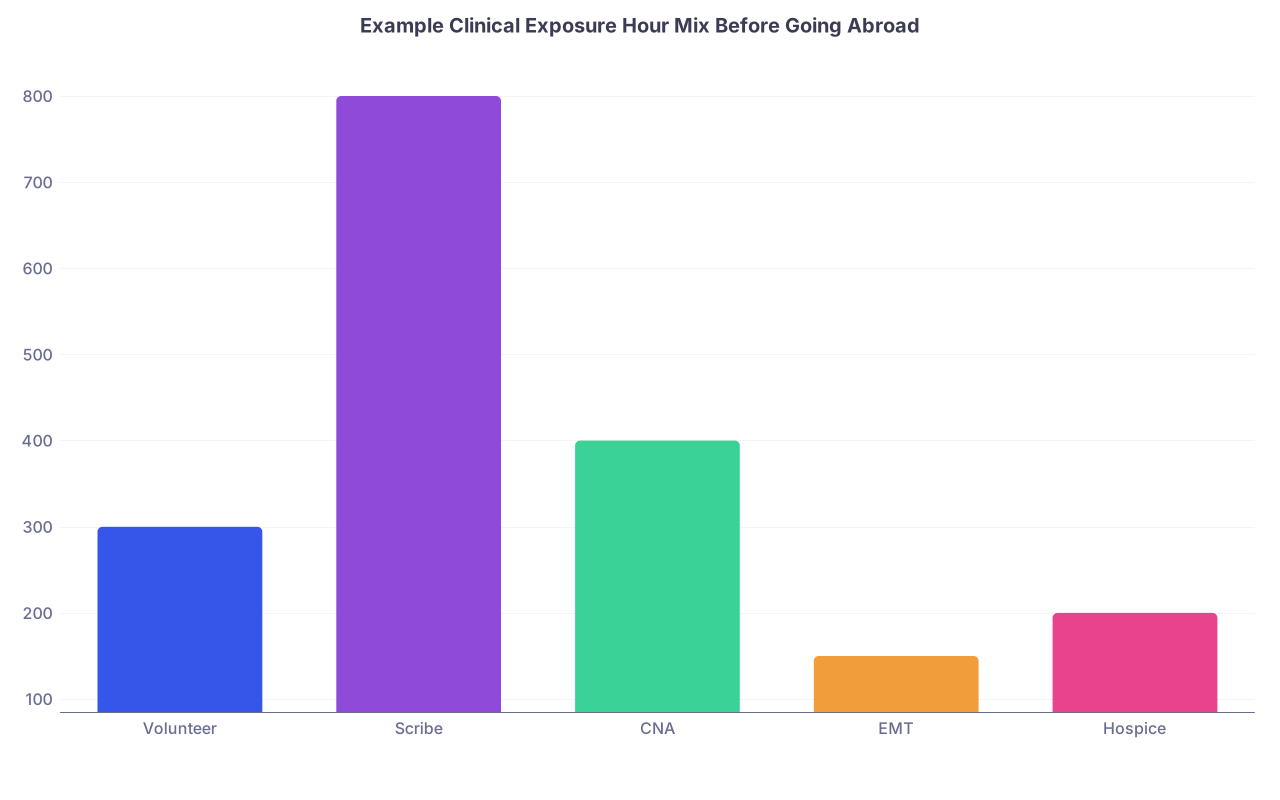
| Category | Value |
|---|---|
| Volunteer | 300 |
| Scribe | 800 |
| CNA | 400 |
| EMT | 150 |
| Hospice | 200 |
If your mix looks anything like that chart before you leave for med school abroad, you are in very solid shape.
Step 7: Use These Roles To Actually Learn The U.S. System
A lot of students stand around patients but do not learn anything useful. That is a waste.
Here is how you turn any role into genuine preparation:
Study the chain of command
- Who writes orders? Who carries them out?
- What does a day in the life of the charge nurse vs attending vs resident look like?
Watch communication patterns
- How do physicians explain bad news?
- How do they talk to patients with low health literacy?
- What words do they avoid?
Look for system problems
- Delays in imaging. Insurance denials. Discharge disasters.
- Keep a small notebook: “System issue I saw today and how staff worked around it.”
Ask smart questions at the right time
- Right after a code is not the time.
- Quiet moment? Ask: “I noticed you chose X instead of Y for this patient. Can you explain why?”
- You are trying to understand reasoning, not impress them.
You are not just collecting hours. You are building an internal library of patient stories and system realities you can draw on later.
Step 8: Align Your Story With Your Plan To Go Abroad
Studying medicine internationally changes the standard. You must show you are not running away from the U.S. system; you are preparing to come back to it.
Use your clinical exposure to support a coherent narrative:
- “I volunteered in a U.S. community health center for two years and saw how uninsured patients struggle with chronic disease. When I chose to study medicine abroad, I deliberately stayed involved with U.S. clinical work each summer so I would be ready to train and serve here afterward.”
That is a story program directors can respect.
Also smart: continue some U.S. involvement during med school breaks:
- Return to your old hospital to volunteer
- Pick up per‑diem CNA or scribe shifts over winter or summer breaks
- Join U.S.‑based research or QI projects remotely with clinicians you met earlier
That continuity matters. It shows commitment, not tourism.
Step 9: Be Strategic About Which Roles You Pick (Based On Your Situation)
Different constraints, different solutions. Do not copy someone else’s exact path without thinking.
Here is a quick decision guide.

| Step | Description |
|---|---|
| Step 1 | Need U.S. clinical experience |
| Step 2 | Hospital or clinic volunteer |
| Step 3 | Scribe or CNA/PCT |
| Step 4 | High-commitment volunteer roles |
| Step 5 | Hospice, ED volunteer, free clinic |
| Step 6 | EMT or ED scribe |
| Step 7 | Outpatient scribe or inpatient CNA |
| Step 8 | Time per week? |
| Step 9 | Need income? |
| Step 10 | Want emergency focus? |
If you:
- Work a lot to support yourself → Scribe or CNA
- Have little time but good flexibility → Volunteer hospital + hospice
- Want high adrenaline and are okay with extra training → EMT
The key is not perfection. It is consistency and proximity to real patients.
Step 10: Fix Your Outreach Approach (Stop Sending Useless Emails)
Half the reason people “cannot get shadowing or exposure” is because their approach is weak.
Even for volunteering or structured roles, you need to sound like someone they can trust around vulnerable patients.
Basic outreach template for a clinic / free clinic / small practice
Keep it short. Professional. Specific.
Subject: Premed student seeking volunteer role with direct patient exposure
Dear [Name or “Volunteer Coordinator”],
My name is [Your Name]. I am a premedical student planning to attend medical school abroad and ultimately return to practice in the United States.
I am looking for a consistent volunteer role (3–4 hours per week for at least 6 months) where I can support patient care within my allowed scope. I am particularly interested in [community health / primary care / underserved care] and would be glad to help with tasks such as room turnover, patient check-in, translation (if applicable), or other support needs.
I have attached a brief resume for your review. If there is someone else I should contact regarding volunteer opportunities, I would appreciate being directed appropriately.
Thank you for your time and consideration,
[Name]
[Phone]
[Email]
You are not asking “Can I shadow for 10 hours?” You are offering long‑term, reliable help. That is what they need.
Step 11: Stop Overrating Overseas “Clinical” Trips Before Med School
You are planning to go abroad for the entire medical degree. Do not double down on that by spending your premed years doing short‑term foreign “medical mission” trips as your main clinical exposure.
Harsh truth:
- Many of those trips are ethically shaky
- You sometimes end up doing things well beyond your training
- U.S. program directors are increasingly unimpressed by them
You can still go. Just do not rely on that alone. If you go, be honest about your role:
- Observing
- Supporting local clinicians with logistics
- Health education within your competence
But your core clinical exposure should be in the U.S. system where you intend to train.

A Concrete 12–18 Month Plan Before You Go Abroad
Let me pull this together into a realistic timeline for someone 1–1.5 years out from starting an international medical school.
Months 0–3
- Apply to 3–5 hospital volunteer programs
- Apply to 2–3 scribe companies or look for CNA courses
- Start hospice or nursing home volunteering if hospital slots are delayed
Months 3–6
- Begin consistent hospital / clinic volunteering (1 shift/week)
- If accepted as scribe, add 1–2 shifts/week; otherwise, finish CNA training
- Do 1–2 virtual shadowing programs to widen specialty exposure (evenings)
Months 6–12
- Work as scribe or CNA/PCT (10–16 hours/week)
- Maintain at least 1 ongoing volunteer role (hospital or hospice)
- Track all experiences + reflect on 1 learning each week in your notes
Months 12–18 (final stretch before departure)
- If possible, increase hours during school breaks
- Request letters of recommendation from physicians or supervisors who know you well
- Summarize your biggest clinical lessons and themes; these will feed directly into:
- Future personal statements
- Residency applications
- Interview answers
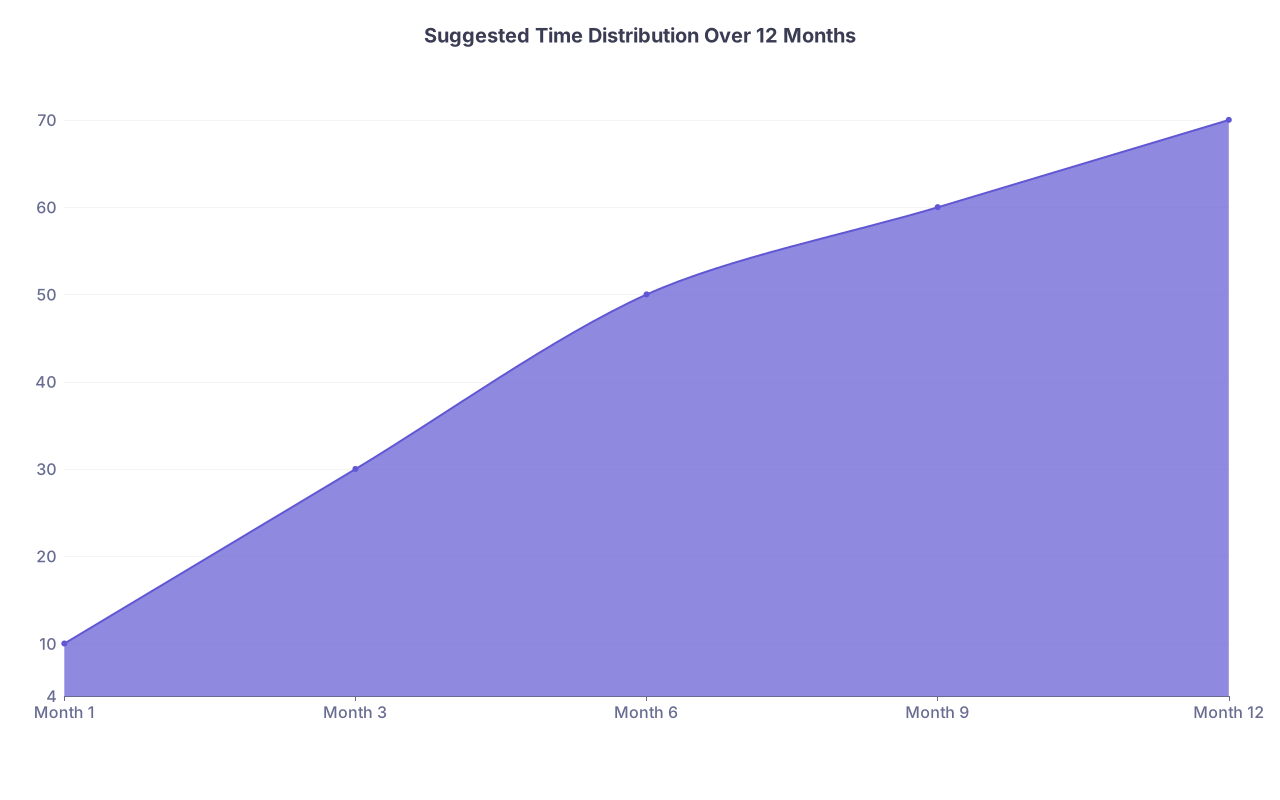
| Category | Value |
|---|---|
| Month 1 | 10 |
| Month 3 | 30 |
| Month 6 | 50 |
| Month 9 | 60 |
| Month 12 | 70 |
That rising curve is what you want: increasing engagement over time, not a one‑month spike and then nothing.
Common Pitfalls To Avoid
You can still mess this up even with good intentions. Avoid these:
Chasing “shadowing hours” checkboxes
Programs care about depth, not a random number.Only doing overseas clinical experiences pre‑med
Looks like you are avoiding the U.S. system, not preparing for it.Short‑term hopping
Two weeks here, one month there, constant turnover. You want at least one anchor role that lasts 6–12 months.Failing to understand boundaries
Do not do procedures, injections, or anything beyond your role. Ever. That can kill your future if discovered.Not building relationships
Show up, do your job, and also talk to staff. Long‑term relationships = strong letters and mentorship later.
How This Sets You Up When You Come Back For Residency
You are playing the long game here. International medical graduates who do best in U.S. residency applications usually share a few traits:
- Strong Step scores
- U.S. clinical experience as a student (electives, observerships)
- And documented pre‑med clinical exposure that started years earlier
Your pre‑med roles let you say, truthfully:
- “I have been working with U.S. patients since before medical school.”
- “I understand how U.S. hospitals actually function.”
- “I did not run abroad to escape the system here; I stayed connected.”
That narrative is powerful. And it starts now, even without a single “shadowing” hour logged.

FAQ (Exactly 4 Questions)
1. Will U.S. residency programs care that I had no traditional pre‑med shadowing if I have strong other clinical roles?
Yes, if your other roles are substantial and patient‑centered, the lack of classic shadowing is not a problem. A year of scribing, CNA work, or consistent hospital volunteering is more meaningful than brief observational shadowing. What matters is that you can clearly articulate what you learned about patient care, the healthcare team, and the U.S. system.
2. Is virtual shadowing worth doing at all if I already have in‑person experience?
As a supplement, yes. Use it to sample specialties you cannot see easily in person or to deepen your understanding of communication and clinical reasoning. Just do not lead with it or treat it as your primary clinical exposure. In applications, mention it briefly and foreground your direct patient‑facing work.
3. I am an international student in the U.S. with visa restrictions. What can I realistically do?
You may be limited in paid work, but most volunteer roles (hospital volunteer, hospice, free clinic support) are open to international students. Start there. If you later get work authorization options (CPT/OPT), you can add paid roles like scribing or CNA. The key is to start with what is allowed and build continuity rather than waiting for the perfect job.
4. How many hours of clinical exposure should I aim for before starting an international medical school?
There is no official cutoff, but as a target, 300–500+ hours of meaningful exposure before you leave is a good baseline. Many strong candidates will have 800–1,500 hours spread across volunteering, scribing, CNA, EMT, or similar roles. Focus less on the exact number and more on having at least one long‑term, patient‑centered role that you can talk about in depth.
Key takeaways:
- You can build a strong U.S. clinical exposure portfolio without a single hour of traditional shadowing by stacking roles like volunteering, scribing, CNA, EMT, and hospice.
- Consistency, proximity to patients, and clear understanding of the U.S. system matter far more than chasing “shadowing hours.”
- Start now, track everything, and treat this as the first chapter in a long, coherent story that ends with you practicing medicine back in the United States.