
Your school’s name is not your destiny. Your portfolio is.
If you are at (or planning to attend) an unknown international medical school, you start the race 30 meters behind. Program directors do not know your curriculum. They do not know your grading. Some of them assume the worst. You are not fixing that with wishful thinking.
You fix it with receipts: research, observerships, and a paper trail that proves you can run with students from well-known schools.
This is the playbook.
1. Understand the Reality You Are Up Against
Before you design a strategy, you need a clear picture of the obstacle. “Unknown international school” means:
- Not widely recognized in the U.S. or Canada
- Limited or no alumni footprint in major teaching hospitals
- Little to no existing affiliation agreements for electives
- Sometimes weaker perceived clinical rigor (even if your individual training is solid)
Program directors do mental triage when they see your application:
- School name: Do I know this place? Do I know anyone from there?
- Objective metrics: USMLE/board scores, class rank, publications.
- U.S. clinical experience: Rotations, observerships, letters from U.S. attendings.
- Signal of grit and initiative: Did this person fight their way into serious academic environments?
You cannot change #1.
You can absolutely crush #2–4.
Let me be blunt: if you are at an unknown school and you are not aggressively building research and U.S. clinical exposure, you are betting your career on luck. That is not a strategy.
2. Strategy Overview: How Research + Observerships Close the Gap
Think in terms of what a skeptical program director needs to feel safe ranking you:
- “Can this person handle our academic workload?” → Research productivity
- “Can they function in an American clinical environment?” → U.S. clinical exposure (even observerships)
- “Can I get trusted, comparative feedback on their performance?” → Strong letters from known U.S. faculty
Research and observerships are not decoration. They solve specific credibility problems:
Research
- Shows you can think analytically, complete long projects, and write academically.
- Gets your name next to attendings from recognized institutions on PubMed.
- Generates letters from people program directors actually know.
Observerships / U.S. clinical experiences
- Prove you have seen U.S. systems, EMRs, communication style, and patient expectations.
- Provide very concrete, behavior-based letters: reliability, professionalism, teamwork.
- Give you realistic insight into what specialties and settings actually fit you.
Your goal is simple:
Build a portfolio so strong that your unknown school becomes a footnote, not the headline.
3. Timeline: When to Start, What to Do Each Phase
Stop thinking “some day.” You need a structured timeline.
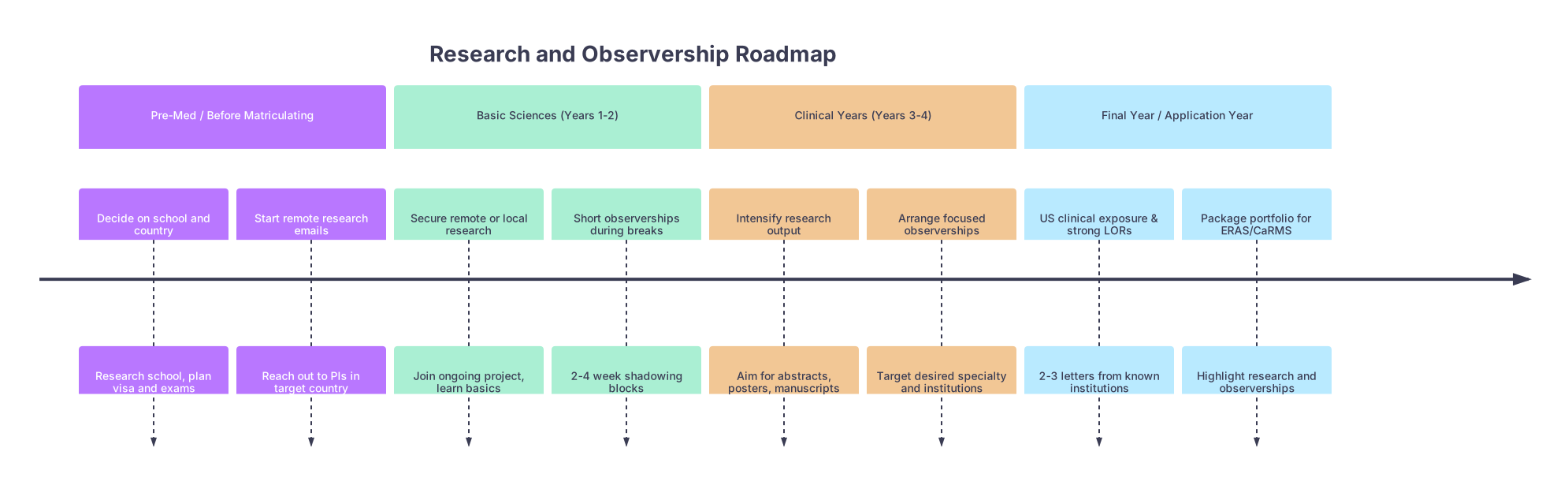
| Period | Event |
|---|---|
| Pre-Med / Before Matriculating - Decide on school and country | Research school, plan visa and exams |
| Pre-Med / Before Matriculating - Start remote research emails | Reach out to PIs in target country |
| Basic Sciences (Years 1-2) - Secure remote or local research | Join ongoing project, learn basics |
| Basic Sciences (Years 1-2) - Short observerships during breaks | 2-4 week shadowing blocks |
| Clinical Years (Years 3-4) - Intensify research output | Aim for abstracts, posters, manuscripts |
| Clinical Years (Years 3-4) - Arrange focused observerships | Target desired specialty and institutions |
| Final Year / Application Year - US clinical exposure & strong LORs | 2-3 letters from known institutions |
| Final Year / Application Year - Package portfolio for ERAS/CaRMS | Highlight research and observerships |
If You Are Still Premed / Not in Med School Yet
You have more flexibility than you think.
Be strategic about the country and city.
Choose a school in a place where research and teaching hospitals actually exist nearby. A cheap school in the middle of nowhere with no tertiary hospital access is an anchor.Start building relationships early.
Even in undergrad, you can:- Work with a PI who has collaborators in the U.S. or Canada
- Attend virtual conferences and meet researchers
- Gather names of potential mentors you will re-contact in med school
Decide your primary target system early (U.S., Canada, U.K., etc.).
Your research and observership plans will differ depending on exam requirements, visa routes, and match behavior.
If You Are Already in Basic Sciences (Preclinical)
This is your research foundation period.
Concrete goals for Years 1–2:
- Join at least one active research project (even if unpaid, even if basic data entry at first).
- Aim to have your name on something tangible by end of Year 2:
- Poster
- Abstract
- Case report
- Small original project
You do not wait until clinical years to start. By then, you will be too busy and too late.
If You Are in Clinical Years
You are in the execution phase.
Goals for Years 3–4:
- Convert prior research work into publications or conference presentations.
- Secure observerships or electives in your target country, in your realistic specialty range.
- Obtain 2–3 strong letters from U.S./Canadian attendings who know you well enough to write specific comments, not generic fluff.
4. Building Research from an International School: Step-by-Step
You do not need a famous lab. You need output and credible mentors.
Step 1: Identify Your Target System and Specialty Band
Do not obsess over one dream specialty (like dermatology or plastic surgery) if you are at a school nobody has heard of. You need a band of specialties that match your academic strength and risk tolerance.
Example bands:
- Highly competitive: derm, plastics, ortho, ENT
- Mid-competitive: anesthesia, EM, radiology, neurology
- Less competitive: internal medicine, pediatrics, FM, psych (still not “easy,” just more realistic)
If you are dead set on a highly competitive specialty from an unknown school, your research output needs to look like a PhD student’s. Be honest with yourself.
Step 2: Decide Your Research “Angle”
You have three main options:
Local research at your international school or nearby hospitals
- Easier to get involved.
- May yield decent output if you are aggressive.
- Main limitation: weaker name recognition.
Remote collaboration with U.S./Canadian/European groups
- Literature reviews, meta-analyses, data analysis, survey studies.
- Zoom/Teams weekly meetings.
- Requires strong email outreach and persistence, but very doable.
Research visits / short-term in-person stints abroad
- Summer research programs, short stays in labs, funded or self-funded.
- Best for building deep relationships and strong letters.
The optimal setup is a combination: local involvement for consistent productivity + at least one connection with a recognizable institution.
Step 3: How to Actually Land a Research Spot (From Abroad)
The generic “cold email” advice you see online is mostly useless. You need to be precise and efficient.
Make a short, credible CV (1–2 pages max):
- Education, exam scores (if any), relevant skills (R, Python, SPSS, Excel, literature search, basic stats), languages.
- Any prior research or presentations, even from undergrad.
Mine for realistic targets:
- Search PubMed: “internal medicine residency [your target city],” “cardiology [your target hospital].”
- Filter for assistant/associate professors; they are hungrier and more approachable.
- Identify labs doing retrospective chart reviews, registry studies, clinical research—these can be done remotely.
Send tightly written, specific emails. No life story.
Bad:
“I am a hardworking international medical student looking for any opportunity…”
Better:
- 3–5 short sentences
- One specific ask
- One concrete way you can help
Example:
Subject: Medical student help with retrospective [field] project
Dear Dr. X,
I am a third-year medical student at [International School] with strong interest in [field]. I have basic training in [R / SPSS / Excel] and experience extracting data from charts for a [small study / local project].
If you have ongoing retrospective or survey projects where an extra reviewer or data extractor would be helpful, I would be glad to contribute remotely and on a fixed schedule. I can commit [10] hours per week for at least [6] months.
I have attached a one-page CV. If it would be useful, I am happy to start with a small trial task so you can gauge my reliability.Sincerely,
[Name]
Volume matters.
- Expect a low response rate.
- Send 50–100 targeted emails over 2–3 weeks, not 5 emails over 6 months.
- Track contacts in a spreadsheet: name, email, date sent, follow-up date.
Follow-up once, politely, after 10–14 days.
No second follow-up unless they requested more information.
Step 4: Turn “Helping Out” into Real Output
Many international students participate in research that never turns into a line on a CV. That is a mistake.
You must:
- Ask early: “What is the realistic timeline for this project to reach submission?”
- Position yourself in roles that make you indispensable:
- Data extraction + cleaning
- Literature review and reference management
- Drafting sections of the manuscript
- Preparing abstracts and posters
Your goal for each major project:
- Be on the author list, not acknowledged.
- Get at least one conference abstract or poster even if the paper takes longer.
- Build enough familiarity with the PI that they can write a detailed letter later.
If a PI is clearly disorganized and nothing moves for 6–12 months, you do not wait forever. Thank them, stay polite, and quietly shift your energy to more productive mentors.
Step 5: Practical Target Numbers (Realistic, Not Fantasy)
From an unknown international school, a solid research profile for internal medicine or pediatrics might look like:
- 2–4 pubmed-indexed papers (some may be middle or later authorship)
- 3–6 posters/abstracts at regional or national meetings
- 1–2 strong letters from PIs at recognized institutions
For more competitive specialties, multiply that by 1.5–2.
This is not mandatory, but I have seen this level of output change minds again and again.
5. Observerships: How to Make Them Count
Observerships are not electives. You cannot bill, you cannot write orders, you may not touch a patient. That does not mean they are useless.
Used correctly, observerships can:
- Give you credible U.S. letters
- Show sustained exposure to U.S. health care
- Provide specialty-specific insight and connections
Step 1: Understand the Types of U.S. Clinical Experiences
| Experience Type | Hands-On? | Eligible Group | Letter Strength Potential |
|---|---|---|---|
| Core clerkship (affiliated) | Yes | Students of partnered schools | Very High |
| Visiting elective (final-year) | Yes | Students meeting school + visa rules | Very High |
| Observership | No | Grads or students, varies by hospital | Moderate–High (if long + engaged) |
| Shadowing (informal) | No | Anyone with connection | Low–Moderate |
| Research + clinic combo | Limited | Depends on PI/department | High (if sustained) |
If your school has no formal affiliation, observerships + research-linked exposure become your main tools.
Step 2: Choosing Where to Do Observerships
You do not chase brand names blindly. You chase places that:
- Actually offer structured observerships to IMGs
- Have residency programs in your target specialty
- Are in locations where PDs are used to seeing international graduates
Community teaching hospitals can be more valuable than “famous” places where you are one of 30 observers who never get to speak.
Step 3: Landing Observerships Without Connections
You have three main routes:
Formal hospital observership programs
- Many academic and community centers list “international observer” or “visiting physician observer” programs on their websites.
- These often require:
- Application fee
- Immunizations, background checks
- Proof of enrollment / graduation
- TOEFL or similar, occasionally
Cold outreach to department coordinators and attendings
- Similar to research outreach, but targeted to clinical exposure.
- Email the program coordinator for the residency with a concise request and dates.
- Also email attendings whose interests match yours.
Leverage any weak tie you can find
- Alumni from your school, even if only one person matched there 10 years ago.
- Friends of friends, relatives, former classmates now doing residency abroad.
- LinkedIn and alumni groups are underrated here.
Again, volume and organization matter. Think 30–50 targeted attempts, tracked in a spreadsheet, not 3 hopeful emails.
Step 4: Make Your Observership High Yield, Not Passive
Too many observers stand in the back and then expect a letter. That is fantasy.
During an observership:
- Show up early, leave late. Every day.
- Read on every single patient you see. Bring notes. Ask 1–2 thoughtful questions per day, not 20.
- Offer small, legal help:
- Pre-round chart review
- Drafting literature summaries for unusual cases
- Creating mini-presentations for the team
Ask the attending upfront, once you have rapport:
“I would like to make the most of this observership. Would it be helpful if I prepare a 5–10 minute presentation on a topic relevant to our patients later this week?”
That sounds professional. It shows initiative. And it gives the attending something concrete to remember when writing your letter.
Step 5: Optimize Duration and Timing
- A 2–4 week observership is the bare minimum.
- 4–8 weeks with the same attending or team is far better for a strong letter.
- Try to schedule observerships:
- In the 12–18 months before your application cycle
- In your target specialty, or at least in a closely related one (IM for cards, FM for primary care, etc.)
6. Combining Research + Observerships Into a Coherent Story
Research on one side, observerships on another, and your unknown school in the middle. You need to connect them into a single narrative.
The story you are aiming for looks like this:
- You chose medicine and your school deliberately, not as a last resort.
- Once enrolled, you aggressively built a track record that meets or exceeds students from better-known schools.
- Your research shows:
- Curiosity
- Persistence
- Ability to work with teams across borders
- Your observerships show:
- You understand U.S./Canadian clinical culture
- You can communicate effectively with patients and teams
- Trusted attendings are willing to vouch for you
Every component of your application should reinforce that.
How It Looks on Paper (ERAS / CaRMS)
-
- Research assistant roles with detailed bullet points: methods used, data handled, responsibilities.
- Observerships: list actual activities, not “I observed.”
Publications / Presentations:
- Group them by theme (cardiology, oncology, etc.) if they support a specialty focus.
Personal statement:
- One clear paragraph tying your international education → research curiosity → observership exposure → targeted specialty interest.
Letters:
- At least one from a research PI who can speak about your analytical skills.
- At least one (ideally two) from U.S./Canadian attendings who supervised your clinical exposure.
7. Common Mistakes That Kill International Applications
I see the same unforced errors repeatedly.
Waiting until final year to start research
- You end up with half-finished projects and “manuscript in preparation” lines that program directors ignore.
Short, scattered observerships
- Two weeks here, one week there, with no depth. That rarely produces strong letters.
Over-valuing paid “USCE packages” with poor reputations
- Many are glorified shadowing mills. PDs know which companies churn out generic letters. This can hurt more than help.
No focus in research
- Seven random case reports in seven different fields looks like noise.
- Better: 3–4 projects around your intended specialty or at least around adult vs pediatric care.
Under-communicating outcomes to mentors
- You do work, disappear, then reappear a year later asking for a letter. Mentors remember those who keep them updated and show gratitude over time.
8. A Concrete 3-Year Action Plan (Example)
Let me give you a specific model. Adjust it to your situation.
Assume:
- You are starting Year 2 at an unknown Caribbean school.
- You want internal medicine → cardiology in the U.S.
- You have no research yet.
Year 2 (Basic Sciences, Part 2)
- Join a local case report or retrospective project with a faculty member.
- Spend 4–6 hours per week learning basic research workflow.
- Start cold emailing U.S. cardiology and internal medicine PIs (50+ emails) for remote involvement.
- Secure at least one remote role by end of the year.
Year 3 (Early Clinical)
- Maintain 8–10 hours per week on remote research.
- Aim to submit:
- 1–2 case reports or short communications
- 1 abstract to a cardiology or internal medicine conference
- Arrange a 4-week observership in internal medicine at a mid-sized U.S. teaching hospital during a break.
- During observership:
- Give one short presentation
- Ask for feedback mid-rotation so you can correct course
- By the final week, if feedback is positive, ask the attending if they would feel comfortable writing a letter.
Year 4 (Final Year / Application Year)
- Intensify research to convert ongoing work into 1–3 manuscripts under review or accepted.
- Do a second, longer 6–8 week observership at a different institution or in a subspecialty clinic relevant to your interest.
- Sit for USMLEs with serious preparation (you cannot offset weak scores with research alone).
- Gather letters:
- 1 from research PI
- 2 from U.S. clinicians who supervised your observerships
- Write a personal statement that:
- Briefly addresses your international path
- Focuses on what you have done to meet and exceed expectations
This is the kind of profile that can pull you out of the “unknown foreign school” bucket and put you solidly in the “interesting candidate” pile.
9. Tracking Your Progress Like a Serious Applicant
You are essentially running a multi-year project. Treat it like one.
Use a simple tracking system:
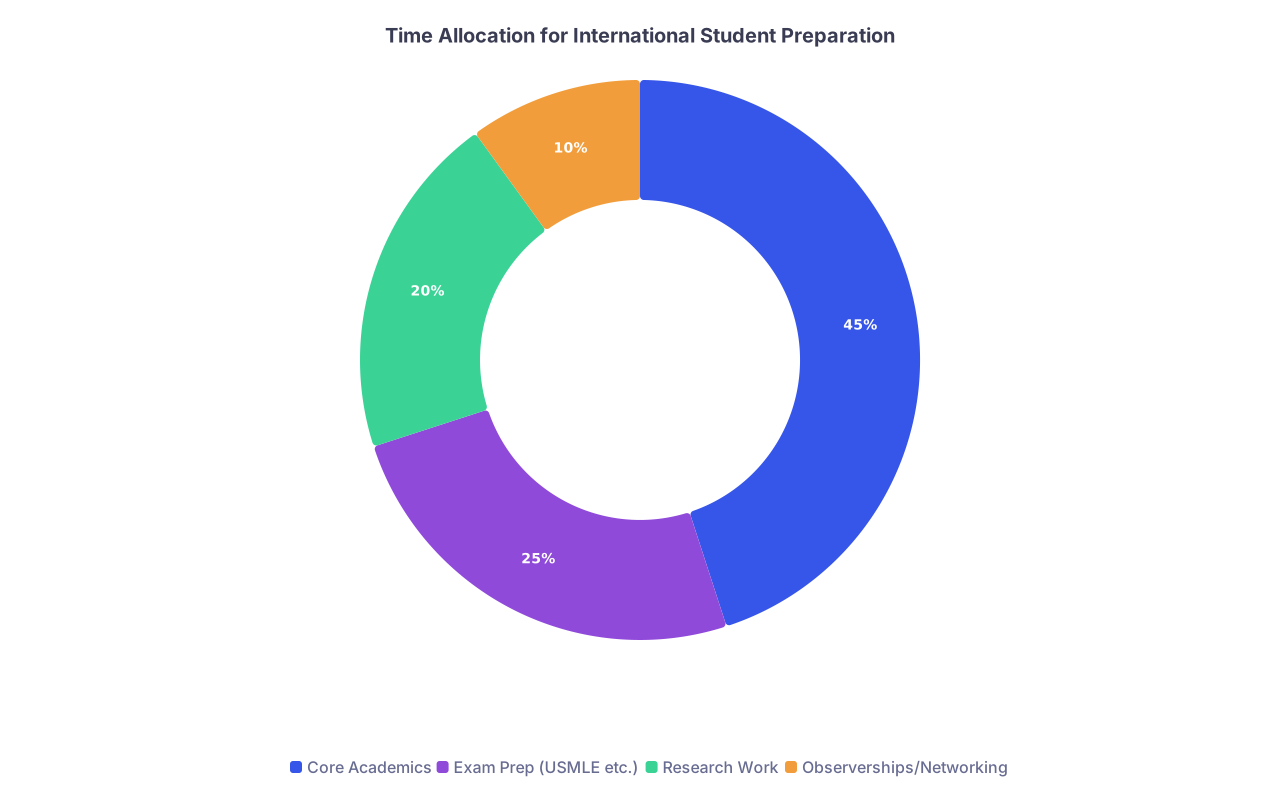
| Category | Value |
|---|---|
| Core Academics | 45 |
| Exam Prep (USMLE etc.) | 25 |
| Research Work | 20 |
| Observerships/Networking | 10 |
This is a realistic split during an intense phase. You can tweak it, but the point stands: research and observerships are not optional side quests. They need fixed weekly time.
Have:
- A research log: dates, tasks done, drafts written, datasets completed.
- An outreach log: who you emailed, when, their response, next step.
- A skills log: new analytic techniques, software, or methods you learn.
When you sit in front of an interviewer and say, “I have been systematically preparing for this for three years,” they should feel it in the details you provide.
Key Takeaways
- Your unknown international school is a handicap, not a sentence. You offset it by producing hard evidence: research output, U.S. clinical exposure, and strong letters.
- Research and observerships must be planned early, executed consistently, and tied to a coherent specialty narrative. Sporadic, last-minute efforts rarely work.
- Volume, persistence, and structure win: dozens of targeted emails, multi-month projects, 4–8 week observerships, and a clearly tracked plan will move you from “unknown” to “proven.”


