

The first people who decide your fate as an international medical graduate are not the program directors. It’s the coordinators—and they filter you long before a PD ever sees your name.
Let me be blunt: the “holistic review” language you read on program websites is aspirational marketing. What actually happens at 7:30 a.m. in the program office is a coordinator with a spreadsheet, search filters, and a pile of unofficial rules that never make it to any policy document.
If you’re an IMG or an FMG planning ahead in premed or early med school, you need to understand this machinery years before you hit ERAS. Because by the time you apply, most of the damage is already done.
What Coordinators Really Do With IMG Applications
Forget the fantasy that your personal statement goes to a thoughtful committee on day one. This is the real sequence.

| Step | Description |
|---|---|
| Step 1 | ERAS Submission |
| Step 2 | Bulk Download by Coordinator |
| Step 3 | Standard Filters |
| Step 4 | IMG Filters & Rules |
| Step 5 | Silent Rejection Bin |
| Step 6 | Shortlist Spreadsheet |
| Step 7 | Maybe Shown to PD |
| Step 8 | US Grad or IMG? |
| Step 9 | Meets Thresholds? |
I’ve watched this play out in internal medicine, FM, psych, prelim surgery, you name it. Different specialties, very similar process.
Coordinators are the first gatekeepers. They’re not “just administrative staff.” They’re the people the PD trusts to not waste their time. And they build entire micro-systems around one basic reality:
Too many applications. Not enough time.
So they create rules, shortcuts, patterns. Some formally approved. Most not. And those hit IMGs hardest.
The Quiet Filters: How IMGs Get Deleted Before Anyone Blinks
You want the real list? This is what coordinators quietly use when they pull up the IMG pile.
1. School Name: The Unofficial “Tier” Sorting
Every coordinator I’ve seen has their own mental tier list of international schools. They may not call it that, but watch how they scroll and you see it.
They scan the “Medical School” column and instantly categorize:
- Known “pipeline” schools they’ve had success with
- Neutral schools they’ve barely seen
- Red-flag schools they’ve been burned by
They don’t say this out loud in meetings, but you hear things in the office:
“Oh, that’s another one from [X Caribbean school]. We had two disasters from there.”
“Keep the CMGs, toss the rest from that list unless scores are amazing.”
If you’re still premed and thinking of an international route, this is where your decision will haunt or help you later.
| Category | Coordinator Mental Label | Practical Effect on Screening |
|---|---|---|
| Longstanding UK/EU/Canadian schools | “Solid international” | Considered if scores okay; not auto-trash |
| Big 4 Caribbean (SGU, AUC, Ross, Saba) | “Common but risky volume” | Need stronger scores/US experience to stand out |
| Newer/unfamiliar Caribbean or offshore | “Unknown / high risk” | Often screened out unless exceptional metrics |
| Indian/Pakistani/Egyptian/etc govt schools | “Depends on prior residents” | Helps if program had good grads from that school |
| For-profit “no-name” schools | “Avoid unless PD insists” | Almost never make it past first filter |
If your school has never had anyone match into that program, you start from a disadvantage before they even look at your scores. That’s reality.
2. Step Scores and Attempts: The Hard Line for IMGs
Coordinators don’t treat IMG scores the same way they treat US grad scores. The cutoffs are higher and less forgiving.
They’ll run queries like:
- Show only IMG applicants with Step 2 ≥ [X]
- Exclude any IMG with exam failures
- Exclude those missing Step 2 at time of application
Here’s how this usually breaks down in internal medicine or FM at mid-tier academic programs:
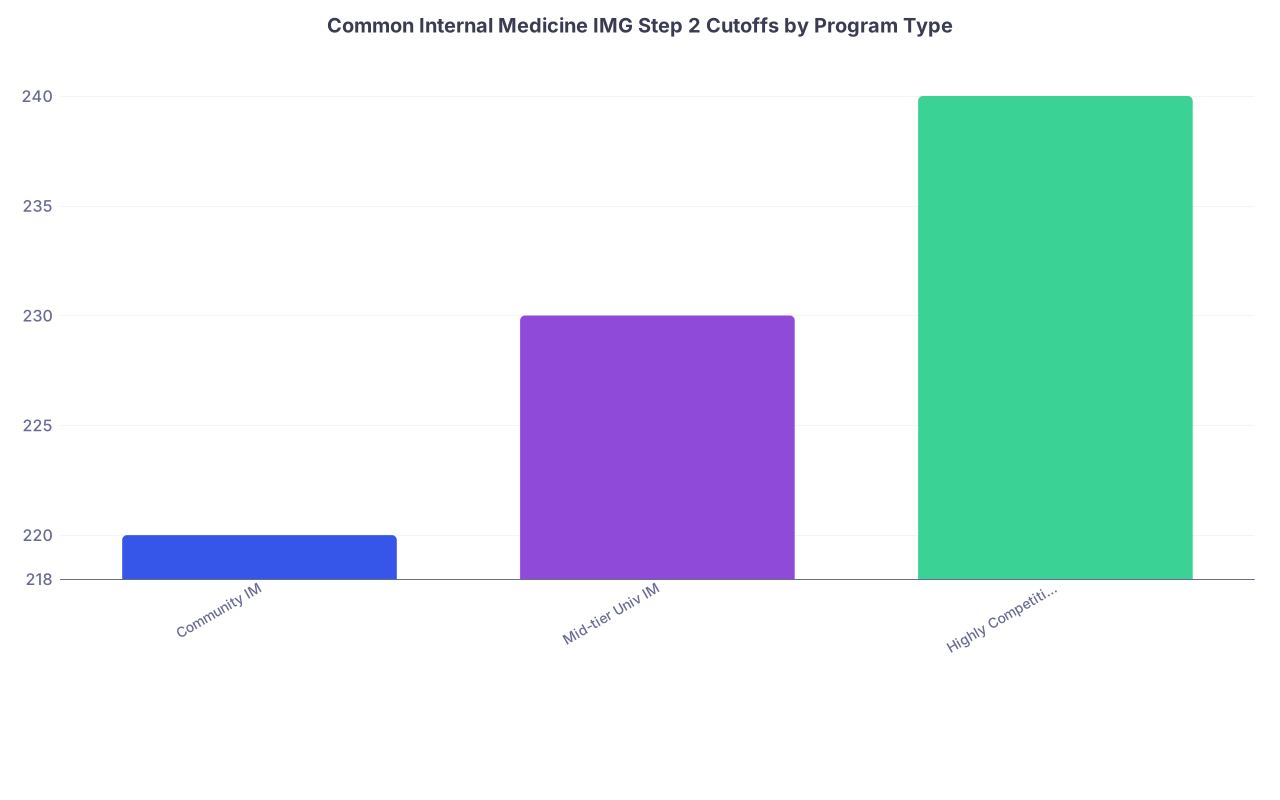
| Category | Value |
|---|---|
| Community IM | 220 |
| Mid-tier Univ IM | 230 |
| Highly Competitive Academic IM | 240 |
Are these official numbers? No. But I’ve watched coordinators say things like:
“For IMGs, let’s keep anything 230 and above. Below that, I’m not flagging them unless research is crazy strong or someone knows them.”
For US grads, the same program might be comfortable with 215–220. Double standard? Sure. But that’s what’s actually happening.
One more brutal truth: many coordinators auto-remove IMGs with:
- Any Step 1 or Step 2 failure
- Multiple attempts
- Missing Step 2 scores (especially in competitive cycles)
Even if the website says they “consider applicants with exam failures.” That line is for legal cover and flexibility. In practice, your file probably never leaves the ERAS portal.
3. Year of Graduation: The Hidden Expiration Date
Most IMGs don’t realize how much “YOG” shapes their chances before anyone bothers to glance at their CV.
Coordinators will literally sort by graduation year and say:
“Let’s cap at 5 years out for IMGs. PD doesn’t want people too far from graduation unless they’re already licensed somewhere or have strong US experience.”
Unofficial norms I’ve repeatedly seen:
- For IMGs: 0–5 years from graduation = realistic. 6–8 years = only if they’re extraordinary. >8 years = almost always binned unless there’s a personal connection or unique skill set.
- For US grads: much more leeway, especially with research-heavy or nontraditional paths.
This is especially deadly if you:
- Finished med school abroad
- Took years off trying to pass the Steps
- Delayed USMLE because of finances
- Worked clinically overseas for years before applying
From a coordinator’s point of view, long time since graduation = rusty, high remediation risk, more work for faculty. They won’t say that to you, but they say it to each other.
4. US Clinical Experience: Not All “USCE” Counts the Same
I’ve heard this sentence more times than I can count:
“Does this IMG have real US clinical experience or just observer stuff?”
Coordinators distinguish between:
- Hands-on USCE: Sub-Is, acting internships, audition rotations, externships with clear patient responsibility
- Shadowing/observerships: passive, no orders, no notes
- Research-only US experience
They’re not fooled by inflated language like “clinical attachment,” “assistant,” or “affiliate.” They read the letters. They know which hospitals never let you touch a patient.
In some programs, the coordinator has a mental rank of USCE:
- Home or affiliated US rotation with strong attending letter
- Reputable community or academic US rotation with specific clinical duties described
- Research plus limited clinical exposure
- Observerships labeled as “observer,” “shadow,” “visiting” without patient care
- Paid “externships” at sketchy for-profit clinics with templated letters
That list determines who gets pulled into the “maybe interview” pile.
If you’re still in med school abroad, this is where you can actually move the needle. One solid, real US rotation at a recognizable site is worth more than six generic observerships at random clinics.
The Coordinator’s Toolkit: How They Actually Filter You
Let me show you how this really looks on the other side of ERAS. Because it’s not mystical.
The First Pass: Mechanical Filters
Step one is almost always technical. Coordinators apply bulk filters inside ERAS or an exported spreadsheet.
Typical variables they sort by for IMGs:
- Citizenship/visa status
- USMLE scores and attempts
- ECFMG certification status
- Medical school name
- Year of graduation
Then they start excluding. Quickly.
I’ve watched a coordinator open the IMG subset and say:
“Okay, we have 900 IMGs. I’ll cut anyone with:
- No Step 2
- Any failures
- More than five years from graduation
- No visa eligibility That’ll get us down to something the PD will actually look at.”
That initial click removes hundreds of you in seconds.
The Second Pass: Pattern Recognition and Red Flags
Once the hard filters are done, they skim what’s left. They’re not reading your essays; they’re scanning your ERAS headers and LOR sources.
They look for:
- Repeated gaps with vague explanations
- Multiple incomplete or withdrawn prior applications to US programs (yes, they notice repeat applicants)
- Sloppy or inconsistent information (different months listed for the same job in CV vs. ERAS fields)
- Letters from unknown faculty at unknown places vs. recognizable US institutions
You know what makes them stop scrolling?
- A US letter from a respected academic name they’ve seen before
- A previous resident from your same school who did well in their program
- A note from the PD: “If we see any applicants from X school, flag them for me”
And what makes them roll their eyes and move on?
- Personal statements that read like copied templates
- Obvious mass-applied generic content (“Your prestigious program…”)
- “Clinical research” that’s really just chart reviews with no outputs, written in buzzword soup
They’re not judging your soul. They’re judging how much trouble you’re likely to be.
Visa Status: The Filter Nobody Admits Is a Filter
Visa issues are the quiet killer of IMG applications.
Coordinators are often the ones who deal with GME, HR, and international offices. They remember the H-1B denial that almost derailed a start date. The J-1 miscommunication that created chaos. The late DS-2019. So they become extremely conservative.
unofficial-but-real rules I’ve heard:
- “We’re saying we sponsor J-1 and H-1B on the website, but this year PD said we’ll only consider H-1B for US grads and very exceptional IMGs.”
- “If they need H-1B and their Step 3 isn’t done by application, I’m not pushing that file.”
- “If they’re not ECFMG certified by ranking time, I tell the PD not to risk it.”
If you’re early in the pipeline, this is one of the few things you can plan properly:
- Get ECFMG certification early
- Do Step 3 before application if you’ll need H-1B (for programs that care about that)
- Understand which states have licensing rules that block you later so programs won’t want to deal with the headache
To coordinators, “clean paperwork” is as attractive as a 240.
The “Whisper List”: Schools and Backgrounds That Get Preferential Eyes
Here’s the part nobody writes on websites.
Some programs have what I call “whisper lists.” Not official policies. Just realities.
They’ll quietly favor:
- Certain Indian, Pakistani, Egyptian government schools whose grads have historically performed well
- Certain Caribbean schools that send them strong candidates year after year
- Specific international schools where the PD or a core faculty trained or did electives
I sat in an IM office where the coordinator literally had a post-it:
“From X, Y, Z med schools → flag for me, history of good residents.”
Another PD told their coordinator: “If you see grads from [specific university in Lebanon and one in India], don’t hard filter them on scores. I want to see those myself.”
You can’t fully control this from abroad. But you can research:
- Where grads from your school have matched in the past 5–10 years
- Which programs list alumni from your country/school on their website
- Who from your school is currently a resident or fellow in the US and where
That tells you where you’re more likely to survive the first pass.
The Cosmetic Stuff That Actually Matters
Does formatting of your application matter? To coordinators, yes—purely as a proxy for how much work you’ll be.
They’re watching out for:
- Chaotic activity descriptions with random capitalization and grammar errors
- CVs uploaded that conflict with what’s typed into ERAS
- Overinflated titles: “Lead clinical research director” for a med student in a tiny clinic
- Unprofessional email addresses and voicemail greetings (yes, they notice when they call)
You think this is trivial. They don’t.
They know attendings will complain if they bring in someone who can’t communicate clearly or who lied on paper. So they look for early tells.
One coordinator I know kept a list: “People we interviewed who turned out totally different from their applications.” She absolutely started recognizing patterns in overblown IMG applications and used that to be harsher with future ones.
How to Play This Game Early: What You Should Do in Premed/Med School
This is the part you actually have control over right now.
You can’t change that you’re international. You can change how coordinators see you when your application lands.
If You’re Still Premed Considering an International School
You should be doing recon like a strategist, not choosing a school based on beach photos.
- Look up match lists from each school—not just raw numbers, but which programs and specialties.
- Check if grads from that school are in US residencies now and where.
- Email or LinkedIn-message a few and ask bluntly: “How does your school’s reputation affect initial screening as an IMG?”
If you’re choosing between:
- A newer Caribbean or offshore school with minimal US presence
vs. - A more established international university with decades of alumni in US residencies
Pick the second, even if it’s a logistical nightmare. Coordinators care about familiarity and track record.
If You’re Already in an International Med School
Build yourself to survive the filters coordinators actually use:
- Aim for Step 2 numbers that clear the “IMG bonus threshold,” not just the pass mark. You’re not competing at the same bar as US grads.
- Get at least one real, hands-on US rotation with strong, specific letters from known institutions.
- Keep your graduation timeline tight. Don’t drift into 7–10 years post-graduation unless you’re stacking serious US experience or another degree.
- Document everything cleanly now. Clear dates, responsibilities, outputs. Makes ERAS cleaner later.
If you do observerships only, stop pretending that’s equivalent to a sub-I. Coordinators can smell the difference.
What Coordinators Remember—and Why You Should Care
Coordinators don’t just remember data. They remember stories.
- The IMG who matched, then failed Step 3 three times and delayed credentialing.
- The one whose visa paperwork was a mess, requiring 20 extra phone calls.
- The one who showed up unprepared for intern year and had multiple patient complaints.
These experiences shape how they screen the next generation of IMGs. They become more conservative, more rigid, more skeptical.
On the flip side:
They also remember the IMG from “that school in India” who became chief resident, crushed boards, stayed as faculty. Suddenly, future grads from that school get a softer look.
You’re not just an applicant. You’re part of a pattern in their mind.
If You Take Nothing Else From This
Three things:
- Program coordinators are your first, hardest filter as an IMG, and they operate with stricter, unofficial rules than anything on a website.
- The big levers they use against you—school name, Step performance (especially Step 2), YOG, visa status, and US clinical experience—can be influenced years before you apply, if you’re strategic.
- Your goal isn’t just to “be good.” It’s to look, on a quick-screen spreadsheet, like the safest, cleanest, least-risk IMG in that stack. If you don’t, you never reach the PD’s eyes.
You want to match from an international school? Stop playing the public game. Start planning for the private one coordinators are actually running.


