

It’s April. You’re scrolling through glossy websites of international medical schools—Caribbean, Eastern Europe, maybe a program in Mexico or the Philippines. You’ve got tuition numbers scribbled in a notebook, match lists open in 10 browser tabs, and your parents keep asking: “So which one are you going to pick?”
You’ve compared cost. You’ve compared weather. You’ve checked “USMLE pass rate” because that’s what everyone online screams about.
But you haven’t really asked one brutal question:
Where will you actually learn medicine?
As in: what hospitals, what clinics, what wards, what attendings, what patient volume, what country.
If you ignore clinical rotation quality when comparing international programs, you are playing Russian roulette with your future. I’ve watched this mistake derail smart, motivated students who should have matched. They didn’t fail because they were lazy or dumb. They failed because their “clerkships” were smoke and mirrors.
Let’s walk through the traps before you step into one.
The Core Mistake: Treating “We Offer Clinical Rotations” Like It Means Anything
Here’s the scammy line you’ll see over and over:
“We offer clinical rotations in the US and UK at top hospitals.”
Sounds great. Means almost nothing.
Programs use that line to distract you from the real questions:
- Where, exactly?
- What type of hospitals?
- Are these core rotations or just electives/observerships?
- How many spots? For how many students?
- Are attendings affiliated with a US medical school?
You can’t assume “US clinical rotations” = strong training. I’ve seen students “rotate” in:
- Tiny community hospitals where med students are basically invisible
- Clinics where they mostly shadowed NPs and never presented a patient
- “Rotations” that were essentially observation with zero evaluation or teaching
Let me be blunt:
Weak clinical rotations = weak letters, weak skills, weak confidence, and weaker match chances.
You cannot fix that later with just “working harder.”
Why Clinical Rotation Quality Is Non‑Negotiable
Students obsess over:
- USMLE Step scores
- Tuition
- Location (sunny island vs cold Eastern Europe)
Those matter. But they do not replace this:
Your third and fourth year clinical training is the core of your medical education.
It’s where you learn how to actually function as a doctor.
Mess this up, and you will:
- Struggle in sub‑internships and away rotations
- Get generic or weak letters of recommendation
- Look “off” clinically compared to US grads on interview day
- Have attendings quietly flag you as “not ready”
Here’s what high‑quality vs low‑quality rotations really mean:
| Factor | High-Quality Rotation | Low-Quality Rotation |
|---|---|---|
| Hospital Type | Teaching hospital, residents present | Small community site, no real teaching culture |
| Role of Student | Takes histories, presents, writes notes | Mostly observes, minimal responsibility |
| Evaluation | Structured evals, feedback, grades | Little to no formal evaluation |
| [Letters of Recommendation](https://residencyadvisor.com/resources/international-med-schools/letters-from-abroad-how-residency-faculty-read-lors-from-img-programs) | Detailed, specific, from academic physicians | Generic, short, from unknown or non-academic MDs |
| Patient Volume/Mix | High volume, diverse pathology | Low volume, limited exposure |
You can survive mediocre preclinical lectures with good self‑study.
You cannot “self‑study” your way out of garbage rotations.
Red Flags in How Programs Talk About Clinical Rotations
If you’re comparing international medical schools and you see any of these patterns, slow down. Hard.
1. Vague or Non‑Specific Hospital Descriptions
Phrases like:
- “Rotations in top US hospitals”
- “Clinical training in major metropolitan areas”
- “Affiliations across the US and UK”
Without naming:
- Specific hospitals
- Whether they are teaching hospitals
- Whether there are residents and US medical students
That’s a problem.
If it’s legit, they can say:
“Core rotations at XYZ Community Hospital (affiliated with ABC US medical school)” or “Electives at DEF Medical Center, with residents from GHI University.”
No names = no trust.
2. “Guaranteed Clinical Rotations in the US” With 300+ Students Per Class
Do the math. A school that:
- Enrolls 300–600 students per year
- Claims guaranteed US rotations
…should be able to show clear capacity: enough spots, multiple hospitals, multi‑year contracts.
I’ve seen:
- Students stuck waiting months for rotations to be scheduled
- Rotations arranged “last minute” in sketchy clinics
- Students rotated 3–4 deep per attending—no hands‑on, no presentations
Ask:
“How many core US clinical slots do you have per year and how many students are you placing in them per year?”
If they dodge or spin, that’s your answer.
3. Heavy Reliance on Outpatient Clinics for “Core” Rotations
Internal medicine “rotation” that’s 90% outpatient clinic?
Surgery “rotation” with almost no OR time?
Psych “rotation” that’s basically tele‑therapy observation?
No.
You need:
- Inpatient exposure for medicine, surgery, peds, OB/GYN
- Actual teams, rounds, and call (or at least some version of it)
- Attendings who know how to teach students and fill out real evaluations
If a program pushes lots of outpatient, non‑teaching, or private practice sites as core training, they’re cutting corners.
4. Everything Is “Student‑Arranged”
Some schools proudly say:
“We allow students to arrange their own rotations in the US/Canada/UK.”
Translation too often:
“We don’t have enough real affiliations, good luck cold‑emailing hospitals.”
A little flexibility is good—especially for electives.
But if:
- Core rotations are on you to arrange
- There’s no clear list of approved sites
- No central coordination or quality control
You’re risking ending up with:
- Observerships instead of true clerkships
- Rotations at places that can’t give letters that count
- Months lost to “waiting for hospital approval”
That’s not training, that’s chaos.
Hidden Consequences Students Don’t See Until It’s Too Late
The real damage from poor clinical rotations shows up 2–4 years later, when you’re applying to residency.
Weak or Useless Letters of Recommendation
Program directors read between the lines fast.
A strong letter from a real US teaching hospital sounds like:
- “She functioned at or above the level of a sub‑intern.”
- “He independently managed 4–6 patients daily and presented concisely.”
- “I would rank this student in the top 10% of all students I’ve supervised.”
A weak letter from a random clinic:
- “He was punctual and professional.”
- “She showed interest in learning and was well liked by staff.”
Translated: “I don’t know how to say this kindly—this student did almost nothing.”
Poor rotation → weak experience → bland letter → red flag in ERAS.
Gaps in Basic Clinical Skills
I’ve watched international grads flounder during sub‑I’s because their rotations trained them to be spectators, not participants. Common gaps:
- Can’t confidently present a patient on rounds
- Struggle to write a coherent assessment and plan
- Never learned to pre‑round or follow patient labs properly
- Awkward with basic bedside communication
This isn’t a character flaw. It’s a training failure.
Your brain only knows what it’s been forced to do repeatedly with supervision and feedback.
Program Director Distrust
Some PDs are already suspicious of international schools. That’s reality.
You can’t fix that by pretending it doesn’t exist.
What slightly softens that bias?
- Known hospitals
- Known attendings
- Solid letters from real US teaching environments
When your application shows rotations at:
- Unknown clinics
- Private offices
- Hospitals with no residents
PDs start asking the question you never want them asking:
“Will this person be safe and effective on day 1 of intern year?”
If they aren’t sure, you slide down their list. Or off it.
How to Actually Judge Clinical Rotation Quality (Not the Marketing Brochure)
Here’s where you stop being passive and start interrogating the program.
Step 1: Get Specific Names and Sites
Ask the admissions office—in writing—for:
- A current list of hospitals/clinical sites where core rotations occur
- Which country each site is in
- Whether each site is inpatient or outpatient
- Whether residents are present and from which school
Then verify:
- Google the hospital. Is it a teaching hospital?
- Check if US MD/DO schools rotate there.
- Ask current students (not just the ones admissions picks for you) where they actually rotated.
If the list “cannot be shared” or is “constantly changing,” that’s not flexibility. That’s instability.
Step 2: Ask How Rotations Are Assigned
You want to know:
- Are core rotations guaranteed in certain countries or just “subject to availability”?
- Is there a lottery? Seniority? First‑come first‑served?
- How long do students typically wait between rotations?
I’ve seen students lose 6–9 months just waiting for the next rotation slot.
Gap after gap. Hard to explain in interviews. Brutal for momentum and exam timing.
Step 3: Look at Ratios – Students vs Slots
Ask bluntly:
- “How many students are in each clinical cohort?”
- “How many rotation slots do you have for core IM, surgery, peds, etc., per year?”
If the ratio is crazy (huge classes, small number of real teaching sites), attendings will be overwhelmed, teaching will suffer, and you’ll be fighting your classmates for chances to present a single patient.
Step 4: Talk to 3 Types of Students/Grads
Don’t just listen to the golden examples the school parades around. Try to find:
- A current clinical‑year student in the average path, not the superstar
- A recent graduate who matched in a non‑competitive specialty (FM, IM, peds)
- Someone who did NOT match and ask specifically:
- How were their rotations?
- Did they feel prepared?
- What feedback did they get from programs?
Patterns will emerge fast.
Step 5: Compare Across Programs With a Simple Grid
Build a simple comparison table for yourself. Something like:
| Program | Core Sites Country | Teaching Hospitals? | US Core Spots Guaranteed? | Avg Wait Between Rotations |
|---|---|---|---|---|
| School A | Mainly Caribbean | Yes, limited | Partially | 1-2 months |
| School B | Mostly US | Yes, multiple | Yes | Minimal |
| School C | Eastern Europe | Mixed | No | 3+ months |
If you’re staring at a school where:
- Cores are mostly overseas in non‑teaching hospitals
- US experience is a couple of electives or observerships
Move on. You’re not just picking a campus. You’re picking the hospitals that will define your training.
Dangerous Rationalizations Students Use to Excuse Bad Rotations
I hear the same justifications over and over from students who end up in trouble.
“I’ll Just Crush Step and That Will Cover It”
Step scores matter. But they’re knowledge tests, not competence guarantees.
Residency programs don’t want a 250 Step score who can’t:
- Present without falling apart
- Call consults appropriately
- Manage basic floor issues
I’ve watched high‑scoring international grads fall apart on sub‑I’s because their rotations were glorified shadowing.
“I’ll Arrange Amazing Rotations in the US Myself”
Maybe. More often:
- Hospitals don’t want to deal with unaffiliated students
- You end up with observerships that don’t count
- You burn months chasing emails and paperwork
Using a school with no solid clinical network and planning to “hack it yourself” is like applying to non‑LCME schools and planning to “hack” your way into the match. Can it work? Rarely. But you’re stacking odds against yourself.
“Somebody From This School Matched Derm So It Must Be Fine”
Every questionable school has that one success story. Usually marketed hard.
One person who:
- Had family connections
- Or did extra research, multiple US away rotations, and 2 extra years of grinding
- Or was simply exceptional and lucky
You’re not building a plan on outliers. You want a school where the average hardworking student lands a reasonable residency, not just the unicorn.
Look at broad patterns:
- Overall match rate (for US residencies, not just any job)
- How many grads match into IM/FM vs unemployment or prelim purgatory
What You Should Prioritize Instead
Let me spell out what actually matters when evaluating clinical rotation quality. These are not “nice‑to‑haves.” They’re non‑negotiables.
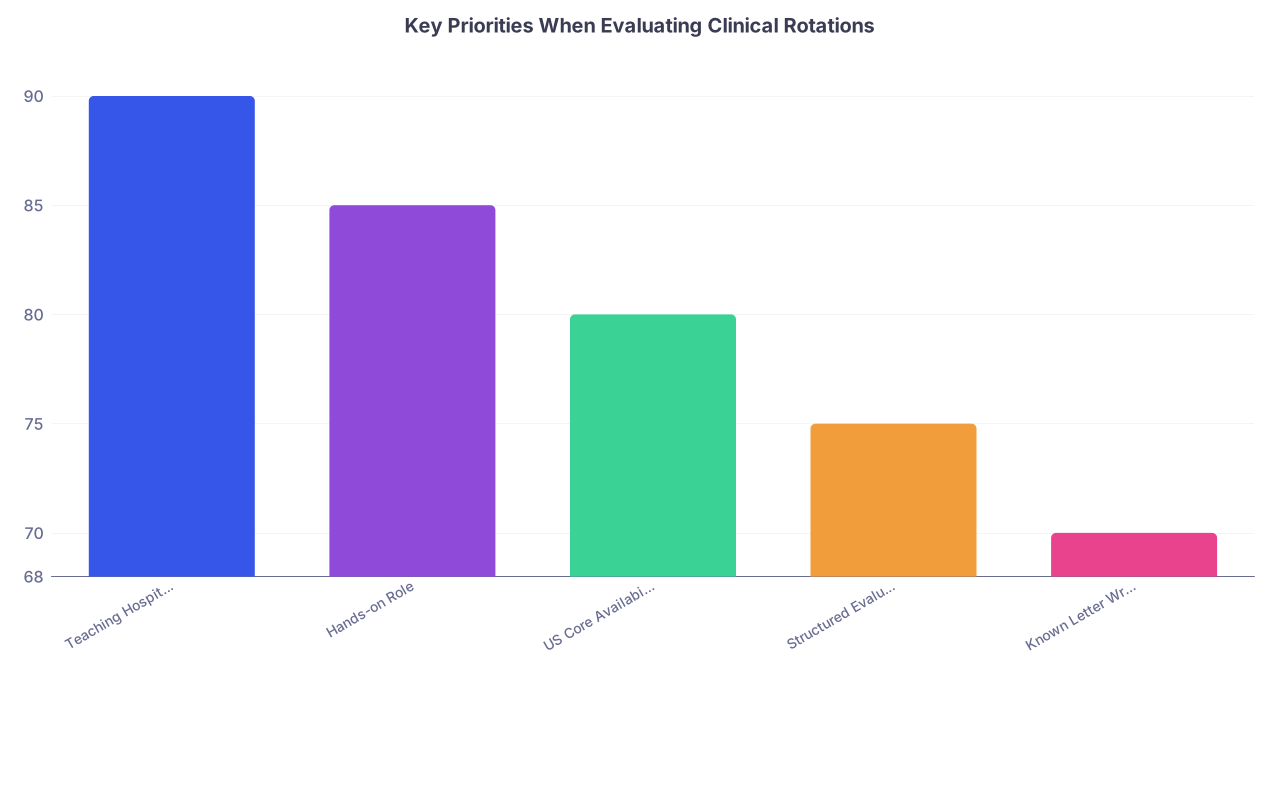
| Category | Value |
|---|---|
| Teaching Hospitals | 90 |
| Hands-on Role | 85 |
| US Core Availability | 80 |
| Structured Evaluations | 75 |
| Known Letter Writers | 70 |
You want:
- Predominantly teaching hospitals with residents and other med students
- Hands‑on roles: histories, physicals, presentations, and notes
- US‑based core rotations (not just 8 weeks of electives capped at the end) if your goal is US residency
- Structured evaluations and grades used in MSPE/Dean’s letter equivalents
- Attendings with academic affiliations whose letters actually carry weight
If a program can’t deliver most of that, it’s not “just as good but cheaper.”
It’s a risk. A big one.
A Quick Reality Check Flow: Is This Program’s Clinical Training Safe?
Use this mental flowchart before you sign anything.

| Step | Description |
|---|---|
| Step 1 | Considering International Med School |
| Step 2 | High Risk - Walk Away |
| Step 3 | Plan for Non-US Practice or High Risk |
| Step 4 | Expect Delays & Overcrowding |
| Step 5 | Shadowing Only - Weak Training |
| Step 6 | More Investigation but Reasonable Starting Point |
| Step 7 | Named Teaching Hospital Sites? |
| Step 8 | US Core Rotations Available? |
| Step 9 | Enough Slots for Class Size? |
| Step 10 | Hands-on Student Role Confirmed? |
If you’re landing on “High Risk,” “Walk Away,” or “Weak Training” more than once, do not gaslight yourself into thinking “I’ll be the exception.”
You probably won’t be.
FAQs
1. If a school has solid USMLE pass rates, does that compensate for weaker clinical rotations?
No. USMLE pass rates tell you students can memorize and self‑study preclinical content and some clinical scenarios. They say nothing about:
- Bedside skills
- Teamwork in a hospital
- Ability to manage real patients
Residency programs know this. They use Step scores as one filter, then rely heavily on:
- Clinical letters
- Clerkship grades
- How you perform on sub‑I’s and away rotations
You can’t fix years of weak clinical exposure with a high test score.
2. Is it ever okay to accept mostly overseas clinical rotations if I want a US residency?
It’s possible, but it’s higher risk and you need a very clear plan. Minimum conditions:
- Overseas rotations are in real teaching hospitals with structured clerkships
- You can still do substantial US electives in your desired specialty
- You’ll get at least 2–3 strong US letters from recognized institutions
Even then, you’re swimming upstream compared to someone doing most cores in the US. If the school offers only a couple of short US observerships and calls that “US clinical experience,” that’s not enough.
3. How can I tell if a rotation counted as a “real” clerkship vs just observership?
Ask yourself:
- Were you formally evaluated with a grade or written evaluation?
- Did you take histories, present, and participate in decision‑making under supervision?
- Was the hospital affiliated with a medical school that runs an accredited residency?
- Did your attending write a detailed letter referencing your clinical performance?
If you were just sitting in the corner, not charting, not presenting, and nobody graded you—residency programs will see that as observation, not genuine training.
4. I already started at an international school and my rotations seem weak. Am I doomed?
Not doomed, but you need to stop pretending it’s fine. Steps:
- Be brutally honest: what are you actually doing on these rotations?
- Talk to your dean/clinical coordinator about switching to stronger sites if possible.
- Aggressively pursue better US electives at teaching hospitals, especially in your target specialty.
- Treat sub‑I’s/aways like live auditions and squeeze maximum feedback and letters from them.
You’ll have less margin for error than someone with consistently strong rotations, but some students do claw their way out of a weak setup. It just takes awareness early and decisive action.
Today’s action step:
Open the websites of the top 2–3 international programs you’re considering. Ignore tuition and Step pass rates for a moment. Go directly to their clinical education section and make a list of every named hospital they mention for core rotations. If that list is vague, tiny, or full of clinics instead of teaching hospitals, don’t rationalize it. Email admissions and ask for a full current site list and how rotations are assigned. Their response—or their refusal to answer—will tell you a lot more about your future than any palm tree photo on the homepage.


