

The biggest threat to your dream of practicing medicine in the U.S. might not be your GPA or MCAT. It might be choosing the wrong type of international medical program in the first place.
Most people do not realize this until it’s far too late—when they’re already years into a degree that will never qualify them for ECFMG certification, USMLE, or U.S. residency. I’ve seen students with perfect English, strong Step scores, and glowing letters…who still could not match because they picked the wrong structure of program on day one.
Do not let that be you.
This isn’t about “good” or “bad” schools. It’s more basic than that: some entire types of international programs simply do not line up with U.S. licensure pathways. And no amount of hard work later will fix that structural mismatch.
Let’s walk through the traps.
The Core Mistake: Confusing “Any Medical Degree” With “U.S.-Eligible Degree”
You’re not just applying to med school. You’re applying to a licensing pipeline.
That pipeline runs through:
- A recognized medical program that meets ECFMG requirements
- The ability to sit for USMLE Step exams
- Eligibility for U.S. residency (ACGME programs)
- State licensing board requirements (which can be stricter than ECFMG)
If your program falls outside that pipeline, you’re done before you start.
The classic mistake: assuming that if a program awards an MD or an MBBS, you can figure out U.S. licensure later.
Wrong.
The Two Program Dimensions That Matter Most
Most international programs that U.S.-aiming students consider can be broken down along two axes:
Curriculum type
- U.S.-style MD (4-year, post-bacc, similar to U.S. structure)
- Non-U.S. style MBBS/MD (5–6 years, often starting after high school)
Regulatory alignment
- Built around ECFMG/USMLE pathways
- Built for domestic or regional practice with no real focus on U.S. licensure
The most dangerous programs are not “bad” schools. They’re schools designed for an entirely different system—often excellent for local practice—but nowhere near aligned with U.S. requirements.
If you don’t know which category your target school sits in, you’re gambling your entire future career on blind faith and website marketing. That’s the mistake.
The Main “Wrong Program” Categories That Destroy U.S. Plans
Here’s where people get burned most often.
| Program Type | Typical Length | Main Risk for U.S. Licensure |
|---|---|---|
| Local MBBS with no U.S. focus | 5–6 years | Curriculum, exams, and clinical sites not aligned with USMLE/ECFMG |
| Off-shore “clinical science only” options | 2–3 years | No full medical curriculum, often not accepted as a full medical degree |
| Unrecognized or newly created schools | Varies | Not listed or recognized by ECFMG/WFME, future eligibility uncertain |
| Schools without structured [U.S. clinical rotations](https://residencyadvisor.com/resources/international-med-schools/ignoring-clinical-rotation-quality-when-comparing-international-programs) | 5–6 years | Poor or no U.S. clinical experience, weak residency competitiveness |
| Distance/hybrid foreign MD programs | Varies | Online-heavy delivery often not recognized as valid medical training |
Let me break down what each trap looks like in real life.
1. Local MBBS Programs Not Geared to the U.S.
Scenario: A U.S. citizen applies to a 6-year MBBS program in Eastern Europe or Asia that mainly serves domestic students. The website says their graduates “have gone on to practice worldwide.” Sounds global. Looks legit. Cheap.
Problem:
- The teaching language might be English, but
- The curriculum is tailored to local licensing exams, not USMLE.
- There’s little or zero structured support for U.S. exams.
- Clinical rotations are in a healthcare system very unlike the U.S.
- U.S. residency placements are rare, sporadic, and not systematically supported.
What goes wrong later?
- You graduate with a theoretical MD/MBBS that technically might let you sit for USMLE (if recognized by ECFMG), but you have:
- No U.S. clinical experience
- No U.S. letters of recommendation
- No idea how to navigate ERAS/NRMP
- A degree from a school program directors barely recognize
You’re trying to compete with Caribbean grads who have 1–2 years of U.S. rotations and built-in USMLE coaching. You lose that battle most of the time.
Red flag: The school’s match list into U.S. is either:
- Nonexistent
- Outdated (“Our 2014 graduate matched in New York!”)
- Or a tiny handful of U.S. placements over a decade
If U.S. licensure is even on your radar, do not treat a generic MBBS program as equivalent to a U.S.-style MD track with proven U.S. outcomes. They are not the same product.
2. “Clinical Science Only” or Transfer-Heavy Programs
There are programs that try to hook you with this pitch:
“Already finished preclinical years elsewhere? Complete your clinical years with us and get an MD!”
Sounds efficient. Feels like a shortcut.
Huge catch:
- Many of these outfits don’t run a full medical program from start to finish.
- They rely on you transferring in after basic sciences from another country or school.
- U.S. licensing authorities often expect your degree-granting program to be a full, recognized medical curriculum—not a clinical add-on.
Risk: The hybrid you construct (basic sciences from one unrecognized program + clinicals from another questionable one) may not be viewed as a valid medical degree for ECFMG certification or for some state licensing boards.
If your path looks like a patchwork of opportunistic transfers, you’re exactly the type of candidate that triggers extra scrutiny—and sometimes outright rejection.
3. Unrecognized or Newly Created Schools
ECFMG currently bases eligibility on whether your school is listed in the World Directory of Medical Schools (WDMS) and meets certain standards (note: WFME recognition is becoming central).
Here’s how students get wrecked:
- They enroll in a brand-new school that isn’t fully recognized yet
- Or they enroll before the school’s accreditor has WFME recognition
- Or they never check the “Remarks” section in WDMS that might restrict ECFMG eligibility
Then, during their training, rules change.
Suddenly:
- Their school can’t sponsor ECFMG certification
- They’re barred from USMLE
- Or certain licensing states refuse grads from that institution
I’ve seen people two years from graduation realize they will never be eligible to apply for U.S. residency. They didn’t miss by a mile. They missed by a line in a directory they never checked.
If you’re not checking WDMS and ECFMG policy updates yourself, you’re trusting your future to school marketing. That’s naïve at best.
The Quiet Killers: Structure Problems That Don’t Show Up in Brochures
Even if the school is recognized, some structural issues make U.S. licensure brutally harder.
1. No Built-In U.S. Clinical Rotations
A program might technically be ECFMG-eligible but do nothing practical to prepare you for U.S. residency.
Watch for:
- Clinical years entirely in local hospitals with no U.S. affiliations
- No established pathway for core rotations (IM, surgery, peds, OB/GYN, psych) in the U.S.
- No system for obtaining U.S. letters of recommendation from faculty known to program directors
You end up graduating with:
- Zero U.S. clinical exposure
- Only vague “observerships” arranged last-minute
- Letters from doctors program directors have never heard of, in systems they don’t trust
That’s not a licensure problem on paper—it’s a match problem in reality. You can pass USMLE and still not match. That’s the part many premeds underestimate.
2. Heavy Online or Distance Components
Another growing trap: “hybrid” foreign MD programs where:
- Basic sciences are mostly online
- Clinicals are loosely arranged or scattered
- Assessment is poorly standardized
U.S. authorities—state boards especially—get very suspicious here.
Some states explicitly require:
- In-person, on-campus didactic teaching
- Structured, supervised clinical rotations in teaching hospitals
If your degree is from a school that treats med school like an online course with occasional in-person labs, a few licensing boards will simply refuse to license you. Period.
It’s not about whether you learned the material. It’s about whether your school’s structure meets regulatory expectations.
The Caribbean Isn’t Automatically Safe Either
People love to oversimplify:
“Caribbean = good for U.S. matching.”
That is dangerous thinking.
Reality: the Caribbean has a few schools with long histories of U.S. placements, strong U.S. affiliations, and established match outcomes. It also has a long list of marginal programs that exist to collect tuition, not to get you licensed.
You can absolutely choose the wrong type of Caribbean program for U.S. licensure.
How Caribbean Programs Differ in Risk
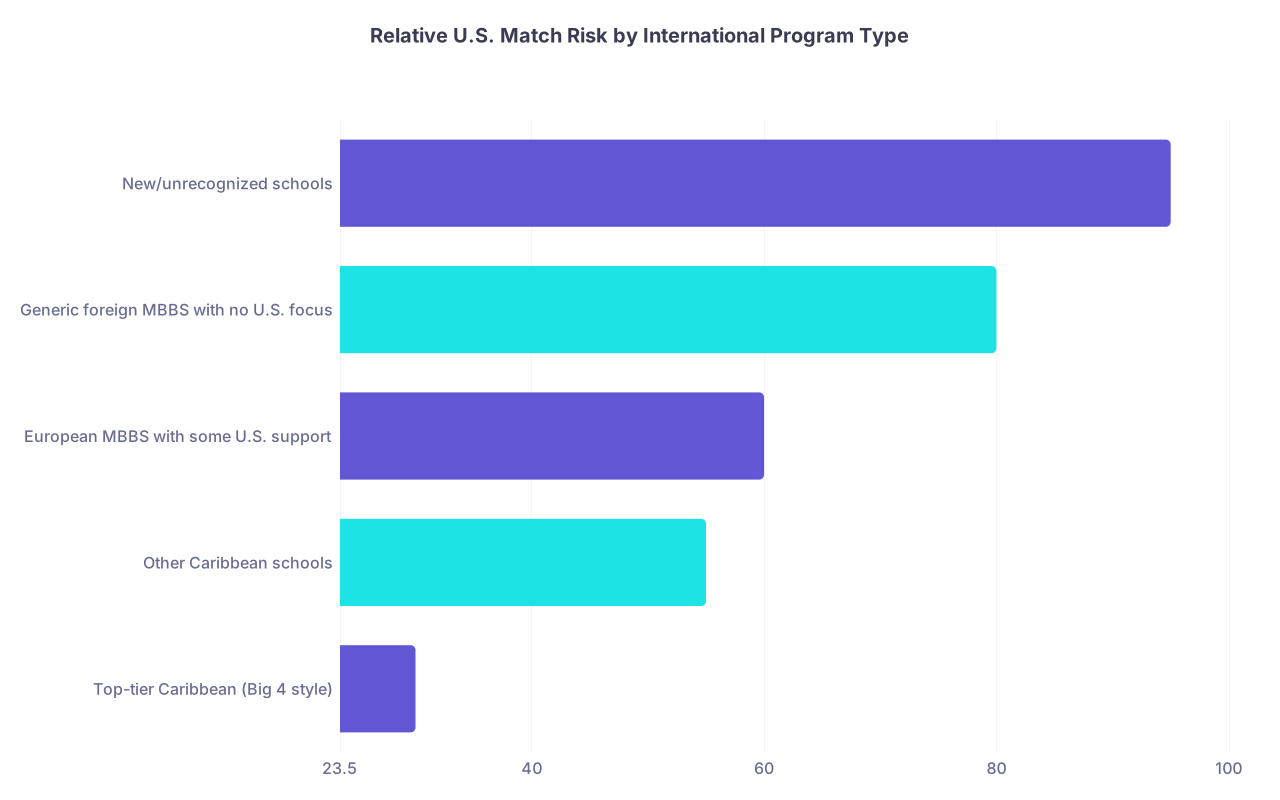
| Category | Value |
|---|---|
| Top-tier Caribbean (Big 4 style) | 30 |
| Other Caribbean schools | 55 |
| European MBBS with some U.S. support | 60 |
| Generic foreign MBBS with no U.S. focus | 80 |
| New/unrecognized schools | 95 |
(Think of those numbers as relative risk of running into serious match/licensure problems, not exact statistics.)
The higher-risk Caribbean programs often:
- Admit massive numbers of students with minimal screening
- Have high attrition after basic sciences
- Struggle to secure enough quality U.S. rotations
- Provide little real match advising beyond templates and generic sessions
Being “in the Caribbean” is not a safety shield.
You still have to ask:
- Is this school’s accreditor WFME-recognized?
- Does ECFMG explicitly accept this degree?
- Where exactly do students do core rotations?
- What percentage of graduates match into ACGME-accredited residency in the U.S.?
If the school can’t give you clear, recent, detailed data—run.
How to Quickly Filter Out the Wrong Program Types
Let’s switch from horror stories to triage. Here’s how you avoid the big structural mistakes before you ever apply.
Step 1: Verify Recognition Properly
Don’t just read the school’s website. Cross-check independently.

| Step | Description |
|---|---|
| Step 1 | Identify School |
| Step 2 | Check WDMS Listing |
| Step 3 | Confirm Accreditor WFME-Recognized |
| Step 4 | Read Remarks Carefully |
| Step 5 | Review U.S. Match Outcomes |
| Step 6 | Reject School for U.S. Plans |
| Step 7 | Listed with Remarks? |
| Step 8 | ECFMG Eligible? |
You want to:
- Look up the school in the World Directory of Medical Schools
- Read every word under “Remarks” (some schools have limited or future-dated eligibility)
- Check ECFMG’s site for any school-specific notes or country-wide policy changes
- Confirm the school’s accreditor is WFME-recognized (this is becoming a global requirement)
If any of this is unclear, do not accept “We’re working on it” as an answer. That phrase has sunk plenty of students.
Step 2: Demand Transparent U.S. Match Data
Ask the school (or better, current upperclassmen and recent grads):
- How many graduates applied to U.S. residency last cycle?
- How many matched into ACGME programs?
- In which specialties and states?
- What percentage did not match after multiple attempts?
If they refuse to give hard data or they cherry-pick a few success stories from a decade, that’s not a confident “we send people to the U.S.” That’s marketing spin.
U.S.-Style MD vs. Non-U.S. MBBS: Which Is Safer for Licensure?
Stop treating MD vs. MBBS as just “different letters.” The structure behind them matters a lot.
| Feature | U.S.-Style MD (Intl.) | Non-U.S. MBBS (5–6 yr) |
|---|---|---|
| Entry level | After bachelor’s | After high school |
| Length | ~4 years | 5–6 years |
| USMLE focus | Often explicit | Variable to none |
| U.S. clinical rotations | Common in Caribbean/top intl | Rare unless special pathway |
| Match advising | Usually built-in | Often minimal for U.S. |
| Curriculum alignment | Closer to U.S. schools | Tailored to local exams |
Can you reach U.S. licensure from an MBBS outside the U.S.? Yes, in some cases.
But:
- It usually requires heavy self-navigation
- You may have to arrange U.S. rotations yourself
- You’re competing with candidates who were structurally trained along a U.S.-oriented path
If you already know you want to practice in the U.S., choosing a program built primarily for U.K., EU, or local practice is a strategic mismatch. It’s like training as a rugby star when your goal is the NFL. Similar, not the same.
Common Premed Myths That Push You into the Wrong Programs
Let me cut through a few persistent lies that send students into bad situations.
Myth 1: “Any MD or MBBS can work in the U.S. if you just pass USMLE.”
Reality:
- Some degrees don’t qualify you for ECFMG at all.
- Others are technically eligible but so misaligned that your odds of matching are tiny.
- State boards can still deny licensure even after residency if your school/structure doesn’t meet their criteria.
Myth 2: “I’ll do a cheap MBBS abroad and figure U.S. stuff later.”
That’s how people wake up at 26 with a foreign degree, no U.S. clinical experience, and no clear licensing pathway.
If you have even a 25% chance you want the U.S., you must decide that before picking a school type.
Myth 3: “New schools are fine; they’ll be recognized by the time I graduate.”
Maybe. Maybe not. You’re betting 6–10 years of your life on speculative accreditation.
I’ve seen schools close. I’ve seen schools lose recognition. I’ve seen governments change rules overnight.
If a school’s recognition status or WFME accreditation is “in progress,” treat that as a dealbreaker, not a minor concern.
A Safer Checklist Before You Apply Anywhere
Use this to protect yourself from the “wrong type” of program.
Ask these questions out loud and do not enroll until you can answer yes to all of them.
Recognition & Eligibility
- Is the school clearly listed in WDMS with no restrictive remarks for my intake year?
- Is the accrediting agency WFME-recognized?
- Can current final-year students still obtain ECFMG certification?
Curriculum & Structure
- Is this a full, recognized medical curriculum (not a clinical add-on)?
- Is most teaching in-person, not largely online?
- Are core requirements similar to U.S.-style med schools?
U.S.-Focused Support
- Does the school have structured USMLE support (courses, dedicated prep)?
- Are there established contracts for core U.S. clinical rotations?
- Do they publish recent, detailed U.S. match statistics?
Graduate Outcomes
- Can you speak to recent graduates now in U.S. residency?
- Do they confirm the school actually helped—not just claimed to?
If you can’t get clear, evidence-based answers, you’re very likely staring at the wrong type of international program for a U.S. future.
What You Should Do Today
Do not sign another document or send another deposit without doing this:
- Make a list of the top 3–5 international programs you’re seriously considering.
- For each one, open the World Directory of Medical Schools in another tab.
- Look up each school, read the Remarks, and cross-check ECFMG’s eligibility rules.
- Write a single sentence for each program:
- “This degree is clearly aligned with U.S. licensure because…”
- Or “This degree has serious unanswered questions about U.S. eligibility.”
If you can’t write that first sentence with confidence and proof, stop. You’re about to make a structural mistake that no amount of future studying can fix.
Open that list right now and start verifying.


