

The biggest mistake premeds make with international medical schools isn’t choosing the wrong country. It’s trusting the wrong person.
The Core Problem: You’re Trusting the Sales Team, Not the Outcomes
Let me be blunt: international school recruiters are salespeople. Their job is not to protect your future. Their job is to fill seats.
That doesn’t make them evil. It makes them biased.
The huge mistake I see over and over: smart, motivated premeds treating recruiter promises like they came from a dean of a U.S. med school or the NRMP itself. They take phrases like “strong U.S. placement,” “high USMLE pass rates,” “recognized in all 50 states,” and “many graduates match into competitive specialties” at face value.
Then four, six, eight years later, reality hits:
- No residency match after 1–2 cycles
- Massive debt that can’t be discharged in bankruptcy
- Schools losing accreditation mid-way
- State licensure blocks in the places you actually want to live
And where’s the recruiter then? Gone. Probably recruiting the next class with the same promises.
If you remember nothing else, remember this:
You cannot outsource due diligence on your entire medical career to a person paid on enrollment.
The Most Dangerous Promises Recruiters Make
There are certain phrases that should set off sirens in your head. I’ve heard them all. Let me walk you through the worst offenders and why they’re so deceptive.
1. “Our Graduates Match into U.S. Residency Every Year”
Sounds comforting. Feels safe. It’s also almost meaningless without context.
What they don’t tell you:
- How many actually applied vs. how many matched
- Whether those were first-time applicants or re-applicants
- What specialties they matched into
- How much self-selection is happening (weak students dropping out or never taking the USMLE)
Here’s the classic pattern:
“We had 180 students in the class, and 100 matched into U.S. residencies this year!”
What they usually won’t add:
- 40 failed somewhere along the way (Step exams, preclinicals, etc.)
- 20 didn’t apply or went home
- 20 applied and didn’t match
- So your “100/180” is now being quietly re-framed as “100/100 who successfully completed all requirements and applied.”
See the trick?
2. “High USMLE Pass Rates”
Another favorite. It sounds scientific. Hard numbers. Objective.
Not really.
There are at least three major ways schools manipulate this:
Filtering who’s allowed to sit for Step 1 / Step 2
Students with weak NBME practice scores are pressured to delay, repeat semesters, or quietly leave. So only the top portion ever takes the exam. Result: “95% first-time pass rate!”Cherry-picked time windows
They’ll quote their best year or a selective multi-year average. That doesn’t guarantee your cohort will look like that. Things change. Fast.Conflating “eventual” vs. “first-time” pass
Taking Step 1 three times and finally passing is not the same as passing on the first attempt—especially from a residency program’s perspective.
3. “Recognized in All 50 States”
This one is a minefield.
Recognition and licensure are not the same as:
- Being treated like a U.S. MD graduate
- Having no additional restrictions
- Being welcomed equally by all residency programs
And sometimes, it’s just flat-out inaccurate.
States like California, Texas, New York, and a few others have very specific rules about:
- Which international schools they recognize
- How many weeks you can rotate in their hospitals
- Whether your school is even eligible for their licenses
What recruiters do:
- Quote old recognition status that’s been revoked
- Use broad phrases like “eligible for U.S. licensure” which may be technically true for one small state, not the ones you care about
- Gloss over restrictions that only show up when you’re about to finish residency and apply for a state license
You never want to discover at PGY-3: “Oh, this state won’t license my school at all.”
4. “Strong U.S. Clinical Rotations”
Another sales classic.
What it can actually mean:
- Rotations in community hospitals no program director has heard of
- Observership-style “rotations” with very little hands-on experience
- Expensive elective rotations you pay extra for, with limited slots
- Random scheduling that doesn’t line up with residency application season
Top concern: U.S. program directors know which international schools run solid, consistent rotations—and which ones send students in chaotic drips with poor supervision.
And they talk.
5. “Our Graduates Match into Competitive Specialties”
Ask this simple question: “Name three graduates from the last two cycles who matched into those specialties, their programs, and their Step scores.”
If the recruiter can’t or won’t answer, it’s not a strong pipeline. It’s a marketing line.
One neurology match in 2017 and one radiology match in 2019 does not equal “strong placement in competitive specialties.” But you’d be amazed how often that’s used as proof.
| Recruiter Claim | What It Often Hides | What You Must Ask For |
|---|---|---|
| “High USMLE pass rates” | Only strongest students allowed to sit | First-time pass rate, number eligible vs. number who sat |
| “Strong U.S. residency placement” | Only counting those who fully applied | Total class size vs. total matched, by specialty |
| “Recognized in all 50 states” | Outdated or partial recognition | Direct state medical board confirmation |
| “Excellent U.S. clinical rotations” | Weak, low-prestige sites | Names of hospitals, length, hands-on role |
| “Many grads in competitive specialties” | Rare one-offs | Actual match list with years and programs |
The Premed Psychology Trap: Why Smart People Fall for This
You’re not dumb. You're ambitious. Which makes you vulnerable.
Here’s what I watch happen:
- You’ve been told “U.S. MD or bust” but your stats aren’t there
- You’re exhausted from studying, working, dealing with family pressure
- A smiling recruiter tells you, “You can still become a doctor. Our graduates match back to the U.S. all the time. Don’t give up your dream.”
All your emotional buttons get pushed:
- Fear of failure
- Shame of not getting into U.S. schools
- Hope that there’s a secret, legitimate backdoor
And suddenly, you want to believe more than you want to verify.
That’s how people sign contracts for $200k+ of debt after one Zoom presentation and a polished brochure.
You can’t make decisions about a decade of your life based on hope and someone else’s canned success stories.
The Real Risks Recruiters Almost Never Emphasize
Let me list the landmines they rarely highlight up front.
1. Attrition Rates
International schools, especially some Caribbean programs, often start with huge classes and end with much smaller graduating cohorts.
Why?
- Academic failure
- Being forced to repeat expensive semesters
- Students dropping out from financial or mental health strain
- Quiet “weeding out” to inflate Step pass stats
But you’ll rarely see “30–40% of starting students don’t finish” printed in the glossy handout.
2. Financial Devastation
You think American med school debt is bad? Try:
- International tuition that’s comparable or even higher
- Living expenses in another country
- Extra fees for rotations, travel, exams, visas
- Limited access to federal loans (depending on school)
- Private loans with ugly interest rates
Now combine this with a lower chance of residency. That’s not just risk—that’s career-ending for some.
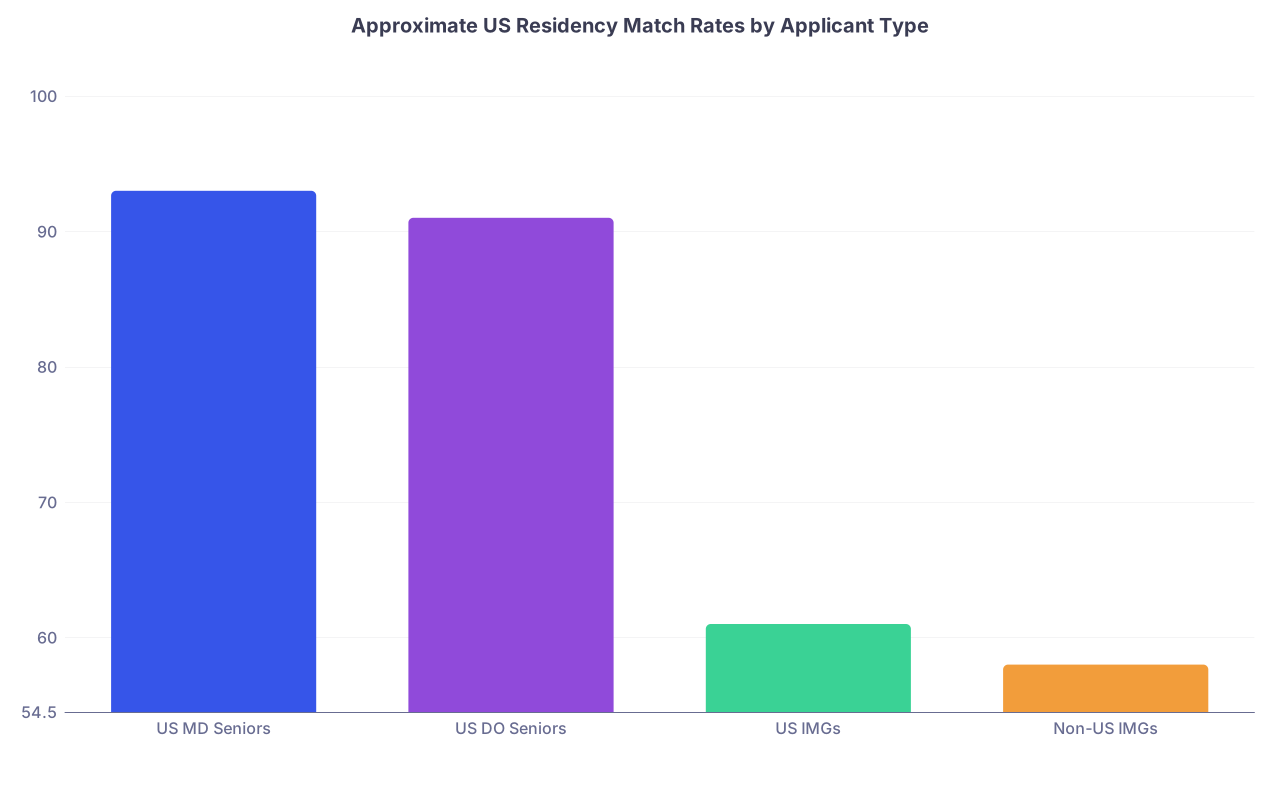
3. Match Rates for IMGs
You need to understand where you’re actually entering the system:
- You won’t be a U.S. MD
- You’ll be an IMG (International Medical Graduate)
And IMGs, even excellent ones, are competing on a different playing field.
| Category | Value |
|---|---|
| US MD Seniors | 93 |
| US DO Seniors | 91 |
| US IMGs | 61 |
| Non-US IMGs | 58 |
These percentages shift by year and specialty, but one thing stays true: it is always harder as an IMG. Some specialties are close to closed doors unless you’re an outlier star.
Recruiters rarely show you these graphs side-by-side.
4. State Restrictions and Policy Changes
This one’s brutal because it’s slow.
Things that can change after you enroll:
- State medical boards updating recognized school lists
- Hospitals changing which schools they allow for rotations
- Visa and immigration policies tightening
- USMLE or residency selection changes that disadvantage IMGs even more
A promise that was “true” in 2015 may be useless in 2026. But recruiters love quoting old success stories like they’re eternal.
How to Stop Overtrusting and Start Verifying
Enough scaring. Let’s get practical.
Here’s how you protect yourself from overtrusting any international medical school recruiter.
Step 1: Demand Numbers in Context, Not Slogans
Before you believe anything about match success, ask for this in writing (email is fine):
- Total number of students who started in the entering class 4–6 years ago
- Number who graduated on-time
- Number who eventually graduated
- Number who applied to U.S. residency in the last 3 cycles
- Number who matched, and in which specialties
- Number who did not match
If they won’t share? That’s your answer.
Good schools may still protect some details, but they can give you enough data to see if their slogans line up with reality.
Step 2: Cross-Check with Independent Sources
Do not stop at what the recruiter or the school’s website says.
You need:
- ECFMG / World Directory of Medical Schools: Is the school listed, and are there notes about restrictions?
- State medical boards (especially California, Texas, New York, your home state): Any explicit recognition or bans for this school?
- Current/past students: Not just the ones the school puts in front of you. Randomly message students on LinkedIn or alumni on social media. Ask specific questions:
- How many in your class dropped out?
- How many matched last year?
- Any issues with rotations or licensing?
If what students tell you contradicts what the recruiter told you, trust the students.

| Step | Description |
|---|---|
| Step 1 | Hear Recruiter Pitch |
| Step 2 | Request Written Data |
| Step 3 | Walk Away |
| Step 4 | Verify with Independent Sources |
| Step 5 | Compare to US MD/DO Options |
| Step 6 | Apply with Eyes Open |
| Step 7 | Full, Clear Data Provided? |
| Step 8 | Data Matches External Info? |
| Step 9 | Still Worth Risk? |
Step 3: Separate “Possible” from “Typical”
Recruiters trade on possibility:
- “We had a student match derm…”
- “One of our grads is in neurosurgery at a big-name program…”
You must ask:
- “Is that typical, or a rare outlier?”
- “What’s the median outcome, not the best one?”
If they keep answering with:
- “It depends…”
- “Every student is different…”
- “We’ve had great success overall…”
Translation: they don’t want to admit the typical pathway is family med, internal med, maybe psych, often in less competitive programs—and even those are not guaranteed.
There is nothing wrong with those specialties. But it’s dishonest to market like everyone’s going into ortho or derm.
Step 4: Run a Worst-Case Scenario, Not Just Best-Case
Ask yourself some uncomfortable questions:
- If I don’t match at all, can I live with this debt?
- If I only match into a less competitive specialty in a less desirable location, am I OK with that?
- If policies tighten and IMG match rates drop further, do I have any fallback?
Recruiters will always push the dream scenario. You need to stare directly at the nightmare scenario and see if you’re still willing to roll the dice.
Big Red Flags You Should Never Ignore
Let’s be concrete. If you see these, slow down or stop entirely.
Pressure to commit quickly
- “Seats are filling fast.”
- “You’ll miss this term; you’ll be a year behind.”
Medicine is a 30–40 year career. You can wait one more cycle if needed.
Vague or evasive when you ask about failures
If they cannot tell you the percentage who never graduate or never match, they’re hiding the true cost of their pipeline.Overemphasis on lifestyle and location
Beaches. Sunshine. Tropical photos everywhere.
If the pitch feels more like a tourism ad than a rigorous professional training program, walk.No clear, recent match list
Match lists older than 3–4 years are almost useless. The game changes quickly.Promises about “guaranteed” anything
No one can guarantee USMLE success. No one can guarantee a residency slot. If they say “guaranteed,” they don’t respect you enough to be honest.

When an International School Might Actually Make Sense
I’m not here to say “never go international.” That would be lazy thinking.
There are situations where it can be a calculated risk:
- You fully understand IMG match statistics and accept them
- You’re genuinely fine with primary care or less competitive specialties
- You have no viable U.S. MD/DO option and don’t want to switch careers
- You’ve thoroughly vetted the specific school’s track record and licensure status
But even then, the key word is calculated. Not emotional. Not based on recruiter optimism. Not based on “I don’t want to feel behind my friends.”
If you do choose this path, you should be going in with:
- A concrete exam plan (Step 1, Step 2, strong scores)
- A realistic financial plan
- A back-up life plan in case residency never materializes
That’s how adults make high-risk decisions. Not by signing because someone in a blazer said, “We’ll get you there.”
| Category | Value |
|---|---|
| Evidence-based factors | 30 |
| Emotional factors | 70 |
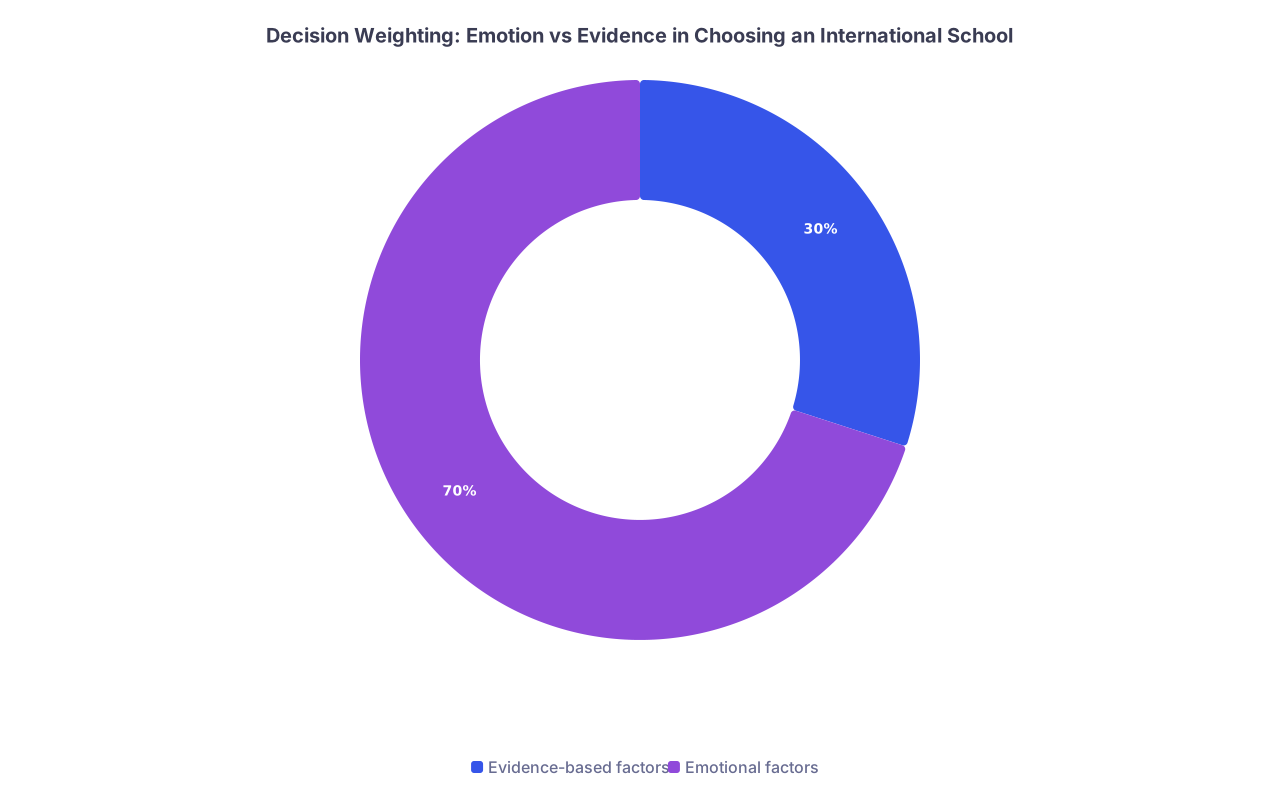
If your current balance looks more like this chart—70% emotion, 30% evidence—you’re not ready to commit.

The Bottom Line: Don’t Let a Sales Pitch Decide Your Career
Here’s the mistake you must avoid:
Treating recruiter promises like verified outcomes.
Recruiters are not:
- Residency program directors
- State medical board officials
- Your financial advisor
- Responsible for your long-term consequences
You are.
So your job isn’t to catch them lying outright. They rarely do that. Your job is to see through the half-truths, the cherry-picked success stories, the clever phrasing, and the omissions.
If you feel yourself thinking:
- “They said it’s fine…”
- “They told me their graduates match every year…”
- “They promised strong U.S. placement…”
Stop.
Replace that with: “Where is that written, verified, and backed with independent data?”
Do This Today
Open the website or brochure of any international medical school you’re considering.
Pick ONE big claim—you’ll see it loud and proud: “High match rates,” “Strong U.S. outcomes,” “Recognized worldwide.”
Now:
- Write that exact claim down.
- Email the admissions office and ask for the raw numbers behind it: class size, number who graduate, number who match, specialties, last 3–5 years.
- While you wait, search the school in the World Directory of Medical Schools and at least one major state medical board site.
If you’re serious about medicine, start proving to yourself right now that you can’t be sold a decade-long commitment by a single unverified promise.


