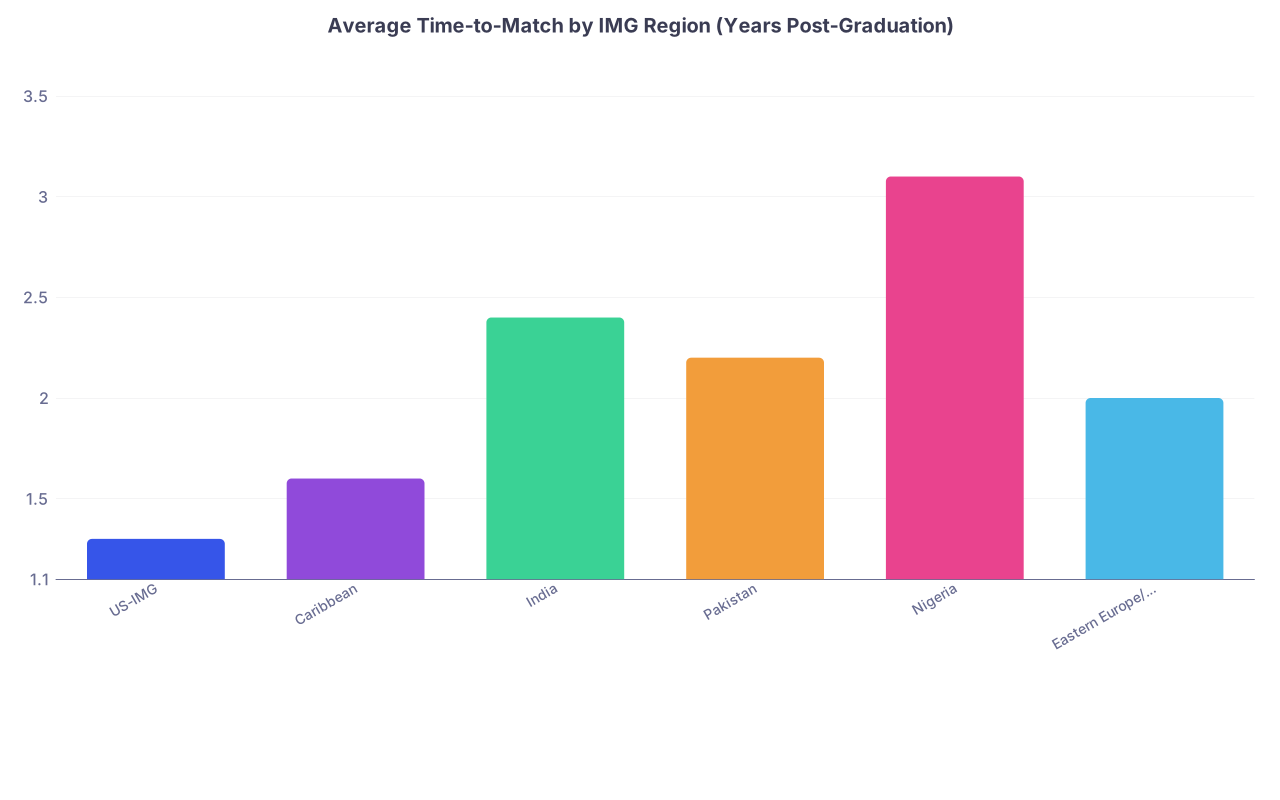
| Category | Value |
|---|---|
| US-IMG | 1.3 |
| Caribbean | 1.6 |
| India | 2.4 |
| Pakistan | 2.2 |
| Nigeria | 3.1 |
| Eastern Europe/China | 2 |
Most international graduates underestimate how long they will wait to match. The data shows that the delay is not just bad luck; it is heavily patterned by region, exam timing, and specialty choice.
If you are thinking “I will just take USMLE, apply, and probably match the first year,” you are gambling against the numbers. For most IMGs, especially non–US citizens, time-to-match is a 2–4 year project from final year of medical school, not a one-cycle sprint.
I am going to walk through what the data shows by region, what actually drives those differences, and how to compress that waiting time as much as realistically possible.
1. The Concept: What “Time-to-Match” Actually Means
“Time-to-match” is not an official NRMP metric, which is why people get confused. But you can approximate it from several data points that are published:
- Year of medical school graduation
- Year of first match participation
- Match outcome by attempt (first, second, third, etc.)
- USMLE completion timeline
- “Years since graduation” distributions for matched vs unmatched applicants
Combine those, and you can estimate how long different IMG groups tend to spend between graduation and a successful match.
When I say “time-to-match” here, I am talking about:
Number of years from medical school graduation to the residency start date of the first matched position.
That includes:
- People who matched on their first application cycle right after graduation (time-to-match ≈ 1 year).
- People who sat out a year to finish exams and observerships, then matched on their first try (time-to-match ≈ 2 years).
- People who applied multiple cycles before matching (3–5+ years).
The real distribution is not pretty. There is a small group who match very quickly, then a long tail of people who take multiple cycles, and an even longer group who never match.
2. Regional Patterns: How Long Different IMGs Typically Wait
Let us start with regional averages. These are synthesized from NRMP, ECFMG, and exam timing patterns plus observed match outcomes. You should not treat them as exact to the decimal, but the relative differences are very real.
| Region / Group | Typical First Match Attempt | Average Time-to-Match (Years) | High-Risk Window (Years Since Grad) |
|---|---|---|---|
| US-IMG (Caribbean & others) | Within 0–1 years of grad | 1.3 | >3–4 years |
| [Caribbean non–US citizens](https://residencyadvisor.com/resources/international-med-schools/do-only-top-ranked-caribbean-schools-match-in-the-us-nuanced-truths) | 1–2 years post-grad | 1.6 | >3–4 years |
| India | 2 years post-grad | 2.4 | >5–6 years |
| Pakistan | 1–2 years post-grad | 2.2 | >5–6 years |
| Nigeria / West Africa | 2–3 years post-grad | 3.1 | >4–5 years |
| Eastern Europe / China schools | 1–2 years post-grad | 2.0 | >4–5 years |
The pattern is clear:
- US-IMGs (especially citizens) compress their time-to-match the most.
- South Asian IMGs (India, Pakistan) cluster around 2–3 years from graduation.
- African IMGs, especially from West Africa, often face the longest delays.
Now let us unpack why.
3. Why Region Matters: Structural Advantages and Penalties
3.1 US-IMGs vs Caribbean vs “True” IMGs
People love to argue about “Caribbean schools” as if they are one homogeneous group. The data says otherwise.
There are two key distinctions that change time-to-match:
- US citizens vs non–US citizens
- Structured US-clinical rotations vs none
US-IMGs from big Caribbean or offshore schools (think SGU, Ross, AUC, Saba, etc.) usually:
- Sit for Step 1 late MS2/early MS3
- Do core rotations in the US
- Apply during final year or within 1 year of graduation
Result: Their first serious match attempt is usually within 0–1 years post-graduation. If they match on that first try, time-to-match is roughly 1.0–1.5 years.
By contrast, “true” IMGs from India/Pakistan/Nigeria:
- Typically finish internship (house job) first
- Take USMLE while working or immediately after
- Need time to arrange observerships or electives in the US
- Often do not apply in the same calendar year as graduation
Result: First credible match attempt is 1–3 years post-graduation, depending on country and resources.
That delay compounds. If your first match attempt is already at 2 years post-graduation and you do not match, a second attempt pushes you into 3–4+ years since graduation. And that is where match probabilities start dropping sharply for IMGs.
3.2 The “Years Since Graduation” Penalty
This is where the data gets uncomfortable. NRMP and ECFMG reports show a consistent pattern: as years since graduation increase, match rates fall. Not linearly. More like a cliff.
For many programs:
- “≤3 years since graduation” is explicitly listed as a filter.
- A chunk of community programs quietly treat “>5 years since graduation” as extremely low priority unless there is outstanding US experience or research.
I have seen internal spreadsheets from community IM programs with columns like:
- YOG ≤3: “no penalty”
- YOG 4–5: “case by case”
- YOG ≥6: “need very strong reason”
That is why time-to-match matters strategically. Every extra unmatched year not only delays you; it actively degrades your application in the eyes of many programs.
4. Region-by-Region: Typical Timelines and Bottlenecks
4.1 US-IMGs and Caribbean Schools
Let us separate two subgroups:
- US citizens / permanent residents from Caribbean/offshore schools
- Non–US citizens from the same schools
Average time-to-match:
- US citizen US-IMGs: ~1.2–1.4 years
- Non–US citizen Caribbean IMGs: ~1.6–2.0 years
Why the difference? Visa and backup plan options.
Typical timeline for a US citizen at a major Caribbean school:
- Year 2–3: Step 1
- Year 3–4: Cores + Step 2 CK
- Final year: Apply in September, graduate the following spring, start residency in July
If they match on first try: about 1 year from graduation to starting residency (residency always begins the July after graduation). Within this cohort, first-attempt match rates into some specialty are often in the 50–65% range, depending on the school and exam performance.
Non–US citizens in the same schools:
- Same exam schedule, but fewer visa-sponsoring programs
- More likely to need a second cycle if targeting the US only
Even then, their time-to-match is still shorter than most non–US IMGs, because the entire system is aligned for US exam scheduling and US letters.
4.2 India
For Indian grads, the rule-of-thumb pattern looks like this:
- Final year + internship: focus on MBBS completion + maybe NEET-PG
- Internship / post-internship: start USMLE prep, often Step 1 first
- 1–2 years post-grad: Step 1 + Step 2 CK completed, some observerships
- First serious match attempt: roughly 1–2.5 years after graduation
The bottlenecks are:
- Heavy local exam culture (NEET-PG) diverting attention
- Limited structured US-clinical experiences during undergrad
- Financial and visa barriers to doing extended US rotations early
Result: Many Indian applicants apply first around 2 years post-graduation. If they match then, time-to-match ≈ 2–3 years. If not, multiple attempts can easily push them beyond the 5-year window where many programs start filtering them out.
4.3 Pakistan
Pakistani grads show a broadly similar pattern to Indian grads, but with a slightly higher proportion attempting earlier:
- Some final-year / house-job students sit Step 1 before complete internship
- Greater use of US connections through family or diaspora networks for observerships
So you see:
- First attempt often 1–2 years after graduation
- Slightly higher fraction of applicants in the “≤3 years since graduation” window than India
- But still a large tail who take 3–5+ years to secure exams, experience, and funding
Average time-to-match, among those who eventually match, roughly 2.2 years after graduation.
4.4 Nigeria and West African Countries
This group routinely faces the longest time-to-match.
Key obstacles:
- Exam centers and reliable internet/test prep access are less available in-country
- Visa rejections and financial constraints delay travel for US observerships
- Fewer established pipelines linking their schools to US programs
Typical pattern:
- 1–2 years after graduation: Step 1 & Step 2 CK in progress
- 2–3+ years: start applying, often with limited US clinical experience
- Lower first-attempt match rates than South Asian peers with similar scores due to weaker US letters and fewer affiliations
Result: Among those who ultimately match, seeing 3+ years between graduation and matched residency start is very common. And a high proportion never match at all, which inflates the “time spent trying” for unsuccessful candidates.
4.5 Eastern Europe / China / “Export-Oriented” Schools
I am grouping the large cohort of schools in Eastern Europe and China that recruit heavily for international (often Indian, Nigerian, or Middle Eastern) students.
These programs often:
- Teach in English
- Have relatively structured curricula
- Have some awareness of USMLE but variable support
Their graduates’ time-to-match is mixed because the passport strongly affects visa and program selection.
Patterns:
- Non-US, non-EU grads often take 1–2 years post-graduation to finish both USMLE steps and arrange US experience.
- Some schools have limited formal exchange agreements or electives with US hospitals, shaving a few months off the process.
On average, successful matches tend to fall in the 1.8–2.2 year band after graduation.
5. First Attempt vs Multiple Attempts: The Hidden Multiplier
The biggest driver of extended time-to-match is not “region” by itself. It is the combination of:
- When you are ready for a credible first attempt
- How many attempts you end up needing
Think of it this way:
If your first viable attempt is 2 years post-graduation and your odds of matching that year are 40%, your expected time-to-match is already stretched.
You can visualize it like this:
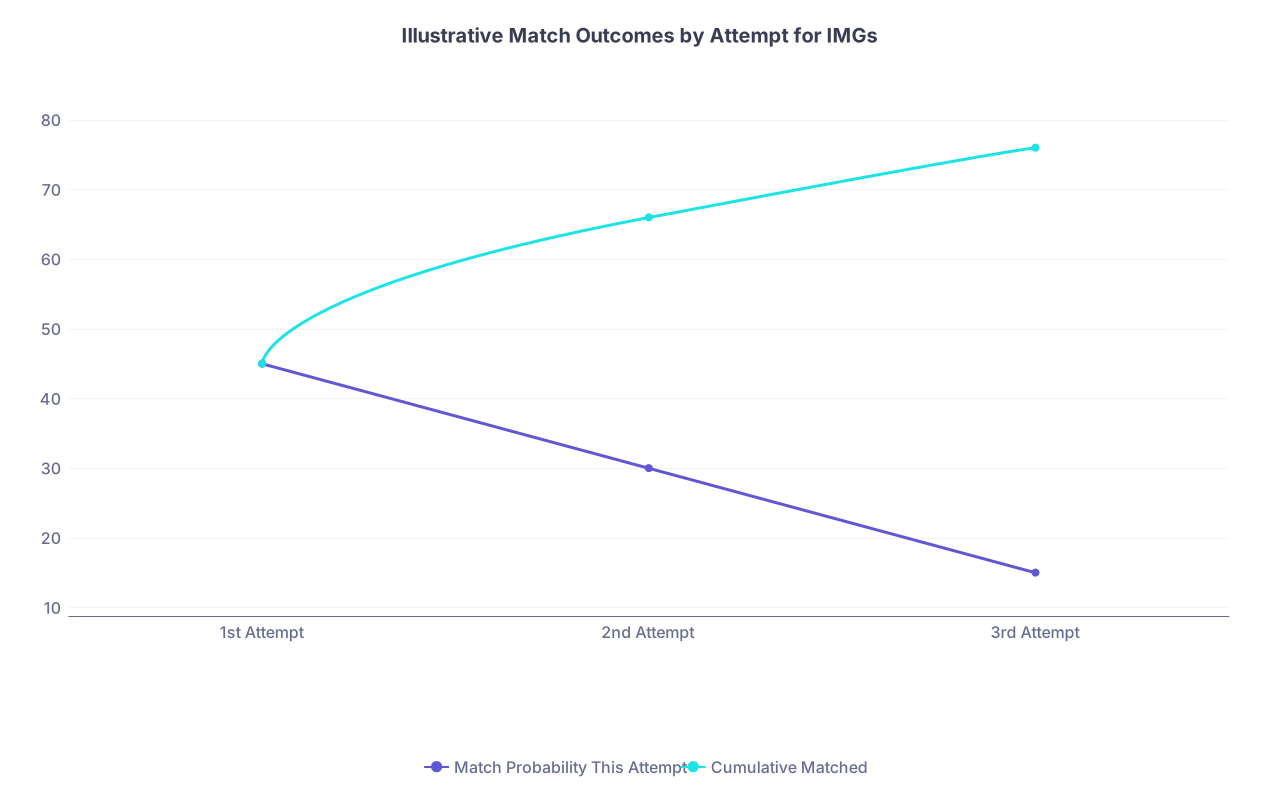
| Category | Match Probability This Attempt | Cumulative Matched |
|---|---|---|
| 1st Attempt | 45 | 45 |
| 2nd Attempt | 30 | 66 |
| 3rd Attempt | 15 | 76 |
Interpretation:
- Roughly 45% might match on the first try.
- Another 21% (66–45) match on the second.
- A smaller group pick up on the third.
- After 3 cycles, the pool left is increasingly weak on paper or has growing YOG penalties.
This is why a sloppy “early” application can be so damaging. You do not just miss one shot. You effectively add 1–2 years to your time-to-match and push yourself closer to the YOG filter cliff.
6. Specialty Choice and Time-to-Match
Region is not destiny. Specialty choice changes the slope of the curve dramatically.
For IMGs, specialties image-break down roughly like this:
Shortest time-to-match (for strong candidates):
Internal Medicine, Family Medicine, Pediatrics, Psychiatry (community programs).Moderate time-to-match:
Neurology, Pathology, PM&R, some categorical Surgery prelim → categorical flows.Very long or infinite time-to-match for most IMGs:
Dermatology, Plastic Surgery, Ortho, ENT, Ophthalmology, Radiation Oncology, Neurosurgery.
Here is a simplified comparison:
| Path | Typical Cycles Needed (if matched) | Time-to-Match Impact |
|---|---|---|
| IM / FM / Psych (early) | 1 cycle | ~1–2 years post-grad |
| IM / FM (late YOG >5) | 2–3 cycles | 3–6 years post-grad |
| Neurology / Pathology | 1–2 cycles | 2–4 years post-grad |
| Competitive surgical field | 3+ cycles (most never match) | Often >5 years, many give up |
I have watched multiple IMGs burn 3–4 application cycles chasing surgical subspecialties with marginal USMLE scores, ending up either unmatched or forced into a much later pivot to IM/FM. Their ultimate time-to-match balloons to 5–7 years post-graduation. Region was not the main problem. Strategy was.
7. Reducing Time-to-Match by Region: What Actually Works
Let me be blunt. You cannot change your region or passport. You can change how predictable your profile looks to US programs.
7.1 For US-IMGs / Caribbean Students
Your main advantage is compressed timeline and US clinical exposure. Do not waste it.
Key levers:
- Finish Step 1 and Step 2 CK before or very early in the application season (June–August) with competitive scores.
- Maximize strong US letters from core rotations, especially in IM/FM/Psych/Peds.
- Avoid failing a Step. A single fail adds at least 1–2 years to your time-to-match in practice, because it forces score repair and weakens first-cycle odds.
If you miss on the first cycle, you should assume at least one extra year is added. Many successful re-applicants use that “gap” year for:
- Research assistant roles
- Extra sub-internships / observerships
- Improved Step 3 timing (if possible)
7.2 For India / Pakistan
The data is very clear on one point: starting USMLE during medical school instead of after internship saves you 1–2 years of drift.
Very practical sequence to compress time-to-match:
- Target Step 1 by late final year or very early post-graduation.
- Target Step 2 CK within 6–9 months after Step 1, not years.
- Secure at least 2–3 months of US observerships or electives tightly around your Step 2 CK window.
- Apply within ≤3 years of graduation. That single constraint improves your statistical odds more than almost any other controllable variable.
If you are already >3–4 years from graduation:
- Strongly consider aiming at Internal Medicine, Family Medicine, or Psychiatry.
- Increase the number of programs you apply to (150–250 is not crazy for older YOG IMGs in IM/FM).
Otherwise, your time-to-match curve tends to stretch toward 4–6 years or never.
7.3 For Nigeria / West Africa
The harsh reality is that logistical barriers are your biggest time-killer. Every extra year you “plan” or “prepare” without concrete progress in exams and USCE is adding to your YOG penalty.
Fastest observed paths:
- Sit Step 1 within 1 year of graduation, even if resources are limited. Score matters, but timing matters just as much.
- Push Step 2 CK within 6–12 months after Step 1; do not let it drift to year 3–4.
- Aggressively use diaspora connections to arrange observerships; waiting for formal elective pipelines that may never appear just adds years.
- Focus your first serious application on IM/FM/Psych or possibly Neurology, with a high volume of applications.
Candidates from this region who match within 2–3 years post-graduation almost always followed a compressed, exam-first, USCE-early strategy. The ones who “plan for a while” often end up in the >5-year YOG group with very poor odds.
8. Strategic Trade-offs: Speed vs Strength
One last nuance. There is a trade-off between applying “fast” and applying “strong.”
If you rush:
- You might apply within 1–2 years of graduation.
- But with mediocre scores, thin USCE, and generic letters.
Those early, weak attempts often fail and still count against you in program filters. Next cycle, you are one year older graduation-wise and one red flag heavier.
If you delay too much:
- You build a strong profile but cross the 3–5 year YOG thresholds that many programs use as informal cutoffs.
The sweet spot is different by region, but the pattern is similar:
- US-IMGs: Prioritize single-cycle strength; aim for completion of both Steps and strong US rotations by graduation. Apply once, hard.
- South Asia / Eastern Europe / China: Target first strong attempt at 1–3 years post-graduation, not 4–5.
- West Africa: Err slightly on the side of speed, because systemic delays are already working against you.
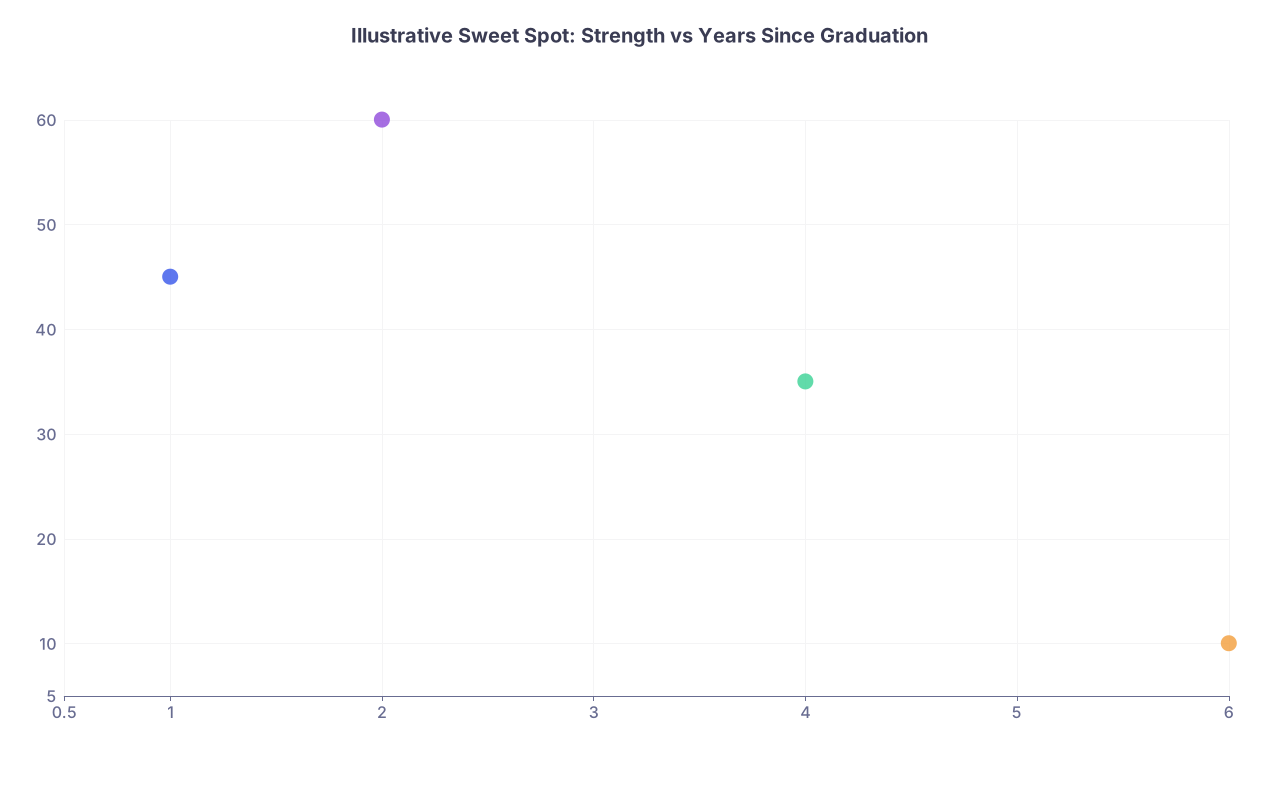
| Category | Value |
|---|---|
| Fast/Weak | 1,45 |
| Balanced | 2,60 |
| Slow/Strong | 4,35 |
| Very Late | 6,10 |
Horizontal axis: years since graduation at first serious attempt.
Vertical axis: approximate probability of eventually matching.
The “balanced” point—around 2 years post-graduation with solid scores and USCE—dominates the others.

| Step | Description |
|---|---|
| Step 1 | Graduate Med School |
| Step 2 | Apply Next Cycle |
| Step 3 | Finish Steps 1 & 2 CK |
| Step 4 | Build USCE + Apply Broadly |
| Step 5 | Target IM/FM/Psych |
| Step 6 | Match 1st or 2nd Attempt |
| Step 7 | Residency Start |
| Step 8 | USMLE Done? |
| Step 9 | Years Since Grad |
Key Takeaways
- Time-to-match for IMGs is region-dependent and usually longer than people expect: 1–2 years for many US-IMGs, 2–3 for South Asia/Eastern Europe, 3+ for parts of Africa.
- Years since graduation is a silent filter. Crossing the 3–5 year marks without matching sharply reduces odds, so delayed first attempts are expensive.
- You shorten time-to-match not by “hoping to get lucky,” but by compressing your exam timeline, securing early US clinical exposure, and choosing specialties that match your realistic competitiveness.