
The data is brutally clear: needing visa sponsorship cuts your US residency match odds. Sometimes by a little. Sometimes by half. Occasionally, it wipes you out entirely at certain programs.
If you are an IMG and you ignore the visa dimension, you are not “being optimistic.” You are just misreading the numbers.
Let me walk through what the data actually says, how big the “visa penalty” really is in different scenarios, and how you can engineer your profile and school choices to minimize that penalty instead of being crushed by it.
1. Baseline: What the Match Looks Like Before Visa Status Enters
You cannot quantify a penalty unless you know the baseline.
Start with the recent NRMP data for the Main Residency Match. Year-to-year noise aside, the pattern is stable:
- US MD seniors: ~92–94% match rate
- US DO seniors: ~88–91% match rate
- US-citizen IMGs: ~55–65% match rate
- Non–US-citizen IMGs: ~55–60% match rate (varies by year and specialty)
That last gap—US MD ~93% vs non–US-citizen IMG ~57%—is the primary penalty. But it is not “the visa penalty” alone. It is a composite of:
- School reputation and location
- Clinical experience in the US
- Step scores and attempts
- Interview count
- Program attitudes toward IMGs and visas
Still, if you hold a non-US passport and no permanent status, your group-level odds cluster around 55–60%, not 90+.
Now, break it down further.
Match odds by specialty and IMG citizenship status
The competitiveness spike is specialty-specific. For a rough (but realistic) picture:
| Specialty | US MD Seniors | US-citizen IMGs | Non–US-citizen IMGs |
|---|---|---|---|
| Internal Med | ~97% | ~60–70% | ~55–65% |
| Family Med | ~96% | ~65–75% | ~60–70% |
| Pediatrics | ~95% | ~55–65% | ~50–60% |
| Psych | ~93% | ~55–65% | ~45–60% |
| General Surgery | ~82–85% | ~35–45% | ~25–40% |
| Anesthesiology | ~82–88% | ~35–50% | ~25–45% |
These are broad ranges built from NRMP and specialty reports. The exact percentages change each year, but the hierarchy does not: primary care > pediatrics/psych > surgical and competitive fields.
Without even touching visa type, the baseline for non–US-citizen IMGs is already massively lower than for US MDs. Visa status then adds another layer of friction.
2. Where the “Visa Sponsorship Penalty” Actually Comes From
The penalty is not just about your passport. It is about program behavior.
There are three big structural filters that hit IMGs needing visas:
- Programs that categorically do not sponsor any visas
- Programs that sponsor only J‑1 (not H‑1B)
- Programs that say they sponsor but de facto almost never rank visa-dependent applicants
Filter (1) wipes out entire swaths of programs from your realistic list. Filter (3) quietly kills your chances at others even after you “pass” the checkbox.
The program-level filter: how many are even in play?
Pull up FREIDA or program websites for any mid-competitive specialty. You will see something like this pattern:
- A large fraction: “We do not sponsor visas”
- Another chunk: “We sponsor J‑1 visas only”
- Smaller subset: “We sponsor J‑1 and H‑1B”
For IMGs needing sponsorship, the “do not sponsor” group has match probability ~0%. Not low. Zero. Because you are not eligible.
If you are choosing an international medical school while aiming for the US, the key is understanding what share of the relevant market you are excluding by needing visa help.
A realistic, rough categorization across all specialties:
- 25–40% of ACGME programs: no visa sponsorship at all
- 40–60%: J‑1 only
- 10–25%: J‑1 and H‑1B
Numbers vary sharply by specialty and region (community internal medicine in the Midwest will differ from anesthesiology in California), but the structure remains: as a visa-dependent IMG, your accessible program pool is significantly smaller than the headline “number of positions” suggests.
3. Quantifying the Sponsorship Penalty at the Application and Interview Stages
You do not feel the visa penalty most acutely on Match Day. You feel it in your email inbox from September to January.
The data pattern I keep seeing when comparing similar candidates:
- Same Step scores (e.g., Step 2 CK 250)
- Similar research (0–2 publications)
- Comparable US clinical experience (2–3 rotations)
- Similar school tiers (non-Caribbean, mid-tier IMGs)
Then:
- US citizen: 35–45 applications → 8–12 interviews
- Non–US-citizen on J‑1 or H‑1B needed: 60–80 applications → 5–8 interviews
Not every case looks like this. But if you look across dozens of applicants, the “interviews per 10 applications” metric typically falls by 30–60% for those needing visas, especially in mid-to-high competitiveness fields.
Let’s quantify.
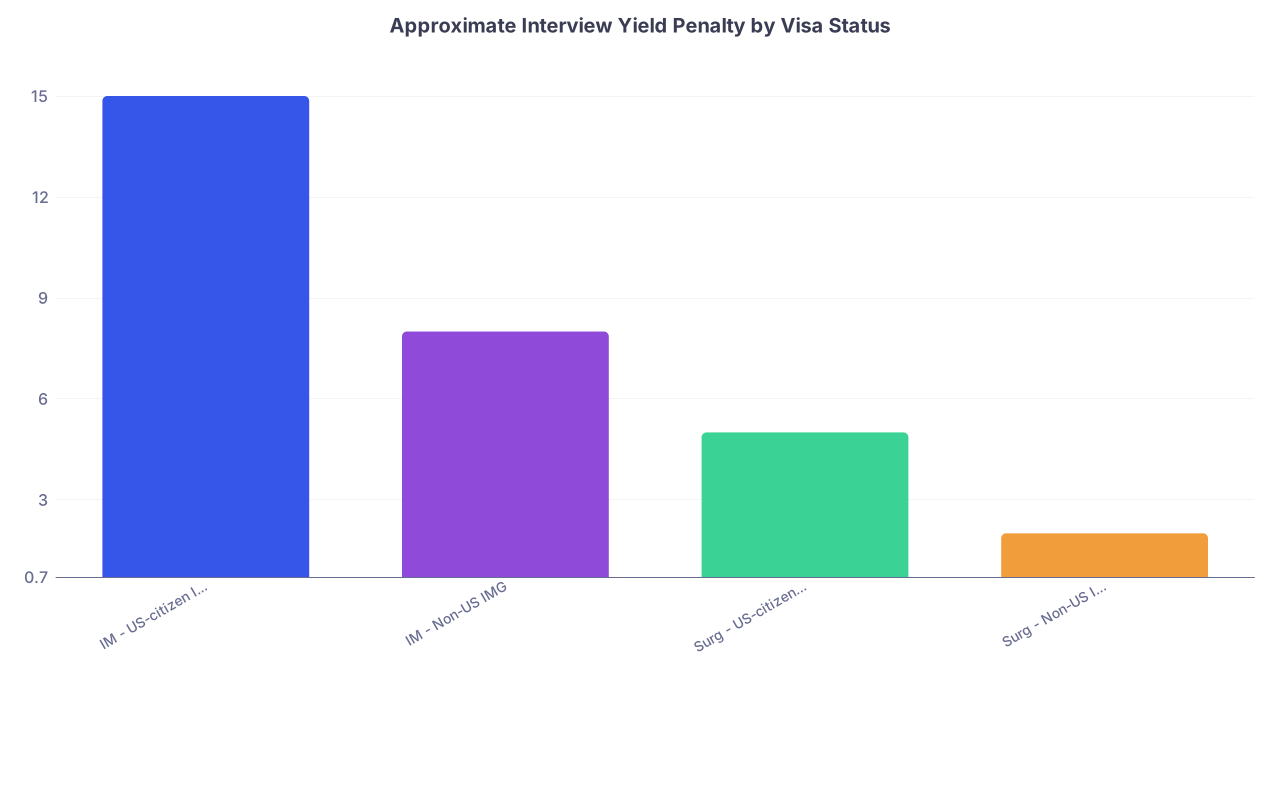
Interview yield penalty by visa status
Define “interview yield” = interviews / applications.
A stylized but realistic example for IMGs targeting internal medicine:
- US-citizen IMG: 100 applications → 15 interviews → yield 0.15
- Non–US-citizen IMG: 100 applications → 8 interviews → yield 0.08
Penalty factor ≈ 0.15 / 0.08 = 1.875
So the non–US-citizen needs almost 1.9 times more applications to reach the same number of interviews.
For a hard surgical field:
- US-citizen IMG: 80 applications → 5 interviews → yield 0.0625
- Non–US-citizen IMG: 80 applications → 2 interviews → yield 0.025
Penalty factor = 0.0625 / 0.025 = 2.5
Twice to two-and-a-half times the application volume for the same interview count is not rare.
| Category | Value |
|---|---|
| IM - US-citizen IMG | 15 |
| IM - Non-US IMG | 8 |
| Surg - US-citizen IMG | 5 |
| Surg - Non-US IMG | 2 |
Translate this into real effort:
- US-citizen IMG aiming for IM may be “safe” around 60–80 targeted applications.
- Non–US-citizen may need 120–160+ to offset the yield drop.
The penalty is not some theoretical concept. It is literally: more fees, more personal statements, more program research, more tracking spreadsheets, because you must throw a wider net to catch the same number of interviews.
4. J‑1 vs H‑1B: Two Different Penalties
People obsess about H‑1B, often irrationally. The data suggest two linked but distinct issues:
- J‑1 vs H‑1B availability affects how many programs you are even viable for.
- Programs that offer H‑1B often quietly raise the bar on Step scores and attempts.
Most programs sponsoring H‑1B demand:
- Step exams all passed on first attempt
- Often a Step 3 score at time of ranking or start date
- Higher minimum Step 2 CK thresholds (think 240+ as a soft floor for many)
Whereas a J‑1-only program might be comfortable with:
- Step 2 CK in the 225–235 range
- No Step 3 yet
- More flexibility around attempts (still, multiple fails are toxic everywhere)
In practice this means:
- The “H‑1B IMG pool” is self-selected: stronger test takers, often graduates of more established schools, more US clinical time.
- The match rates of those who actually apply with realistic profiles to H‑1B‑friendly programs can be relatively decent. The real penalty is access, not success.
For planning school choice, here is the bottom line:
- If you are early (premed or early med school) and know you will need a visa, default assumption should be J‑1.
- H‑1B is a bonus tier reserved for:
- Higher Step scores
- Willingness to take Step 3 early
- More complex documentation and timing
Do not plan your whole career around H‑1B availability unless you also plan to hit top-decile metrics. The average IMG does not.
5. The Hidden Filter: Programs That “Sponsor” but Rarely Rank IMGs with Visas
There is a more subtle penalty that does not show up in FREIDA checkboxes at all.
You will see many programs with the line: “We accept IMGs and sponsor J‑1 visas.” Then you check their current residents:
- All US grads.
- One or two IMGs total.
- Often both IMGs are US citizens or Green Card holders.
I have manually looked up rosters for multiple programs after candidates asked why they received no responses despite strong profiles (Step 2 CK 250+, solid LORs, decent research). The answer was obvious from the PGY-1 list: they talk a big game about IMGs, but they do not actually match non–US-citizen IMGs.
So your effectively “IMG + visa-friendly” program pool is smaller than the official visa-friendly pool.
The working heuristic I give people:
- Of programs that say they sponsor J‑1:
- Maybe half genuinely consider and rank non–US-citizen IMGs regularly.
- The rest do it occasionally, with a strong bias toward US-citizen IMGs or Green Card holders when credentials are similar.
If you are serious about quantifying your odds, you should do this kind of manual sampling:
- Take 30 programs from your specialty of interest
- Check: “Do they sponsor visas?” Yes/no
- Then check their current resident list for PGY-1 to PGY-3
- Mark how many are clearly IMGs and how many are visibly non-US-citizen (foreign names, foreign schools, etc.)
You will see clear strata: some programs have 40–70% IMGs; others have 0–1. The visa penalty collapses into “those 0–1 IMG programs are simply not your market.”
6. School Choice: Which IMGs Pay the Highest and Lowest Visa Penalties?
Not all “international” medical schools face the same penalty curve. Far from it.
There are three broad strata:
- US-branch or highly US-integrated schools (e.g., certain Caribbean schools with large US match pipelines)
- Established non-US schools with some US presence (Eastern Europe, India, Pakistan, the Philippines, etc., with decent alumni footprints)
- Very new or low-volume schools with weak US track records
Same visa need. Very different outcomes.
Data pattern: where you study amplifies or blunts the visa penalty
Programs think in risk categories. Visa-dependent IMGs at “known” schools are perceived as lower risk than visa-dependent IMGs at unknown or low-output institutions.
To make this concrete, imagine three non–US-citizen IMGs with similar Step 2 CK scores around 245, 3 US LORs, and solid English:
- Candidate A: large Caribbean school with 100+ US matches annually
- Candidate B: Government medical college in India with dozens of alumni in US residencies
- Candidate C: Small private school in Eastern Europe with 3–5 US alumni per year
Even with identical test scores, the actual interview numbers I see tend to look like:
| Candidate | School Type | Applications | Interviews |
|---|---|---|---|
| A | High-volume Caribbean | 120 | 15–20 |
| B | Established non-US public | 120 | 10–15 |
| C | Low-output, lesser-known | 120 | 4–8 |
The visa requirement is constant. The sponsor penalty is magnified or muted depending on how “risky” your school looks to the program.
If you are premed deciding where to enroll internationally, you should not just ask “Does this school place into US residencies?” You want numbers:
- How many non–US-citizen grads match to the US each year?
- Which specialties?
- With what visa types?
- How many attempts and gaps are common?
Most schools will talk about “alumni in the US.” That phrase is statistically useless. You care about recent, visa-dependent matches per year.
7. Step Scores, Attempts, and the Multiplier Effect of Visa Status
Visa status never works in isolation. It interacts with your metrics.
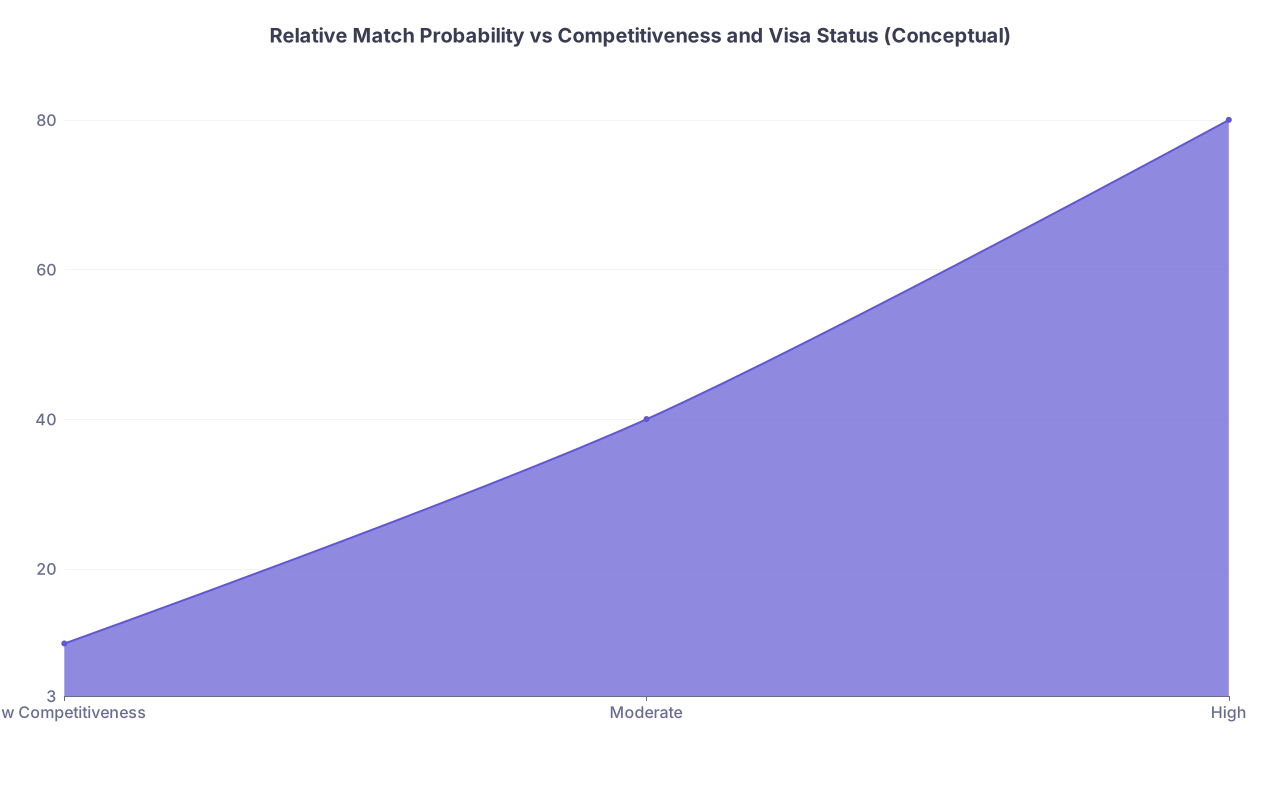
I like to think of it as a multiplier on your underlying competitiveness, not an independent variable. A simple mental model:
- Base “match probability” driven by:
- Step scores
- Attempts
- Recency of graduation
- US clinical experience
- Research / extras
Then:
- Visa factor ≈ 0.6–0.8 for many midrange profiles (i.e., 20–40% reduction in odds)
But that factor is not fixed. It changes with your strength:
- If you have Step 2 CK 260+, fresh grad, strong US LORs, the visa penalty is smaller in relative terms. You are already in the top few percent of IMGs. Many programs will stretch to sponsor you.
- If you have Step 2 CK 225, 1–2 attempts, older YOG, the visa penalty is brutal. It can turn “low but non-zero” odds into mathematically negligible odds.
To visualize this idea:
| Category | Value |
|---|---|
| Low Competitiveness | 10 |
| Moderate | 40 |
| High | 80 |
Think of that “80” for high competitiveness as maybe dropping to 65–70 for a strong visa-dependent IMG. Painful, but survivable.
The “10” for low competitiveness? Multiply that by a visa factor of 0.6 and you slide toward effectively 0. That is how people end up unmatched year after year.
8. Strategies to Shrink the Sponsorship Penalty (Before You Graduate)
If you are still in premed or early medical school abroad, you actually have time to influence the numbers. Not by magic. By stacking the deck.
Here is what the data and patterns strongly support:
Choose specialties with higher IMG and visa tolerance.
Internal medicine, family medicine, and certain community-based pediatrics and psychiatry programs are structurally more open. The IMG percentages in those programs routinely exceed 30–40%. That matters.Prioritize US clinical experience in visa-friendly, IMG-heavy programs.
Having US LORs from places that already train many visa-dependent IMGs changes how your file is read. Programs use prior trust as a heuristic.
If you rotate at a program that sponsors J‑1 and regularly matches non–US-citizen IMGs, your visa need is just a logistical detail, not a red flag.Maintain a clean exam profile.
For someone who needs sponsorship:- A Step failure is more expensive than for a citizen. It is not “one problem among many.” It frequently moves you from “difficult but possible” to “statistically near-zero,” especially for competitive fields.
- Passing everything on the first attempt is not optional. It is baseline damage control.
Plan for volume.
Visa-dependent IMGs who match tend to:- Apply to more programs (often 120–200, depending on specialty)
- Start ERAS work early so they can handle the volume without chaos
Use real data to build a targeted list.
Do not spray 200 applications randomly. Instead:- Sample resident rosters
- Categorize programs as:
- No IMGs
- Few IMGs (and mostly citizens)
- IMG-heavy and visa-friendly
You want the third category to dominate your list.
9. How to Read the Penalty Correctly if You’re Still Premed
If you are not yet in medical school and thinking of going abroad, you should be reading all of this through a planning lens, not a panic lens.
The data suggest a few hard truths:
- If you need a visa and attend a low-output, unknown school, and pursue a competitive specialty, the combined penalty is multiplicative. You are stacking three negative coefficients on top of each other.
- If you need a visa but attend a school with a strong US match history, keep a clean exam record, target IMG-heavy specialties, and prepare for higher application volume, your match odds are not fantastic—but they are real.
A simple scenario analysis for a non–US-citizen IMG aiming at internal medicine:
Strong profile (Step 2 CK ≥ 245, first attempt, recent grad, 2+ US rotations, solid LORs, IMG-heavy program rotations):
- Realistic match probability: 70–80% with 120–150 intelligently chosen applications.
Moderate profile (Step 2 CK 230–238, first attempt, some USCE, average LORs):
- Realistic match probability: 40–60% with 150–200 applications, and heavy focus on community, visa-friendly programs.
Weak profile (Step 2 CK < 225, attempts, gaps, limited USCE):
- Match probability drops into the 0–20% band rapidly when combined with visa needs.
Nobody will put these numbers in their glossy brochures. But residency coordinators talk this way in private all the time. “Visa plus attempts” is almost a code phrase for “we are probably not touching this file.”
Visa status does not make a strong candidate weak. It makes a marginal candidate non-viable and a strong candidate work much harder than a US citizen with identical metrics.
If you are international and early in your training, that is the takeaway that should guide your decisions:
- Choose schools and specialties where the visa penalty is historically smaller.
- Build a profile that minimizes every other weakness so visa is the only “minus” on your sheet.
- Plan on greater application volume and more targeted research than your US peers.
Do not rely on hope. Rely on the data patterns of who actually matches with sponsorship every March.
If you can internalize that now, during premed and early medical school, you will design a path where visa status is a handicap, not a deal-breaker. The next step after that is tactical: building your specific school list, exam plan, and specialty target with those penalty multipliers in mind. But that is a deeper optimization problem—for another conversation.