

Most premeds wildly misunderstand how MD–PhD and research tracks work outside the United States.
If you are looking at international medical schools and you care about research, you cannot just copy–paste the U.S. MD–PhD mental framework. That is how people end up in the wrong program, in the wrong country, with the wrong expectations.
Let me break this down specifically: international MD–PhD and “research tracks” fall into a few predictable patterns. The names are confusing, the structures vary, and some “MD–PhD”s abroad are essentially a light thesis add‑on, while others are brutal, full PhD commitments embedded in medical training.
You need to know which is which.
1. The Big Picture: How International MD–PhD Models Differ from the U.S.
The classic U.S. model (think MSTP at places like Harvard, UCSF, Washington University in St. Louis) is:
- 2 years pre‑clinical MD
- 3–4 years PhD
- 2 years clinical MD
Integrated. Funded. Highly structured. Strong branding.
Outside the U.S., three things commonly change:
- The timing: PhD can be before, during, or after the main medical degree.
- The depth: “Research track” can mean anything from a 6‑month project to a full 3–4 year PhD.
- The degree structure: Some countries are graduate entry (like U.S.), others are 6‑year undergrad‑entry MD/MBBS, which changes where you can insert research years.
To frame the landscape, here is how major regions tend to organize MD–PhD or research‑heavy tracks:
| Region / Country Group | Typical Model Type |
|---|---|
| UK / Ireland | MBBS/MBChB + intercalated BSc/MSC + optional PhD |
| Continental Europe | Integrated MD + add-on PhD (often after core MD) |
| Canada | U.S.-like formal MD–PhD programs |
| Australia / NZ | MD + optional MPhil/PhD (usually parallel or sequential) |
| East Asia (e.g., China, Japan, Korea) | Parallel MD + PhD or sequential MD then PhD |
| [Caribbean / Offshore](https://residencyadvisor.com/resources/international-med-schools/caribbean-vs-eastern-european-md-programs-structural-differences-that-matter) | Mostly minimal formal MD–PhD, some [research electives only](https://residencyadvisor.com/resources/international-med-schools/elective-vs-core-rotations-for-imgs-how-foreign-schools-structure-training) |
There are exceptions. But if a school’s brochure is opaque, assume it fits one of these buckets, then verify the details.
2. True Integrated MD–PhD Programs (U.S.-Style Equivalents Abroad)
A few non‑U.S. programs really do approximate the U.S. MD–PhD structure: substantial time in research, clear integration, and explicit preparation for a physician‑scientist career.
Canada
Canadian MD–PhD programs are the closest cousins to the U.S. MSTP.
You see this at:
- University of Toronto MD/PhD
- McGill University MDCM & PhD
- University of British Columbia MD/PhD
- University of Calgary, University of Ottawa, etc.
Typical model:
- Apply directly to MD–PhD (sometimes at the same time as MD, sometimes during early MD years).
- Total duration ~7–8 years.
- Usually 2 years early MD, then 3–4 years PhD, then return to final MD clinical years.
- Funded stipend for the PhD years; tuition arrangements vary but usually more favorable than stand‑alone MD.
These are serious research programs. Graduates commonly enter academic tracks, competitive residencies, and have a decent international reputation.
If you plan to:
- Return to the U.S. for residency
- Build a research‑heavy academic career
- Keep options for NIH‑style environments
…Canadian MD–PhD programs are some of the strongest “international” options because the structure and culture match U.S. expectations.
Selected European Integrated Programs
Some European universities have named MD–PhD or “Clinician Scientist” tracks that are not just loose add‑ons:
- Karolinska Institutet (Sweden) – MD combined with PhD opportunities and formal clinician‑scientist tracks.
- University of Zurich / ETH Zurich (Switzerland) – MD and PhD integration is common for academically oriented students.
- Leiden, Utrecht, Amsterdam UMC (Netherlands) – structured MD + PhD patterns, sometimes more sequential than integrated.
But here is the key difference from North America: in Europe, the “medical degree” is often considered a first professional degree, and the PhD is often effectively a separate, though coordinated, degree, even when branded together.
They may market it as:
- “MD–PhD track”
- “Clinician Scientist program”
- “Research training for medical students”
You must ask:
- How many years are dedicated specifically to the PhD?
- Is the PhD interval full‑time research or watered down with part‑time clinical?
- How are you funded? Stipend? Competitive fellowship? Nothing?
- Are you admitted to a specific grad school / department at the same time?
If the program cannot give you clear answers, it is probably more “build‑your‑own research” than a formal MD–PhD.
3. UK and Ireland: Intercalated Degrees, Not True MD–PhDs
This is where many students get misled by marketing language.
In the UK and Ireland, most med schools are 5–6 year undergrad‑entry MBBS/MBChB or equivalent. What they call “research tracks” often means:
- Intercalated BSc/BA/BMedSci: You take a full extra year (usually after 2nd or 3rd year) to do a research‑heavy bachelor’s or master’s‑level degree in a related field.
- Optional intercalated MSc or MRes: Similar idea, but at a higher level and often more research‑heavy.
Example:
- University College London: MBBS with an integrated BSc (intercalated year)
- University of Edinburgh: MBChB with intercalated BMedSci
- Trinity College Dublin, University College Dublin: intercalated research degrees during medical school.
These are valuable. I have seen students come out of an intercalated year with first‑author publications, genuine lab skills, and excellent mentors.
But let’s be honest: they are not equivalent to a 3–4 year PhD.
Typical intercalated year:
- 6–9 months of project work
- Some taught modules
- A thesis of 10,000–20,000 words
- One substantial (but single) research experience
So if you see “MBBS with integrated research degree” or “MBBS with BSc in Medical Sciences,” treat it as:
- A strong research enrichment, not a full physician‑scientist commitment.
- Good foundation if you later do a standalone PhD or MD research degree.
Some UK graduates then do:
- A PhD after graduation (common in academic training pathways).
- An “MD(Res)” – a research MD degree separate from the primary MBBS, somewhat similar to a professional doctorate based on clinical research.
For U.S. residency applications, an intercalated year plus several strong publications can still look excellent. But do not conflate it with an 8‑year MD–PhD.
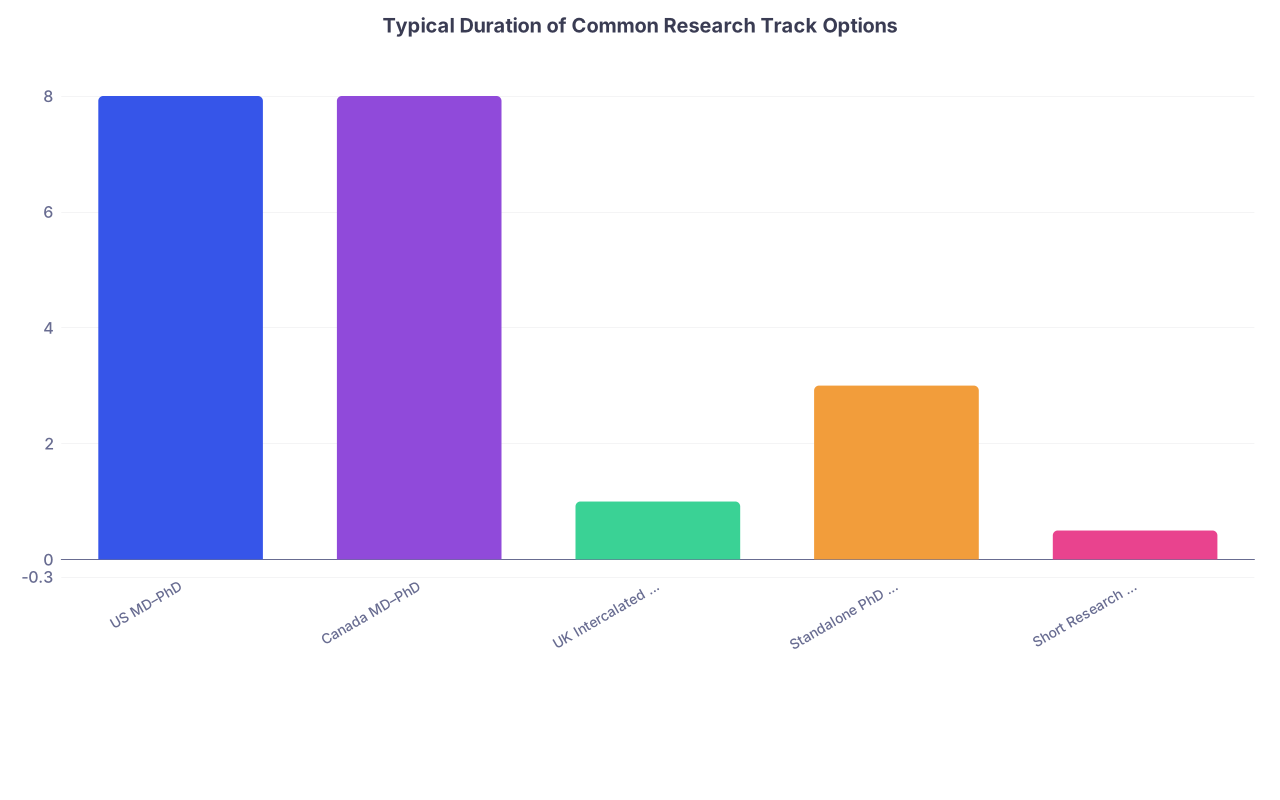
| Category | Value |
|---|---|
| US MD–PhD | 8 |
| Canada MD–PhD | 8 |
| UK Intercalated BSc | 1 |
| Standalone PhD after MD | 3 |
| Short Research Track (Honours) | 0.5 |
4. Australia and New Zealand: MD with Embedded or Parallel Research
Australia and New Zealand run mainly 4‑year graduate‑entry MD programs, but they also have:
- Honours years
- MPhil or PhD options for medical students or recent graduates
- “MD with Distinction in Research” style tracks
Common structures:
MD + Honours / MPhil (Research)
You do an extra research year (often between MD years or right after) to complete a Master of Philosophy or Honours degree. More serious than a typical project, less than a full PhD.Parallel MD + PhD
Some universities (e.g., University of Queensland, University of Melbourne, UNSW) allow high‑achieving MD students to enroll in a PhD during MD.
Usually reality looks like this:- You stretch both degrees over a longer time.
- You might take leave from MD for 2–3 full‑time PhD years.
- You need serious time management and strong supervision or you will drown.
Sequential MD then PhD
You complete MD, then enter a 3–4 year PhD, often tied to a teaching hospital or university department.
These programs can be powerful if:
- You are willing to stay in the region for training.
- You want to do clinical + lab/clinical research in Australia/NZ systems.
- You are fine with less formal branding as “MD–PhD” but equivalent real work.
What goes wrong: students see a line in the brochure like “opportunities to undertake PhD during MD” and imagine U.S.-style automatic funding and robust structure. No. Often you have to independently secure a supervisor, scholarship, and design.
5. Continental Europe: MD plus PhD Is Common but Often Sequential
In countries like Germany, the Netherlands, Scandinavia, Switzerland, and others, it is quite normal for physicians to hold a PhD.
However, the path is different.
Typical pattern:
- Complete the main medical degree (5–6 years).
- Start residency or junior doctor position.
- Enroll in a PhD program concurrently or sequentially, often in a university hospital lab or clinical research unit.
- Take 3–4 years, sometimes longer, to complete the PhD while partially working clinically.
In some places, they still use a Dr. med. degree that resembles a “lighter” research thesis compared with a U.S./UK PhD. In others, the PhD is standardized and robust.
To evaluate a European option, ask specifically:
- Is there a formal MD–PhD entry track at admission, or is it something you build later?
- Is the PhD recognized internationally as equivalent to a U.S. PhD (most modern European PhDs are)?
- How many first‑author papers do PhD graduates typically have?
- Are there clear physician‑scientist career paths post‑PhD?
European MD + PhD can set you up extremely well for academic medicine, especially within Europe. For U.S. or Canadian returns, the brand recognition is more variable, but strong publications and letters travel well.
6. East Asia: Parallel or Sequential MD and PhD Tracks
East Asian systems (China, Japan, South Korea, Singapore, etc.) vary widely, but some common designs appear.
Parallel Degree Tracks
Some universities offer combined programs where you enroll in:
- A medical degree (MBBS, MD equivalent)
- A PhD program, sometimes under the same faculty
Realistically, the structure is:
- Heavier coursework and lab time during the med curriculum
- Periods of leave from clinical work to complete intense experimental phases
- Total time extending to 8–9 years or more
Funding and supervision quality are extremely variable. You can find world‑class labs in places like:
- University of Tokyo
- Seoul National University
- National University of Singapore
- Peking University, Fudan University
But the program label “MD–PhD” is not standardized. You need to look at actual graduation timelines, publication expectations, and placement of recent alumni.
Sequential MD then PhD
Very common:
- Graduate from med school.
- Join a university hospital department.
- Undertake a PhD in the same field (e.g., cardiology, oncology, immunology) while working as a junior doctor.
This can be deeply research‑intensive, but again, it is coordinated after the main MD, not truly integrated like a single 8‑year combined program.
For students planning to train and practice long‑term in East Asia, this is perfectly rational. For someone trying to use an East Asian MD–PhD as a stepping stone back to North America, it gets more complicated and requires serious homework on recognition, licensing, and language proficiency.
7. Caribbean / Offshore Schools: Research Tracks Are Usually Cosmetic
If you are looking at international medical schools from the U.S., odds are you have stumbled across Caribbean or other “offshore” programs that market “research opportunities” or even “MD with research.”
Let me be blunt: in most of these environments, a “research track” is:
- An optional short project
- Sometimes an online or literature‑based assignment
- Rarely a true, mentored, hypothesis‑driven, publishable research program
There are exceptions at schools that have genuine affiliations with U.S. or Canadian teaching hospitals and established PI‑level mentors. But those are exceptions, not the rule.
If a school:
- Does not have a real on‑site research lab infrastructure
- Cannot list multiple faculty with active grants and PubMed‑indexed work
- Treats research as an elective add‑on in years 3–4 with minimal protected time
…you are not looking at a true MD–PhD or even a robust research track.
This matters because U.S. residency program directors know this. A generic “research certificate” from a low‑tier offshore school is not equivalent to actual bench or clinical research with publications.
If research is a core goal for you, you should be extremely skeptical of offshore MD programs that advertise “research tracks” without concrete details.
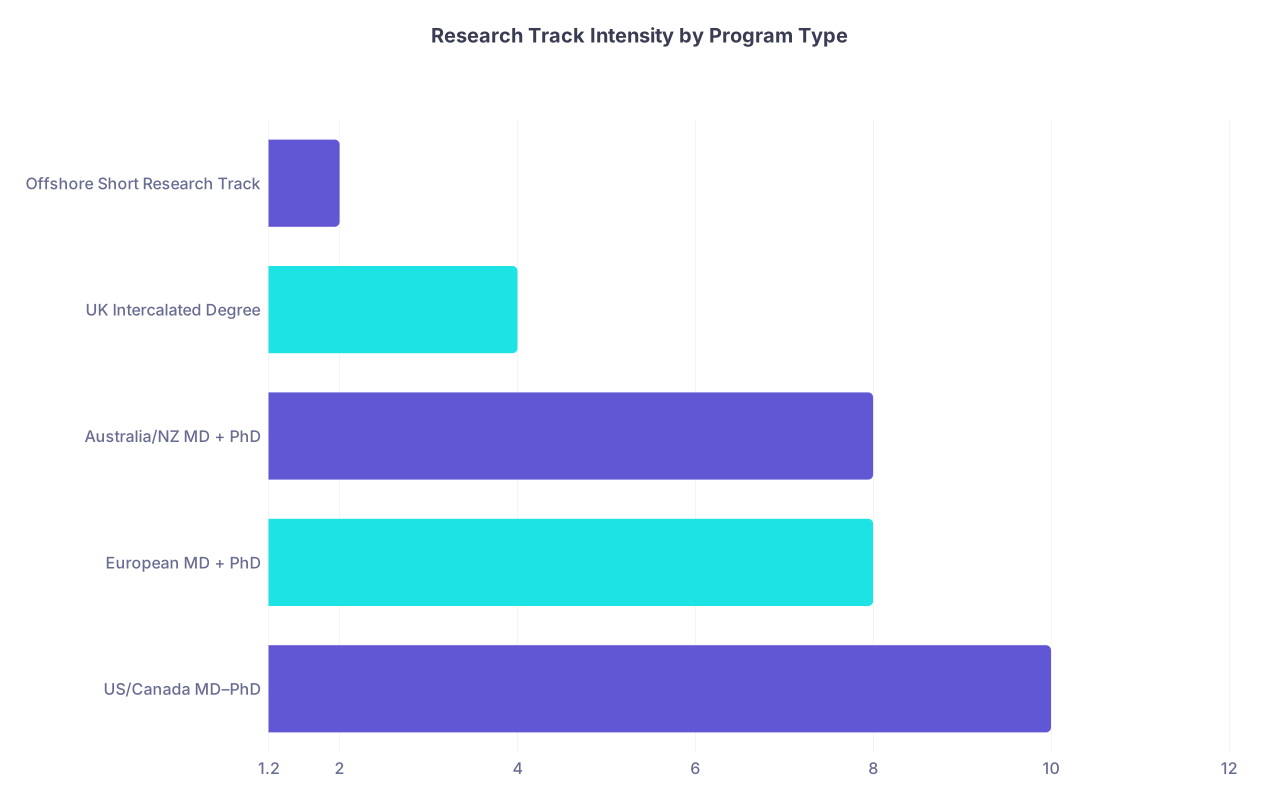
| Category | Value |
|---|---|
| US/Canada MD–PhD | 10 |
| European MD + PhD | 8 |
| Australia/NZ MD + PhD | 8 |
| UK Intercalated Degree | 4 |
| Offshore Short Research Track | 2 |
(Scale 1–10: higher = more research depth and time commitment; this is conceptual, not a formal metric.)
8. How to Compare Options as a Premed or Early Medical Student
Forget the labels for a moment. I do not care if it is called MD–PhD, MBBS with Research, Clinician Scientist Pathway, or something invented by marketing.
You should evaluate programs on five practical axes:
Time Commitment
- How many total years?
- How many of those years are primarily research?
Funding
- Are MD years funded, partially funded, or full tuition?
- Are PhD/research years accompanied by a stipend or are you expected to self‑fund?
Research Environment Quality
- Do they have actual labs, core facilities, clinical trial units?
- Can they name specific productive PIs with recent publications?
- Do students regularly get first‑author or high‑impact co‑author publications?
Integration with Clinical Training
- Is there clear protected time for research?
- Are there official policies about taking leave for PhD years and returning to clinical?
Alumni Outcomes
- What are graduates actually doing 5–10 years out?
- Do they hold academic positions? Get major fellowships? Match into strong residencies?

9. Strategic Choices Based on Your Goals
Let’s match program types to realistic goals.
If you want a classic physician‑scientist career in North America
You are aiming for:
- 70–80% research, 20–30% clinical
- NIH grants, academic promotion, lab leadership
Best fits:
- U.S. MSTP MD–PhD programs
- Canadian MD–PhD programs (Toronto, McGill, UBC, etc.)
- Selected top‑tier European MD + PhD tracks with clear academic pipelines
International MD-only plus later PhD can still get you there, but it is a longer and more fragmented path.
If you want to be a strong clinician with meaningful research involvement
You are thinking:
- 10–30% research, 70–90% clinical
- Interested in trials, outcomes research, occasional lab collaborations
Solid options:
- UK/Ireland MBBS with intercalated degree + later research training
- Australian/NZ MD with an Honours or MPhil year
- European MD + a focused research master’s or smaller PhD during early residency
You do not necessarily need an 8‑year MD–PhD. You need good mentorship, at least one major research project, and a residency that values scholarship.
If you are U.S.-based and just want some research exposure at an international school
For U.S. residency competitiveness, having:
- A handful of abstracts
- 1–2 solid publications
- Good letters from research mentors
…is more valuable than a random “research certificate.”
For that, programs with:
- Real intercalated years (UK/Ireland)
- Proper MD research projects (some European or Australian/New Zealand schools)
- Strong partner institutions in the U.S. or Europe
…are worth more than flashy but shallow options from offshore schools.

| Step | Description |
|---|---|
| Step 1 | Premed / Undergrad |
| Step 2 | US/Canada MD–PhD |
| Step 3 | UK/Ireland MBBS + Intercalated |
| Step 4 | Europe MD then PhD |
| Step 5 | Australia/NZ MD + Honours/PhD |
| Step 6 | Offshore MD with short research |
| Step 7 | Academic Physician-Scientist |
| Step 8 | Clinician with research & possible later PhD |
| Step 9 | Primarily Clinical Career |
| Step 10 | Region / School Type |
10. Red Flags and Green Flags When Evaluating Programs
You are going to see a lot of buzzwords. Filter them hard.
Red Flags
- “World‑class research track” with no specific projects, labs, or PIs listed.
- Vague language like “research‑enhanced curriculum” without clear protected time.
- No mention of actual publications by students.
- No track record of graduates going into academic positions or serious fellowships.
- “MD–PhD” label with total program length under 6.5–7 years. That is not realistic.
Green Flags
- A clearly stated program length (e.g., “8 years: 4 MD + 4 PhD”).
- Explicit description of funding: “PhD years fully funded with annual stipend of X.”
- Named departments and supervisors, with recent PubMed‑listed work.
- Actual lists of student publications and awards.
- Clear rules on how medical and PhD timelines are integrated (e.g., break between MD2 and MD3).
You are not buying a logo. You are signing up for 7–10 years of your life. Demand specifics.
11. Practical Steps for a Premed Considering International MD–PhD / Research Tracks
If you are early (premed or pre‑application), here is how to be systematic without losing your mind.
Decide which of these best describes you:
- “I want full‑on physician‑scientist, lots of lab time.”
- “I want to be research‑literate and contribute, but mostly clinical.”
- “I just do not want to be totally cut off from research.”
Shortlist regions that match that intensity:
- High intensity: US/Canada MD–PhD, some Europe, some Asia.
- Moderate: UK/Ireland with intercalation, Australia/NZ with Honours/PhD combos.
- Low to moderate: many standard MDs with optional small projects.
For each shortlisted school, email or ask:
- “How many medical students in the last 5 years have completed X research degree?”
- “What is the typical publication output of students in this track?”
- “How are PhD or research years funded and scheduled?”
- “Where are your research‑track graduates now?”
Cross‑check what they tell you with:
- PubMed searches for “University X medical student research”
- Alumni LinkedIn profiles
- Residency match lists and academic appointments
If a program cannot show evidence that their “research track” produces actual, tangible scholarly output and career outcomes, treat it as marketing fluff.
FAQs
1. Is an international MD–PhD viewed the same as a U.S. MD–PhD for U.S. residency applications?
Not automatically. Program directors care about the substance: publications, letters, and actual research training. A Canadian MD–PhD or a strong European MD + PhD with multiple first‑author papers can be very competitive. A vaguely structured “MD–PhD” from a low‑research environment will not carry the same weight. The name of the degree is less important than your track record and the reputation of the institutions involved.
2. If I do an intercalated BSc in the UK or Ireland, do I still need a PhD later for an academic career?
In most cases, yes. An intercalated year is a strong introduction to research and can lead to early publications, but it is not equivalent to a full‑length PhD. Many UK academic clinicians follow a path of MBBS + intercalated BSc → foundation training → PhD (or MD(Res)) during or around specialty training. The intercalated degree helps you win competitive academic fellowships and proves you can handle research, but it does not replace a full doctoral degree in research‑intense careers.
3. Should I avoid Caribbean or offshore schools if I am interested in research?
If serious, long‑term research or an academic career is your priority, Caribbean/offshore schools are usually a poor fit. Most do not have the infrastructure, funding, or culture to support sustained, high‑quality research. You may be able to arrange short projects or external electives, but that will not match the training from a proper MD–PhD or a research‑heavy track at a major university. For someone whose primary goal is simply becoming a practicing clinician, offshore schools can be a path; for a budding physician‑scientist, they are rarely optimal.
4. Is it better to do an integrated MD–PhD or an MD followed by a separate PhD?
Integrated programs are efficient and structured, with clear support and protected time. They work well if you are already certain about a research‑heavy career. MD followed by PhD offers more flexibility: you can confirm your interests during clinical exposure, choose a more focused topic, and sometimes align your PhD directly with your chosen specialty. The trade‑off is more fragmentation and sometimes longer total training time. Both routes can produce strong physician‑scientists if the research environment and mentorship are good.
5. Can I start in a standard MD program abroad and later “add on” a PhD if I discover a love for research?
Yes, in many systems that is normal. In the UK, Europe, Australia/NZ, and East Asia, it is quite common to enter med school as a standard student, get involved in research, then apply for a PhD or MD(Res) during or after early postgraduate years. The key is early involvement: join labs, seek out supervisors, and build a track record so that when you apply for funded PhD positions, you are competitive. Do not assume that “adding on” a PhD is automatic—you still need to win a spot and funding.
6. If I want to return to the U.S. after an international MD–PhD or research track, what should I prioritize now?
Prioritize three things: (1) Accreditation and licensing—make sure the medical degree is recognized for ECFMG/USMLE eligibility. (2) Research quality—aim for environments where you can produce peer‑reviewed publications with well‑known PIs. (3) Mentorship and letters—strong, detailed letters from internationally recognized researchers carry enormous weight. If you can combine a recognized medical degree, a serious research record, and mentors who are visible in your field, your chances of transitioning back to the U.S. system improve substantially.
Key takeaways:
- Do not trust labels—“MD–PhD” and “research track” can mean anything from 6 months of project work to 4 years of hardcore PhD.
- Compare programs on time, funding, research environment, integration, and alumni outcomes, not on glossy marketing.
- Match the intensity of the program to your actual career goals; you do not need an 8‑year MD–PhD to be research‑literate, but you do need serious structure and mentorship if you want to be a true physician‑scientist.


