

You’re sitting at your desk with fifteen tabs open: “Caribbean med school accreditation,” “Will UK MD be accepted in Canada,” “IMG horror stories,” and that one Reddit thread you really, really should’ve stopped reading 45 minutes ago.
Your brain’s doing that spiral:
What if I spend 6 years and thousands of dollars on an international medical degree… and my home country just shrugs and says, “Yeah, we don’t recognize this”?
What if I can’t get licensed?
What if I can’t match?
What if I end up back home, explaining to my family that I’m “kind of a doctor, but not really, not here”?
You’re not crazy for thinking this. You’re smart. Because this is one of the biggest silent traps in the “I’ll just go abroad for med school” plan.
Let me be blunt:
Yes, your international degree can absolutely end up being partially useless in your home country.
No, this is not rare.
And yes, you can avoid most of the disaster scenarios if you know exactly what to check now, before you sign anything or pay any deposit.
Let’s walk through it step by step. Worst-case-scenario brain and all.
The Ugly Truth: Not All Medical Degrees Travel Well
There’s this fantasy a lot of people have:
“A medical degree is a medical degree. Once I’m a doctor somewhere, I can come back home and just… be a doctor.”
That’s not how it works.
Every country has its own rules. And they don’t care that your school had palm trees, small-group learning, and a fancy simulation lab. They care about:
- Where your school is located
- Who accredits it
- Whether your country’s medical council actually recognizes that accreditation
- Whether you meet their exam / internship / language / training structure requirements
Here’s the nightmare situation I’ve actually seen:
- Student from Country A goes to an unrecognized school in Country B
- Graduates, passes local exams there
- Comes home to Country A
- Country A’s medical council: “We don’t recognize your school or its accreditation. You can’t get a license here.”
- Result: They’re technically a doctor on paper… but not allowed to practice where their family, support system, and life are.
Is that recoverable? Sometimes. Through years of extra exams, repeat internships, maybe moving permanently to another country. But often? It’s brutal.
So your anxiety is valid. The risk is real. The goal now is to make it smaller and visible instead of this giant formless monster in your head.
Step 1: Clarify Your “Home” Plan (Even If You’re Unsure)
Before you even look at a school, you need to answer a question you’ve probably been dodging:
“Where do I actually want to be licensed and practicing long-term?”
Not “I’m open to many countries.”
Not “Maybe Europe or the US or Canada or my home country.”
Pick your top 1–2 priority countries.
Why? Because recognition is country-specific. A school that’s fantastic for practicing in the UK might be useless if you decide you want to practice in India or Nigeria or the US later.
Be honest with yourself:
- If you really want to come back home eventually, your home country’s recognition matters most.
- If you’re 100% sure you never want to work in your home country again (be honest; very few people are truly 100%), then you optimize for the country you want.
But don’t lie to yourself with “I’ll figure it out later.” That’s exactly how people get trapped.
Step 2: Check If Your Home Country Recognizes the School (Not Just the Degree)
Now the concrete part. This is where most people are too vague.
You don’t want:
“Does this country accept international doctors?”
You want:
“Does my home country’s medical council recognize this exact school and its accreditation?”
You’re checking at two levels:
- Is the medical school properly accredited in its own country?
- Is that accreditation (and sometimes that school name) accepted by the medical authority in your home country?
Here’s what you actually do (yes, literally):
- Go to your home country’s official medical council / licensing board website.
- Examples: GMC (UK), ECFMG/NBME/State boards (US context), MCC (Canada), NMC (India), HPCSA (South Africa), etc.
- Look for:
- Lists of recognized foreign medical schools
- Lists of approved accreditation agencies
- Specific rules about foreign-trained doctors / IMGs / international graduates
- If there’s a searchable database of schools, type in the school’s name.
- If they list accreditation bodies, check if your potential school’s accreditor is on that list.
And then—yes—email or call them directly.
You literally say something like:
“I’m a citizen/resident planning to attend [School Name] in [Country]. It’s accredited by [Accreditation Agency]. If I complete my medical degree there, will I be eligible to apply for [internship / licensing exam / registration] in [Home Country] under current regulations?”
Save their written reply. Screenshot the page where they say it. Back it up.
Because regulations change. And you don’t want to rely on “some guy in a Facebook group said it was fine.”
Step 3: Don’t Be Fooled by Vague Phrases Schools Use
Schools will say pretty things. Some of them are technically true but practically useless.
Red flag phrases:
- “Our graduates have practiced in the US/UK/Canada/Europe.”
→ How many? When? Before or after rule changes? Top graduates only? - “We are listed in [World Directory / WHO directory].”
→ Listing is not the same as your home country recognizing it. - “We meet international standards.”
→ Means nothing without named accreditation bodies and countries that accept them. - “Our degree is globally recognized.”
→ Straight-up marketing fluff. There is no such thing as “globally recognized.”
You want:
- The exact name of their accrediting body (e.g., CAAM-HP, LCME, WFME-recognized agency, etc.)
- Evidence that this accreditor is accepted by your target country’s medical council
- Concrete data: “X% of our grads get Y license / match in Z country.”
If they dodge, change the subject, or send you pretty brochures instead of actual accreditation documents?
Walk away. Or at least slow way, way down.
Step 4: Understand That Exams ≠ Automatic Acceptance
A lot of people tell themselves:
“It’s fine. I’ll just take USMLE / PLAB / MCCQE / licensing exam later. Exams fix everything.”
They don’t.
Licensing usually has several gates:
- School recognition / accreditation
- Eligibility to sit the licensing exams
- Completion of internships/housemanship/residency in accepted systems
- Possibly language requirements
- Sometimes additional years of supervised practice
You can’t always brute-force your way in with tests alone if your school isn’t recognized at the regulatory level.
Example situations I’ve seen:
- Person passes USMLE but can’t get ECFMG certification because their school isn’t recognized under newer WFME requirements.
- Graduate from certain foreign schools can’t do internship at home because their degree length/structure doesn’t match local standards.
- Country requires your degree to be from a program with X years of clinical training physically in that country.
So you’re not just asking, “Can I take the exam?”
You’re asking, “If I pass, can I actually get licensed and work?”
Step 5: Check Upcoming Rule Changes (Especially Around 2024–2025 and Beyond)
Here’s where it gets even more fun (sarcastically): rules are changing.
For example, ECFMG (for US) moved toward requiring schools to be accredited by a recognized agency (WFME-recognized) for graduates to be certified. Some countries are tightening or updating their lists of acceptable schools.
So when you check:
- Don’t just look at “current policy.”
- Check “transitional policies,” “upcoming requirements,” or “from year X onward.”
If you’re starting in, say, 2025 and graduating in 2031, you care about rules 6–8 years from now. Nobody can predict everything, but if a school is already on shaky ground with accreditation, you’re playing with fire.
Step 6: Compare Schools by Risk, Not Just Brochures
Your brain right now is juggling vague impressions: beaches, tuition, maybe match stats. You need something more concrete.
Here’s how I’d mentally bucket schools based on regulatory risk:
| Risk Level | Typical Features |
|---|---|
| Lower Risk | Public schools in established systems (e.g., UK, Ireland, some EU), strong national accreditation, long history of grads returning to your home country |
| Moderate Risk | Well-known Caribbean / foreign private schools with WFME-recognized accreditation and consistent match/licensing data |
| Higher Risk | Newer private schools, vague accreditation, few grads in your target country, aggressive marketing |
| Extreme Risk | Unaccredited schools, no clear accreditation info, not listed or explicitly rejected by your home council |
You don’t need zero risk. But if you’re already anxious (you are, you’re reading this), going for “higher” or “extreme” risk schools is like signing up for several years of chronic background panic.
Step 7: Talk to Graduates Who Actually Went Back Home
Not just any grads. SPECIFIC grads.
You want:
“People from my country who went to this school and are now practicing back home or stuck in limbo.”
Ask them:
- Did your home council give you any trouble recognizing your degree?
- Were there surprise extra exams, required documents, or years of practice?
- Did rules change between you starting and you finishing?
- Are there classmates who couldn’t come back home at all?
And listen for hesitation.
If they say, “It worked for me, but honestly, now the rules are getting stricter and I’d be nervous if I were starting now”? Believe them.
Step 8: Don’t Forget the “Plan B” Question
Your anxiety is going to whisper:
“What if they change the rules halfway through med school and I’m screwed anyway?”
That can happen. It’s rare, but it can.
So ask yourself now:
“If the worst happens and I can’t easily go back home, is the backup—staying in that country or going to a third country—something I could live with?”
If the answer is, “Absolutely not, I’d be devastated,” your tolerance for risk needs to be low. That probably means:
- More conservative school choices
- Extra time spent applying/reapplying to safer options
- Maybe waiting a year instead of leaping into the first international offer
There’s no shame in that. I’ve seen people spend a decade untangling a rushed decision they made at 21.
A Quick Visual: The Path From Foreign School to Practicing Back Home

| Step | Description |
|---|---|
| Step 1 | Choose Foreign Med School |
| Step 2 | High Risk of No License Back Home |
| Step 3 | Complete Degree |
| Step 4 | Pass Required Exams |
| Step 5 | Apply for Registration/License |
| Step 6 | Practice in Home Country |
| Step 7 | School Recognized by Home Council? |
| Step 8 | Eligible for Licensing Exam? |
| Step 9 | Internship/Residency Accepted by Home Country? |
Your job right now is to find out whether you’re on the “Yes” path or quietly headed toward that big red “Z”.
What to Actually Check, In One Place
Here’s a concrete checklist you can literally copy into a note and work through:
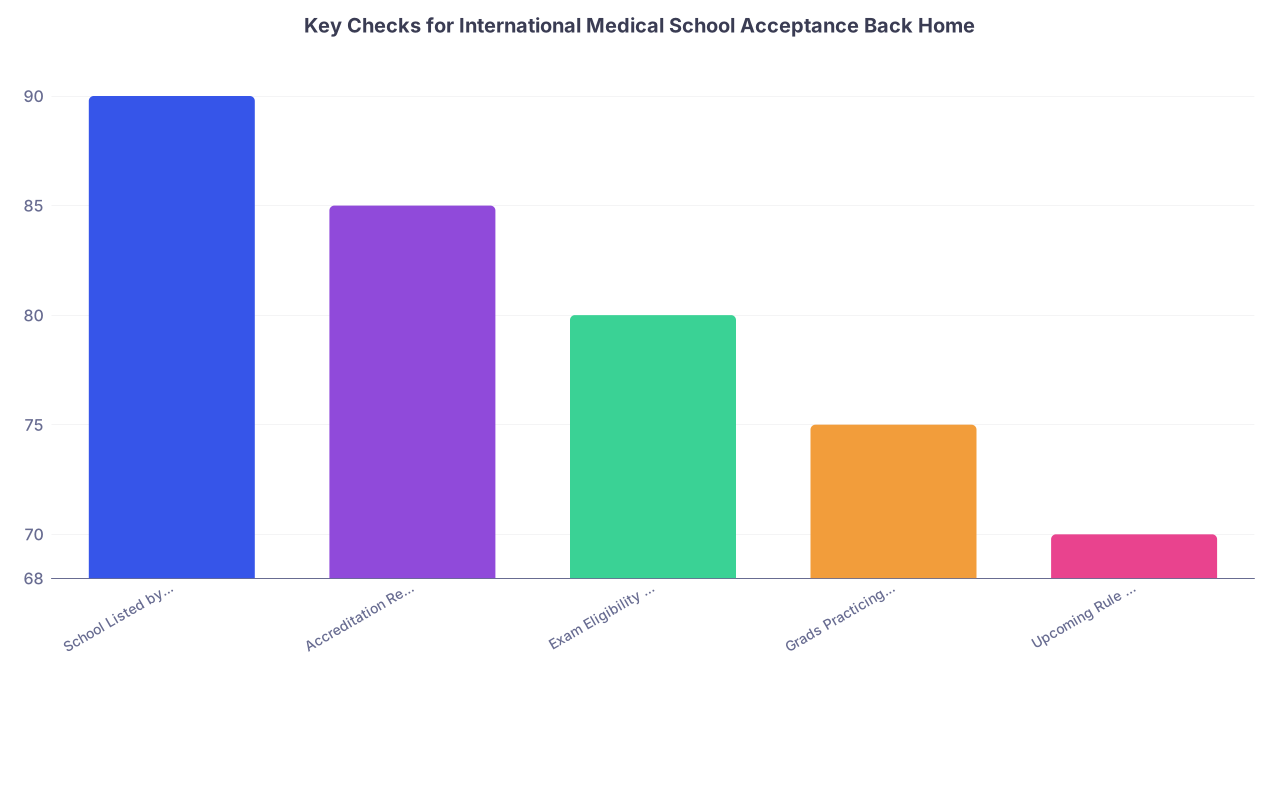
| Category | Value |
|---|---|
| School Listed by Home Council | 90 |
| Accreditation Recognized | 85 |
| Exam Eligibility Confirmed | 80 |
| Grads Practicing Back Home | 75 |
| Upcoming Rule Changes Reviewed | 70 |
(Those numbers aren’t real stats; think of them as “priority levels.” Top of the list is absolutely non-negotiable.)
You want:
- Confirmation your exact school is accepted or at least not blacklisted
- Proof that your school’s accreditor is recognized by your home country
- Written confirmation of exam eligibility from the exam body if relevant (USMLE, PLAB, etc.)
- Actual people from your country who returned and are practicing
- Awareness of any upcoming policy shifts that might impact your graduation year
If you can’t check most of these off with evidence, not vibes, your anxiety isn’t overreacting. It’s warning you.
If You’re Already Enrolled or Halfway Through…
Deep breath.
If you’re already in year 2 or 3 of an international program and now you’re panicking, you’re not the first.
You still do the same checks. But now you’re asking:
- Am I still on track for home-country recognition under the current and future rules?
- Do I need to adjust my career goal (e.g., switch target country, plan for residency elsewhere)?
- Is transferring to a different school an option (sometimes very hard, but occasionally possible)?
The worst thing you can do is ignore the anxiety and “hope it works out.” It might. But if it doesn’t, you’ll wish you’d gotten clarity earlier.
Sometimes, the answer after all the checks is:
“Yes, it’s stressful, but it is possible. The path is just narrow and competitive.”
That’s still scary, but at least it’s specific fear instead of this foggy dread.
FAQ (Exactly 5 Questions)
1. If a school is in the World Directory of Medical Schools, does that mean my degree will be accepted back home?
No. Being in the World Directory is like existing in a big phonebook. It means the school exists, not that your home country accepts it. Your medical council might require that the school be accredited by a specific agency, that it meets certain training standards, or might even have an explicit approved/rejected list. Always check your home authority’s rules, not just the World Directory.
2. The school told me their degree is “recognized worldwide.” Are they lying?
They’re exaggerating. Hard. There is no such thing as a medical degree that is automatically recognized “worldwide.” Some degrees transfer more smoothly across countries; others don’t. A responsible school will tell you exactly which countries their grads commonly practice in, what exams they take, and what accreditation they hold. If they throw vague phrases at you instead of specifics, be suspicious.
3. Can’t I fix everything later by doing residency in the US/UK and then going home?
Sometimes yes, sometimes no. Some home countries are happy if you complete residency in certain countries (e.g., US, UK, Canada, Australia) and then return. Others still look at where you went to medical school and may restrict or complicate your registration. Also, matching into residency as an IMG is hard and getting harder. Assuming you’ll “just do US residency” is not a low-risk plan. It’s a gamble.
4. What if rules change while I’m in medical school and my originally recognized school becomes a problem?
This is the worst-case scenario your brain is already obsessing over, and yes, it happens occasionally. If it does, you usually have a few options: work in the country you trained in, target a third country that still accepts your school, or jump through extra hoops (additional exams, supervised practice, repeat internships) back home. To de-risk this, choose schools with strong, stable, WFME-recognized accreditation and a long history of graduates successfully returning to your country.
5. Is it ever better to wait and reapply at home than rush into an international school now?
Often, yes. If your stats are borderline but not hopeless, and your alternative is a high-risk, poorly accredited international school that your home country might not accept, waiting a year to strengthen your application can be the smarter long-term move. A one-year delay is nothing compared to being locked out of practicing in your home country or losing years fighting licensing battles.
Today’s concrete, actually-doable next step:
Open your home country’s medical council / licensing authority website.
Find the section on foreign medical schools or international graduates.
Write down exactly what they say about recognized schools, accreditation, and exam eligibility. If it’s still not clear, draft a short email to them right now with the specific school names you’re considering and ask plainly:
“Will a graduate from [School] be eligible for licensing in [Your Country] under current rules?”
Hit save. Then send it.


