

Last week I got a DM from a student in India: “Be honest. If I don’t go to a ‘name-brand’ international school, am I basically killing my chances at matching in the US?” I stared at the message way too long because… I’ve asked that same question in my head a thousand times.
You look at match lists, forums full of doom, memes about “Caribbean mills,” and suddenly it feels like there’s a giant invisible blacklist based entirely on the name of your school. Like you could work yourself into the ground and still get filtered out by a line in your ERAS file that you can’t change.
Let me say the hard part first: school name does matter. It’s not imaginary. But it doesn’t matter in the way our anxious brains keep telling us at 2 a.m. — that it’s the only thing that matters and everything else is pointless. The reality is uglier and more nuanced than that.
Let’s unpack it properly, not the Reddit version.
Where School Name Actually Hurts (And Where It Doesn’t)
The part nobody likes to say out loud: there is bias. Program directors are human, tired, overloaded, and under pressure to pick “safe” candidates fast. When they see “University of Toronto” or “Oxford” they don’t blink. When they see “Xyz International School of Medicine” they might.
Not always. But enough that you feel it.
Where school name tends to hurt you most:
- In automated or quick manual screening
- At programs that almost never take IMGs
- When your scores and application are only “average”
- When your school has a bad or unknown reputation
But where it matters way less:
- In programs that historically take a lot of IMGs
- When you have strong USMLE scores and solid US clinical experience
- When your letters are from well-known US attendings
- When your story and performance make you hard to ignore
Here’s the ugly math people try to dance around:
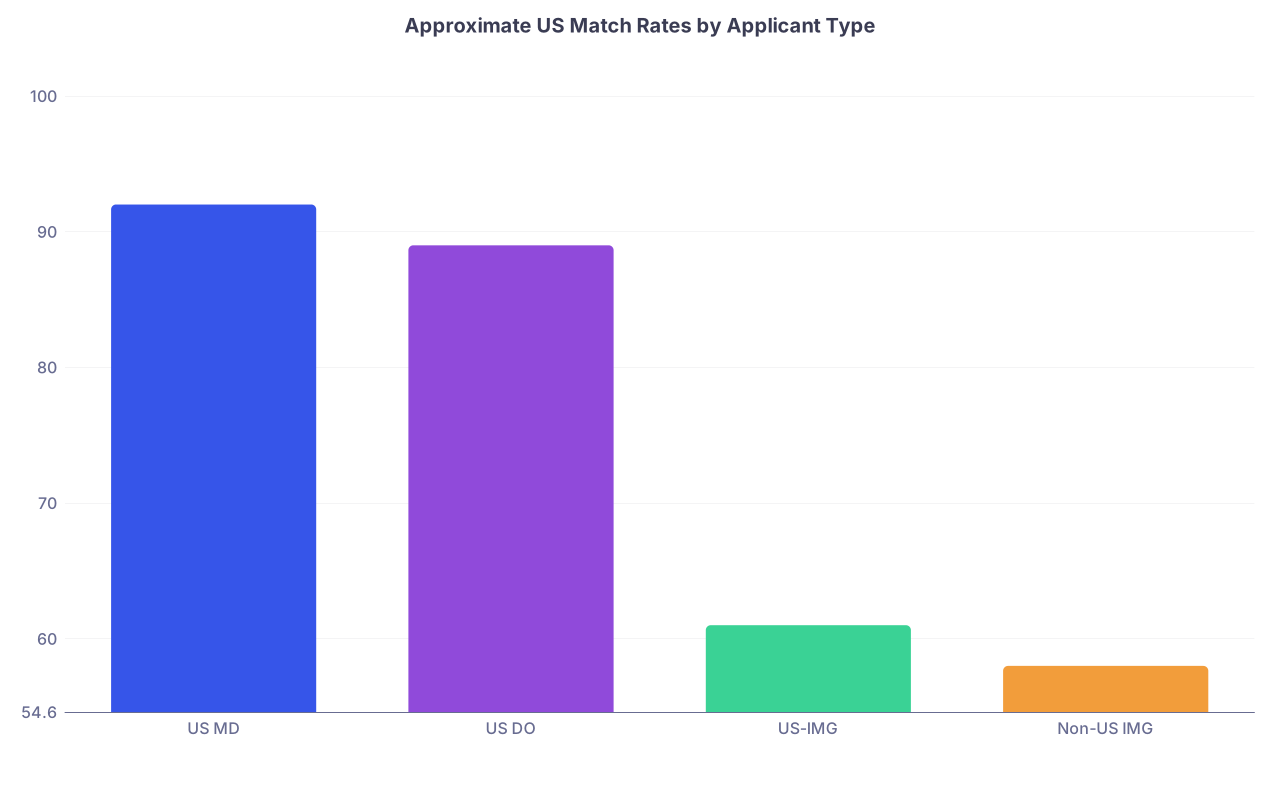
| Category | Value |
|---|---|
| US MD | 92 |
| US DO | 89 |
| US-IMG | 61 |
| Non-US IMG | 58 |
Numbers like this are why we panic. But look at them a bit differently: around 6 in 10 IMGs do match. That’s not rigged-lottery territory. That’s “the game is harder, and you can’t be mediocre” territory.
School name is one of the reasons it’s harder. Not the only one.
The Quiet Sorting: How Programs Actually Look at Your School
Nobody sends you an email saying, “We rejected you because we don’t like your school.” It’s more subtle.
This is roughly what happens on their side (and yes, I’ve had attendings lay this out pretty bluntly):
- They get 3,000+ applications for, say, 12 spots.
- Someone sets filters: US grad vs IMG, minimum Step 2 score, visa requirement, etc.
- For the IMGs that survive the filter, they glance at schools and quickly bucket them:
- “Known good / we’ve had good residents from here”
- “Neutral / don’t know them, will judge by the rest”
- “Concern / had bad experiences / notorious for weak prep”
Then the rest of your application either confirms or fights that gut reaction.
So yes, a famous international school or one they’ve had great grads from before can give you a tiny boost. A Caribbean school with a reputation for poor clinical training can be a drag.
But notice something: once you’re in that “neutral / don’t know” group, your school name isn’t killing you. It’s just… not helping you either. You have to create your own advantage with everything else.
Types of International Schools: They’re Not All Viewed the Same
Here’s where the “all IMGs are doomed” narrative is just wrong.
| School Type | Typical Program Director Reaction |
|---|---|
| Well-known non-US (Toronto, McGill, Oxford) | Basically like US grads, minimal suspicion |
| Strong EU/UK schools with some US presence | Generally positive/neutral |
| Established Caribbean with long US history | Mixed; depends on their past residents |
| New/unknown international schools | Neutral-to-skeptical; need proof you’re strong |
| Schools with bad rep or very low match stats | Clear disadvantage; you must massively outperform |
What nobody tells you early enough: “IMG” is not a single category in people’s heads. A grad from University of Toronto and a grad from an unaccredited-for-years offshore school are both “IMGs” on paper, but that label is hiding a lot.
So when you’re choosing where to go, you’re not really choosing between “IMG vs not.” You’re choosing between:
- An IMG route where your school helps or at least doesn’t hurt
- An IMG route where your school is a known problem you’ll be fighting for years
And yeah, some schools fall into that second group. That’s not fearmongering — it’s reality.
Does a “Big Name” International School Fix Everything?
No. And this is where our anxious brains lie to us the other way.
It’s easy to think: “If I can just get into a famous international school — like UCL, Cambridge, or a big-name European university — I’ll be safe.”
Here’s the blunt truth:
- A famous international school does not erase the IMG bias
- It does make some programs more comfortable taking a chance on you
- It does not forgive low USMLE scores
- It does not replace US clinical experience or strong letters
I’ve watched people from very good European schools miss the match because they:
- Didn’t take Step 2 seriously enough
- Had zero meaningful US letters
- Applied too few programs or only to super-competitive cities
- Assumed name + decent stats = automatic interviews
On the flip side, I’ve seen people from mid-tier Caribbean schools match into Internal Medicine and even Anesthesia because they played every other part of the game aggressively right: high scores, strong rotations, smart school list, tons of applications.
So yes, name matters. But not enough to save a weak application. And not so much that a strong application from a less-famous school is doomed.
If You Haven’t Started Med School Yet: How to Actually Factor School Name In
This is where the anxiety explodes, especially for premeds staring at glossy international school websites.
You’re probably thinking:
- “If I choose wrong, I wreck my chances forever.”
- “But I don’t even know which schools are ‘good’ or ‘bad’ as IMGs.”
- “All the schools say they place tons of grads in the US. Someone is lying.”
You’re not wrong to be suspicious. Some schools market like it’s a resort brochure.
Here’s how to keep your brain from spinning completely out:
1. Look at real match data, not brochure spin
You want:
- Total number of grads per year
- Number who actually apply to US residency
- Number who match, and into what
If a school only shows 10 “example matches” without telling you how many people didn’t match, that’s not transparency — that’s marketing.
2. Find out how programs talk about them
Ask residents, attendings, anyone who reviews applications. You’ll hear stuff like:
- “We’ve had great people from X school; I’d interview them again.”
- “We don’t touch Y anymore, we had two disasters from there.”
- “Honestly, I don’t know that school; I just look at the scores and letters.”
That offhand comment matters more than any ranking site.
3. Recognize that new/unknown schools add an extra burden
If your school is very new or completely unknown in the US, nobody is going to blacklist you. They’re just going to lean harder on:
- Your Step 2 score
- Your US clinical experience
- Your letters from US physicians
Which means: if you pick an unknown school, you’re signing up for a path where “average” won’t cut it.
How Much More You Have to Do When Your School Name Doesn’t Carry You
This is the part that really stings. Because yes, you probably will have to work harder than a US MD from a mid-tier school.
Here’s what that extra work looks like in practice:
- You can’t treat Step 2 like a pass/fail hurdle; you need it as a weapon
- You can’t rely only on home-country rotations; you need solid US hands-on experience
- You can’t show up with generic letters; you need US attendings who actually remember you
- You can’t apply to 30 programs and hope; you might be looking at 100+ for some specialties
And no, that’s not “fair.” But it’s real.
To visualize the tradeoff:
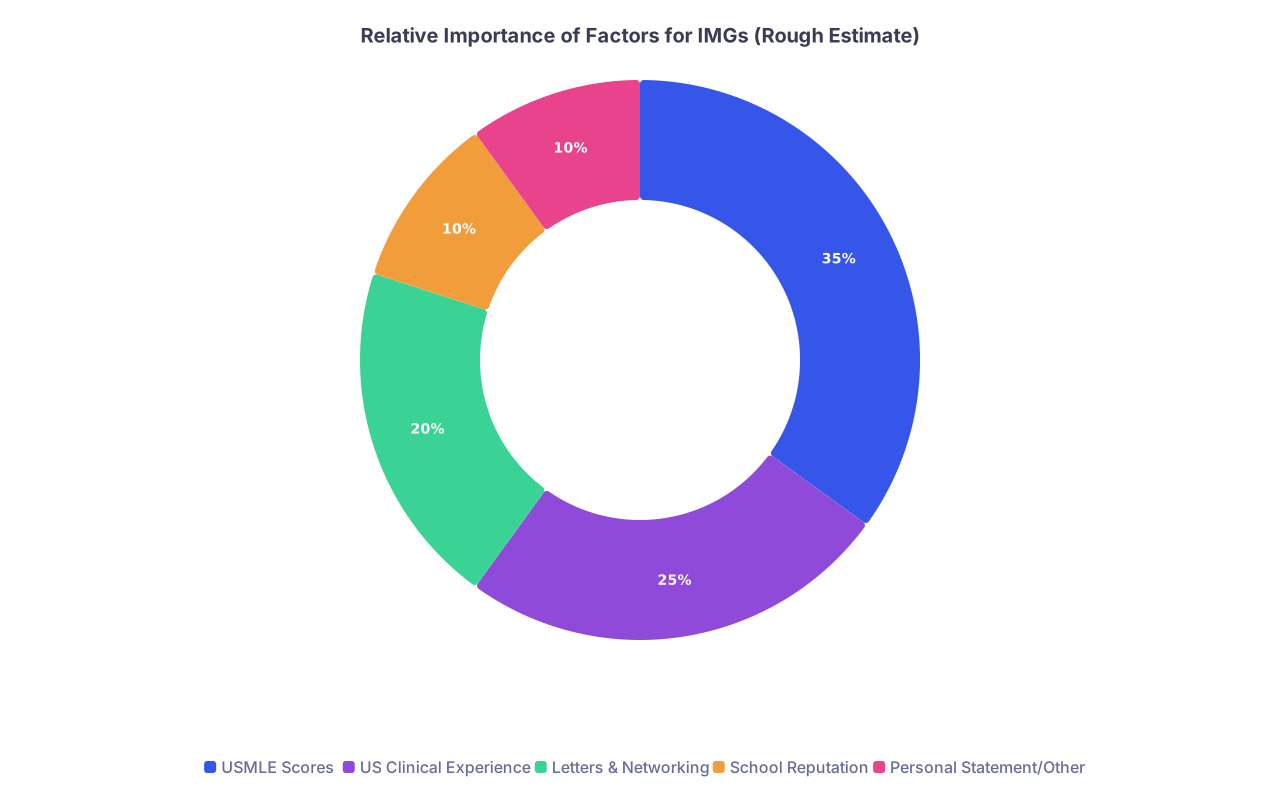
| Category | Value |
|---|---|
| USMLE Scores | 35 |
| US Clinical Experience | 25 |
| Letters & Networking | 20 |
| School Reputation | 10 |
| Personal Statement/Other | 10 |
School reputation is a slice of the pie. A meaningful one. But not half the chart.
When your school name is weaker or unknown, you’re basically forced to inflate the other slices.
What If You’re Already At a Lesser-Known or Caribbean School?
This is where the panic can be suffocating.
You can’t transfer. You’re locked in. And now every random comment online about “Carib grads being doomed” feels personal.
Here’s the cruel truth and the not-so-cruel truth:
Cruel truth:
- Some specialties will be almost closed to you (Derm, Ortho, Plastics, etc.)
- Your margin for error is way smaller
- You’ll be compared to a stereotype you didn’t create
Not-so-cruel truth:
- Matching into IM, FM, Psych, Peds, even some other fields is absolutely possible
- Plenty of residents around the US started exactly where you are
- No program director actually cares what strangers on Reddit think; they care what your attending says about you, what your score looks like, and how you show up
If you’re already at a school with a weaker name, your strategy has to be painfully intentional:
- Aim for specialties where IMGs are common
- Get US rotations early enough to secure strong LORs
- Treat every rotation like a 1-month audition for a future letter or phone call
- Apply broadly and strategically (including community and smaller programs)
You’re allowed to be angry that you have to think this way. But thinking this way gives you a fighting chance.
Bias Is Real. But It’s Not a Death Sentence.
Let me say it straight:
- Yes, there is match bias against IMGs.
- Yes, school name is part of that.
- No, it doesn’t completely determine your fate.
Your school name is your starting position, not your final score.
If you’re at or headed to a school that isn’t famous, it just means:
- You don’t get the automatic “halo effect” some schools enjoy
- You need to build your credibility with numbers (scores), performance (rotations), and people (letters, networking)
- You can’t rely on “average” and pray the name will carry you — because it won’t
If you’re still choosing a school, factor the name in. Heavily. Anyone saying, “All schools are the same, just work hard” is lying or delusional. They’re not the ones whose ERAS will be auto-filtered.
But if your path is already set, obsessing over the label on your diploma won’t move the needle now. What you do from this point forward actually will.
Quick Reality Check Before You Spiral Again
Three things to walk away with:
- School name matters, but it’s one piece — not the entire game. IMG bias is real, but not absolute.
- If you haven’t started yet, choose a school with a proven US match history; if you’re already there, shift focus to scores, US experience, and letters.
- Your application can absolutely overcome a non-famous school — but only if you stop hoping the name will save you and start building the parts that actually change outcomes.


