

What actually happens when two applicants look the same on paper—same Step 2, similar research, similar letters—but one is from a U.S. MD school and the other is from an offshore Caribbean school?
If you think program directors genuinely do not care where you went to medical school, you’re not paying attention to the data—or the way selection committees actually talk behind closed doors.
Let me be blunt: the myth that “school doesn’t matter, only scores and performance do” is comforting. It’s also wrong. Not hopelessly wrong, but wrong enough that it can wreck your planning if you’re an international or premed considering an offshore or lower-tier option.
Let’s walk through what the evidence actually shows.
What Program Directors Say (When They’re Being Polite)
Every few years, the NRMP runs a Program Director Survey. It’s not gossip; it’s one of the few hard windows into how programs claim to make decisions.
Here’s the kicker: “Medical school attended” is explicitly listed as a factor. It’s not invisible. It’s not “we don’t look at that.” They rate its importance.
In many specialties, “type of medical school” and “medical school reputation” fall into the “moderate” importance tier. Not top of the list like Step 2 CK used to be, but absolutely not irrelevant.
When you sit in an actual selection meeting, you hear variations of:
- “She’s from [strong U.S. MD school], they usually prepare people well.”
- “He’s from a Caribbean school—check the transcript carefully.”
- “What’s this school? Anyone know anything about it?”
- “FMG, but from a solid European program, and strong letters.”
That’s not theoretical. That’s how files are actually discussed.
No one says, “We don’t care where you trained.” They just act like they do care. Because they do.
The Match Data That Blows Up the Myth
Let’s stop hand-waving and look at outcomes. If school didn’t matter, then applicants with similar scores and similar profiles would match at similar rates, regardless of where they trained.
That’s not what happens.
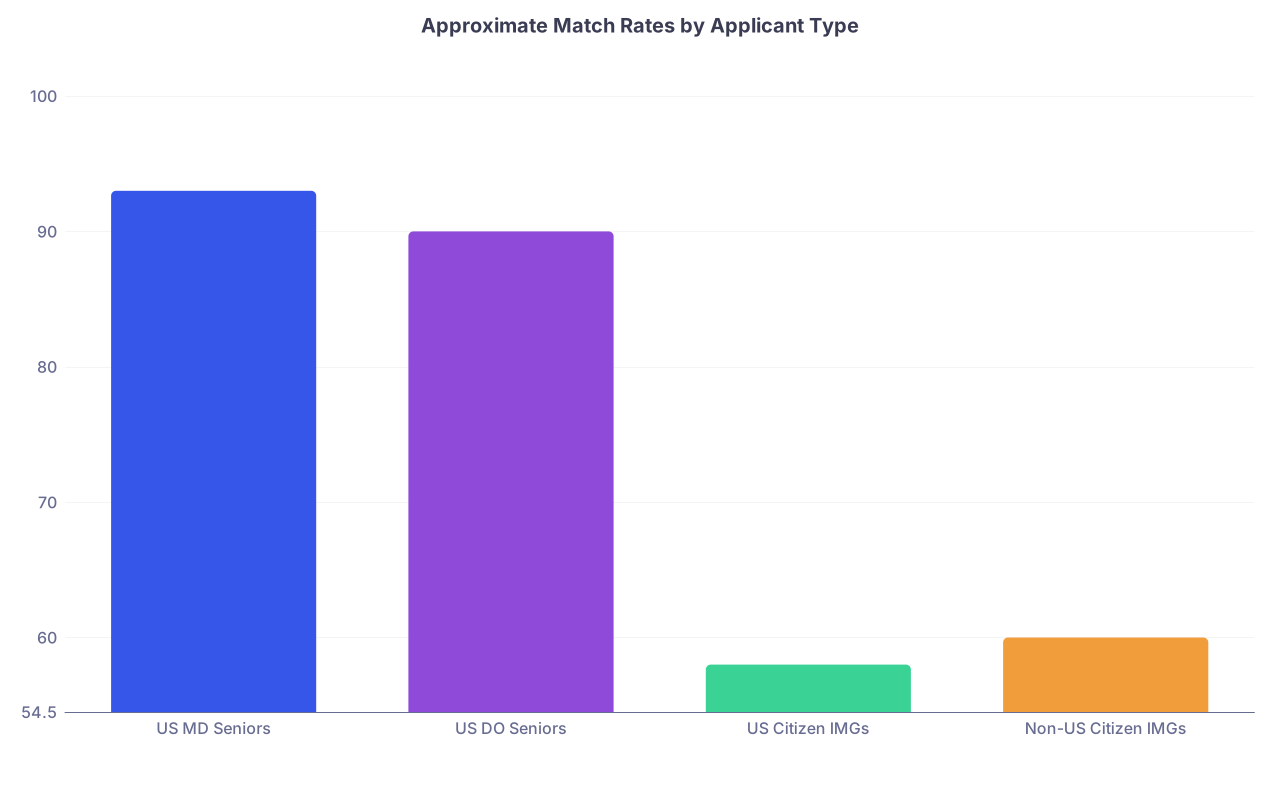
Using recent NRMP data patterns (these numbers shift slightly year to year but the trend is the same):
| Applicant Type | Overall Match Rate |
|---|---|
| U.S. MD Seniors | ~92–94% |
| U.S. DO Seniors | ~89–91% |
| U.S. Citizen IMGs | ~55–60% |
| Non-U.S. Citizen IMGs | ~58–62% |
If program directors truly didn’t care where you went to school, you wouldn’t see a 30–40 percentage point gap between U.S. MD seniors and U.S. citizen IMGs.
You can spin it if you want—say “maybe IMGs have lower scores.” Some do. But even at similar Step scores, IMGs consistently have to be stronger in other ways to get the same outcome. That’s the part people gloss over.
| Category | Value |
|---|---|
| US MD Seniors | 93 |
| US DO Seniors | 90 |
| US Citizen IMGs | 58 |
| Non-US Citizen IMGs | 60 |
Here’s what you’re really up against: the burden of proof is higher if you’re not from a known, trusted U.S. medical school. You are not playing the same game on the same difficulty setting.
Why School Matters to Program Directors (They’re Not Being Evil, Just Risk-Averse)
Most applicants imagine residency selection as this fair, holistic, saintly process. It’s not. It’s an exercise in risk management run by overworked faculty who’ve been burned before.
Why does “where you trained” matter so much? A few very practical reasons.
First: Predictability.
A program director who’s been taking graduates from, say, University of Michigan or UTSW or even a solid mid-tier state school for ten years knows what that product looks like. They know those students have a baseline of clinical exposure, testing support, and professionalism expectations.
With an unknown foreign school—or even a Caribbean school they’ve never worked with—they’re guessing. The curriculum might be good. Or it might be two years of chaotic lecture, inconsistent clinical rotations, and minimal oversight. They don’t have time to run a full investigation for each applicant.
Second: Burn scars.
Every program has stories.
- “We matched a Caribbean grad three years ago, looked good on paper, struggled massively on the wards.”
- “Had an IMG who’d never managed an inpatient service; took months to get up to speed.”
- “Communication issues, professionalism flags, chronic Step failures.”
What happens after that? The PD says, out loud: “We need to be more careful with where our applicants are coming from.” Translation: they start filtering harder by school.
Third: Volume and shortcuts.
Some big programs get 3,000+ applications for 10–20 spots. They can’t read every file in depth. So they build screens.
Sometimes those screens are explicit: “We don’t consider Caribbean schools.” Sometimes they’re more subtle but just as lethal: “We prioritize U.S. MD/DO and selected IMGs from schools we know.”
That’s not “caring about school prestige” in the abstract. It’s ruthless triage.
The Ugly Truth About Caribbean and Lesser-Known Schools
There’s a persistent sales line aimed at desperate premeds: “U.S. residency programs don’t care where you went to school if you have good scores.” This line keeps offshore schools in business.
The data does not back that up.
Here’s the pattern I’ve seen, over and over:
- A premed with a 3.1 GPA and poor advising ends up at a big-name Caribbean school.
- School tells them: “Do well, crush Step, you’ll match just like U.S. grads.”
- Fast-forward: Step 1 is now pass/fail, Step 2 CK becomes the only major numerical filter left.
- Residency programs suddenly have even less objective data to distinguish applicants.
- Guess what becomes more important? School reputation. Clinical evaluations. Letters. Reliability of the training pipeline.
Caribbean schools have another structural problem: their own match rates. Many publish only partial, cherry-picked data. When you see “92% match!” in their marketing, read the fine print: usually that’s “92% of those who applied through our internal system and didn’t disappear.”
The true denominator—the number of people who started at that school and never even made it to a U.S. residency—is far lower.
Compare that with U.S. MD schools, where >90% of seniors match each year in some specialty, often on their first attempt. That’s not “they’re smarter humans.” It’s a system that programs trust.
When School Probably Matters Less (But Still Not Zero)
Let’s inject some nuance. This isn’t “if you’re not U.S. MD, you’re doomed.” That’s also nonsense.
There are scenarios where where you went to med school matters less:
Internal candidates: An IMG doing a research year or observership at a specific program, known to the attendings, with strong in-person performance. The PD might care more about, “Can this person function on our service?” than, “Where is this school ranked?”
Highly valued IMGs: Certain European, Canadian, and some Asian schools have built reputations for producing excellent trainees. If your school has a track record with specific U.S. programs, that helps.
Less competitive specialties and underfilled programs: In rural family medicine, psychiatry at mid-tier community hospitals, or prelim spots, program directors may relax school bias when faced with unfilled positions.
Notice what’s happening in all of those: the local reputation of the applicant or the school can override general suspicion. But it doesn’t erase it entirely.
Step 1 Pass/Fail: School Just Became More Important, Not Less
A lot of students had this fantasy: “With Step 1 pass/fail, programs won’t screen by scores anymore, so everything becomes more holistic and fair.”
Nice story. Reality is harsher.
You took away one of the most powerful, standardized numbers programs used to compare applicants across schools. What’s left?
- Step 2 CK
- School reputation
- Letters (which are subjective and variable)
- Class rank / quartile if reported
- Research/experiences
So if you’re at a lesser-known or lower-trust school, you’ve just had one of your best ways to prove “I can hang with U.S. MDs” de-emphasized. Step 2 still matters, yes, but the halo of “this school’s students consistently do well here” now carries more weight.
If you’re deciding now between, say, a newer Caribbean school and waiting a year to improve your GPA/MCAT for a shot at U.S. DO or an established foreign program with better outcomes, this shift should factor heavily into your decision.
Premeds: How This Should Actually Change Your Planning
You can’t control program director bias. You can control the risk you take on when you pick your medical school.
Here’s the mindset most premeds have: “Any MD anywhere is fine, and if I work hard I’ll get where I want.”
Here’s the mindset you actually need: “The further I get from a trusted, well-known school pipeline, the more I’ll have to overcompensate later.”
That doesn’t mean never attend an international school. It means stop pretending they’re equivalent.
If you’re a U.S. premed considering options, think of the ladders this way:
| Path | Relative Risk for U.S. Match |
|---|---|
| U.S. MD | Lowest |
| U.S. DO | Low–Moderate |
| Established IMG (EU/Canada) | Moderate |
| Big-name Caribbean | High |
| Lesser-known offshore IMG | Very High |
Is this perfect? No. Are there exceptions? Of course. But if you plan based on exceptions, you’re gambling, not strategizing.
For Current IMGs: What You Can Actually Do (Instead of Just Hoping)
If you’re already at an international school, the point isn’t to panic. It’s to be brutally realistic.
Your school does matter in the eyes of U.S. residency directors. So you counter that by building a body of evidence that says: “Ignore the school, look at me.”
That usually means:
- Scoring high on Step 2 CK. Not “average U.S. MD” high. Higher.
- Strategically targeting specialties and programs that historically take IMGs.
- Getting U.S. clinical experience with strong, detailed letters from faculty who know how to write for U.S. programs.
- If possible, doing research or an observership at the specific institution where you want to match.
- Applying smartly—not spamming 200 programs in ultra-competitive fields, but playing the actual odds.
None of that erases the bias, but it can get you past the first round of filters, which is often where school name does the most damage.

| Step | Description |
|---|---|
| Step 1 | IMG in Medical School |
| Step 2 | Excel in Coursework |
| Step 3 | High Step 2 CK Score |
| Step 4 | U.S. Clinical Rotations |
| Step 5 | Strong U.S. Letters |
| Step 6 | Targeted Program List |
| Step 7 | Interviews and Match |
The Quiet Exceptions: Where School Name Really Can Fall Away
I’ve seen this a few times and it’s worth acknowledging.
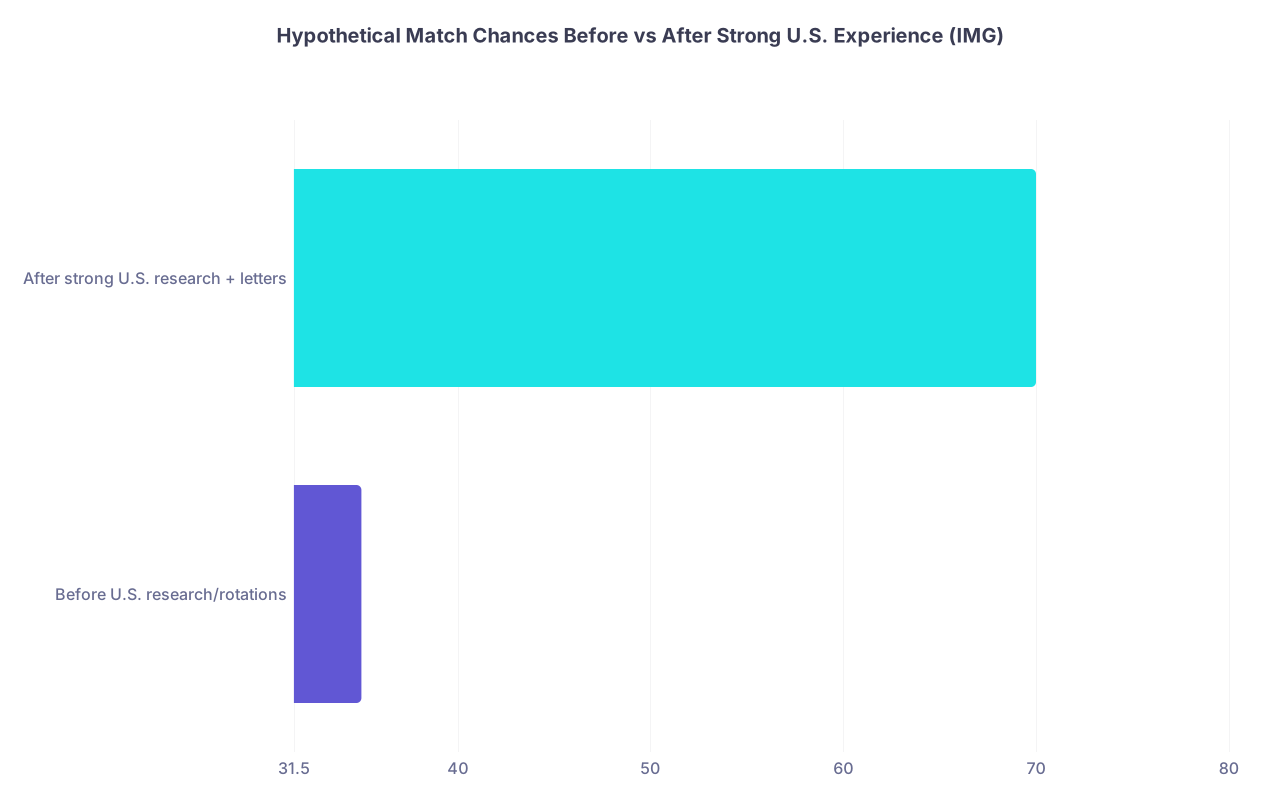
A non-U.S. citizen IMG from a lesser-known Eastern European school shows up, does a research fellowship at a major U.S. academic center, becomes the go-to person in a lab. First author on multiple papers. Everyone on that service knows them. By the time ERAS opens, the PD is saying, “We need to keep this person.”
At that point, the original school name matters a lot less. You’ve essentially rebranded yourself through your U.S. institution.
This isn’t accessible to everyone. It takes time, visas, funding, and frankly luck. But it’s proof that the rule isn’t absolute—it’s just the default. And you only escape the default with a deliberate, uphill strategy.
| Category | Value |
|---|---|
| Before U.S. research/rotations | 35 |
| After strong U.S. research + letters | 70 |
FAQ (Exactly 3 Questions)
1. If I have a 260+ Step 2 CK as an IMG, does my school still matter?
Yes. You’ll clear more filters, get more looks, and overcome a lot of bias, but your school doesn’t suddenly vanish from consideration. Many competitive programs still reserve most spots for U.S. MD/DO. Your score moves you into contention; it doesn’t magically equalize you with every U.S. grad.
2. Are all Caribbean schools the same in the eyes of program directors?
No. Some of the big four (SGU, AUC, Ross, Saba) are better known and more represented in U.S. residencies than small, newer offshore schools. But “better known” is not the same as “treated like U.S. MD.” They’re still viewed as higher risk compared with U.S. schools and high-reputation foreign programs.
3. If I’m a premed with borderline stats, should I take a Caribbean acceptance or wait and reapply in the U.S.?
If you’re aiming to practice in the U.S., it’s usually better to exhaust every realistic path to U.S. MD/DO (including post-bacc, SMP, MCAT/GPA repair, a reapplication cycle) before committing to a Caribbean school. Not because you can’t succeed from there—some do—but because the structural disadvantage is real, persistent, and shows up in the match data every single year.
Key points: Program directors absolutely care where you went to medical school; they just phrase it as “trust in the training pipeline” and “past experience with that school.” Being at a lesser-known or offshore school doesn’t make residency impossible, but it does raise the bar and the risk. If you’re early in the path, treat school choice like a high-stakes, long-term decision—not a detail the match will magically ignore.


