

The idea that going abroad for med school automatically kills your shot at competitive specialties is lazy, half-true advice that scares a lot of smart people into bad decisions.
The truth is harsher and more useful: going abroad does not close doors. It just means those doors are heavier, the hinges are rusty, and you’ll have to push a hell of a lot harder than U.S. grads. Some doors are barely open at all. Others are wide enough if you’re exceptional and strategic.
Let’s strip this down to what the data actually show—and where people are just repeating folklore from 2008.
What Actually Happens to IMGs in the Match
If you’re thinking about an international med school (Caribbean, Ireland, Eastern Europe, etc.), here’s the first reality check: the U.S. residency Match doesn’t care about your feelings, only your numbers.
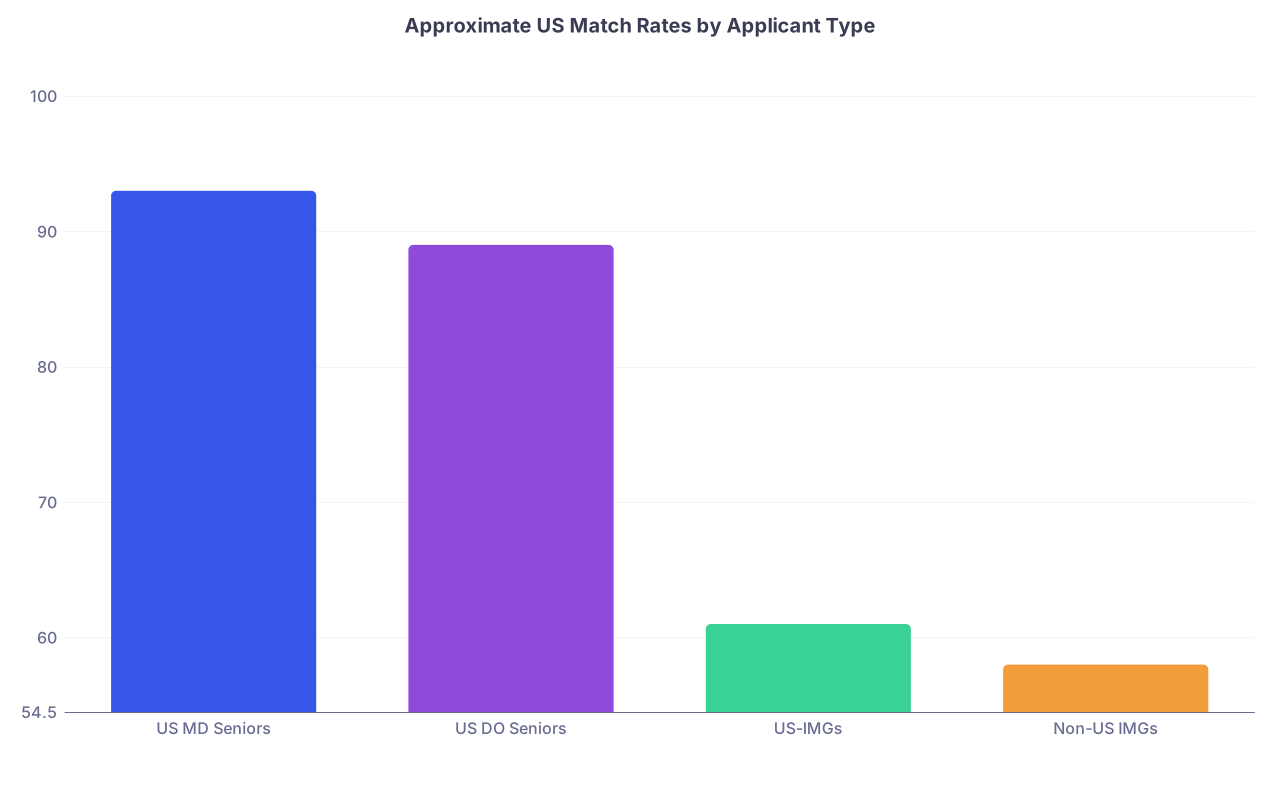
| Category | Value |
|---|---|
| US MD Seniors | 93 |
| US DO Seniors | 89 |
| US-IMGs | 61 |
| Non-US IMGs | 58 |
These are ballpark NRMP numbers from recent years. They wiggle a bit year to year, but the hierarchy is very consistent:
- US MD seniors at the top
- US DO seniors close behind
- U.S. citizens who went abroad (US-IMGs)
- Non-US IMGs at the bottom
So no, going abroad does not mean “you’ll never match.” But you’re stepping into a lower-probability category from day one.
Now, here’s where people get it wrong: they stop at “IMGs match less” and don’t ask the only question that matters for you:
What happens specifically in competitive specialties?
Competitive Specialties: The Door Is Open, But It’s Narrow
Let me be blunt: if your dream is plastic surgery and you’re already planning on leaving the U.S. for school, you’re playing on hard mode with permadeath.
IMGs absolutely do match into competitive specialties—derm, ortho, neurosurgery, ENT, plastics—but the numbers are tiny and almost always involve one or more of:
- USMLE scores in the stratosphere (historically 260+ when Step 1 had a score)
- Strong U.S.-based research, often with dedicated research years
- Personal connections / networking at specific programs
- Often a non-traditional path (prelim years, research fellowships, switching in)
Let’s look at specialty-level trends in broad strokes.
| Specialty | Door Status for IMGs |
|---|---|
| Internal Medicine | Wide open |
| Family Medicine | Wide open |
| Pediatrics | Open |
| Psychiatry | Open |
| Neurology | Moderately open |
| Anesthesiology | Tight but passable |
| EM | Tightening significantly |
| General Surgery | Tight, program-dependent |
| Ortho / Derm / Plastics / ENT / Neurosurg | Nearly closed (but not zero) |
That last row is what everyone means when they say “going abroad closes doors.” They’re overgeneralizing from the most competitive 5–6 fields to all of medicine.
Reality: for the core specialties (IM, FM, peds, psych, neurology), international grads match every year in large numbers. The “closed doors” narrative is flat-out wrong there.
Where it’s mostly accurate is for:
- Dermatology
- Integrated plastics
- Neurosurgery
- Orthopedic surgery
- ENT
- Radiology (getting tighter)
- Certain fellowships later on (derm, interventional cards, some advanced GI, etc.)
But even then, “impossible” is not accurate. “Statistically unlikely unless you’re an outlier and extremely disciplined” is more honest.
The Real Levers: It’s Not Just Where You Go, It’s How You Perform
Here’s what people rarely admit: a lot of premeds using “I’ll go abroad and still do derm” as a narrative weren’t competitive for derm from the start.
You don’t suddenly become a 99.9th percentile applicant by crossing an ocean.
If you go abroad and want any shot at a competitive field, these levers matter more than your passport stamp:
Exam performance (USMLE / COMLEX)
Historically, IMGs who broke into competitive fields had monster Step 1 and 2 scores. Now Step 1 is pass/fail, but Step 2 still matters a lot. For you as an IMG, it matters more.U.S. clinical exposure
Not all “electives abroad” are equal. Doing a cardiology elective at some random hospital no one’s heard of is different from doing sub-Is at U.S. academic centers that actually match people into your target specialty.Research
Especially for derm, radiation oncology, ortho, neurosurgery, and academic internal medicine. This often means:- A research year at a U.S. institution
- Abstracts, posters, and ideally publications with attendings in your target field
- Being known by name by someone on a selection committee
Program targeting and strategy
IMGs who match competitively rarely “spray and pray.” They:- Identify IMG-friendly programs
- Build relationships early
- Sometimes match into a less-competitive field first, then transition later
The Myth of “International School Doesn’t Matter If You’re Strong”
You’ll hear this from older physicians sometimes: “If you’re good, it doesn’t matter where you went.”
That was closer to true 20–30 years ago. It’s not true in the current applicant glut.
Here’s the ugly but accurate breakdown:
Caribbean “Big 4” (SGU, AUC, Ross, Saba):
These schools send many grads into primary care and internal medicine. They also produce some success stories in anesthesia, EM, even occasional surgery subspecialties. But attrition is high, and there’s a large tail of unmatched grads with six-figure debt.Established international schools with U.S. pipelines (e.g., Irish, some UK, some Israeli programs that regularly place into U.S. residencies):
Generally stronger outcomes than random Eastern European or Latin American schools. Still not equivalent to U.S. MD, but better network and structure.Random newer / lower-tier international schools with minimal U.S. track record:
This is where dreams go to die. Little match support, limited U.S. clinical rotation access, and often students don’t realize how disadvantaged they are until M4.
Saying “the school doesn’t matter, only you do” is like saying “the prestige of your law school doesn’t matter for BigLaw.” It sounds meritocratic and feel-good. It’s also false.
The specific school, its U.S. rotation network, USMLE prep support, and historical match list matter a lot—especially if you’re aiming even vaguely north of family medicine.
What the Data Say About Specialty Choices for IMGs
You’ll see this pattern in NRMP data year after year: IMGs cluster in certain fields.
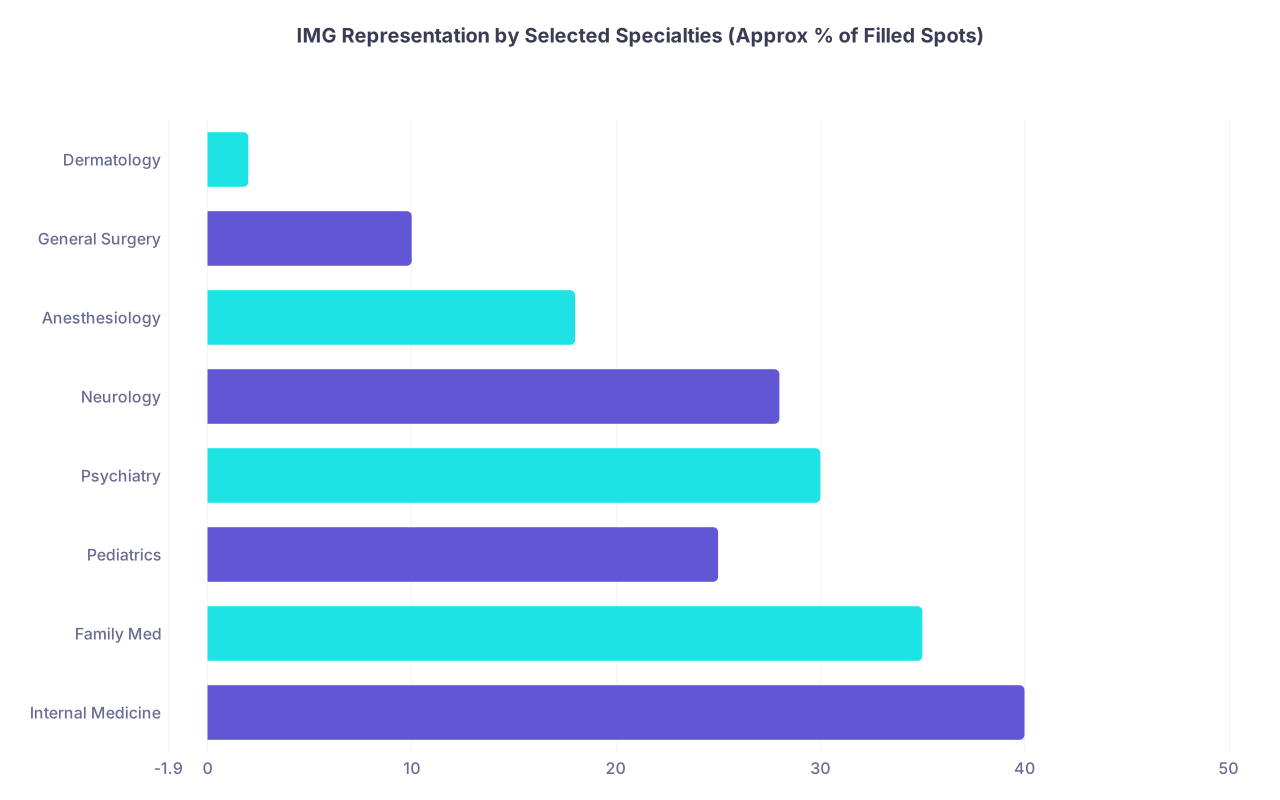
| Category | Value |
|---|---|
| Internal Medicine | 40 |
| Family Med | 35 |
| Pediatrics | 25 |
| Psychiatry | 30 |
| Neurology | 28 |
| Anesthesiology | 18 |
| General Surgery | 10 |
| Dermatology | 2 |
Interpretation:
- Internal medicine is very IMG-heavy. A huge chunk of categorical IM spots go to IMGs.
- Family medicine, psych, and neurology also have strong IMG representation.
- Anesthesia and general surgery: there is a path, but you’re competing uphill.
- Dermatology: IMGs exist, but they are statistical noise compared to U.S. grads.
So does going abroad close doors? To some, yes. To others, no. To internal medicine? Not remotely. To derm? For 98–99% of people, yes.
The Timing Trap: The Biggest Door That Closes Is Actually Flexibility
Here’s the nasty little secret no one tells 21-year-olds signing up for offshore schools:
By going abroad, you’re not just making it harder to get a competitive specialty—you’re making it harder to change your mind later.
U.S. MD/DO vs IMG flexibility:
| Scenario | US MD/DO Grad | IMG |
|---|---|---|
| Switch from IM to Anesthesia | Hard but feasible | Very difficult |
| Pivot into a research-heavy fellowship | Challenging, possible | Requires outlier CV |
| Go into academic medicine at top center | Achievable | Rare, but exists |
| Re-apply after a non-match | Painful but supported | Often devastating |
As a U.S. MD/DO, if you wake up M3 and realize you love ortho, you still have a shot if you’re strong. As an IMG, that window is practically closed unless you’re already an academic monster.
That’s the real “closed door.” Not just derm or ENT. Flexibility.
Common Myths About Going Abroad and Competitive Specialties
Let’s kill a few repeat offenders.
Myth 1: “I’ll just crush the USMLE and I’ll be fine.”
Reality: High scores help, but they don’t erase IMG status. Program directors still have to explain to their committees why they’re taking an unknown-school grad over a U.S. MD with similar metrics.
Also, Step 1 is now pass/fail. Your Step 2 CK will matter, but you’ve lost one major quantitative way to differentiate.
Exceptional scores + strong U.S. rotations + research + networking can overcome IMG status. “I’ll just do great on exams” isn’t a strategy. It’s a wish.
Myth 2: “My cousin’s friend matched derm from a Caribbean school, so it’s definitely possible.”
Sure. Someone also wins the lottery. The fact that one person did it proves that the probability is >0. It says nothing about whether it’s a reasonable plan for you.
You want base rates, not stories.
Myth 3: “If I can’t get into a U.S. MD now, I’ll go Caribbean and come back as competitive as they are.”
If you weren’t competitive for a U.S. MD or DO seat with your current app, the most common outcome abroad is not “return as a competitive derm applicant.” It’s:
- Struggling with a compressed curriculum
- Fighting for limited U.S. clinical spots
- Matching into a less competitive, service-heavy program—if you match at all
Can you outgrow your earlier stats and blossom later? Absolutely. Some people do. But building a plan around being the exception is a brutal way to gamble six figures and 4–6 years.
Who Shouldn’t Go Abroad If They Care About Competitive Specialties?
I’m going to say this plainly.
You probably should not go abroad if:
- Your heart is absolutely set on derm, plastics, neurosurgery, ENT, or ortho
- You’re already a marginal standardized test taker and hate high-stakes exams
- You want maximum flexibility to change specialties later
- You’re not prepared to network aggressively and possibly take extra research years
Those combinations are a setup for long-term regret.
On the other hand, going abroad can make sense if:
- You understand that primary care or internal medicine is your likely outcome
- You’re okay with odds that are worse than U.S. MD/DO, but not catastrophic
- You choose a school with a proven, long-term match record into the U.S.
- You’re realistic about debt, visas (if you’re not a U.S. citizen), and Plan B
Notice what I didn’t say: “Never go abroad.” The absolutist advice is just as wrong as the fairy tales.
How to Keep Doors Open If You Do Go Abroad
If you read all this and still plan to go overseas, fine. Here’s what people who actually succeed tend to do differently:
Pick the school like it’s a job offer, not a vacation brochure.
Look at:- 5–10 year U.S. match lists
- Where those grads match (community vs big academic, which specialties)
- USMLE pass rates, not just “students who sat for it”
Plan your U.S. clinical exposure from day one.
You want:- Core rotations in decent U.S. teaching hospitals if possible
- Sub-Is in the U.S. in your target field
- Letters from U.S. faculty that program directors actually know and trust
Start research early, especially if you’re eyeing anything competitive.
Reach out to U.S. faculty, do remote projects, come in person for summers or a research year. The IMG who matches anesthesia or cards fellowship from abroad usually has a CV that looks like a PhD-lite.Be honest about your trajectory by mid-M2.
If your scores, grades, and feedback are average, recalibrate away from the ultra-competitive fields. Hope is not a strategy. Neither is denial.
The Short Answer: Does Going Abroad Close Doors?
No. It doesn’t “close doors” in some magical, final way.
But it does:
- Lower your baseline odds across the board
- Make the most competitive specialties extremely unlikely
- Shrink your flexibility to change fields later
- Force you to be much more deliberate and better-than-average just to land where a U.S. MD can reach with “solid but not spectacular”
If someone tells you “going abroad is fine, you just have to work hard,” they’re leaving out crucial context. Plenty of people abroad work brutally hard and still end up unmatched or funneled into options they didn’t really choose.
If you decide to go anyway, do it with your eyes open, the data in front of you, and a Plan B that you can live with.
Key takeaways:
- Going abroad does not automatically kill your shot at competitive specialties, but it makes them statistically rare and realistically off the table for most people.
- Core fields like internal medicine, family medicine, psych, and peds remain very accessible to IMGs—those doors are far from closed.
- The real cost of going abroad isn’t just competitiveness; it’s lost flexibility and higher stakes if you change your mind or underperform even slightly.


