
The idea that you can “skip USMLE” and still keep all your licensing options open is a fantasy—marketed hard, and dangerously misleading.
If you’re a premed or early medical student looking at international schools and hearing phrases like “no USMLE strategy,” “USMLE-optional,” or “we focus on local licensing, not the US,” stop. This is where people lose years of their lives and tens of thousands of dollars because they didn’t understand what those words really cost them later.
Let me walk you through the traps, because I’ve watched this movie play out too many times.
1. The First Lie: “You Can Always Take USMLE Later”
Here’s the core problem: by the time you realize you need the USMLE, it may be too late for it to actually help you.
Schools that pitch a “no USMLE strategy” usually say things like:
- “Our graduates work successfully in [country X], you don’t need USMLE.”
- “The USMLE is changing; it’s not necessary anymore.”
- “We prepare you for our national exam instead; if you want USMLE, you can always do that afterward.”
Sounds comfortable. Less pressure. More “flexible,” right?
No. It’s anesthesia before surgery—feels good, but you might not wake up where you expected.
Here’s what they’re not emphasizing:
Timing matters.
USMLE Step 1 and Step 2 CK are not just random exams you can take whenever. The knowledge is front-loaded in preclinical and early clinical years. If your curriculum never aligned with USMLE content, every year that passes makes that exam harder and your chances lower.Residency applications have a timeline.
NRMP Match cycles, Step timing, ECFMG certification deadlines—they’re not built around your school’s “no USMLE” marketing. If you decide in your final year that you want to go to the US, you’re suddenly trying to cram multiple USMLE steps, get US clinical experience, and apply in 1–2 years. Most people can’t pull that off.Some schools don’t have the infrastructure or permission for USMLE.
“You can take it later” sometimes quietly means:
– on your own,
– off your own curriculum,
– with no real institutional support,
– and occasionally with eligibility issues if the school isn’t properly recognized.
A “no USMLE strategy” isn’t neutral. It’s a strategic decision that narrows your licensing and career options. You should only accept that trade-off if you fully understand it. Most applicants don’t.
2. The Credential Trap: School Recognition and ECFMG Status
You can’t talk about US licensing without talking about one acronym: ECFMG.
If your ultimate or even possible goal includes practicing in the United States, your school must meet a few non-negotiables:
- Listed and appropriately classified in the World Directory of Medical Schools (WDOMS)
- Recognized/approved by the local regulatory authority in its home country
- Meeting ECFMG 2024+ accreditation requirements (WFME-recognized accreditation)
Schools that downplay USMLE often also downplay these details. That’s not a coincidence.
Here’s a simple comparison to keep in your back pocket:
| Factor | Green Flag | Red Flag |
|---|---|---|
| WDOMS Listing | Clear MD/MBBS listing, recognized status | Missing, vague, or newly created program with unclear status |
| Local Accreditation | Recognized by national medical council | “Pending” or “special” local status only |
| WFME/ECFMG Pathway | Accredited by WFME-recognized agency | No clear plan to meet WFME standards |
| US Graduate History | Consistent US residencies over years | Few or zero US matches, vague claims |
| Admin Transparency | Clear answers with proof | Evasive, “we’re working on it” responses |
The mistake: students accept “our grads practice successfully worldwide” as proof of US viability. It’s not. A grad working “somewhere in North America” might be in a non-resident, non-licensed role, or in Canada/Caribbean in a very limited scope. Or they matched a decade ago under rules that no longer apply.
If a school is pushing a “no USMLE strategy” but also:
- can’t show recent US matches, and
- is vague about ECFMG, WDOMS, or WFME accreditation,
you should assume that “no USMLE” is less a strategy and more a limitation they’re trying to rebrand.
3. The Country Trap: Local Exams Are Not Global Currency
A lot of “no USMLE” schools sell you on a different prize: “We are optimized for [Country X] licensing exam” (PLAB, AMC, MCCQE, HAAD/DHA, etc).
They’ll say:
- “Our curriculum is focused on the UK system, not the US.”
- “Our grads go to Australia, Canada, or the Gulf—USMLE isn’t needed.”
- “We train for our national exam, which is globally respected.”
Here’s the nasty little secret: almost every destination country has gotten stricter about foreign graduates in the last decade. Not looser.
And just because a country technically allows foreign grads doesn’t mean:
- you’ll get residency spots, or
- the path is realistic as an IMG, or
- the rules will stay the same when you finish.
Let me be blunt: if a school markets itself heavily to international students but its “main” destination country does not have a clear, realistic pipeline for foreign graduates to fully qualify and work long term, that is a massive red flag.
You need to ask:
- How many graduates from my country have actually obtained full licensure in that destination in the last 3–5 years?
- Are those full, independent licenses, or time-limited training contracts?
- Are rules for foreign medical graduates tightening (they usually are)?
If they keep answering with “we have many working successfully abroad” and no numbers or specifics, treat that like a politician’s promise. Pretty. Empty.
4. The Timeline & Exam Saturation Disaster
There’s another detail most premeds ignore: exam fatigue and timing. You are not a machine that can just “add USMLE later” like a software patch.
Look at a realistic exam stack for an IMG chasing a non-USMLE path but later panicking and trying to pivot into the US:
- Local school exams (years 1–5/6)
- Local/national licensing exam (if required)
- Possibly language exams (IELTS/OET for UK/Aus, etc.)
- Then, after graduation:
– USMLE Step 1 (after being away from preclinical content for years)
– USMLE Step 2 CK
– Maybe OET/TOEFL for US programs that require English proof
– Research, clinical electives, etc.
By the time many of these students decide “I need the US option,” they’re already:
- exhausted,
- older (29–32+),
- juggling jobs or family responsibilities,
- and trying to revive long-dead biochemistry and pathology.
On paper it’s possible. In real life, very few pull it off well enough to be competitive.
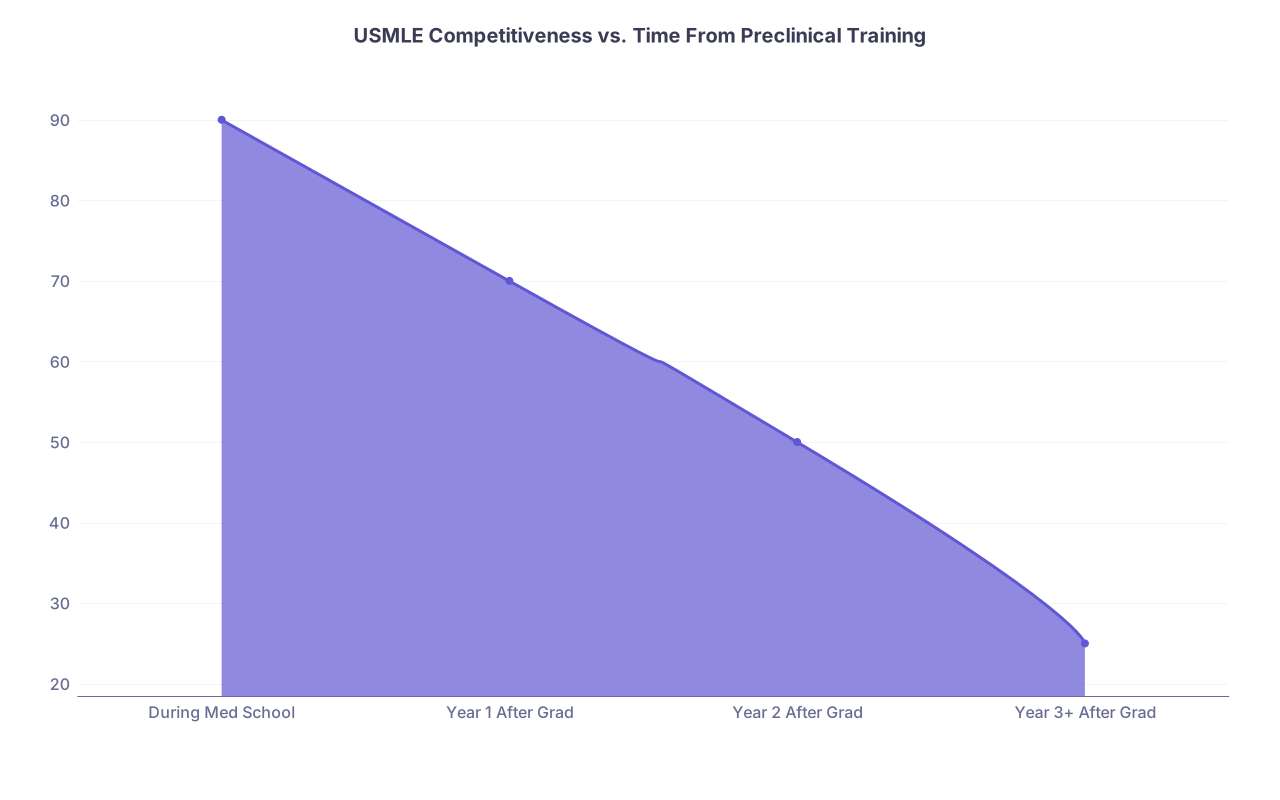
Here’s a rough visualization of what happens to your window of opportunity the later you decide to care about USMLE:
| Category | Value |
|---|---|
| During Med School | 90 |
| Year 1 After Grad | 70 |
| Year 2 After Grad | 50 |
| Year 3+ After Grad | 25 |
That drop-off isn’t official data; it’s reality from watching scores and success rates. Knowledge decays. Life gets complicated. Motivation dies.
If you’re even considering the US, embedding a “no USMLE strategy” into your school years is basically betting that:
- you’ll never change your mind,
- every other country will keep doors open,
- and nothing in your life will push you toward wanting a US option.
People are terrible at predicting that. You will not be the exception.
5. The Curriculum Problem: Not All MDs Are Built for USMLE
Here’s something that rarely gets spelled out: some international schools are structurally incapable of preparing you for USMLE—even if they claim they “support” it.
Warning signs:
- Very few or no USMLE-style questions in exams
- No dedicated Step 1/Step 2 CK prep periods built into the schedule
- Faculty who clearly have never taken or seriously taught USMLE content
- Administration that keeps saying “students who are motivated can do it themselves”
I’ve seen this live: students at a Caribbean or Eastern European school trying to prep for USMLE Step 1 using First Aid and UWorld, while their school exams test random minutiae not even remotely aligned with USMLE objectives. So they’re juggling two separate curricula, neither done well.
If you’re choosing between a “no USMLE strategy” school and a school that:
- explicitly integrates USMLE-style teaching,
- tracks USMLE outcomes,
- has faculty who understand the exam,
you’re not just choosing comfort vs stress. You’re choosing between:
- a degree that’s structurally compatible with multiple licensing systems, and
- a degree that’s welded to a very narrow set of options.
Choosing the second one because it sounds easier is how you wake up at 30 with a medical degree that doesn’t translate where you want to live.
6. The Marketing Red Flags: How Schools Spin “No USMLE”
Let’s call out the classic phrases that should ring alarm bells.
Watch for these lines in brochures, webinars, or “advisors” presentations:
“We focus on training caring physicians, not test-takers.”
Translation: Our students don’t perform well on standardized exams.“Most of our grads choose to stay and serve locally, not chase US residencies.”
Translation: They can’t get US residencies, so we reframed it.“USMLE is only one path; our curriculum emphasizes real clinical skills.”
Translation: We won’t invest in what’s needed to produce competitive USMLE scores.“Our graduates are eligible to sit for licensing exams in multiple countries.”
Translation: Eligibility ≠ realistic success or actual licensure rates.“We have a special relationship with hospitals abroad.”
Ask: Which hospitals? Are those observerships, electives, or real training posts?
If you hear those lines and they’re paired with:
- no hard data on USMLE pass rates,
- no specific lists of where grads matched in the US (with years and specialties),
- vague claims about “many countries,”
you’re being sold a story, not a strategy.
7. How to Pressure-Test a “No USMLE Strategy” School
If you still want to consider such a school, fine. But don’t walk in blind.
Here’s how to test whether the “no USMLE” angle is a thoughtful choice or a mask for weak outcomes.
Ask these questions directly (in writing if you can):
“How many graduates from the last 5 years have:
- Obtained ECFMG certification?
- Matched into US residencies? (List programs and specialties.)
- Gained full licensure in [target country]?”
“Are you accredited by a WFME-recognized agency? Which one? Since when?”
“Are there dedicated USMLE prep resources integrated into the curriculum?
- Protected study periods?
- Faculty who teach specifically for USMLE?
- Historical first-time pass rates?”
“Do you have formal agreements for clinical rotations in the US, UK, or other countries?
- Are these observerships or hands-on clerkships?
- How many slots per year?
- How are they allocated?”
Then watch how they respond.
If they:
- Avoid numbers
- Give only percentages without sample sizes (“80% do well on licensing exams!”)
- Offer testimonials instead of data
- “Don’t have that info right now”
you have your answer. They’re hiding a weak track record.
8. The Bait-and-Switch: Changing Rules Midway
One more nightmare scenario I’ve actually seen:
- Student enrolls at a “no USMLE strategy” school in Year 1
- School is “working on” US affiliations, ECFMG issues, or accreditation
- Midway through their education, regulations change—ECFMG tightens WFME rules, or the home country alters recognition standards
- Suddenly:
- USMLE eligibility is complicated or blocked
- Clinical rotation options abroad disappear
- Graduates face new licensing hurdles their seniors never had
The student says, “But admissions told me…”
The dean shrugs. Regulations changed. Not their problem.
You must assume regulations will get stricter while you study, not easier. So if the school is already on shaky ground with recognition and US/UK options, imagine what five years of tightening rules will do.
Choosing a school that’s barely or not yet aligned with WFME, ECFMG, and major destination requirements is gambling that the regulatory trend of the last decade will magically reverse just for you. That’s delusional.
9. When a “No USMLE Strategy” Might Be Acceptable
Let me be fair. There are a few narrow scenarios where a “no USMLE” approach isn’t instantly insane.
Examples:
- You’re a citizen of Country X, firmly committed to living there permanently.
- The school is well recognized by your national medical council.
- Your country has a stable, structured pathway for local grads to residency and licensure.
- You have zero interest in the US, UK, Canada, or Australia. Not even as a “maybe.”
Even then, I’d still want:
- WDOMS listing that looks solid
- Clear, stable licensing pathways at home
- Honest data on residency placement in your own country
But let’s be honest: many premeds now say, “I think I’ll stay local” because they’re 18–20 and can’t imagine moving continents. Then 8 years later they’re married, burned out, or facing terrible local job markets and suddenly wish they had the US as a safety net.
If that might be you—and it might—then a school whose entire pitch is “you don’t need USMLE” is dangerous.
10. Concrete Mistakes to Avoid (So You Don’t Regret This at 30)
Let me condense this into the actual errors that blow up people’s futures:
Choosing a school just because it sounds “easier” than a USMLE-focused one.
You are not buying comfort. You’re trading optionality for short-term relief.Believing marketing phrases instead of demanding hard data.
“Worldwide opportunities” means nothing without a list of where graduates are fully licensed.Ignoring ECFMG/WFME status because “I may not want the US anyway.”
You have no idea what future-you will want. Don’t cement that decision at 19.Assuming multiple licensing exams (local + USMLE + others) is realistically doable after graduation.
Most people do not have the stamina or time for that.Betting on countries whose policies for foreign grads are tightening every year.
UK, Canada, Australia, Gulf states—none of these are getting easier for IMGs.Not checking how aligned the curriculum is with any international exam standard.
A siloed, idiosyncratic curriculum locks you into one narrow system.
11. A Simple Decision Rule Before You Enroll
Before you sign anything or wire a deposit to an international school that pitches a “no USMLE strategy,” force yourself to answer this honestly:
“If my home country job market collapses or politics change, and if the UK, Canada, Australia, and Gulf become even harder for IMGs, will I be okay never having the US as a serious option?”
If the answer is “I’m not sure” or “that would really scare me,” then you have no business at a school that doesn’t take USMLE and global recognition seriously.
You don’t have to love tests. But you cannot pretend they don’t exist.

| Step | Description |
|---|---|
| Step 1 | Considering Intl Med School |
| Step 2 | Require USMLE-Friendly School |
| Step 3 | Verify Strong Local Path Only |
| Step 4 | Lower Long-Term Risk |
| Step 5 | High Risk: Avoid or Rethink |
| Step 6 | Still Check Recognition & Outcomes |
| Step 7 | US/Global Option Important? |
| Step 8 | Future Change Possible? |
| Step 9 | School Has ECFMG/WFME, USMLE Track, Data? |
Key Takeaways
- A “no USMLE strategy” is not a neutral preference; it usually signals narrow licensing options and weak international outcomes.
- If there’s any chance you’ll want the US—or simply want flexibility—pick a school with solid recognition, ECFMG/WFME alignment, and a real USMLE track record.
- Do not trust marketing language without hard numbers on accreditation, exam pass rates, and actual graduate licensing destinations; your future self will pay for any shortcuts you take here.


