

The fantasy that you can “do it all” perfectly—ace an overseas med school and be fully present for every family need back home—is a lie.
You can’t. And the sooner you accept that, the better decisions you’ll make and the less guilt will eat you alive.
This is about managing family obligations realistically while you’re thousands of miles away in a demanding overseas medical program. Not theory. Not “self-care” posters. What actually works when it’s 3 a.m., you’ve got an anatomy exam tomorrow, and your mom is texting you updates from the ER about your grandfather.
If you’re planning to attend, or already enrolled in, a distant international medical school (Caribbean, Eastern Europe, Asia, etc.) and you’ve got real family responsibilities—ill parents, younger siblings, financial support, single-parent household—here’s how to handle it without burning yourself or your career down.
Step 1: Get Brutally Clear on Your Non‑Negotiables
Do this before you get on the plane, if possible. If you’re already overseas, do it now.
You need to decide: what exactly counts as a level of family obligation that justifies you blowing up your study schedule, missing class, or flying home?
Vague ideas like “family comes first” will destroy you in med school. You need categories.
Start with three buckets:
- True emergencies
- Serious but non-urgent issues
- Routine / emotional needs
Let’s make that concrete.
| Category | Examples | Typical Response |
|---|---|---|
| True Emergency | ICU admission, major surgery, death, life-changing diagnosis | Consider flying home, notify school |
| Serious / Non-Urgent | Worsening chronic illness, financial crisis, sibling school issues | Schedule calls, problem-solve remotely |
| Routine / Emotional | Loneliness, minor disagreements, minor health issues | Regular check-ins, boundaries around exams |
You and your closest family (whoever you actually talk to regularly) need to agree—out loud—what goes in each category.
Example conversation with your parent:
“If someone is in the ICU, dies, or is going into a big surgery with major risk, I want you to call me immediately, no matter what time. If it’s something like your blood pressure slightly up, or a routine doctor appointment, text me and we’ll talk during our regular call time. I’m not ignoring you; I’m protecting school so I can actually finish this and help long term.”
If you don’t do this, everything will feel like an emergency, and you will drown.
Step 2: Build a Communication System That Doesn’t Derail Your Study Life
Random calls, panic texts, and WhatsApp novels will shred your concentration and your anxiety.
You need a system. Simple, predictable, and explicit.
Set Default Call Windows
Pick 2–3 regular times per week when you’re available for longer calls, adjusted for time zones.
Example:
- Wednesday: 30–45 minutes
- Saturday: 1 hour
- Sunday: 30 minutes
Tell your family:
“These are the times I’m definitely available for a proper call. Outside of these, I may be in class or in the library. If it’s urgent-urgent, call twice in a row and I’ll step out if I can.”
Set these times around lighter academic blocks, not right before major exams.
Use a Simple “Urgency Protocol”
Create a very low-tech triage method so they don’t feel ignored and you don’t get yanked from studying every 10 minutes.
Here’s a system that actually works:
- 1 text: “Call when free” = low urgency
- 2 missed calls in a row or “911” text = call ASAP
- Photos / documents sent = for next scheduled call
And then hold the line. If they abuse the “911” signal, you address it calmly:
“When you use the emergency signal for non-emergencies, I start ignoring it. Then I might miss something real. We can’t do that. Let’s keep 911 for serious things only.”
You’re training the system, not scolding your family.
Step 3: Decide Now When You Will and Will Not Fly Home
The worst decisions happen when you’re in shock, half-awake at 3 a.m., and you get a call that someone’s in the hospital.
You need a pre-decided framework so you’re not starting from zero in crisis mode.
Ask yourself:
- For which events will I definitely fly home if at all possible?
- For which events will I probably not fly home, even if it hurts emotionally?
- What exam blocks / semesters are essentially “no-fly” zones unless it’s life-or-death?
For many students, the “definitely” list includes:
- Death of a first-degree relative (parent, sibling, sometimes grandparent who raised you)
- Major surgery with high risk (e.g., CABG, neurosurgery for parent)
The “probably not” list might include:
- Gradual decline of a chronically ill relative
- Death of a more distant relative
- Non-critical surgeries
Cruel? Sometimes. But you’re not a teleporter. You’re a med student with limited money and attendance policies, on a path that ultimately helps your family more long-term.
Spell this out to your family before you leave:
“There might be things that break my heart but I still won’t be able to come home for, especially during exam blocks. It doesn’t mean I don’t care. It means if I break this program, I lose the chance to help everyone for the next 30 years.”
You’re not asking permission. You’re setting expectations.
Step 4: Create a Support Network There And Here
Being the “responsible one” in your family is a trap when you leave the country. You cannot be the primary responder from 7,000 miles away.
You need two support networks:
- On the ground near your family
- On the ground where you’re studying
Near Your Family
Map out people who can physically show up when stuff happens:
- Local relatives
- Close family friends
- Neighbors who’ve known you for years
- Your family’s primary care doctor or social worker
And then you make it official. You talk to them before you leave:
“If something happens with my mom, can I list you as the person to check in on her? I’ll handle as much as I can financially and logistically, but I need someone who can physically be there.”
You also set up:
- Shared group chat for updates (e.g., “Family Health Updates”)
- Clear responsibilities: “Uncle Raj is point person for getting to the hospital if needed. Aunt Lila helps with rides.”
Do not just assume people “will help.” Get explicit yeses.
Near Your Med School
You need 3 types of people:
- One admin contact (dean of students / student affairs)
- One faculty member who knows your name and situation
- 2–3 classmates you trust
Why? Because when something hits the fan—death, emergency back home—you don’t want to be cold-emailing a generic office address.
Tell at least one person in student affairs your situation early:
“I’m an international student and the oldest child in a single-parent family. My mom has [condition]. I manage some responsibilities at home. I’m committed to this program, but if serious events happen, I may need guidance. Is there someone I can reach out to if there’s a family emergency?”
This is not weakness. It’s risk management.
Step 5: Get Your Money and Legal Stuff in Order Before You Go
If you’re even partially responsible for your family’s finances, you can’t wing this.
You need:
- A way to send money quickly
- A way to manage critical documents
- Clarity on medical and legal decision-makers
Financial Setup
Minimum:
- Online banking with international access
- A backup person on your accounts if you trust them (or at least power of attorney for specific emergencies)
- A realistic monthly amount you can send home without destroying your own survival
Do not commit to “I’ll send whatever you need every month.” That’s how you end up skipping meals and extra resources you actually need for board exams.
Instead:
“I can realistically send $X per month regularly, and up to $Y extra in emergencies. If something huge happens, we’ll re-evaluate, but we can’t build the family budget on imaginary money.”
Medical / Legal Decisions
If you currently function as the “mini adult” in your household, you may think everything needs to go through you. That doesn’t work overseas.
Make sure:
- Someone is clearly designated as medical decision-maker for ill relatives (healthcare proxy / POA where applicable)
- Critical documents are scanned and stored securely where you and a local relative can access them
If you’re the legal decision-maker but overseas, tell the treating doctors explicitly when major issues arise:
“I’m the official proxy but I’m overseas. Here’s my number. Please make sure my [relative at home] is looped in on all updates and decisions. They can physically be there for signatures and logistics.”
Step 6: Time Zones, Rotations, and Reality
Time zones will mess you up if you don’t plan around them. You’ll either be sleep deprived from 2 a.m. calls or emotionally absent.
Map it out.
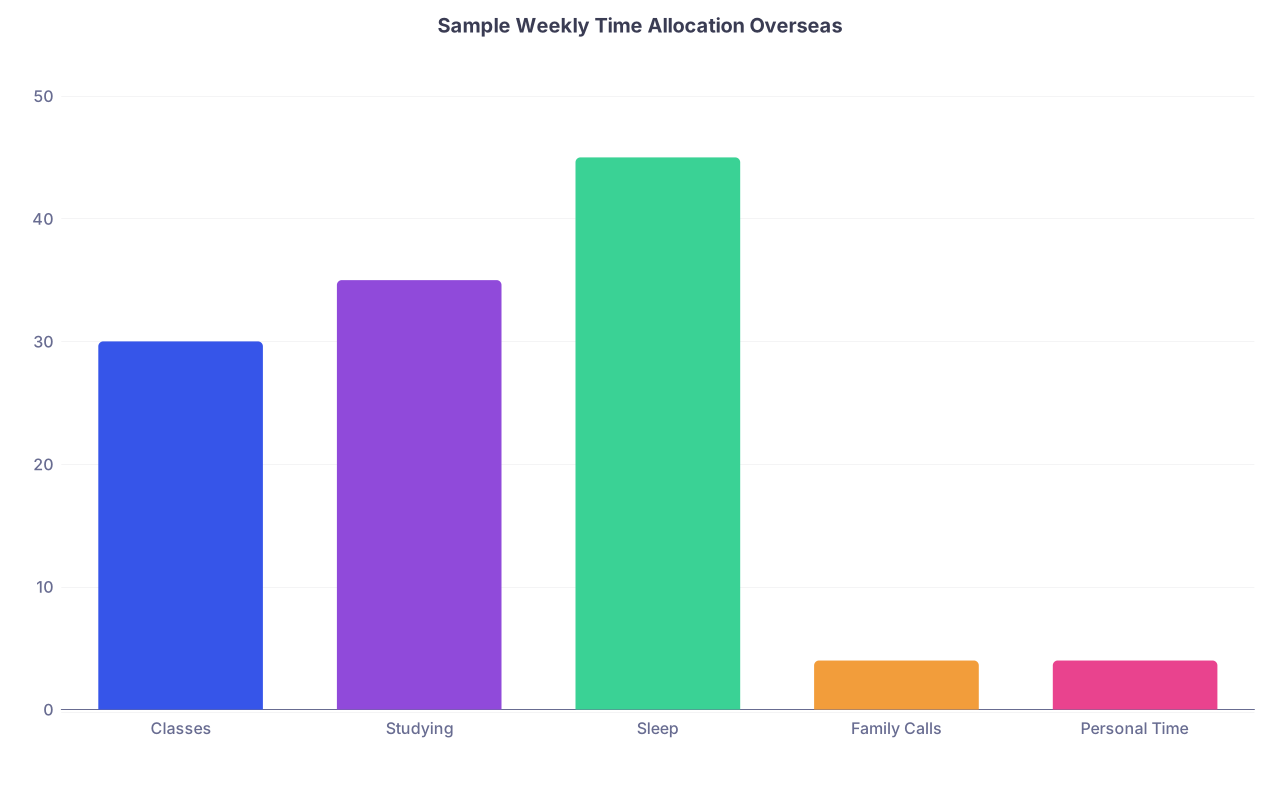
| Category | Value |
|---|---|
| Classes | 30 |
| Studying | 35 |
| Sleep | 45 |
| Family Calls | 4 |
| Personal Time | 4 |
Look at when your family is awake versus your class and study blocks. Then you choose:
- Are your primary calls morning your time, evening theirs?
- Or vice versa?
If your family is in North America and you’re in Eastern Europe, early evening your time is morning for them. That’s usually workable.
Where it gets ugly is clinical years (if you’re doing some rotations locally overseas before US/Canada/UK rotations). Your hours become chaotic. You’re on call. Your schedule stops being your own.
So you adjust the expectations again:
“Pre-clinical years I can usually call at [times]. When I hit clinical rotations, my schedule will get unpredictable. Let’s plan that I’ll text daily or almost daily, but calls might be more flexible, mostly on my post-call days or weekends.”
You re-negotiate as your life changes. Otherwise, resentment builds because “you used to call more.”
Step 7: Handling Guilt Without Letting It Run Your Life
You will feel guilty. About missing birthdays. About not being there for a hospital visit. About your younger sibling saying, “I wish you were here.”
Feeling guilty doesn’t mean you’re wrong. It just means you care.
Here’s what you do with that guilt:
Translate some of it into structured presence
- Short daily voice notes
- One thoughtful message after big events (“How was your appointment? What did the doctor say?”)
- Occasional small surprise gestures (food delivery back home, a gift, a letter)
Kill the fake guilt
Ask yourself for each situation:- Was this truly within my control?
- Did I break a promise, or am I just not superhuman?
- Would I advise another med student in my situation to drop everything?
If you wouldn’t judge another student, stop crucifying yourself.
Step 8: Be Honest About When Med School Might Need to Pause
This is the nuclear option. But it’s real.
Sometimes the situation at home is so bad—both parents critically ill, you’re literally the only caregiver, catastrophic event—that grinding through an overseas med program might not be the right call at that time.
That does not mean you “failed.” It means life threw a truck at you.
Cases where a pause or LOA (leave of absence) is reasonable:
- You are the only possible caregiver for a parent or sibling and there is no one else, period
- Massive financial collapse where your presence at home changes the outcome
- Severe deterioration in your own mental health from trying to do both
If you reach this threshold, you do not just ghost your program. You talk to:
- Student affairs / dean of students
- Financial aid office (if applicable)
- Your trusted faculty member
And you say something like:
“I’m deeply committed to finishing, but my home situation has become [brief description]. I need to explore a possible leave of absence or structured plan so I don’t fail out and burn every bridge. What options exist?”
I’ve seen students do a 6–12 month LOA, stabilize family issues, work some, then come back and crush it. I’ve also seen people try to white-knuckle everything and end up failing semesters, losing visas, and tanking their chances of residency.
Pride is expensive.
Step 9: Protect Your Own Health Like You’re Your Patient
If you crash, everything else crashes.
Overseas med school + constant family stress is a perfect recipe for:
- Insomnia
- Anxiety / panic attacks
- Depression
- Burnout by third semester
You’re not going to therapy your way out of systemic pressure, but you can do a few concrete things:
- Identify one mental health support resource near school (campus counseling, local therapist who speaks your language, or telehealth across borders if allowed)
- Set a minimum standard: 6 hours of sleep, most nights. Non-negotiable during non-exam weeks.
- Move your body at least 3x/week. I don’t care if it’s push-ups in your dorm.
And when you start thinking: “I can’t complain because my family has it worse,” stop. Pain isn’t a competition. If you disintegrate, you stop being useful to anyone.
Step 10: Bring Your Family Into the Mission—Without Letting Them Run It
If your family sees med school as the thing that “stole you,” they’ll resent it. If they see it as their long-term project too, they’re more likely to protect it.
Talk to them like adults:
“I’m doing this so in 10 years we’re not constantly in crisis about money and healthcare. I need your help protecting this path, even when it sucks in the short term. That might mean I miss some things I wish I could be there for. But this is how we change our long-term situation.”
You’re not begging. You’re inviting them into a shared sacrifice.
Then you show them progress. Photos of your white coat ceremony. Messages like:
“We just finished cardiology. I finally understand all the meds you’re taking.”
That transforms your absence into an investment, not an abandonment.
A Quick Reality Check: Overseas Adds Extra Friction
Being at a distant international med school carries added complications beyond family:
- Visa restrictions
- Expensive last-minute flights
- Academic calendars slightly out of sync with US/Canada holidays
- Sometimes weaker school support infrastructure
Plan for that.

| Step | Description |
|---|---|
| Step 1 | Family Event |
| Step 2 | Contact Dean & Family Weigh Options |
| Step 3 | Book Flight if Financially Possible |
| Step 4 | Support by Calls, Money, Local Helpers |
| Step 5 | Life-threatening or Death? |
| Step 6 | Exam Block or Critical Rotation? |
| Step 7 | Can Support Remotely? |
| Step 8 | Only Caregiver? |
You won’t always choose perfectly. But a framework beats panic.
What You Should Do This Week
Even if you’re months away from flying out, you can start tightening this up now.
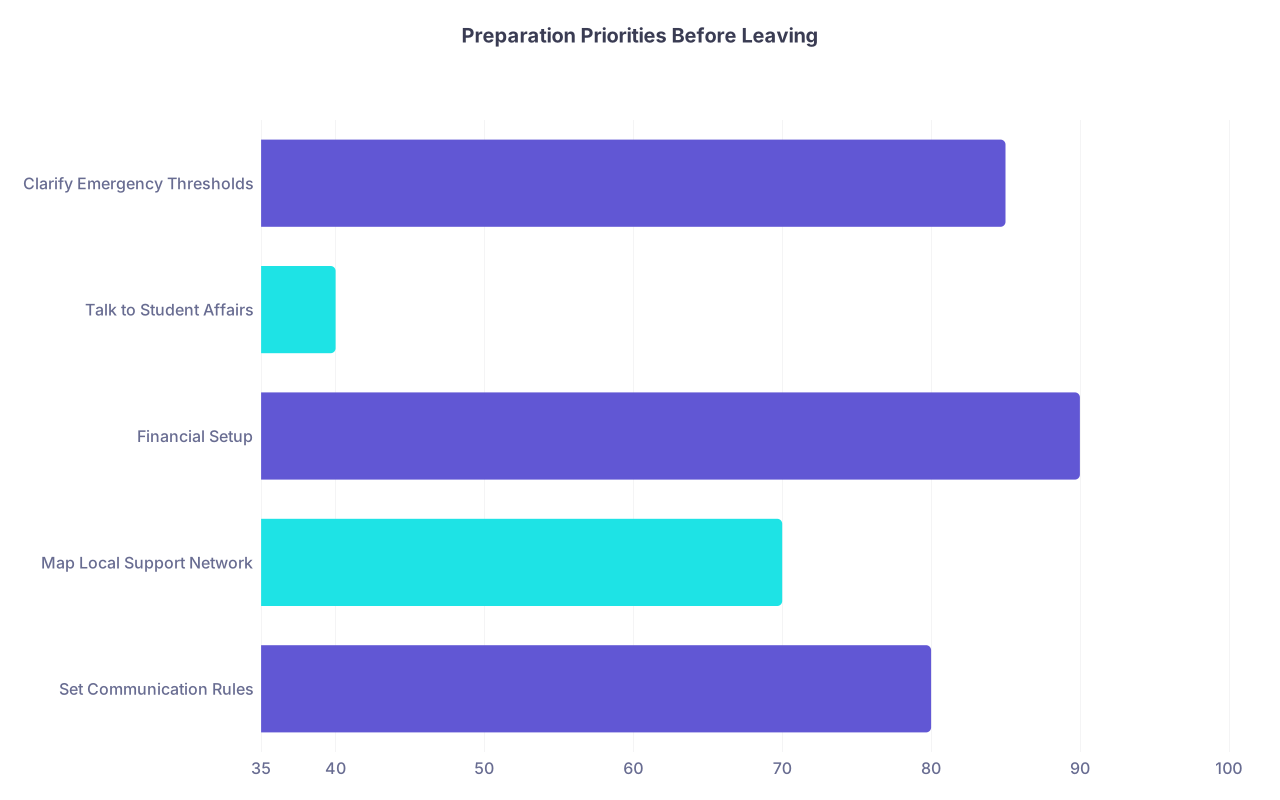
| Category | Value |
|---|---|
| Set Communication Rules | 80 |
| Map Local Support Network | 70 |
| Financial Setup | 90 |
| Talk to Student Affairs | 40 |
| Clarify Emergency Thresholds | 85 |
Focus on the top three: money setup, communication rules, emergency thresholds. Then layer the rest.
FAQ (Exactly 3 Questions)
1. What if my family guilt-trips me every time I can’t immediately respond or come home?
You call it out calmly, and you separate feelings from decisions.
Example response:
“I hear that you’re hurt and that you miss me. I miss you too. But we already agreed that I can’t come home for non-emergencies during exam blocks. If I break that, I risk failing and losing everything I’ve worked for. I’m willing to talk more often after this exam, but I can’t change my decision about this week.”
If they keep pushing, shorten the conversation instead of arguing. “I love you, I have to go study now. Let’s talk on [day/time], okay?” Then stick to it. Over time, consistent boundaries retrain the dynamic more than one perfect speech.
2. Should I tell my med school everything about my family situation, or will that make me look weak?
You don’t need to dump your life story on admissions or every professor. But someone in a position of authority should know the basics.
Share enough to explain potential disruptions:
“I’m an international student and help manage care for a chronically ill parent back home. I’m fully committed to this program, but I want to know what structures are in place for students who have occasional serious family emergencies.”
That’s it. You’re not asking for special treatment every week. You’re establishing context and opening a channel. When something serious happens, you’re not just “the student who suddenly disappeared”; you’re the student with a documented situation asking for structured options.
3. Is it selfish to prioritize my studies over being physically there for my family right now?
No. It’s strategic. There’s a difference between abandoning your family and making a time-limited sacrifice to build a future where you can actually help.
Selfish would be: blowing money on nonsense, ignoring calls for weeks, refusing any responsibility, using med school as an excuse to disappear. That’s not what you’re describing.
You’re talking about missing some events, managing things from a distance, and building a career that will give you:
- Stable income
- Healthcare knowledge
- Long-term power to support them
That’s not selfish. That’s painful, adult prioritization.
Open a blank document or notes app right now and write down three things:
- Your definition of a “true emergency” that would justify flying home
- The regular weekly time slots you’ll offer your family for calls
- The names of 2 people near your family and 2 people at your future school you can loop in as your support team
That’s your starting blueprint. Everything else you refine as you go.


