

You’re in an airport with a one‑way ticket back home and way too many thoughts in your head.
You left an international medical program (or premed pathway) earlier than planned. Maybe it was after a brutal first semester. Maybe you lasted a year or two and finally hit a breaking point. Or you got dismissed. Or your family situation blew up and staying wasn’t an option.
What you know:
You’re going home.
What you don’t know:
What the hell happens next.
This is for that exact moment. You’re not trying to debate whether international med school is “good or bad” in theory. You’re on the ground, plans blown up, and you need a new plan that isn’t just vibes and panic.
Let’s rebuild it, step by step.
1. First Week Back: Stabilize and Get the Facts
Forget the long‑term plan for a moment. Your first job is not “fix your entire career.” It’s stabilize, collect information, and stop making blind decisions.
A. Control the story before it controls you
You do not owe everyone a TED Talk about why you left.
Decide on a short, honest, controlled explanation you can use with:
- Family
- Friends
- Professors/advisors back home
- Future applications
Something like:
- “The program’s curriculum and support structure weren’t a good fit for me, and after serious consideration I decided the best move for my long‑term career was to return and reassess my options.”
- “There were major issues with [mental health/family situation/finances], and staying wasn’t sustainable. I came back to stabilize and build a better path forward.”
Short. Honest. Not self‑destructive. You can add detail when it really matters (personal statements, interviews), but you need a default story now so you don’t babble out of anxiety.
B. Document everything before you forget
Within the first week or two back, while it’s still fresh, write down:
- Exact dates you enrolled and left
- Courses completed, grades, exam attempts
- Any official communications (dismissal letters, LOAs, emails about your status)
- Reason(s) you left, from your point of view
Save all:
- Transcripts
- Acceptance letters
- Program handbooks (especially grading/dismissal policies)
- Emails about your status
You’ll need this later when schools ask, “Have you ever matriculated at a medical school or health professions program?” and “Explain the circumstances.”
C. Get clarity on your official status
You need to know exactly how your prior school classifies you:
- Voluntary withdrawal
- Academic dismissal
- Administrative withdrawal (e.g., non‑payment, visa issues)
- Leave of absence
If it’s not clear, email the registrar or dean’s office:
“Dear [Name],
For my records, can you please confirm my official status with the school and effective date of withdrawal/dismissal? I may need this for future applications.
Sincerely,
[Your Name]”
Don’t guess. Future applications will ask this in annoying detail.
2. What Actually Happened? Honest Autopsy
You can’t build a better plan if you lie to yourself about why the first one blew up.
A. Separate the noise from the core problem
Common realities I’ve seen:
- The school was unregulated or low‑quality; you realized matching to the U.S. would be a nightmare.
- You went in with weak undergrad foundations and got crushed on basic sciences.
- You underestimated how hard it is to be away from home, alone, in a different system.
- Mental health collapsed. Panic attacks. Depression.
- Visa/financial chaos.
- You were dismissed and only got the “you’re not meeting standards” email without real support.
Write down your honest answer to two questions:
- If everything else stayed the same, but you woke up back there tomorrow, what would still be a problem?
- What could realistically have been different on your end (skills, preparation, choices)?
You’re not writing this for an admissions committee. You’re writing it for you.
B. Academic vs non‑academic reasons
You need to be extremely clear on which bucket your situation lives in:
- Mostly academic: failed multiple courses, repeated exams, Step/IFOM failures, formal dismissal for performance.
- Mostly non‑academic: finances, family crisis, political unrest, health issues, visa, unsafe environment.
- Mixed: you were struggling academically and then a non‑academic crisis blew it up.
Why this matters:
Academic dismissal is harder (not impossible) to come back from for MD/DO. Non‑academic withdrawal is easier to frame as “life happened, I regrouped, and improved.”
3. Build a Realistic Goal Set (Not the Fantasy Version)
Before you start firing off applications, you need to decide what “success” looks like now. Without Instagram, without ego.
A. The menu of realistic directions
You’re in the category: “Returned home early from an international medical program.” The realistic paths from here usually look like:
| Path | Competitiveness for You |
|---|---|
| US/Canadian MD | Tough to very tough, depends heavily on prior record |
| [US DO](https://residencyadvisor.com/resources/international-med-schools/is-an-international-md-always-worse-than-a-us-do-what-the-data-suggests) | Possible for some, especially if non-academic withdrawal |
| US/Canada SMP/Post-bacc then MD/DO | Often necessary bridge step |
| Nursing/PA/NP or other health field | Common and often very viable |
| Non-clinical (public health, research, industry) | Wide range of options |
If you were academically dismissed, straight MD in the U.S./Canada is extremely uphill. DO might still be possible with a strong redemption arc. If you left for non‑academic reasons and had good grades, you’ve got more options.
B. Define a primary and a backup plan
Do not walk into this with only one fragile dream. Do it like this:
- Primary Plan: Best realistic version of “I still want to practice medicine.”
- Plan B: Different route in healthcare or adjacent field that you’d actually tolerate living with.
Example:
- Primary: 1–2 years of U.S. coursework/Post‑bacc → MCAT → apply DO with full transparency.
- Plan B: If not competitive for DO after 1–2 cycles, pivot to PA school or MPH + clinical research career.
This isn’t “giving up.” It’s acting like an adult with a finite amount of time and money.
4. Repairing Your Academic Record (If Needed)
If your departure involved poor academic performance, this is the section you can’t skip.
A. Take fresh, hard, relevant coursework
You need recent, A‑level performance in:
- Upper‑division biology (physiology, micro, genetics, biochem)
- Possibly physics and chemistry if your undergrad record was soft
- Statistics/biostats if you’re leaning toward public health later
Community college vs 4‑year?
If you already have a bachelor’s, a formal post‑bacc or taking courses at a 4‑year university (even as non‑degree) usually looks stronger than random scattered CC classes. But if CC is what’s accessible and you crush the classes, that’s better than nothing.
B. Special Master’s Programs (SMPs)
For some of you, an SMP is the only realistic bridge back to MD/DO:
- One‑year, graduate‑level, often at or affiliated with a med school
- You take med school‑style classes; your performance is used as a proxy for your ability to handle the real thing
- Usually high risk/high reward: do well and doors open; bomb it and options shrink fast
If you’ve been dismissed from a medical program, you need to check whether the SMP will even consider you. Some explicitly exclude prior med students. Email them and ask bluntly.
C. Prove you can complete something
If the pattern on your record is “start things, burn out, leave,” you need a completed thing:
- Finish a degree you paused
- Complete a structured certificate program
- Finish a multi‑semester research project with a poster or publication
Committees care about follow‑through as much as raw intelligence.
5. Handling the MCAT and Application Timing
Do not rush back into applications because you feel behind.
A. Timeline sanity check
Use a simple timeline:
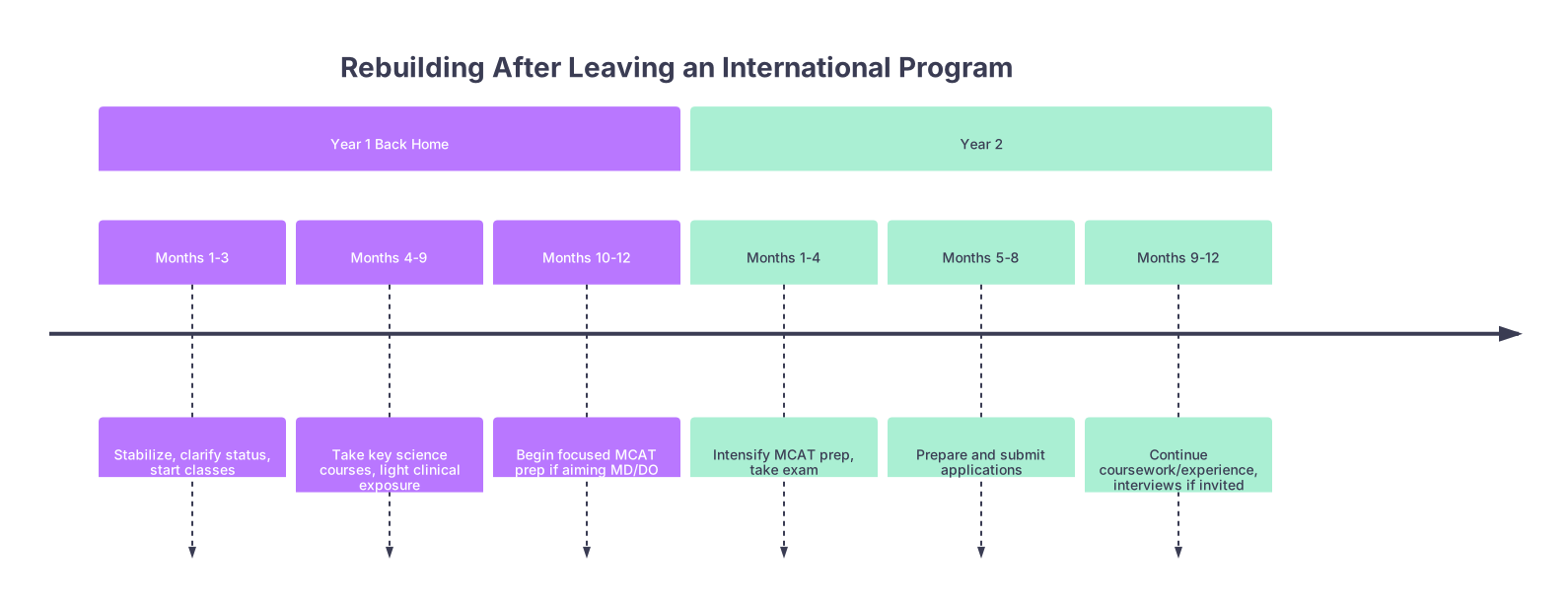
| Period | Event |
|---|---|
| Year 1 Back Home - Months 1-3 | Stabilize, clarify status, start classes |
| Year 1 Back Home - Months 4-9 | Take key science courses, light clinical exposure |
| Year 1 Back Home - Months 10-12 | Begin focused MCAT prep if aiming MD/DO |
| Year 2 - Months 1-4 | Intensify MCAT prep, take exam |
| Year 2 - Months 5-8 | Prepare and submit applications |
| Year 2 - Months 9-12 | Continue coursework/experience, interviews if invited |
If you came back in, say, March, and you’re thinking of applying that same June? That’s usually a bad idea. You’ll have no time to repair your academic story or get a strong MCAT.
You probably need 1–2 years of rebuilding before a serious application.
B. MCAT: make it a data point in your favor
If your past academic performance is questionable, you need the MCAT to say:
“I can handle the volume and complexity now.”
- If you’ve already taken it and scored low: consider a structured prep plan and delay applications until you have a score that actually helps your case.
- If you’ve never taken it: do not register until you’ve rebuilt your fundamentals with fresh coursework.
6. Explaining Leaving an International Program in Future Applications
Here’s where most people screw this up. They either overshare and sound unstable, or under‑explain and look evasive.
A. How to answer, “Have you ever matriculated at a medical school?”
If you started that international MD program and took classes: the honest answer is yes, you have matriculated at a medical school. You must disclose this on AMCAS/AACOMAS where asked.
Do not gamble on “maybe it doesn’t count.” Schools share information. Lying is worse than any dismissal.
B. Structure your explanation
When you get a “please explain” text box or write a personal statement, use a tight structure:
- Brief context: where, when, what program.
- The primary reason you left (in plain language).
- What you did afterward to address the underlying issue(s).
- What changed about you and how that shows in your new record.
Example for non‑academic withdrawal:
“I matriculated at [International University] in 2022. During my first year, my father developed severe health complications and required long‑term support at home. Balancing his care from abroad with a demanding basic science curriculum became unsustainable, and I made the decision to withdraw and return home. Since then, I have completed additional upper‑division science coursework with a 3.8 GPA while working part‑time and helping manage his care, which has strengthened my time management skills and confirmed my commitment to medicine under realistic circumstances.”
Example for academic difficulty:
“I matriculated at [International University] in 2021 and struggled with the volume and pace of the basic science curriculum, ultimately leading to academic dismissal. At the time, I relied almost entirely on rote memorization and did not seek help early. Returning home, I took responsibility for these weaknesses. Over the last two years, I completed 32 credits of upper‑division biology and biochemistry with a 3.9 GPA while working as a medical scribe. I worked with an academic coach to develop spaced‑repetition and active learning systems and built a consistent study routine. These changes are reflected not only in my coursework but also in my MCAT performance.”
That’s the shape you’re going for: own it, don’t drown in it.
7. Choosing Whether to Re‑enter Medicine or Pivot
Hard truth: for some of you, the best move is not trying to claw your way back into MD/DO.
A. Signs a clinical MD/DO route may be the wrong hill to die on
- You were miserable in basic sciences, not just stressed. Zero joy, constant dread.
- The idea of 7–10 more years of training makes your stomach flip in a bad way.
- Your mental health tanked and hasn’t stabilized even after being back for months.
- You’re more drawn to population‑level, research, or systems work than one‑on‑one clinical care.
- You cannot realistically afford more years of tuition, apps, exams, and uncertainty.
Medicine is not the only way to be “in healthcare” or to have prestige or to help people. It’s just the most loudly advertised one.
B. Strong, non‑consolation‑prize alternatives
If you pivot, do it intentionally, not as a shame‑based default.
- PA: Still clinical, less training time, more flexibility. But still competitive; you’ll need strong science and patient care hours.
- Nursing → NP/CRNA: High responsibility and autonomy, very employable, wide variety of roles.
- Pharmacy, PT, OT, SLP: Each with their own rigor, but more focused scopes.
- Public health (MPH), epidemiology, health policy: For those who care more about systems than individual visits.
- Clinical research, medical writing, biotech/industry roles: Use the science background without the MD training path.
You’re allowed to want a life that isn’t 80‑hour weeks, call nights, and constant liability risk.
8. Rebuilding Your Experiences and References
You can’t serve committees the same pre‑international CV and expect a different result. You need post‑return evidence that you’re growing.
A. Clinical exposure back home
Aim for roles where you:
- See real patients
- Work with licensed clinicians
- Show up consistently over time
Think:
- Medical scribe
- ED tech / CNA (if you can get certified)
- MA in a clinic
- Hospital volunteer with regular shifts, not just one‑off events
You’re proving you still want the patient‑care grind after your experience abroad, not just the title.
B. Letters of recommendation that address the “gap”
You want at least one letter that:
- Is from AFTER your return
- Speaks to your reliability, maturity, and follow‑through
- Ideally, comes from someone who knows you came back from a prior program and still chose to show up consistently
That could be:
- A science professor in your new coursework
- A supervising physician where you work
- A PI who sees your work ethic day‑to‑day
Give them context when you ask. Not your entire life story, but enough that they can authentically say, “This is someone who faced a major setback and responded constructively.”
9. A Quick Reality Check on Competitiveness
You’re probably wondering, “Okay, but do I actually have a shot?”
Here’s a blunt, oversimplified snapshot:
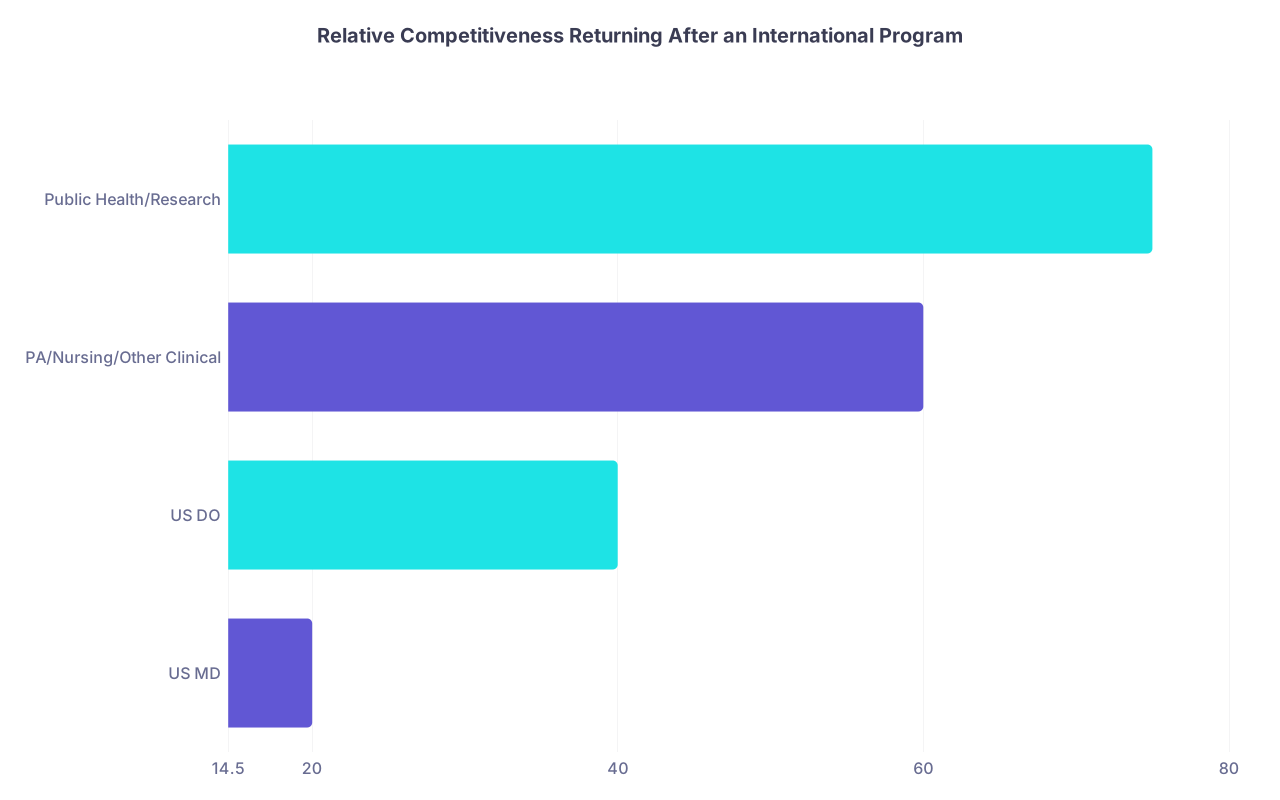
| Category | Value |
|---|---|
| US MD | 20 |
| US DO | 40 |
| PA/Nursing/Other Clinical | 60 |
| Public Health/Research | 75 |
Interpretation (very rough, not scientific):
- US MD: Possible but rare unless your international record was strong and you left for non‑academic, compelling reasons, and you now have an outstanding MCAT and U.S. record.
- US DO: More open to non‑traditional paths and redemption arcs, but still not easy. Strong recent academics and a mature story are non‑negotiable.
- PA/Nursing/Other clinical: Depending on your undergrad and post‑return work, often realistic if you commit fully.
- Public health/research: Many viable paths that care more about your skills and record now than your past misstep.
10. Managing Family, Shame, and Your Own Head
This part wrecks more people than the academics.
A. Family pressure and cultural expectations
If you come from a culture where “doctor” equals success, leaving an international program can feel like betrayal.
Set boundaries early:
- “I understand you’re disappointed. I’m still committed to a career in healthcare, but I need time to rebuild this carefully instead of rushing into another mistake.”
- “I’m working on concrete steps: [courses, job, timeline]. I’ll share updates when I have them, but I can’t discuss this every day.”
You don’t have to defend yourself at every dinner.
B. Dealing with shame without letting it drive decisions
You will be tempted to:
- Jump into another questionable international school because “I need to be a doctor quickly.”
- Repress the whole experience and pretend it didn’t happen when applying again.
- Decide your entire life is ruined and spiral.
All bad moves.
Use the experience as data:
- You know what isolation abroad felt like.
- You know what kind of curriculum destroyed you, or what support you lacked.
- You know how you respond when things start to crumble.
Your new plan should directly respond to that data.
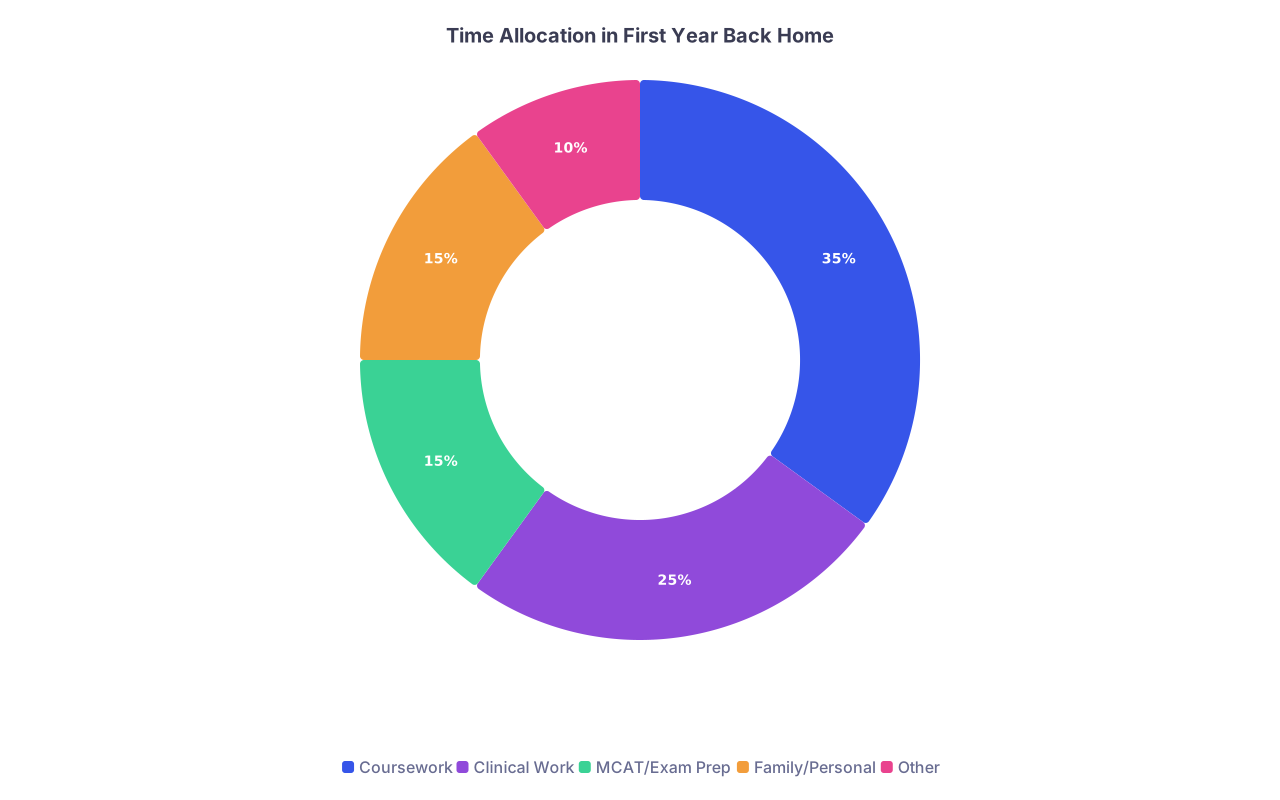
| Category | Value |
|---|---|
| Coursework | 35 |
| Clinical Work | 25 |
| MCAT/Exam Prep | 15 |
| Family/Personal | 15 |
| Other | 10 |

Key Takeaways
- Do a clear, honest autopsy of why you left and get your official status in writing; this shapes everything that comes next.
- Spend 1–2 years rebuilding with real coursework, meaningful clinical work, and a coherent story, not rushed re‑applications.
- Choose a primary path and a real backup, and be honest about whether MD/DO is still the right fit—or if a different healthcare or science route will give you a better life.


