
The wrong international route can quietly kill your career before you ever touch a stethoscope.
Let me be blunt: “Caribbean vs Europe” isn’t a cute preference question. It’s a strategic decision about risk, match odds, debt, and how much pain you’re willing to tolerate getting back into the U.S. or other competitive systems.
Here’s how to sort out which path actually fits your profile rather than some random Reddit success story.
1. The Core Question: What Problem Are You Trying To Solve?
You don’t look at Caribbean or European schools because everything’s going great.
You’re usually trying to fix one (or more) of these:
- GPA is shaky (sub‑3.5, sometimes sub‑3.3)
- MCAT is weak or multiple attempts
- You’re a non-traditional applicant needing flexibility or a second chance
- You want a shorter path or faster entry
- You’re shut out of U.S./Canadian schools and don’t want to quit on medicine
Different routes solve different problems.
Caribbean schools mostly sell you access: rolling admissions, flexible entry dates, looser GPA/MCAT thresholds.
European schools mostly sell you structure and legitimacy: 6-year programs after high school or English-taught MDs with more traditional academic setups, often cheaper than U.S. or Caribbean.
So the real question isn’t “Caribbean vs Europe.”
It’s: given my stats, age, finances, and specialty goals, which route gives me the highest probability of a decent match without financial self-destruction?
2. Quick Profile Match: Who Typically Fits Where?
Here’s the quick-and-dirty reality check.
| Profile Type | Better Initial Fit |
|---|---|
| Low GPA + low MCAT, wants US | Caribbean (selective schools only) |
| Solid GPA, weak MCAT, flexible on country | Europe |
| Wants to practice in EU/UK long-term | Europe |
| Wants fastest path back to US, accepts high risk | Caribbean (big 4 only) |
| Younger student, okay with 6-year path | Europe |
| Non-traditional, needs rolling admissions | Caribbean |
If you’re already thinking “but I’m kind of in between,” that’s normal. We’ll walk through the decision more systematically.
3. Hard Truth: Match Outcomes and Risk Profiles
Forget the marketing. Look at outcomes.
Caribbean: Very High Variability
There’s a brutal hierarchy in the Caribbean.
Top tier (commonly called the “Big 4”):
- St. George’s University (SGU)
- Ross University
- American University of the Caribbean (AUC)
- Saba University
These have:
- Established U.S. clinical rotation networks
- Long track records of grads matching into U.S. residencies
- Still lower match rates than U.S. MD/DO, and way more risk for low performers
Then there’s everyone else. Many of those schools:
- Have minimal data
- Higher attrition
- Poorer clinical placements
- Students vanishing into “I did 2.5 years and stopped” territory
If you choose Caribbean and you’re not in the top group of students (good Step scores, no repeats, no professionalism issues), things can get ugly. I’ve seen:
- People graduate, do 1 prelim year, then never secure a categorical spot
- $250k+ in debt with no residency
- Students stuck in low-quality, disorganized clinical rotations that don’t help them stand out
Caribbean is high-access, high-risk. The bottom half of the class is in real trouble.
Europe: More Stable Academically, But Less U.S.-Oriented
European English-taught programs (think Poland, Czech Republic, Hungary, Italy, Ireland, etc.) usually give you:
- A more traditional medical education structure
- Lower tuition than most Caribbean schools
- Better long-term options if you’re open to practicing in the EU/UK/Middle East
But:
- They’re not built primarily as “U.S. residency factories”
- You’ll likely need to self-navigate USMLE prep, observerships, and networking
- Depending on country, there may be language requirements to see patients
- Getting back to the U.S. is absolutely possible, but not guaranteed, and often more complex
Bottom line:
- Caribbean = more U.S.-focused, but with a big match-risk cliff
- Europe = more academically stable, better for EU/UK plans, more work to position yourself for the U.S.
4. Key Decision Factors: Caribbean vs Europe
Let’s break it down into the stuff that actually matters.
Factor 1: Your Stats and Application Profile
If your stats are very weak (for U.S. standards):
Caribbean might take you when Europe won’t, especially if:
- GPA < 3.2
- MCAT < 500 or multiple low attempts
- Limited time to improve your application and no appetite for post-bacc/SMP
Europe is more realistic if:
- You’re earlier in your path (could start a 6-year program)
- Your academics are decent but not U.S.-competitive
- You don’t have a usable MCAT or don’t want to retake
If you can realistically improve your U.S. competitiveness with 1–2 more years of work, that’s usually smarter than jumping straight to either route.
Factor 2: Where You Want to Practice
Here’s the biggest fork in the road.
If you’re 100% set on U.S. residency and practice:
- Caribbean (Big 4) sometimes makes more sense than random Europe, but only if:
- You’re prepared to be near top of your class
- You can handle very high pressure around exams and USMLE
- You’re okay that competitive specialties (Derm, Plastics, Ortho, etc.) are basically out
- Caribbean (Big 4) sometimes makes more sense than random Europe, but only if:
If you’re open to Europe/UK/Middle East/other international practice:
- Europe wins. Way more flexible pathways.
- You can still try for U.S. later with good Step scores and clinical exposure.
If you want maximum geographic flexibility, Europe usually beats Caribbean long-term.
Factor 3: Money and Debt Tolerance
This part gets ignored until it’s too late.
Typical situation:
-
- Total cost (tuition + living) can easily hit $250k–$350k+
- Largely private loans, higher interest
- High risk if you don’t match or drop out
Europe:
- Some programs: ~$10–15k/year tuition, others higher, but usually still less than Caribbean
- 6-year programs cost more in total time, but per year often less
- Sometimes access to local loans, but often still self-funded
If your financial safety net is weak, taking Caribbean-level debt with uncertain match odds is dangerous. Europe, while longer, often leaves you with less financial devastation if things don’t go perfectly.
5. Training Environment, Clinical Rotations, and Steps
Preclinical and Teaching Style
Caribbean:
- Intense basic science years, often on small islands
- Designed to push you hard toward USMLE Step 1
- High attrition—people wash out early
Europe:
- 6-year models: basic science integrated from early years
- More traditional lectures, hospital-based teaching, sometimes less standardized exam coaching
- Less hand-holding toward USMLE unless you self-organize
If you need structure and accountability for standardized exams, Caribbean may give more exam-oriented teaching. If you’re more self-directed, you can build a strong USMLE plan from Europe too—but it’s on you.
Clinical Rotations
This is where a lot of people underestimate complexity.
Caribbean:
- Big 4 have U.S.-based core rotations (NY, NJ, FL, etc.)
- You’ll rotate alongside U.S. students sometimes, which helps letters and networking
- But: scheduling can be chaotic, sites sometimes rotate through many students, and you may have to move constantly between sites
Europe:
- Clinical years usually in local hospitals in that country
- Great exposure; but for U.S. purposes, programs may not recognize non-U.S. clinicals the same way
- You’ll almost always need U.S.-based electives/observerships later to be competitive for residency
You want U.S. letters from U.S. attendings. Caribbean makes that more built-in. Europe makes it more DIY.
6. Your Personality and Risk Tolerance
Let’s be real. Your temperament matters.
Caribbean is a good fit only if:
- You’re mentally tough and resilient
- You can handle being in a high-attrition environment without melting down
- You’re willing to outwork your peers consistently
- You accept that you might still not get the specialty or location you want
Europe is a better fit if:
- You’re comfortable being an outsider in a new culture and possibly a new language
- You can handle some bureaucratic nonsense (visas, translations, licensing rules)
- You’re playing the long game—not in a rush to “finish fastest” at all costs
If you crumble under uncertainty, neither path will be fun. But the Caribbean stress is more about performance and elimination, while Europe’s stress is about systems, logistics, and long-term positioning.
7. Simple Framework: Which Route Fits Your Profile Best?
Use this as a reality filter.
You’re probably a better fit for the Caribbean (Big 4 only) if:
- You’re dead set on U.S. residency
- You fully understand the match risks and still accept them
- You didn’t get into U.S./Canadian MD/DO and can’t realistically fix your app soon
- You’re okay with:
- Internal Medicine, FM, Peds, Psych, Neuro, Path as likely targets
- Less shot at hyper-competitive specialties
- You can access funding and are comfortable with high debt if you match
You’re probably a better fit for Europe if:
- You’re earlier in your path (e.g., high school grad or early college)
- You’re open to practicing in Europe/UK or other regions
- You want a more traditional academic pathway
- Your stats are borderline for U.S. but decent overall
- You want lower long-term cost and can tolerate more time in training
8. Concrete Example Scenarios
Let’s make this less abstract.
Student A: 24 years old, U.S. citizen, GPA 3.1, MCAT 496, rejected from all U.S. MD/DO schools twice. Wants IM or FM, no strong specialty preference.
- Caribbean Big 4 may make more sense if they accept him and he’s ready to grind hard.
- Europe is possible, but 6 more years abroad may feel long, and getting back to U.S. will be complex.
Student B: 18, strong high school grades, wants to be a doctor, open to Europe or U.S., financially limited, no desire for ultra-competitive specialties.
- Europe 6-year MD in a reputable EU school probably better than Caribbean.
- Cheaper, more stable, more options later.
Student C: 26, Canadian, BSc with 3.5 GPA, MCAT 503, rejected domestically, open to practicing in UK/Europe, not obsessed with U.S.
- European MD (Ireland, Poland, Czech, etc.) is usually better than Caribbean.
- Keeps more doors open and often has structured paths back to Canada/UK/other systems.
9. Timeline, Licensing, and Hidden Admin Hassles
Here’s the simplified workflow for each route.

| Step | Description |
|---|---|
| Step 1 | Caribbean Matriculation |
| Step 2 | Basic Sciences on Island |
| Step 3 | USMLE Step 1 |
| Step 4 | US Clinical Rotations |
| Step 5 | USMLE Step 2 |
| Step 6 | Apply to US Residency |
| Step 7 | Europe Matriculation |
| Step 8 | Preclinical/Clinical in Europe |
| Step 9 | USMLE Step 1/2 (self-prep) |
| Step 10 | US Electives/Observerships |
Neither path is “easy.” But Caribbean has a cleaner, U.S.-oriented sequence. Europe is more “build your own bridge” to the U.S.
You also need to think about:
- Language exams (for some European countries)
- Visa requirements
- ECFMG rules and school listing (for both Caribbean and Europe)
- State-specific restrictions (California, Texas, etc. sometimes restrict certain schools)
Always check if your target school is:
- Recognized by the local country’s medical authority
- Listed appropriately in the World Directory of Medical Schools with ECFMG-eligible status
- Not blacklisted or restricted by key U.S. states you might care about
10. What I’d Tell You If We Were Sitting Across a Table
Here’s how I usually put it when someone asks me this straight:
- If you still have realistic shots at U.S./Canadian MD/DO with 1–2 more years of work (post-bacc, SMP, MCAT retake), fix your app first. Don’t default to international because you’re impatient.
- If you must go international and:
- You’re open to Europe/UK and flexible on career location → go Europe.
- You’re absolutely locked on U.S. practice, understand the risk, and get into a Big 4 Caribbean → Caribbean is on the table, but go in eyes open.
- Do not pick a random Caribbean school just because their admissions office emails you every other day. That’s how people end up stranded.
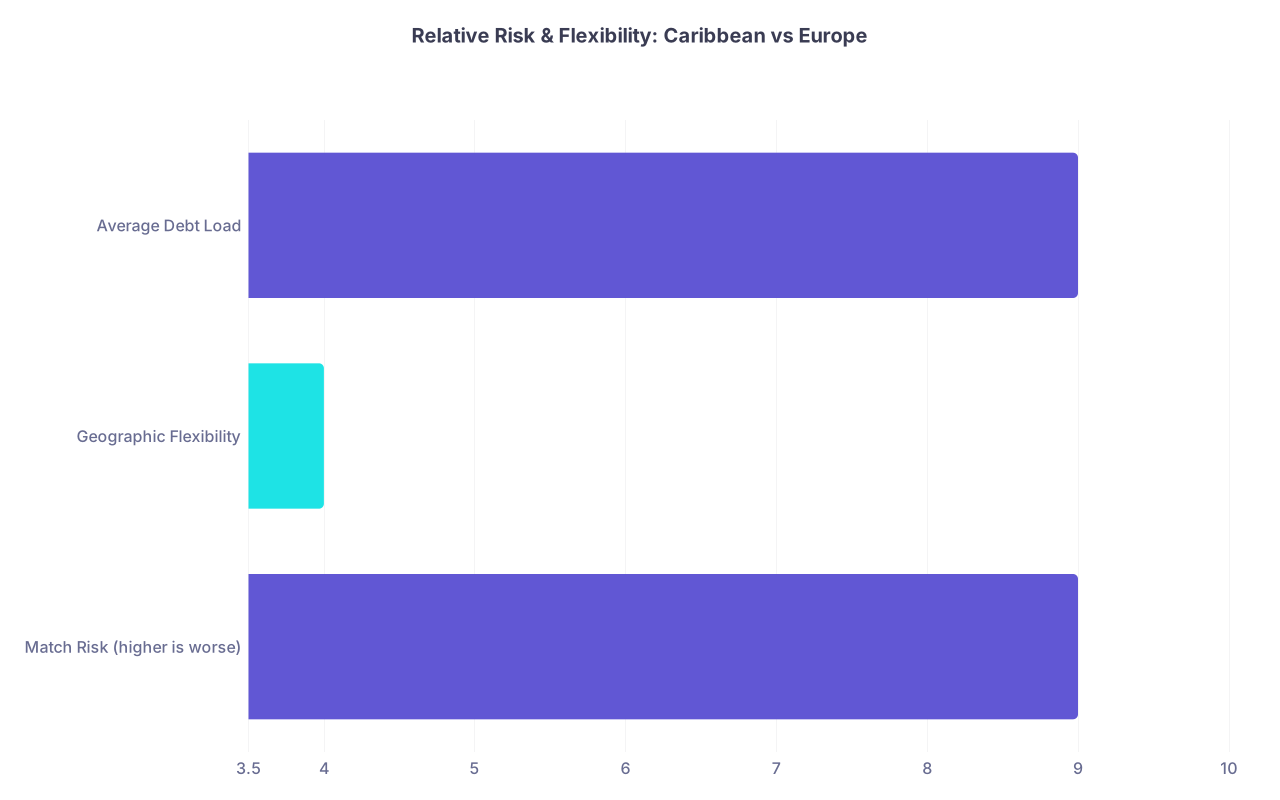
| Category | Value |
|---|---|
| Match Risk (higher is worse) | 9 |
| Geographic Flexibility | 4 |
| Average Debt Load | 9 |
(Think of those numbers as rough “risk scores” out of 10, not precise data—Caribbean generally higher match risk and debt, lower flexibility. Europe the opposite.)
FAQ (exactly 6 questions)
1. Is Caribbean medical school always a bad idea?
No. It’s a high-risk idea, not automatically a bad one. If you go to a reputable Caribbean school (SGU, Ross, AUC, Saba), perform near the top of your class, and target realistic specialties like IM, FM, Peds, Psych, you can absolutely match into U.S. residency. But it’s unforgiving. Middle or bottom of the class + mediocre board scores + high debt = serious career and financial risk.
2. Which European countries are most common for North American students?
You’ll see a lot of students in:
- Poland (Jagiellonian, Medical University of Warsaw, etc.)
- Czech Republic (Charles University)
- Hungary (Semmelweis, Szeged, Debrecen)
- Italy (various English-taught programs)
- Ireland (for Canadians especially)
These programs often have English tracks specifically marketed to international students. Quality varies, so you need to check accreditation, graduate outcomes, and how many actually return to North America if that’s your goal.
3. How hard is it to get U.S. residency from a European school?
Hard, but doable if you’re strategic. You’ll need:
- Strong USMLE Step scores (especially Step 2 now)
- U.S. clinical experience (electives, observerships)
- U.S.-based letters of recommendation
- A realistic specialty choice (IM/FM/Peds/Psych are more attainable than Derm/Neurosurg)
You’ll be competing as an IMG, same as Caribbean grads, but with slightly different strengths (often stronger broad clinical training, but less built-in U.S. exposure unless you create it).
4. Are 6-year European programs after high school respected in the U.S.?
Yes, if the school is recognized and ECFMG-eligible. Many physicians in the U.S. trained in 6-year European or other international programs. Those degrees are valid; residency programs mostly care about:
- ECFMG certification
- Board scores
- Clinical performance and letters
- Communication skills and professionalism
The “6-year vs 4-year” piece is not the main issue. Your IMG status and performance are.
5. If my dream is a competitive specialty (Derm, Ortho, Plastics), should I go Caribbean or Europe?
Honestly? Neither is a good launchpad for hyper-competitive U.S. specialties. You’ll be fighting an uphill battle from day one. Your best shot at those fields is:
- Repairing your application and trying again for U.S./Canadian MD/DO
- Crushing your metrics and building niche research if you do go international
But if you already know you want Derm or Ortho and you’re choosing between Caribbean and Europe, that’s a signal to pause and rethink the plan.
6. How do I sanity-check a specific Caribbean or European school before enrolling?
Do three things:
- Verify it in the World Directory of Medical Schools and check ECFMG eligibility.
- Ask for real match lists from the past 3–5 years and look for:
- U.S./Canada matches or local residency placements
- Specialty distribution (are people mostly matching into IM/FM/Peds?)
- Talk to current students and recent grads not handpicked by admissions. Ask about:
- Attrition rates
- Clinical rotation quality and locations
- Administrative chaos vs support
If a school dodges data questions, gives vague match info, or pushes you to commit fast, that’s a red flag.
Key takeaways:
- Caribbean = U.S.-focused but high risk and high debt; Europe = more stable academically, better long-term flexibility, but more DIY for U.S. return.
- Your stats, finances, and willingness to accept uncertainty matter more than marketing or anecdotes.
- If you can still fix your U.S./Canadian application, do that first. International should be a deliberate strategy, not a panic move.