
Language of instruction matters more than most international applicants want to admit.
If you’re aiming for a U.S. residency, the language you train in will shape your clinical communication, exam performance, letters, and how programs perceive you. It’s not everything—but it’s not a small detail either.
Let’s walk through how much it matters, where it really matters, and what to do if your medical education isn’t in English.
The short answer: It matters in three big ways
Here’s the direct breakdown:
Your clinical language affects:
- How strong your US clinical evaluations and letters can be
- How comfortable you sound on interview day
- How efficiently you function on U.S. rotations
Your study language affects:
- How hard U.S.-style exams (like USMLE) feel
- How fast you can read and process dense English questions
- Your ability to write notes, consults, and emails in a way that doesn’t raise red flags
Program perception (fair or not) affects:
- Whether they worry about communication problems
- Whether they believe you’ll struggle with patient interactions, documentation, and team dynamics
A non‑English language of instruction doesn’t doom you. I’ve seen plenty of graduates from Spanish, Russian, Arabic, and Chinese‑language schools match well.
But they all had to do extra work to prove one thing: “My English is not your problem.”
How program directors really think about language
Residency programs care about one thing above all: can you safely and efficiently take care of U.S. patients on day one of intern year?
Language fits into that in a few specific ways:
- Can you understand fast verbal instructions from attendings, nurses, consultants?
- Can you write clear notes that don’t require constant correction?
- Will patients trust you and follow your plans?
- Will you slow the team down because you’re translating in your head all day?
They don’t sit around ranking “English vs Spanish vs French” schools. They look at risk.
If your:
- Medical school language is not English
- Transcript and letters are from non‑English environments
- CV has minimal U.S. clinical experience
- Interview English is slightly awkward or slow
…then the perceived risk goes up. A lot.
Conversely, if you:
- Studied in another language but crushed USMLE (especially C&CS-style items)
- Did strong U.S. clinical rotations with glowing comments about your communication
- Sound fluent and natural on interview day
…most programs stop thinking about your med school language entirely.
Comparing common paths: English vs non‑English schools
Here’s how language of instruction typically affects the path to U.S. residency.
| Training Path | Relative Language Impact | Extra Work Needed |
|---|---|---|
| U.S./Canada MD (English) | Low | Minimal |
| Caribbean/Intl MD (English) | Low–Moderate | USCE, strong scores |
| Intl MD (non‑English, strong English skills) | Moderate | USCE, proof of fluency |
| Intl MD (non‑English, weaker English) | High | Major remediation |
Notice something: the problem isn’t which language; it’s the gap between your training environment and your target environment.
If you study medicine in English, your daily life already matches U.S. documentation, abbreviations, and verbal patterns. If you study in another language, you’re working in translation—unless you actively build a parallel English medical life.
Where language of instruction matters the most
Let’s zoom into the exact choke points.
1. USMLE Step exams
USMLE is written in dense, idiomatic medical English. Even native speakers find some questions wordy and tricky.
If you:
- Learned pathology, pharmacology, and physiology in another language
- Use different names or abbreviations for drugs and lab tests
- Rarely read long English stems
Then you’re stacking difficulty on top of difficulty.
Students from non‑English schools often say:
- “I knew the content but misread the question.”
- “Time was a bigger issue than knowledge.”
- “I had to re‑read stems multiple times.”
That’s a language problem, not a content problem.
Bottom line: Non‑English instruction doesn’t prevent high scores, but you’ll need extra months of English‑only question practice (UWorld, NBME, AMBOSS, etc.) to close that gap.
2. U.S. clinical experience (USCE)
This is where language shows up brutally clearly.
On a U.S. rotation, attendings and residents will judge you on:
- How you present patients (organized, fluent, concise?)
- Your progress notes and H&Ps (clear, professional, minimal grammar issues?)
- Your ability to pick up subtle things patients say (sarcasm, euphemisms, slang)
If your thoughts are solid but your mouth and keyboard lag, your evaluations suffer.
Good programs read between the lines of letters. Phrases like:
- “Improved throughout the rotation”
- “With more time in the system, will be more efficient”
…often translate to “language and system issues slowed them down.”
You want comments like:
- “Communicated with patients and team at the level of our U.S. students.”
- “Excellent English; no concerns about communication with patients or staff.”
You only get those if your English and your medical content can run at the same speed.
3. Interviews
Programs don’t have a checkbox for “language of instruction.” They have a human conversation with you.
Red flags they worry about:
- Long pauses while you translate in your head
- Overly formal, stiff, or memorized answers
- Difficulty understanding rapid questions or jokes
- Misuse of basic clinical terms (“I make a therapy” instead of “I start treatment”)
One awkward interview can undo months of hard work on your application.
Again, your school’s language doesn’t doom you. But if it’s not English, you must over‑prepare the English conversation side.
Where language matters less than you think
Let’s be fair. Some people unnecessarily panic.
Here’s where language of instruction is less critical than applicants assume:
ERAS filters and basic eligibility
Most programs don’t filter by med school language. They filter by:- USMLE scores
- Year of graduation
- Visa status
- School accreditation / ECFMG status
Specialty choice by itself
People love to say “language schools can’t match competitive specialties.”
That’s lazy thinking. Plenty of graduates from non‑English schools match:- Internal medicine at solid academic programs
- Family med, pediatrics, psych
- Even some competitive fields if everything else is exceptional
The bottleneck is usually scores + USCE + connections, not language alone.
Being a native English speaker who studied abroad in another language
If you grew up in the U.S., Canada, UK, etc., and went to a Spanish‑ or Polish‑language school, language of instruction isn’t your main hurdle. Programs will see you speak native English in interviews. Your challenge is more about school reputation and clinical training quality.
If you’re choosing a school now: how much should language matter?
If you’re still premed or deciding between international options, here’s the blunt guidance.
Strong preference: English‑language curriculum
If you already know you want U.S. residency, an English‑language curriculum is usually the smoother path, especially if:
- You’re not already fluent and comfortable in English
- You don’t want to invest heavily in language training on top of medical training
Caribbean schools, some European schools, and many international programs now offer full English tracks.
But don’t be naive. An English‑language school with weak clinical training or poor match history is still a bad deal. Language helps only if the overall package is reasonable.
Reasonable choice: non‑English school, but with a plan
A non‑English school can still be a solid option if:
- The school is reputable locally and gives you strong clinical skills
- You commit early to:
- Doing all your exam prep in English
- Building English medical vocabulary daily
- Getting U.S. clinical experience as soon as you can
- Practicing spoken medical English with real humans, not just reading
In this route, you are responsible for building the English layer on top of your core training.
If you’re already at a non‑English school: how to fix the gap
You can’t change the language of instruction. You can change how prepared you are for the U.S.
Here’s the practical framework:
Step 1: Shift your study universe into English
- Use only English‑language resources for USMLE prep (UWorld, Boards & Beyond, Pathoma, etc.)
- Start this early—ideally from year 1 or 2—not six months before Step 1
- Read guidelines (ACC, AHA, IDSA) in English, not translations
- Write your own notes in English, even if lectures are in another language
Step 2: Train your reading speed and question comprehension
- Do timed question blocks from early on. Don’t wait until dedicated.
- After each block, don’t just review content—also ask:
- Did I misread anything?
- Which phrases confused me?
- Do I need to learn certain recurring wording (e.g., “insidious onset,” “prodrome,” “tenesmus”)?
Build an “English exam vocabulary” list. Yes, it’s nerdy. It works.
Step 3: Build spoken clinical English
You need to be able to:
- Present a patient in English without translating from your native language
- Explain diagnoses and treatments in simple English to a layperson
- Participate in team discussions without freezing
Concrete ways to do this:
- Join or create an English‑only medical discussion group with classmates
- Present fake patients in English to a friend every week
- Shadow English‑speaking doctors locally if possible
- Use online platforms where doctors/students discuss cases in English (forums, webinars)
Step 4: Get high‑quality U.S. clinical experience
This is your proof.
For non‑English instruction, I’d aim for:
- At least 2–3 months of hands‑on or closely supervised USCE (not just observerships)
- Rotations where attendings are known to write detailed letters
- Settings with heavy verbal interaction: internal medicine, family medicine, pediatrics
Ask attendings if they’re comfortable commenting specifically on your communication skills in letters. You want those lines in writing.
Step 5: Over‑prepare for interviews
By the time you’re interviewing, you want your English to be “non‑issue level.”
- Practice with mock interviews over Zoom with native speakers or near‑native colleagues
- Record yourself answering common questions and listen for:
- Long pauses
- Overuse of fillers
- Awkward phrasing (“I was making internship” vs “I completed an internship”)
- Prepare 3–4 patient stories you can tell with clear, emotional, and precise English
If by practice round 5–6 your interviewer forgets you trained in another language, you’re in good shape.
Realistic expectations: what language won’t fix
Even perfect English won’t fix:
- Weak scores (especially Step 2 CK)
- A long gap since graduation
- Zero U.S. clinical experience
- Poor letters of recommendation
- A low‑tier or unrecognized medical school
Language is one lever. You still need the other pillars: knowledge, exams, clinical performance, professionalism.
But poor English will magnify all your other weaknesses. Strong English will let your strengths actually show.
Quick comparison: should you worry?
Use this as a rough self‑check:
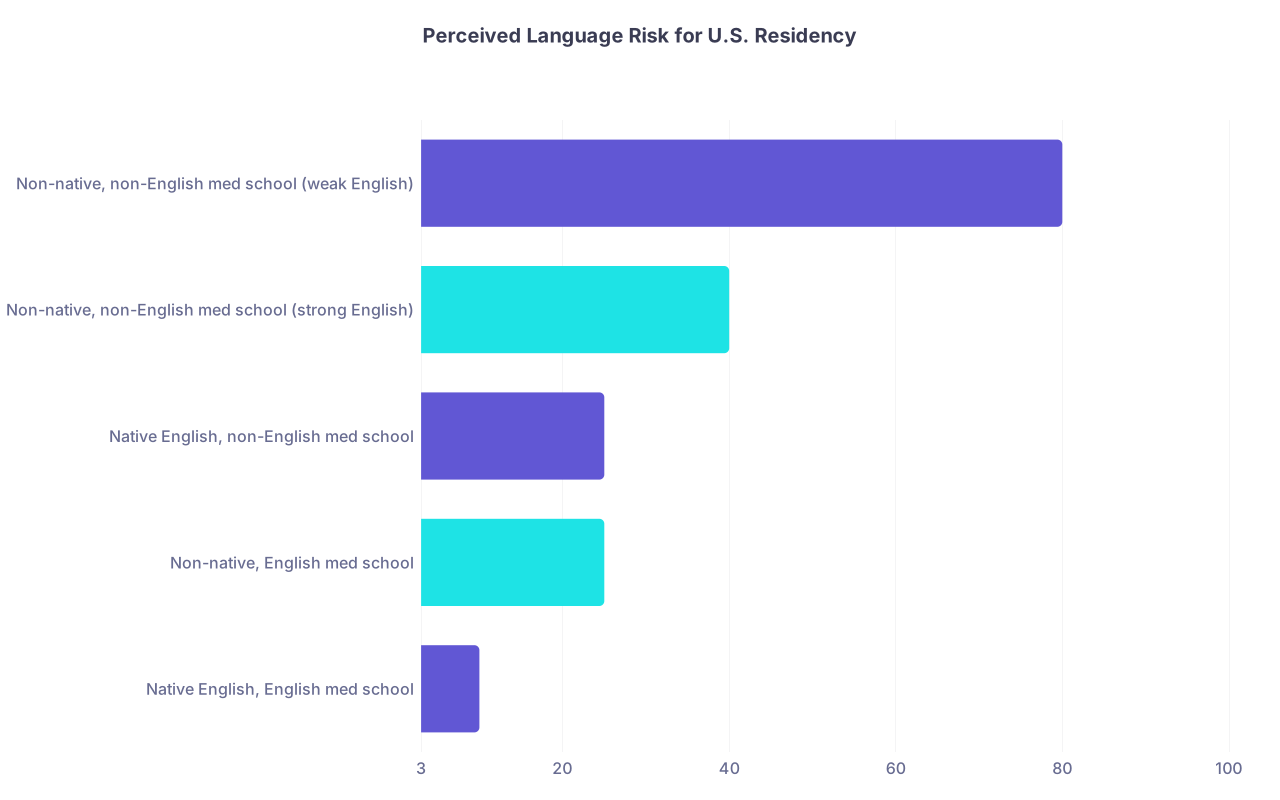
| Category | Value |
|---|---|
| Native English, English med school | 10 |
| Non-native, English med school | 25 |
| Native English, non-English med school | 25 |
| Non-native, non-English med school (strong English) | 40 |
| Non-native, non-English med school (weak English) | 80 |
If you’re in that last group—non‑native, non‑English school, and your English is currently shaky—you don’t need panic. You need a plan and consistent work, starting now.

| Step | Description |
|---|---|
| Step 1 | Choose/Attend Med School |
| Step 2 | Focus on USMLE & USCE |
| Step 3 | Shift Study to English |
| Step 4 | USMLE Prep in English |
| Step 5 | Spoken Clinical English Practice |
| Step 6 | U.S. Clinical Experience |
| Step 7 | Strong Letters & Interviews |
| Step 8 | Stronger Match Chances |
| Step 9 | Language of Instruction |
FAQ (7 questions)
1. Will a non‑English language of instruction automatically hurt my chances for U.S. residency?
No, not automatically. Programs don’t usually reject you just because your school teaches in another language. What they care about is whether your English is good enough for safe, efficient patient care. If your USMLE scores, U.S. clinical evaluations, and interviews all show strong communication skills, your school’s teaching language fades into the background.
2. Is it better to pick a weaker English‑language school over a stronger non‑English one?
Not necessarily. A low‑quality English‑language school with poor match outcomes is still a bad deal. You’re better off at a strong, reputable non‑English school where you get excellent clinical training, as long as you commit early to building your English medical skills in parallel. Ideally, you want both: decent school + English curriculum. But if you have to choose, don’t sacrifice overall training quality just for language.
3. How fluent does my English need to be for U.S. residency?
You don’t need to sound like a native speaker, but you do need to: understand fast spoken English, present patients clearly, write readable notes with minimal grammar issues, and handle a long interview day without mental exhaustion from translating. If attendings or interviewers are subconsciously adjusting their speech for you, you’re not quite there yet. Aim for “they forget I’m not a native speaker after 5 minutes” level.
4. Can I match without any U.S. clinical experience if my English is good?
It’s possible but significantly harder, especially for international grads. Even with great English, programs like to see proof that you can function in the U.S. system—documentation style, team communication, patient interaction. For non‑English med schools, I’d consider meaningful USCE (at least 2–3 months) almost mandatory if you’re serious about a U.S. match.
5. How early should I start studying medical content in English if my school teaches in another language?
As early as you can tolerate. Ideally from year 1 or 2, you’d start reading at least some textbooks, question banks, and guidelines in English. By the time you’re 12–18 months out from Step 1/2, your entire exam world should be in English: questions, explanations, notes. Don’t wait until “dedicated” to flip the switch; that’s how you end up knowing the medicine but struggling with the language.
6. Do programs see my school’s language of instruction directly on ERAS?
Not usually in a structured field. They infer it from the country, school, your transcript, and how your letters are written. They may ask you directly on interview day what language your clinical training was in. They’ll definitely notice if your written application or interview English doesn’t match the level they expect from a safe intern.
7. If my English is currently weak, what’s the single most important thing I should do first?
Pick one domain and commit hard for 3–6 months: I’d start with reading and question practice in English. Daily habit: 20–40 USMLE‑style questions + 10–20 minutes aloud summarizing what you learned in English, even if you feel ridiculous. Once your reading and comprehension speed improve, layer in spoken practice with others. Don’t wait. Language takes time to build, and every year you delay makes the eventual U.S. transition rougher.
Key takeaways:
- Language of instruction matters because it shapes how ready you are for U.S.-style exams, clinical work, and interviews—but it’s one factor, not destiny.
- If your school isn’t in English, you need a deliberate plan: study, practice, and get evaluated in English long before you ever apply for residency.
- Your real goal is simple: by the time programs meet you, your English should be such a non‑issue that they can focus on what actually matters—your clinical ability, reliability, and fit.