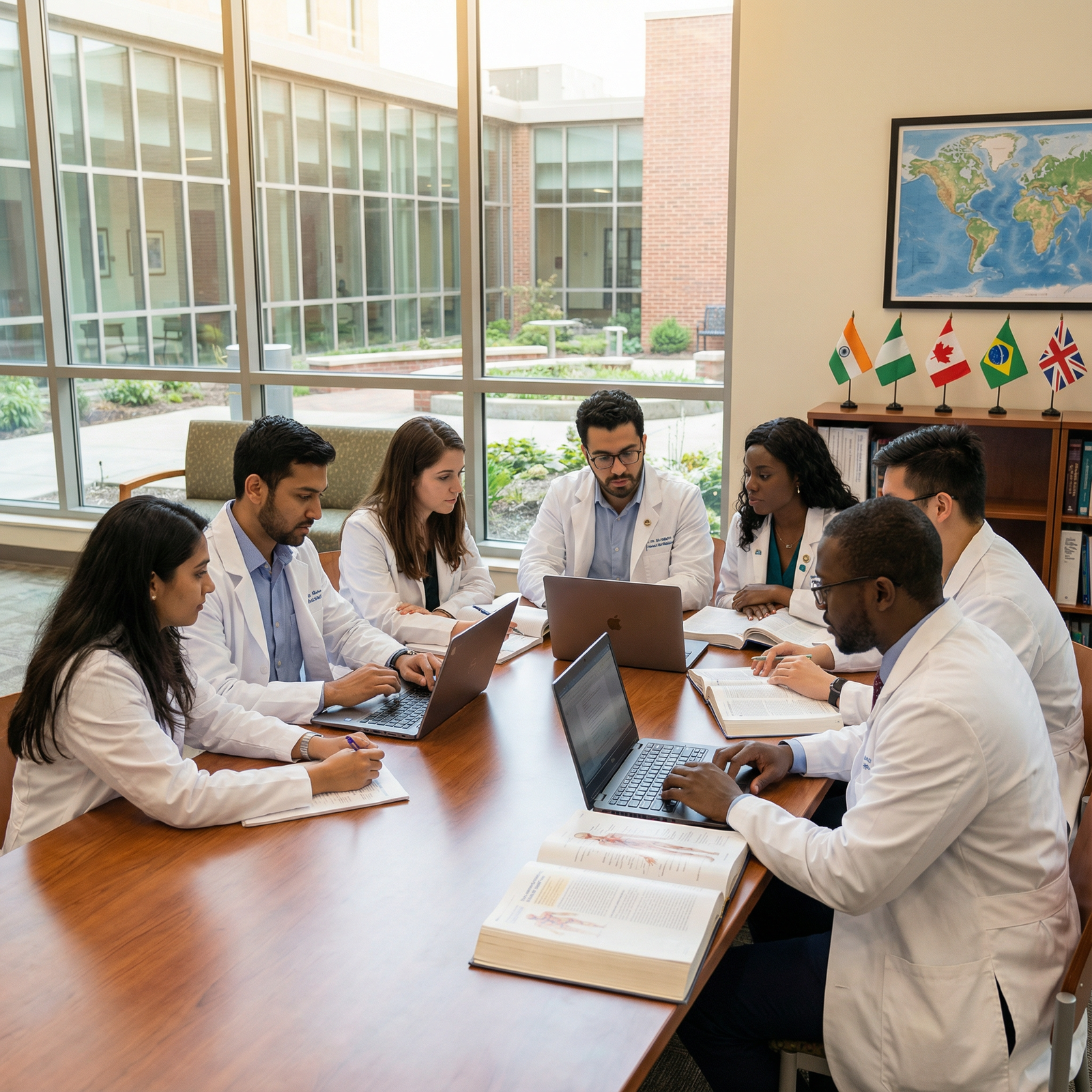
The brutal truth: Most international grads will not match into the most competitive U.S. specialties. But some do every single year—because they treat it like a long, strategic campaign, not a wish.
You want to know if you can realistically do it. Yes, you might. But only if you understand the landscape and plan early, while you’re still premed or in medical school.
Let’s walk through what it actually takes.
1. Which specialties are “competitive” for international grads?
People throw around “competitive” loosely. For international medical graduates (IMGs), the bar is different.
The specialties that are brutal for IMGs:
- Dermatology
- Plastic Surgery
- Neurosurgery
- Orthopedic Surgery
- Otolaryngology (ENT)
- Integrated Vascular Surgery
- Integrated Cardiothoracic Surgery
- Radiation Oncology (small field, tiny number of spots)
- Ophthalmology (separate match)
- Urology (separate match, but still tough)
Then there are specialties that are technically possible but still very hard for IMGs at academic or “top tier” programs:
- Diagnostic Radiology
- Anesthesiology
- Emergency Medicine
- General Surgery (categorical)
And relatively more open, but still not easy:
- Internal Medicine (university programs, high-tier academic tracks, competitive fellowships)
- Pediatrics at top institutions
- OB/GYN at competitive places
To be clear: matching IM into a random community hospital is not the same game as matching derm, ortho, plastics, or neurosurgery as an IMG. That’s varsity-level.
2. What does an IMG who matches a competitive specialty actually look like?
I’m not talking about unicorn myth. I’m talking about the real pattern I’ve seen over and over.
Here’s the profile that keeps showing up:
- USMLE (or Step) performance:
- Step 2 CK: typically 250+ for the ultra-competitive fields
- Step 3: done early, also strong if taken
- Academics:
- Near the top of their class (or equivalent narrative if the school does not rank)
- Honors in core clinical rotations, especially in the specialty of interest
- Research:
- 5–20+ publications, abstracts, or posters
- Often 1–3 years of dedicated research in the U.S. at a known academic center
- At least one U.S. faculty mentor in the specialty who actively advocates for them
- Clinical experience in the U.S.:
- Multiple U.S. clinical electives or observerships in the specialty
- Ideally sub-internship (sub-I) or strong hands-on experience, if their visa and school allow
- Networking:
- They’re known by name to at least a few program directors or faculty
- Strong letters from U.S. attendings in the specialty
- Visas/status:
- Either U.S. citizen/permanent resident or they targeted programs that routinely sponsor J-1/H-1B and know this in advance
If you’re reading this as a premed or early med student and thinking, “That sounds insane,” good. That’s the level of effort this path requires. It is not fair. But it is the reality.
3. How much does school choice matter if you’re still premed?
A lot. More than most premed advisors will admit.
If you know you want a hyper-competitive U.S. specialty and you’re still premed, your decision tree should be ruthless.

| Step | Description |
|---|---|
| Step 1 | Premed Student |
| Step 2 | Prioritize US/Canadian MD |
| Step 3 | Top-tier IMG-friendly schools (Ireland, UK, AUS, SG, Israel) |
| Step 4 | Caribbean / Unknown schools (High risk) |
| Step 5 | Competitive specialty realistically possible |
| Step 6 | Competitive but harder |
| Step 7 | Hyper-competitive paths rare and extreme |
| Step 8 | Can you attend US/Canadian MD? |
| Step 9 | International Option? |
Here’s the blunt hierarchy if your eventual goal is a competitive U.S. specialty:
| Training Location | Realistic Chance at Very Competitive Specialty* |
|---|---|
| U.S. MD (LCME-accredited) | Highest |
| Canadian MD | Very high (with U.S. exams and connections) |
| U.S. DO | Moderate; specialty-dependent |
| Top non-US schools (UK/Ireland/Aus/SG/etc) | Low–moderate, with strong strategy |
| Caribbean schools | Very low for ultra-competitive fields |
*“Very competitive specialty” = derm, plastics, neurosurgery, ortho, ENT, etc.
If you’re still premed and dead set on a competitive U.S. specialty, the correct move is do everything possible to attend a U.S. MD or Canadian school. That might mean:
- Retaking the MCAT
- Doing an extra year to boost GPA
- Expanding school lists
- Applying broadly and strategically one more cycle
If that’s impossible, then the next best move is a well-established, IMG-friendly international school with a track record of U.S. matches: Ireland (RCSI, UCD), UK (King’s, UCL, etc.), Australia (Monash, Melbourne, Sydney), Israel (Sackler), Singapore.
Random, unproven schools—or lower-tier Caribbean schools—are a very steep uphill battle for anything competitive.
4. If you’re already in an international school, how early should you plan?
Yesterday.
The students who pull off competitive matches as IMGs start early:
- Pre-clinical years (Year 1–2):
- Lock in strong grades; aim for the top of your class
- Get involved in research ASAP, ideally in your target specialty or a closely related one
- Learn about U.S. exams, visa issues, and eligibility requirements
- Mid school (Year 3–4 in a 6-year program, or MS2–3 in a 4-year):
- Prepare seriously for Step 2 CK (since Step 1 is now pass/fail, Step 2 is your differentiator)
- Start emailing potential U.S. research mentors
- Line up U.S. clinical experiences early, especially in your chosen specialty
- Final years:
- Consider a dedicated U.S. research year if your school and finances allow
- Stack U.S. letters of recommendation from well-known faculty
- Target your applications with surgical precision (no random fishing)
If you only decide in your final year that you “might try” for derm or neurosurgery as an IMG, you’re functionally too late in most cases.
5. What are the hard filters programs use for IMGs?
Programs will not say it on their website, but here are the silent rules I’ve seen play out.
Hard filters they often apply to IMGs:
- Step 2 CK below ~240 for ultra-competitive fields = auto-screened out at many programs
- No U.S. clinical experience = rarely considered
- No research in the specialty = unlikely at academic centers
- Significant gaps in training with no explanation
- Visa needs when the program doesn’t regularly sponsor visas
And the “softer” but very real filters:
- Unknown school with no track record at that program
- Generic letters from non-U.S. faculty only
- Application reads like someone who just “likes the specialty” instead of a 3–5 year deliberate path
You’re not competing against average IMGs. You’re competing against stellar U.S. MDs and the top 1–5% of IMGs globally who built their entire med school around this goal.
6. Strategic ways to increase your odds as an IMG
Here’s how to move yourself from fantasy to “this might actually work” territory.
6.1. Pick your specialty early and commit
You do not have the luxury of indecision if you want derm/plastics/ortho/neurosurgery as an IMG.
By early clinical years, you should be able to answer:
- Who are three U.S. researchers in this specialty whose work you’ve actually read?
- Which U.S. programs are known to ever take IMGs in that specialty?
- What is the typical profile (scores, research, background) of IMGs who matched there?
If you cannot answer that, you’re still in the “daydreaming” stage.
6.2. Build a serious research foundation
For hyper-competitive fields, research is not optional. It’s currency.
Good paths:
- Get a research position (paid or volunteer) at a U.S. academic center in your target specialty
- Take a research year between med school years if your curriculum allows
- Accept that you may spend 1–3 years after graduation doing U.S. research before matching
Bad strategy: collecting random low-yield case reports spread across unrelated fields and thinking that’s enough for derm or neurosurgery. It is not.
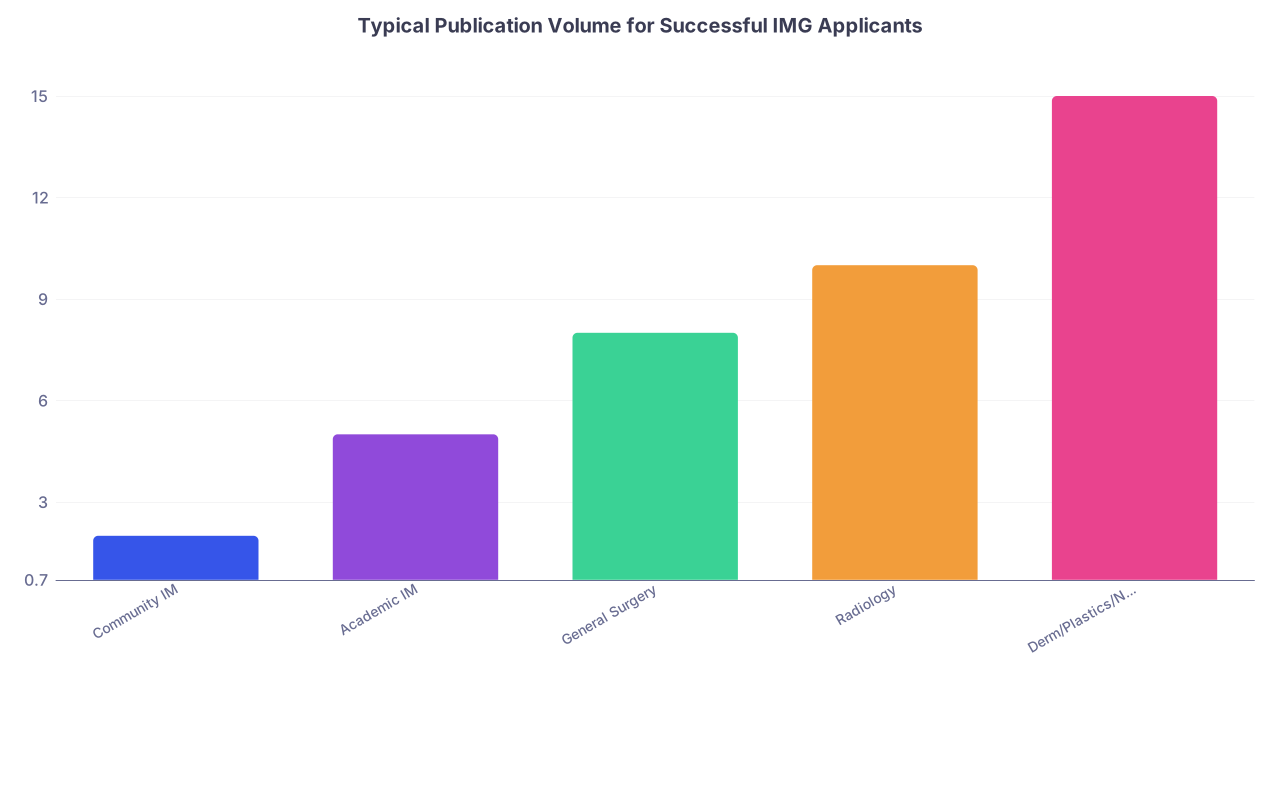
| Category | Value |
|---|---|
| Community IM | 2 |
| Academic IM | 5 |
| General Surgery | 8 |
| Radiology | 10 |
| Derm/Plastics/Neurosurg | 15 |
Those numbers aren’t official; they reflect what I actually see in successful applications.
6.3. Target U.S. clinical exposure smartly
You want:
- Clinical electives / sub-Is in your chosen specialty at places that might realistically rank you
- A mix of academic and IMG-friendly programs
- Direct interaction with faculty who write strong, specific letters
If your school restricts where you can rotate, plan early and fight bureaucracy politely but firmly. The earlier you start paperwork, the more options you’ll have.
6.4. Know which programs even consider IMGs
Do not guess. Use real data:
- Program websites and past resident bios
- Reach out to current residents (especially any IMGs) on LinkedIn or email
- Look at NRMP charts and program lists, but do not stop there
- Talk to your own school’s alumni who matched in the U.S. and track where they ended up
Your application list for a competitive specialty should be:
- Heavy on programs with a known IMG history
- Honest about your visa needs
- Big enough to offset the low odds (you’ll likely apply to 60–100+ programs for some specialties)
7. When should you pivot away from a hyper-competitive specialty?
This part no one likes to talk about, but it’s crucial.
There are moments when the smart move is to pivot:
- Step 2 CK is significantly below 245 and you’re aiming for derm/plastics/neurosurgery as an IMG
- Zero meaningful research in the field by late med school and no realistic way to add it soon
- No U.S. clinical access in that specialty and graduation is approaching
- Personal/financial constraints make extra research years or a backup plan impossible
A pivot is not failure. It is strategy.
Common pivots that still allow solid careers:
- From neurosurgery/ortho → general surgery, radiology, anesthesiology (still not easy, but more realistic)
- From derm → internal medicine with a plan for strong fellowship (rheum, allergy, heme/onc)
- From ENT → general surgery, IM, or radiology
You can still build a highly specialized, intellectually challenging career from “less competitive” cores. But you have to be honest with yourself early enough to adjust.
8. So, can you realistically match a competitive specialty as an international grad?
Ask yourself these questions right now:
- Am I willing to design the next 4–7 years of my life around this one goal?
- Can I realistically hit Step 2 CK in the mid‑250s or higher with disciplined preparation?
- Do I have or can I obtain access to serious research opportunities in my specialty?
- Does my school’s name and track record help me at least a little—or am I starting from deep in the hole?
- Can I afford (financially and emotionally) extra years for research or reapplying if needed?
If your honest answers are mostly yes, then yes—it is realistic, meaning possible with intense, sustained effort and smart strategy.
If your answers are mostly no, then you can absolutely still have a strong U.S. career—but you should consider a more attainable specialty early and build excellence there instead of chasing a fantasy.
FAQ: Competitive Specialties as an International Grad
1. I’m a premed thinking about going to a Caribbean school. Can I still do derm or neurosurgery?
Technically? Yes. Practically? Almost never. Matching any residency from some Caribbean schools is already an uphill fight; matching derm/neurosurgery from there is like winning the lottery twice. If you’re premed and serious about those specialties, every ounce of energy should go into maximizing your chances at a U.S. MD/DO or a well-established non-U.S. school with a strong U.S. match history.
2. I already started at an international school. Is it too late to aim high?
No, but the clock’s ticking. If you’re early (pre-clinical), you can still build grades, research, and U.S. connections. If you’re late (final years) with no research, average scores, and no U.S. experience, then derm/ortho/neurosurgery are almost certainly out. But radiology, anesthesia, general surgery, or strong internal medicine programs may still be within reach if you act aggressively now.
3. Do I really need 250+ on Step 2 CK for a competitive specialty as an IMG?
For the most competitive surgical and lifestyle specialties, yes, in most cases. Could someone match with a lower score? Rarely, but they usually have something extreme in their favor: PhD-level research, major grants, citizenship plus elite school, inside connections, or a prior match elsewhere. If you want to play this game as an IMG, you treat Step 2 CK like a once-in-a-career exam.
4. Is it smarter to match an “easier” specialty first, then switch to a competitive one later?
Usually not. Switching into derm, plastics, or neurosurgery from another residency is extremely rare, especially for IMGs. Sometimes people transition from general surgery → plastics or vascular, or from IM → more competitive medicine fellowships, but “back door into derm/neurosurg” is mostly a myth. If you’re serious about those fields, build a direct, strong application the first time. If that fails and you need a backup, then commit fully to that backup and be excellent there.
5. What’s the single most impactful thing I can do this year if I want a competitive specialty as an IMG?
If you’re still in med school: lock in your exam performance and secure real research in your target specialty with a U.S.-based or internationally recognized mentor. That combination—high Step 2 and credible specialty research—is the backbone of most successful IMG applications in competitive fields. Today, that means this: look up three potential research mentors, draft one concise email for the highest-yield one, and send it. Tonight.