What Visa Type Do I Need If I Plan to Return to the U.S. After Studying Abroad?
What actually happens, visa-wise, if you go to medical school overseas and then want to come back to the U.S. for residency or practice?
Here’s the blunt truth: the visa you’ll need later depends on two things:
- your current citizenship and status, and
- your exact plan when you return (residency vs research vs full-time job).
Let’s break it down cleanly.
Step 1: Start With Your Citizenship Status
Everything flows from this. If you don’t get this right, the rest of the conversation is pointless.

If you’re a U.S. citizen
You don’t need a visa to “come back” to the U.S. after studying abroad. You enter on your U.S. passport. Period.
Your real issues are:
- Getting ECFMG certification (so you can apply to U.S. residencies)
- Passing the USMLEs (or whatever equivalent the system requires by the time you finish)
- Matching into a residency
Immigration is not your problem. Training is.
If you’re a U.S. permanent resident (green card holder)
Same deal: no visa needed to live and work in the U.S. again.
BUT: You do need to protect your permanent resident status while you’re abroad.
If you leave the U.S. for medical school and stay away for years, you can absolutely lose your green card. I’ve seen it happen to students who “thought it’d be fine.”
Basic rules:
- Absence > 6 months: can trigger more questions on reentry
- Absence ≥ 1 year: you risk being found to have abandoned residency
- Long training abroad (4–6 years med school) is a giant red flag
What you should seriously consider:
- Applying for a reentry permit before you leave (Form I‑131).
That’s basically you telling USCIS: “I’m leaving for a while, but I’m not abandoning U.S. residence.”
If you lose your green card, you’re back in the same bucket as any other foreign national: you’ll need a trainee or work visa later.
If you’re NOT a U.S. citizen or permanent resident
Now we’re actually talking visas.
You’ll study abroad as whatever that country requires (usually a student visa there). The U.S. visa question only comes up when:
- You apply for U.S. residency or fellowship
- You come for research/observerships/externships
- You later work as an attending in the U.S.
Different purpose = different visa.
Step 2: Decide What You’re Coming Back For
Don’t think “Which U.S. visa should I pick?”
Think “What am I coming to the U.S. to do?”
Then match that purpose to a visa category.
| Purpose in U.S. | Typical Visa Type | Dual Intent? |
|---|---|---|
| Residency/Fellowship | J-1 or H-1B | J-1: No, H-1B: Yes |
| Research only | J-1 Research/Scholar | No |
| Observership/short visit | B-1/B-2 or J-1 short-term | No |
| Attending physician job | H-1B or O-1 | H-1B: Yes, O-1: Yes |
The Big Two for Residency: J‑1 vs H‑1B
If your main plan is:
“I’ll do med school abroad, then come back to the U.S. for residency,”
you’re almost always choosing between J‑1 and H‑1B for your GME (Graduate Medical Education) training.
J‑1 Physician Visa (Most Common for Residency)
This is the classic “IMG residency visa.” It’s run through ECFMG as your sponsor.
What it’s for:
- You’re in a U.S. residency or fellowship as a trainee, not as a worker
- Category: J‑1 Exchange Visitor – Physician
Pros:
- Widely used and understood by programs
- Many community programs only sponsor J‑1, not H‑1B
- Application process is pretty standardized through ECFMG
Cons (and they’re big):
- Two‑year home-country physical presence requirement (the infamous “2-year rule”).
After your training, you must return to your home country for a total of 2 years or get a waiver before you can:- Get an H‑1B
- Get a green card
- Change to most long‑term U.S. statuses
- No “dual intent” — it’s supposed to be temporary, educational, and with the expectation you’ll go home
So if you’re already telling yourself, “I plan to build my permanent life in the U.S. after residency,” J‑1 alone is not the full story. You’ll either:
- Go home for 2 years after training, or
- Get a J‑1 waiver job (usually in an underserved area) and jump to H‑1B later
H‑1B Visa for Residency (More Competitive, More Flexible Long-Term)
H‑1B is a work visa for “specialty occupations.” Medicine qualifies.
For residency/fellowship, you need:
- USMLE Step 3 passed
- A hospital/program willing to sponsor H‑1B (many don’t)
- Usually full ECFMG certification before they’ll go this route
Pros:
- Dual intent: you can pursue a green card while on H‑1B
- No 2-year home-country return requirement like J‑1
- Cleaner long-term path if your ultimate goal is U.S. permanent residence
Cons:
- Not every residency program sponsors H‑1B (many explicitly say “J‑1 only”)
- Step 3 requirement before H‑1B filing is a major bottleneck
- Cap issues can come up for some employers (less common in big teaching hospitals, but still a factor)
If you’re thinking long-term U.S. life, H‑1B is better than J‑1. But harder to secure.
Other Visa Types You’ll Hear About (And When They Matter)
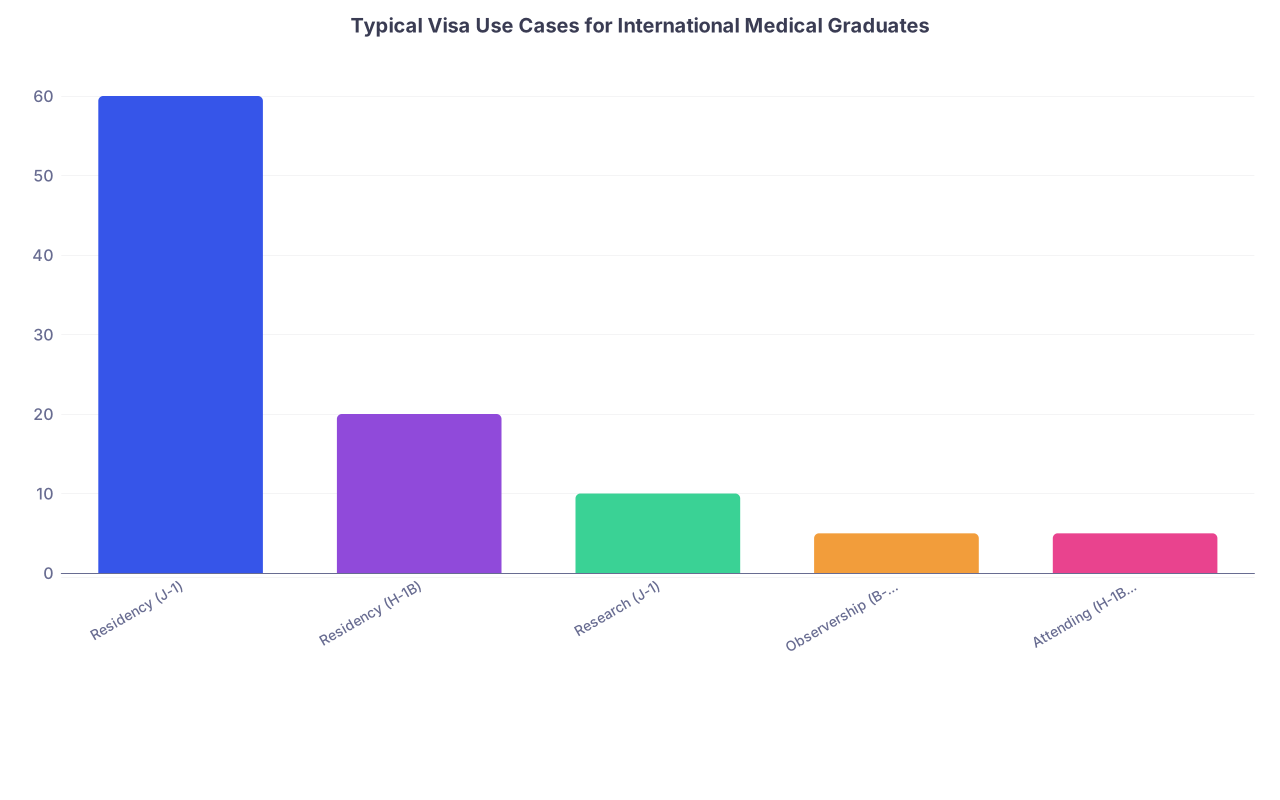
| Category | Value |
|---|---|
| Residency (J-1) | 60 |
| Residency (H-1B) | 20 |
| Research (J-1) | 10 |
| Observership (B-1/B-2) | 5 |
| Attending (H-1B/O-1) | 5 |
B‑1/B‑2 Visitor Visa
Purpose: Short visits, observerships, interviews, conferences, USCE (unpaid).
You don’t train or work clinically on this. You’re an observer only.
You might use this:
- For U.S. residency interviews
- For 2–8 week observerships at a hospital
- To attend medical conferences or meetings
This is not your long-term solution. It’s a bridge for short-term exposure.
J‑1 Research Scholar / Short-Term Scholar (Non-Clinical)
Purpose: Research only. No direct patient care.
Useful for:
- Doing a research year(s) at a U.S. institution to strengthen your CV
- Taking a gap between med school and residency applications
- Postdoctoral research if you shift toward academia
This has its own rules and sometimes its own 2‑year return requirement, depending on funding and skill list. Don’t confuse this with the J‑1 physician category used for residency.
O‑1 Visa (For Extraordinary Ability)
Purpose: Work visa for people with “extraordinary ability” in science, education, athletics, etc.
For medicine, this generally comes into play later:
- Post-residency, as an attending
- Often for people with strong publications, awards, big-name references
If you’re just starting med school abroad, O‑1 is not your immediate concern. It’s more of a “future you” thing if you build a strong academic portfolio.
If You Want to Stay in the U.S. Long-Term After Training
This is what most people actually care about when they ask, “What visa type do I need?”
They don’t just mean “How do I do residency?”
They mean “How do I end up living and working in the U.S. as a doctor long-term?”
Here’s the realistic hierarchy.

| Step | Description |
|---|---|
| Step 1 | Med School Abroad |
| Step 2 | Apply to US Residency |
| Step 3 | J-1 Residency |
| Step 4 | H-1B Residency |
| Step 5 | Return on H-1B/Green Card Later |
| Step 6 | Change to H-1B in US |
| Step 7 | Directly Pursue H-1B Extension/Green Card |
| Step 8 | Residency Visa |
| Step 9 | After Residency |
Best Long-Term Route (If You Can Pull It Off)
- Get H‑1B for residency
- Stay on H‑1B as a fellow or attending
- Have your employer sponsor you for a green card (EB‑2 or EB‑3, sometimes NIW if underserved area)
Why it’s better:
- No 2‑year J‑1 home requirement blocking your green card
- You keep lawful status the whole way
- You keep options open for later O‑1 or permanent residence
Reality check:
You’ll need a program that:
- Sponsors H‑1B, and
- Accepts IMGs with H‑1B, and
- Is somewhere you can realistically match with your scores, school, and CV
You’re not just picking a visa type. You’re picking which doors you’re closing or leaving open.
Typical J‑1 → Waiver → H‑1B → Green Card Route
If you end up on J‑1 for residency (most IMGs do), the usual survival path looks like:
- Do residency/fellowship on J‑1
- Get a J‑1 waiver job (like Conrad 30 in an underserved area)
- Switch to H‑1B at that job
- Have that employer file your green card (often EB‑2 NIW or employer-sponsored EB‑2/EB‑3)
- After some years, you’re a permanent resident
Messy? Yes. But very common.
How Your Choice of Medical School Country Affects Visas
The U.S. doesn’t care where you went in terms of the visa category, but it absolutely cares in practice for whether you get a visa-sponsoring residency.
Things that actually matter:
- How strongly your school’s graduates match to U.S. residencies
- How well known the school is to U.S. program directors
- How good your clinical exposure and letters will be
- How early you can start USMLE prep and USCE
Caribbean schools, Eastern Europe, Asia, and Latin America all send people to the U.S. every year. But the numbers, specialties, and visa sponsorship patterns differ a lot.
Don’t choose a school just because “they send people to the U.S.” Ask:
- How many matched last year?
- How many were on J‑1 vs H‑1B?
- What specialties? What states?
- Do they have structured USMLE prep and U.S. rotations?
Concrete To-Do List Before You Commit to Studying Abroad
Here’s what you should actually do now, before you ship yourself and your life savings overseas.
Identify your current status:
- U.S. citizen, PR, or foreign national?
- If PR, talk to an immigration lawyer about reentry permits.
Decide your real long-term goal:
- “I want to train in the U.S. then go back home.”
- “I want to live and practice in the U.S. permanently.”
Those are different playbooks.
Look at residency programs now:
- Check whether they sponsor J‑1 only or J‑1 and H‑1B
- Match that to the specialties you’re interested in
Ask each target med school:
- How many grads matched to U.S. residencies in the last 3–5 years?
- Any data on visa types (J‑1 vs H‑1B) for their graduates?
- Do they support USMLE prep and U.S. clinical rotations?
Have one consultation with a qualified immigration attorney:
- Especially if you’re not a U.S. citizen/PR
- Ask them bluntly: “If I do med school in X country and want to end up practicing in the U.S., what’s the most realistic visa path for me?”
FAQ (Exactly 7 Questions)
1. I’m a U.S. citizen going to med school abroad. Do I need a visa to return for residency?
No. You’ll return on your U.S. passport. You don’t need a work or trainee visa. Your focus should be on ECFMG certification, USMLE scores, and building a competitive residency application.
2. I’m a green card holder planning to do med school abroad. Can I lose my U.S. permanent residence?
Yes. Long absences (like 4–6 years of med school) can be treated as abandonment of your green card. You should talk to an immigration attorney about a reentry permit before you leave and about how often you need to return and maintain ties to the U.S.
3. Which is better for residency: J‑1 or H‑1B?
For long-term U.S. life, H‑1B is better. It allows dual intent and doesn’t force you into a 2‑year home-country stay. But it’s harder to get: fewer programs sponsor it and you usually need Step 3 done beforehand. J‑1 is more common and easier to get, but carries the 2‑year return requirement or the need for a waiver job later.
4. Can I switch from J‑1 to H‑1B after residency without going home for 2 years?
Yes, but only if you get a J‑1 waiver first. That typically means taking a qualifying job (often in an underserved area) that sponsors your waiver, then moving to H‑1B status through that employer. Without the waiver, the 2‑year home-country rule blocks H‑1B and most green card options.
5. Do I need a visa to come to the U.S. just for observerships or interviews?
If you’re not a U.S. citizen/PR, yes. Usually you’ll use a B‑1/B‑2 visitor visa (or ESTA if you’re from a Visa Waiver country) for short stays like observerships, away rotations (non-clinical), or residency interviews. That visa does not allow hands-on clinical work, just observation and meetings.
6. Does the country where I do medical school change which U.S. visa I qualify for?
Not directly. The visa category (J‑1, H‑1B, etc.) is about what you’re doing in the U.S., not where you studied. But indirectly, your school’s reputation and match outcomes massively affect whether you can get into programs that offer H‑1B, or any U.S. program at all.
7. I want to eventually get a green card as a doctor. Which path makes that easiest?
The cleanest route is: match to a program that sponsors H‑1B, do residency (and maybe fellowship) on H‑1B, then have your employer sponsor your green card (often EB‑2/EB‑3, sometimes NIW). If you start on J‑1, you’ll usually need a J‑1 waiver job in an underserved area, move to H‑1B, and then pursue a green card.
Open a spreadsheet right now and make three columns: “My Status Today,” “Residency Goal in U.S.,” and “Realistic Visa Path (J‑1/H‑1B/Other).” Fill it in based on your situation. If you can’t do it clearly, that’s your signal to get concrete advice before you commit to an overseas medical school.