
The way most people read Caribbean and European med school match lists is wrong—and it leads them straight into six-figure mistakes.
You cannot just look at a glossy PDF with “98% match rate!” in big letters and a list of hospitals that sound impressive. You need to know what’s behind those numbers, what’s missing, and how to decode them like someone who’s actually been around residency programs.
Let me walk you through how to do this like a grown-up, not like a marketing department’s dream customer.
Step 1: Stop trusting the headline match rate
If you remember nothing else, remember this: the “overall match rate” on most international school websites is basically an advertisement, not an honest statistic.
Here’s what you need to ask immediately:
- Match rate for whom?
- Match rate in what?
- Match rate where?
Let’s break those down.
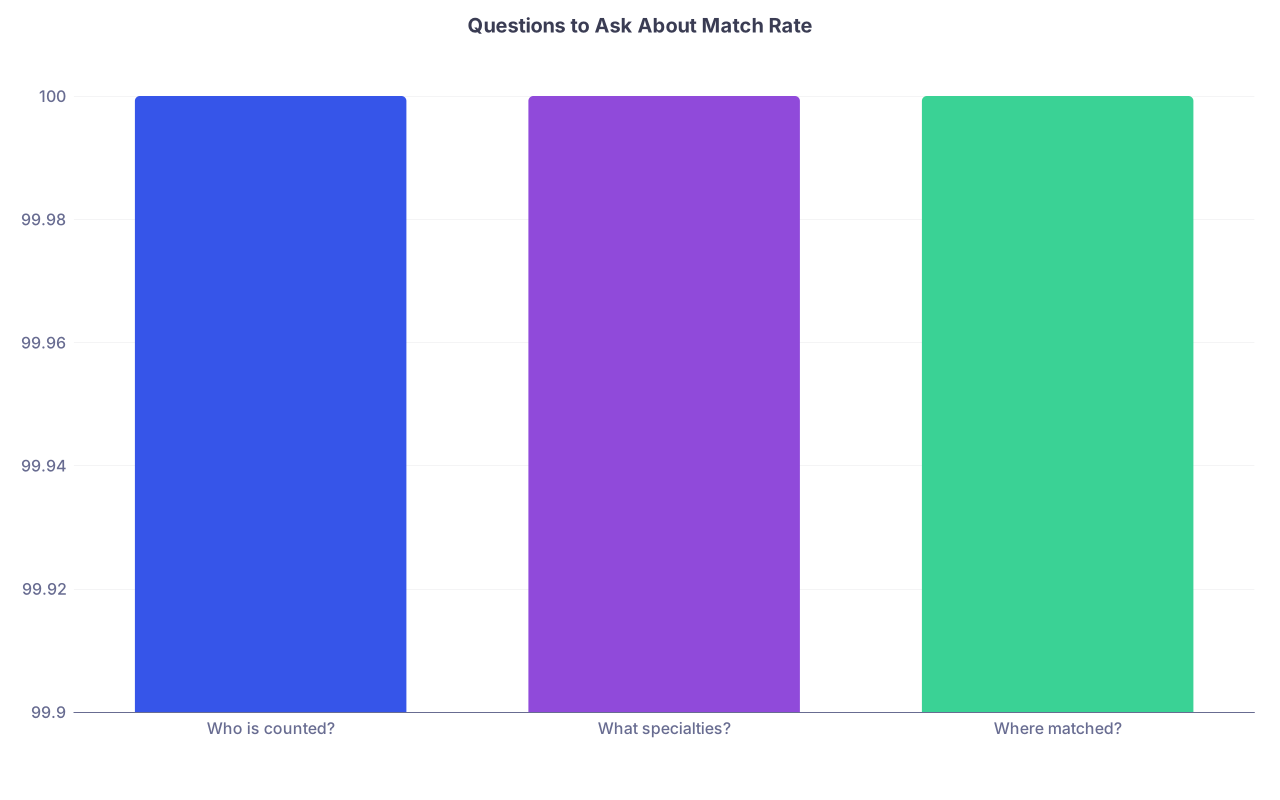
1. Who is included in the match rate?
Many Caribbean and some European schools love to quote something like “94% residency attainment rate.” But:
- Are they counting only students who reached graduation?
- Are they excluding people who failed out or left?
- Are they only counting people who applied for residency?
- Are they including people who matched in non-US systems (e.g., UK, home country) and bundling that into one pretty number?
You want this, specifically:
- Match rate among all first-time US residency applicants from that school in a given year
- Split for US-IMGs vs non-US-IMGs (US citizens who went abroad vs international citizens)
If they can’t or won’t show that breakdown, treat the headline number as marketing, not data.
| Category | Value |
|---|---|
| Who is counted? | 100 |
| What specialties? | 100 |
| Where matched? | 100 |
2. Match rate in what specialties?
A “strong match list” that’s 90% Internal Medicine preliminary, Family Medicine, and Transitional Years is not the same as a list with a good chunk of categorical IM, EM, Anesthesia, Surgery, Psych, etc.
Nothing wrong with primary care. But if you’re dreaming of Derm, Ortho, or even EM/Anesthesia, you have to be brutally realistic:
- Caribbean and most non-US schools have very low rates into the most competitive specialties.
- Even moderately competitive fields (EM, Anesthesia, Rad, some IM subs) are much harder as an IMG.
So when you see a school bragging “Matched in Surgery!” dig:
- Was it categorical general surgery or a one-year prelim spot?
- One person in surgery out of 600 grads is a fluke, not a pattern.
3. Match rate where?
There’s a world of difference between:
- Matching in the US vs Canada vs UK vs home country
- Matching at community programs vs major academic centers
- Matching at unaccredited or visa-restrictive hospitals overseas
For US residency chances, the only thing that really matters is:
How many grads are matching into ACGME-accredited US programs, and in which specialties?
Anything else is noise.
Step 2: Read the actual match list like a program director would
The match list itself is where the truth hides. You need to look past the school’s hype and read the fine print.
Here’s how.
Look at the distribution of specialties
Do not just scan for big-name hospitals. Scan for patterns.
You want to tally (even roughly):
- How many matched to:
- Internal Medicine (categorical vs prelim)
- Family Medicine
- Pediatrics
- Psychiatry
- Transitional Year
- Neurology
- General Surgery (categorical vs prelim)
- EM, Anesthesia, Radiology, OB/GYN, Ortho, etc.
If you see:
- Tons of IM prelim + Transitional Year + “Surgery – Preliminary”
- Very few categorical IM, FM, Peds, Psych
- Rare or zero EM/Anesthesia/Rads/competitive fields
…that’s a school where many students are scrambling for anything.
Decode “prelim” vs “categorical”
New students always miss this and it absolutely matters:
- Categorical = full residency program (e.g., 3 years IM, 4 years Psych)
- Preliminary = 1-year position (often a placeholder, with no guaranteed continuation)
A match list full of:
- “Internal Medicine – Preliminary”
- “General Surgery – Preliminary”
- “Transitional Year”
…means lots of grads are not landing stable, full training slots. These people will be back in the match later trying to secure a categorical position, sometimes unsuccessfully.
If a school’s match list does not label prelim vs categorical, that’s not an accident. That’s concealment.
Step 3: Compare Caribbean vs European match patterns realistically
You’re not comparing “Caribbean vs Europe” in a vacuum. You’re comparing specific schools with specific track records.
Still, there are typical patterns.
| Pathway | US Match Rate (First-Time Applicants) | Competitive Specialties | Primary Care Chances |
|---|---|---|---|
| US MD | Highest | Strong | Very strong |
| US DO | High | Moderate–Strong | Very strong |
| Top Caribbean (big 4-ish) | Moderate | Low | Moderate |
| Other Caribbean | Low | Very low | Low–Moderate |
| EU med school (US-focused) | Very variable | Very low | Low–Moderate |
Caribbean “Big 4” (SGU, Ross, AUC, Saba) generally:
- Have longer-established US match pipelines
- Offer US clinical rotations at known teaching hospitals
- Have a large alumni network in US community programs
But they also:
- Take in huge classes
- Filter people out with brutal attrition before USMLEs and clinicals
- Still leave a non-trivial chunk unmatched
European schools (Poland, Ireland, Italy, Eastern Europe, etc.):
- Vary wildly. Some have US-focused tracks; some barely think about the US.
- You may have to DIY USMLE prep and US clinical rotations.
- Many grads end up staying in Europe or going back to their home countries rather than the US.
Key point: Match lists from Europe can look thin not because the school is bad, but because fewer grads even apply to the US.
That’s why you must ask: “How many actually tried to match in the US last year, and how many succeeded?”
Step 4: Demand these 7 specific pieces of data
If you’re being serious about this decision, here’s what you ask admissions (in writing, politely but firmly):
- For the last 3–5 years, what was your:
- Number of US students starting basic sciences each year
- Number who reached clinicals
- Number who ultimately graduated
- Among graduates who applied to the US match as first-time applicants:
- How many matched to ACGME-accredited US programs?
- What is that percentage, by year?
- Breakdown of matched specialties by category:
- Primary care (IM, FM, Peds)
- Psych/Neuro
- Hospital-based (EM, Anesthesia, Rads, Path)
- Surgical specialties
- Percentage of positions that were:
- Categorical vs preliminary vs transitional
- USMLE Step 1 and Step 2 CK:
- First-time pass rates for US students
- Mean scores (if they’ll share)
- For European schools:
- How many grads each year apply to the US vs stay in Europe?
- A full, unedited match list with program names and specialties, not just cherry-picked highlights.
If all you get back is a marketing PDF and vague reassurances, that tells you everything you need to know.
Step 5: Assess your risk tolerance against the match data
This is the part people avoid. They want a school to tell them “you’ll be fine.” That’s not how this works.
Here’s the harsh reality:
- If you’d be a strong US MD/DO applicant, going abroad usually worsens your odds, not improves them.
- Caribbean/EU can make sense if:
- You’ve already struck out in US cycles
- You understand you’re likely headed toward primary care in a community program
- You’re okay with significant risk of not matching at all
Look at the school’s match list, then ask yourself:
- Could I live with my outcome looking like the average grad from this school?
- Would I be okay if I ended up in IM/FM/Peds/Psych at a small community program, not an academic center?
- Am I prepared to crush USMLEs (Step 1 and 2 CK) because, as an IMG, mediocre scores will probably sink me?
If your internal voice is saying “No, I want competitive specialties, big cities, top hospitals,” then you’re playing in the wrong league by going offshore. You’re making the game twice as hard for yourself.
Step 6: Red flags and green flags in match lists
To make this concrete, look for these patterns.
Green flags
- Match lists that:
- Clearly label “categorical,” “preliminary,” “transitional”
- Provide full program names and locations
- Show consistent matches each year into primary care across multiple community programs
- Data separated:
- US grads vs non-US grads
- US match vs non-US systems
- Step 1/2 pass rates for US students above ~85–90% first-time
Red flags
- Vague statements like “99% of grads eventually secure residency worldwide”
- No raw numbers (only percentages)
- Match lists that:
- Only show hospital names but not specialty or position type
- Highlight famous hospitals but you can’t tell if it’s prelim vs categorical
- Very few matches per year despite large class sizes
- Lots of “preliminary” and “transitional year” with few categorical slots
When something looks off, it usually is.
Step 7: How to sanity-check specific programs yourself
Don’t just trust the school’s website. Cross-check.
- Look up the hospitals listed in the match list:
- Are they ACGME-accredited residency programs?
- Are they community vs university programs?
- Check if they commonly take IMGs:
- Many program websites list past or current resident medical schools.
- Search:
- “[Hospital name] residency IMG friendly”
- “[Hospital] [specialty] program residents” and look at the med schools represented.
You’re trying to answer: Is this a real pipeline, or a one-off case they keep marketing for ten years?
Quick mental framework to evaluate any match list
When you see a match list, run through this checklist:
- Volume: How many total matches per year vs reported class size?
- US focus: How many US ACGME matches vs non-US placements?
- Specialty pattern: Mostly primary care vs mix of specialties?
- Position type: Clear labeling of categorical vs prelim vs transitional?
- Trend: Similar outcomes across several years, or noisy/erratic?
- Transparency: Are they hiding key details or putting it all on the table?
If at any step you have to work too hard to decode the truth, assume the truth is not flattering.
A simple decision tree for you
Here’s the practical sequence I’d use if I were advising you directly.

| Step | Description |
|---|---|
| Step 1 | Considering Caribbean/European school |
| Step 2 | Apply US first if at all possible |
| Step 3 | Request hard match data from school |
| Step 4 | High risk. Reconsider or accept primary-care-only mindset |
| Step 5 | Review specialty mix and prelim vs categorical |
| Step 6 | Step back. Consider reapplying in US or alternative paths |
| Step 7 | Proceed with eyes open and USMLE-first mindset |
| Step 8 | Have you applied to US MD/DO? |
| Step 9 | US ACGME match rate for US citizens >= 60%? |
| Step 10 | Comfortable with likely outcome? |
FAQ: Evaluating Match Lists from Caribbean and European Med Schools
1. Is a 90–95% “residency attainment rate” from a Caribbean school believable?
Usually not in the way you think. That number often includes:
- Only graduates (excluding those who failed out)
- People matching outside the US
- People who took multiple cycles to match
- Sometimes even non-ACGME programs
You want to see: first-time US match rate among US grads, not a blended feel-good number.
2. How many matches into competitive specialties should I expect from an international school?
For most Caribbean and European schools, matches into Derm, Ortho, ENT, Plastics, Neurosurgery, and sometimes EM or Anesthesia will be extremely rare—single digits, if any, out of hundreds of grads. If a school markets one Ortho match from 2017 on every brochure, take that as a rare exception, not a repeatable outcome.
3. Are European medical schools better than Caribbean schools for US residency?
“Better” is the wrong word. They’re different. Many European schools are not primarily designed as US feeder schools. That can mean:
- Less structured USMLE support
- Less help arranging US clinical rotations
- Fewer grads targeting the US
That said, some specific programs (e.g., English-language tracks in Poland or Ireland that have explicit US-focused streams) may produce outcomes comparable to mid-tier Caribbean schools. You have to evaluate school by school, not “Europe vs Caribbean” as a block.
4. If a school refuses to give detailed match data, is that a deal-breaker?
In my opinion, yes—or very close. You’re about to spend $200k+ and years of your life. If a school cannot or will not:
- Provide multi-year US match numbers
- Separate US grads vs non-US grads
- Show specialties and position types clearly
…you’re walking in blind. Meanwhile, US MD/DO schools publish detailed match lists without drama. The contrast is telling.
5. What’s a “minimally acceptable” match profile for me to even consider an international school?
Bare minimum, I’d look for:
- Consistent US ACGME match rate of at least ~60%+ for US citizens as first-time applicants
- Majority of matches in categorical IM/FM/Peds/Psych, not just prelims and TYs
- Clear USMLE Step 1/2 first-time pass rates above ~85–90% for US students
Even then, you should assume you’re primarily aiming for community-based primary care, and you’ll need strong scores and solid US clinical evaluations to be competitive.
Open one Caribbean or European school’s match list right now and do this: count how many entries say “preliminary” or “transitional year.” If you cannot tell, or if that number makes your stomach drop, listen to that feeling before you sign anything.