

The belief that you “cannot be competitive without full U.S. core rotations” is flat-out wrong. What kills international medical graduates is not lack of opportunity; it is lack of a clear, ruthless strategy to build U.S. exposure with the little access they actually have.
You are not in a U.S. med school. You will not magically get 24 weeks of ACGME hospital clerkships. Fine. You can still build a credible U.S.-ready profile. But you have to stop thinking like a passenger and start acting like a project manager.
Here is how you fix this.
1. Know What “U.S. Clinical Exposure” Actually Means
Most IMGs talk about “U.S. clinical experience” like it is one thing. Programs do not. They slice it into categories in their heads, and some count more than others.
| Type of Experience | Typical Label Used by Programs | Relative Strength |
|---|---|---|
| Inpatient, hands-on, 3rd/4th year electives at teaching hospitals | U.S. Clinical Experience (USCE) | Very High |
| Outpatient hands-on electives / subinternships | U.S. Clinical Experience (USCE) | High |
| Observerships in academic hospitals | U.S. Clinical Exposure | Medium |
| Private office observerships | “Shadowing” / Exposure | Low–Medium |
| Research with some clinical interface | Research / Exposure | Variable |
If your school gives you:
- 0–1 official U.S. rotations, or
- only “affiliated” clinics that are basically private offices, or
- you are in a country where U.S. rotations are nearly impossible
…you need to strategically combine several weaker forms of exposure into something that looks coherent and intentional.
The real goals of U.S. exposure
Programs care less about the label and more about whether you:
- Understand U.S. clinical culture (EMR, documentation, hierarchy, patient expectations).
- Have at least 1–2 U.S. physicians willing to write detailed, believable letters.
- Can function in English with patients and teams without drama.
- Show commitment to the U.S. system in the specialty you say you want.
Your question is not “How do I copy an American medical student’s transcript?”
Your question is “How do I hit those four goals with the cards I have?”
2. Audit Your Reality and Pick a Target
You cannot fix what you have not measured. Do an honest, unflinching audit.
Step 1: Map out your constraints
Write down:
- Your year in school and expected graduation date
- Passport/visa situation (visa-free entry? visitor visa possible? J-1/H-1B history?)
- Money you can realistically invest (not fantasy money)
- Current U.S. contacts (family, alumni, faculty, random LinkedIn connections)
- School rules about taking electives abroad (how many weeks, what years, what approvals)
Most IMGs skip this and jump straight into “what rotations can I get?” That is like choosing a surgery before knowing the diagnosis.
Step 2: Pick a realistic specialty band
Some specialties are brutal for IMGs without top-tier U.S. experience: dermatology, plastics, ortho, neurosurgery. If you are aiming for those with no U.S. core rotations and weak research, you are playing lottery, not strategy.
General bands:
More realistic without heavy U.S. cores (with good scores and letters):
Internal Medicine, Family Medicine, Pediatrics, Psychiatry, Neurology, PathologyHarder but not impossible if you build strong targeted exposure:
General Surgery, OB/GYN, EM, AnesthesiologyBorderline unrealistic without major U.S. electives + strong research:
Derm, Ortho, Neurosurgery, Plastics, ENT, Urology, Ophthalmology
You can still try something competitive, but your plan must be aggressive: step scores, research, and very selective, high-quality exposure.
3. Turn One or Two Rotations into a Signal, Not a Footnote
You said “limited rotations abroad.” Fine. Then each week you do get in the U.S. has to hit above its weight.
A. Choose rotations that do double duty
One 4-week rotation can do several things at once:
- Give you a strong letter writer
- Provide cases and stories for your personal statement and interviews
- Show direct alignment with your chosen specialty
- Demonstrate comfort in the U.S. system (EMR, rounding, presentations)
Priority rules:
- Academic over private practice
- In your target specialty over random filler
- Service that sees diverse pathology over sleepy outpatient clinics
- A supervisor who regularly works with students over someone “doing you a favor”
If you can do only 8 weeks total in the U.S., a smart combination might be:
- 4 weeks: Internal Medicine inpatient at a teaching hospital
- 4 weeks: Rotation in your desired field (e.g., cardiology, psych, FM clinic, etc.)
B. Act like a subintern, not a visiting tourist
You want attendings thinking: “This person functions like our own students.”
Concrete behaviors:
- Show up early, print lists, pre-round on 2–3 patients without being told.
- Volunteer to write mock notes (even if they cannot go in the chart) and ask for feedback.
- Present patients in the local style (“one-liner, then HPI, then focused exam, etc.”).
- Ask the resident or senior: “What do your best students do that your average ones do not?” Then do it.
- Keep a small notebook of cases, learning points, and feedback.
You are building not just experience, but stories:
- “Tell me about a time you handled a difficult patient.”
- “Describe a situation where you received critical feedback.”
Your limited rotation should give you 10+ specific, U.S.-based examples to use later.
C. Extract the letter properly
Do not finish a rotation and then send a sad email three months later. You need to prime the pump.
Week 3–4 script to your attending:
“Dr. Smith, I am aiming to apply to Internal Medicine in the U.S. next year. I have really valued working with you and the team.
If you feel you know my clinical work well enough, would you be comfortable writing a strong letter of recommendation for my residency applications?”
Key parts: “strong letter,” “know my work well enough,” and putting it in person, not just email.
Then you send:
- Your CV
- USMLE scores (if available)
- A short paragraph about your goals and what you did on the rotation (patients followed, presentations, any small projects)
One good U.S. letter from a real attending who worked with you closely beats three generic “She was present and punctual” letters from random observers.
4. Supplement Rotations with Strategic Observerships
No, observerships are not as strong as official electives. Yes, too many low-quality shadowing experiences look weak. But well-chosen observerships can:
- Give you U.S. context
- Provide exposure in your specialty
- Sometimes lead to letters (if you contribute meaningfully in allowed ways)
A. Prioritize academic or large group settings
You want:
- Large teaching hospitals
- Community hospitals with residency programs
- Big multispecialty groups with structured observer programs
Avoid endless shadowing in a tiny solo clinic where your entire role is “stand in the corner and nod.”
B. Behave like a quiet worker, not a tourist
You are not there for selfies in a white coat. You are there to show you can:
- Show up consistently and on time
- Ask focused, clinical questions (not “How do I get a green card?”)
- Read about cases you observed and discuss them the next day
- Offer small, allowed help: organizing lists, calling records, prepping patient education materials (if permitted)
End goal: not just “I did an observership,” but a specific attending thinking, “If I had a spot, I’d take this person as a resident.”
5. Build U.S.-Relevant Experience Without Physically Being in the U.S.
Limited rotations abroad means you cannot camp out in the U.S. for a year. So you stack U.S.-aligned experiences from your home base.
A. Remote / international research with U.S. collaborators
Research still moves the needle, especially tied to your specialty.
How to build this:
- Identify U.S. departments that publish heavily in your interest area (use PubMed).
- Look for authors with international ties or projects involving your country/region.
- Email a tight proposal offering concrete help, not vague “I want to learn.”
Example structure:
- Subject: “Medical student offering data analysis help for [X] project”
- 3 sentences about who you are (school, year, exam status)
- 2 sentences about skills (Excel, R, basic statistics, systematic reviews)
- 1–2 lines suggesting how you can help (“I can screen abstracts, extract data, manage REDCap entries, etc.”)
You do this 30–40 times intelligently, not 3 times lazily.
Even one poster at a U.S. conference or one coauthored paper with a U.S. institution is better than zero. It screams: “I can operate at your level.”
B. Telehealth / virtual clinics with U.S. teams
Post‑2020, more groups run virtual clinics or reach out to overseas students.
Look for:
- U.S.-run global health projects that include teleconsults
- Academic departments with global partnership programs
- NGOs with U.S. physicians supervising remote clinical work
You log “virtual encounter experience” supervised by U.S. doctors, learn their clinical reasoning, and sometimes squeeze out a letter.
C. Structured U.S.-focused self-education
Do not underestimate how much programs respect a student who clearly knows the U.S. system from day one.
Concrete actions:
- Learn a major U.S. EMR workflow on your own (Epic-style logic, order sets, note templates).
- Use resources like UpToDate, U.S. guidelines (USPSTF, ACC/AHA, etc.), and practice designing U.S.-style plans.
- Watch U.S.-based case conferences, grand rounds (many on YouTube from big centers).
You then showcase this in interviews:
- “In my home country, we would do X, but I know U.S. guidelines recommend Y because of Z trial. On my limited U.S. rotation I practiced doing it the U.S. way.”
Translate: I am trainable; minimal orientation required.
6. Create a Coherent “U.S. Story” in Your Application
Your experiences will be fragmented. That is fine. What kills IMGs is when they look random.
You want to tie everything into one clear narrative: “I had limited official access, but I built substantial U.S.-relevant exposure by design.”
A. Use your personal statement to control the narrative
Do not whine about your school’s limitations. Acknowledge constraints once, then focus on what you did anyway.
Example framing:
- “Because my medical school offers only 4 weeks of official electives abroad, I knew I would need to be deliberate about my U.S. exposure.”
- “I chose an Internal Medicine elective at [Hospital] where I cared for [concise example].”
- “To complement this, I pursued an observership in outpatient cardiology and engaged in a remote outcomes project with a U.S. team at [Institution].”
You are showing intention and problem-solving, not victimhood.
B. Make your CV tell a U.S.‑aligned story
Group your experiences under headings like:
- “U.S. Clinical Electives”
- “U.S.-Based Observerships / Exposure”
- “Research and Scholarly Activity (U.S.-Collaborative)”
Do not scatter them randomly. You want program directors skimming your CV to immediately see: “Okay, this person has at least some U.S. touchpoints.”
7. Manage Timelines and Scores Ruthlessly
If you are short on U.S. rotations, your metrics cannot be mediocre. Programs will forgive your school’s limitations far faster than they forgive your exam failures.
A. USMLE strategy with limited rotations
Short version: do not waste your U.S. rotation time studying for exams. That is backwards.
Optimal order if possible:
- Finish your major clinical cores at home.
- Prep seriously for Step 1 (even if pass/fail, aim for comfort with U.S.-style questions).
- Take Step 1.
- Take Step 2 CK after a period of heavy question‑bank work and clinical exposure.
- Then schedule U.S. rotations once your clinical reasoning in U.S. question style is solid.
Why? Because on rotation you want to impress, not cram. If you are still mixing up basic management sequences, you will not stand out.
B. Time your U.S. rotations relative to ERAS
Ideal: at least one major U.S. rotation done by May–June before your ERAS application year so:
- You have time to get letters uploaded.
- You can reference those experiences in your personal statement.
- You are not waiting on last‑minute letters in October like half the applicant pool.
If your school’s calendar is rigid, then you design backward from your graduation date and match cycle, not forward from vague plans.
8. Build and Exploit a Micro‑Network
This part is uncomfortable for many IMGs. Too bad. Quiet, competent students who never follow up leave opportunities on the table.
A. Track every contact
Make a simple spreadsheet:
- Name
- Role (attending, resident, coordinator, fellow)
- Place and type of contact (rotation, observership, research, conference)
- Specialty
- What you did with them / what they saw you do
- Last contact date
You are not spamming people. You are maintaining a professional network like any American student does without feeling guilty.
B. Ask targeted, small favors
Things you can reasonably ask:
- “May I list you as a reference if programs have questions?”
- “Could I email you once my ERAS application is ready to get your perspective on my program list?”
- “Do you know if your program considers IMGs, and what they especially value?”
Once in a while, yes, this leads to:
- An observership spot
- A rotation recommendation
- An internal forward of your CV
Most of your classmates abroad never even ask. That is your edge.
9. Sample 12‑Month Plan If You Only Get One U.S. Elective
Here is what a concrete, disciplined plan can look like for a student in 4th/5th year with only one 4-week U.S. elective available.
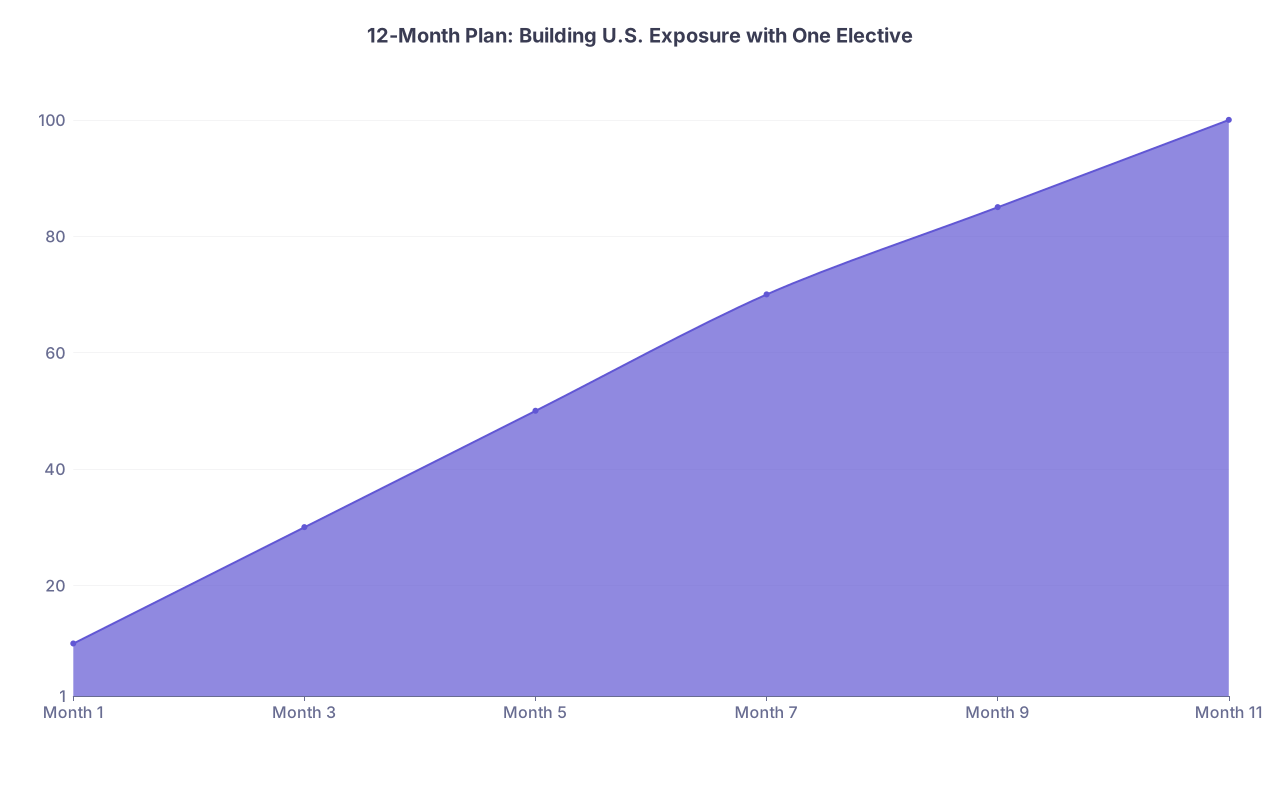
| Category | Value |
|---|---|
| Month 1 | 10 |
| Month 3 | 30 |
| Month 5 | 50 |
| Month 7 | 70 |
| Month 9 | 85 |
| Month 11 | 100 |
Think of the “value” as your competitiveness percentage relative to your own best potential, not the whole world.
Months 1–3
- Finish major home-country clinical cores.
- Heavy Step 1 prep (if not done).
- Start building research outreach list and sending emails.
- Identify at least 20–30 potential observership programs and understand their requirements and deadlines.
Months 4–6
- Take Step 1 if pending. Start CK prep.
- Secure at least one remote research commitment with a U.S.-based mentor or team.
- Confirm dates for your single U.S. elective and apply for required documents (visas, immunizations, insurance, background checks).
- If possible, arrange a short observership before or after the elective in the same city.
Months 7–9
- Take CK (ideally before traveling, so your mind is free).
- Do the U.S. elective and crush it (see earlier section).
- Immediately follow with 2–4 weeks of observership if your visa/time allows.
- Ask for letters in person in Week 3–4.
Months 10–12
- Finalize ERAS personal statement weaving in your U.S. rotation / observership / research.
- Make program list realistically weighted toward IMG‑friendly institutions.
- Stay in touch with letter writers and research mentors.
- Continue remote research work so it does not look like a one‑month fling.
Is this perfect? No. But you go from “zero exposure and hand‑waving” to “one solid U.S. elective, one observership, and one U.S.-linked research line” in a year. That is a serious upgrade.
10. Common Pitfalls That Sink IMGs with Limited Rotations
Learn from others’ mistakes. I have watched these wreck otherwise decent applications.
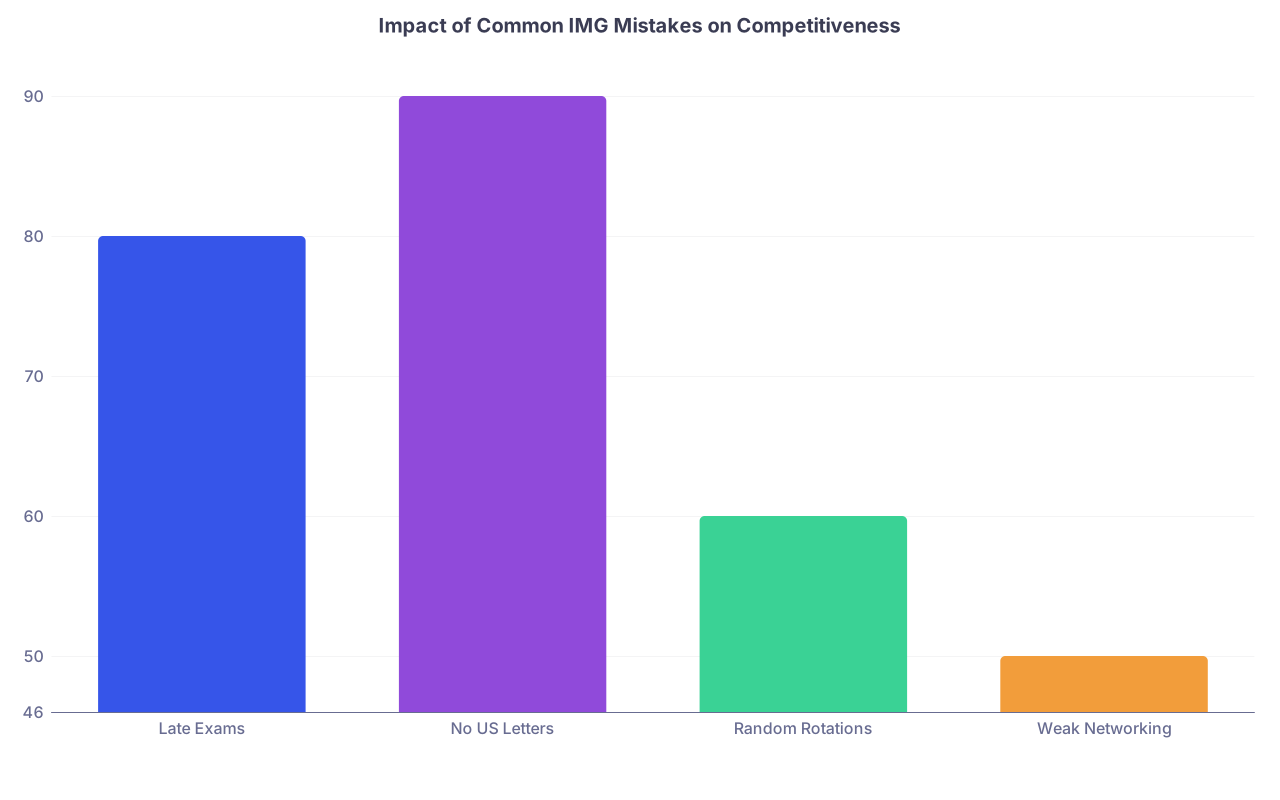
| Category | Value |
|---|---|
| Late Exams | 80 |
| No US Letters | 90 |
| Random Rotations | 60 |
| Weak Networking | 50 |
Higher value = more damage to your competitiveness (again, relative scale, not exact percentages).
A. Waiting too long for a “perfect” rotation
You do not need Mayo or Harvard to get value. One decent community hospital where people actually work with you beats two years of procrastination chasing brand names.
B. Collecting weak letters from random observers
A vague letter from a busy professor who barely remembers you is dead weight. You are better off with fewer, stronger letters from people who supervised you meaningfully.
C. Overloading on random observerships
Ten scattered 1-week shadowing experiences in different specialties make you look lost. Better: one or two 4-week blocks in or near your target specialty.
D. Not aligning specialty choice with your exposure
If all your U.S. exposure is in Internal Medicine and your application screams “I want surgery,” that disconnect will hurt you. Your U.S. exposure should support the story you are telling.


