You are here
You just got serious about applying to a European medical program taught in English. Maybe it is in Poland, Italy, the Czech Republic, or the Netherlands. The website says “Program language: English.” The entrance exam is in English. The OSCEs will be in English. And you are thinking:
“My grammar is fine. But can I really take a patient history in English? Present a case? Argue a differential diagnosis in front of attendings without sounding lost?”
That is the right fear. I have watched smart students fail oral exams, not because they did not know the medicine, but because they could not say it cleanly in English under pressure. I have also seen average English speakers turn into very strong communicators by doing six specific things consistently for 6–12 months before starting school.
This is what you need: not “better English” in general. Better medical English. The way real students talk on the wards. The way examiners expect you to speak. So let us fix that.
Step 1: Get brutally clear on the real communication tasks
Do not start with random “medical English” textbooks. Start with the actual tasks you will need to perform, especially in the first 2–3 years.
Here is what almost every European English-taught med program will demand:
Entrance exam & interviews
- Reading and understanding biology/chemistry/physics questions in English
- Explaining your reasoning briefly
- Possibly a motivation letter or interview
First 2 preclinical years
- Answering oral exam questions in anatomy, physiology, biochemistry
- Presenting short definitions: “What is heart failure?” “Define anemia.”
- Describing mechanisms: “Explain how insulin works.”
- Reading and understanding lecture slides and textbooks
Clinical years
- Taking a basic history in English
- Presenting a patient case to a doctor
- Explaining diagnoses and treatments clearly
- Participating in bedside teaching
If your current "English practice" does not match these tasks, you are wasting time.
So first, write down your honest current level for each of these:
- Reading speed for scientific/medical texts
- Comfort speaking for 2–3 minutes without stopping
- Listening to fast English (lectures, YouTube) and actually understanding the details
- Writing short, clear paragraphs with correct grammar
Now you know what to target.
Step 2: Build a medical English core – not random vocab lists
You do not need all of medical English. You need the 20% you will use 80% of the time.
Here is the core you must master before you start:
- Body systems in English (cardiovascular, respiratory, GI, neuro, endocrine, musculoskeletal, renal, reproductive)
- Common symptoms: chest pain, shortness of breath, dizziness, nausea, swelling, fatigue, fever, headache, etc.
- Basic patient history questions
- Clinical verbs: complain of, present with, suffer from, refer, admit, discharge, prescribe, monitor, rule out
- Exam phrases: on examination, vital signs, unremarkable, within normal limits
Stop memorizing isolated words like “acetabulum” if you cannot say “The patient came in because of pain in the right hip.”
Here is a concrete 6-week protocol to build your core:
Week 1–2: Systems and symptoms
- Make 8 sections in a notebook or digital doc: Heart, Lungs, Brain, GI, Kidneys, Hormones, Muscles/Bones, Blood.
- For each section:
- List the main organs
- Add 10–15 common diseases in English
- Add 10–15 related symptoms in English
Week 3–4: History and exam language
Every day, write and say out loud:
- 5 history questions
- 5 exam-related phrases
Example sets:
- “What brings you in today?”
- “How long have you had this problem?”
- “Does anything make it better or worse?”
- “Do you have any allergies?”
- “Are you taking any medications?”
Exam phrases:
- “On examination, the patient appears comfortable.”
- “Heart sounds are normal, no murmurs detected.”
- “Lungs are clear to auscultation.”
- “There is no abdominal tenderness.”
- “Vital signs are within normal limits.”
Week 5–6: Short case sentences
Pick common conditions: hypertension, diabetes, pneumonia, myocardial infarction, asthma, depression.
For each condition, write 3–5 sentences following this pattern:
- “X is a condition where…”
- “It is characterized by…”
- “Risk factors include…”
- “Patients typically present with…”
- “Treatment usually involves…”
You are building templates that you will re-use in every exam.
Step 3: Create a daily English training routine that actually works
Random practice does nothing. You need a fixed, boring, effective routine.
Aim for 60–90 minutes per day, broken into 3 blocks:
- Speaking (20–30 minutes)
- Listening (20–30 minutes)
- Reading + writing (20–30 minutes)
1. Speaking: the part most students skip
If your mouth does not practice, you will freeze in oral exams.
Here is what to do:
Daily 5-minute monologue
- Pick a topic: “Hypertension,” “Anatomy of the heart,” “Causes of chest pain.”
- Set a timer for 5 minutes.
- Talk out loud in English without stopping. No phone. No notes.
- Accept mistakes. The goal is flow, not perfection.
Record 2 minutes every other day
- Use your phone.
- Pick one small topic: “What is diabetes?”
- Record yourself explaining it to a non-medical friend.
- Listen once. Note 2–3 errors or awkward phrases. Re-record once using better phrases.
Shadowing (copying native speakers)
- Find a short YouTube clip of a doctor explaining something to a patient (BBC health, Mayo Clinic, NHS, etc.).
- Listen to 1 minute. Then play each sentence and immediately repeat it, trying to match rhythm and intonation.
- 10 minutes of this is more powerful than any “pronunciation course.”
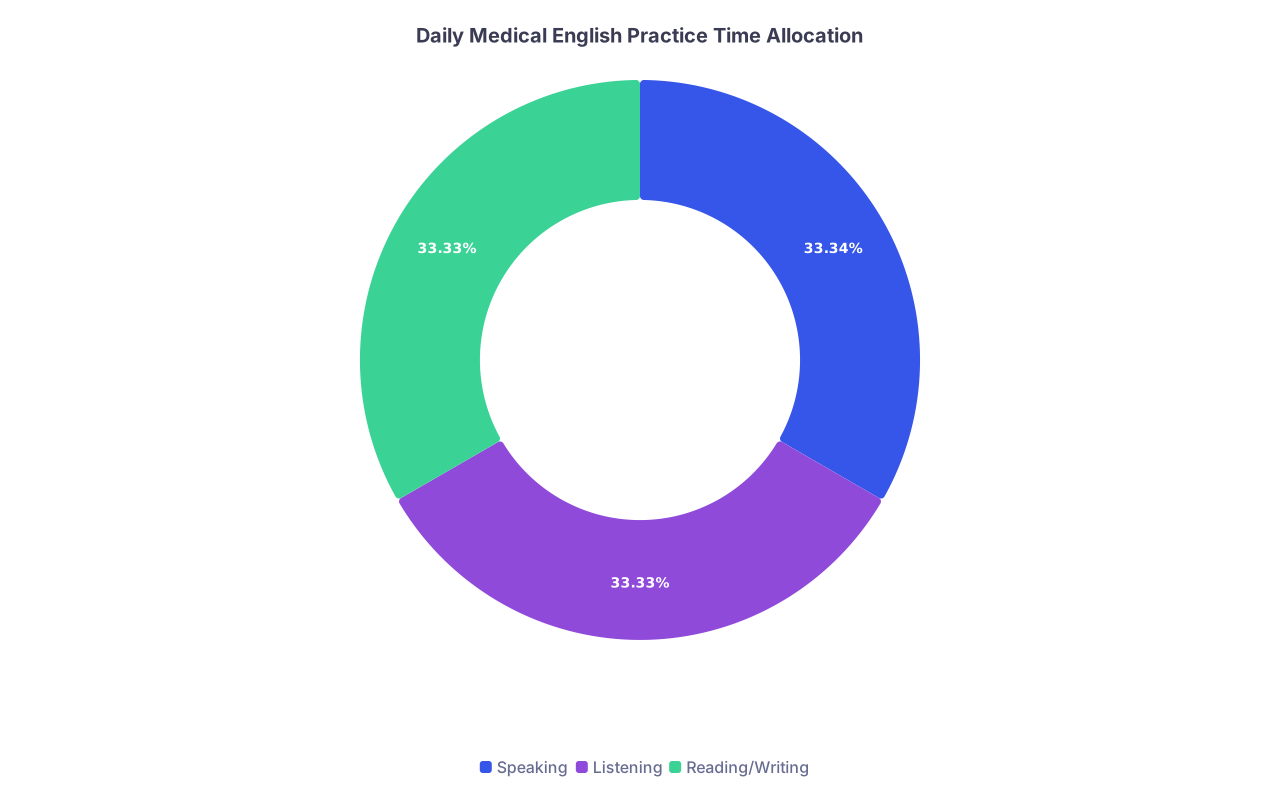
| Category | Value |
|---|---|
| Speaking | 30 |
| Listening | 30 |
| Reading/Writing | 30 |
2. Listening: simulate real-life pressure
You are going to get hit with fast English: lecture halls, clinical explanations, exam questions.
Here’s the drill:
Choose your sources:
- “Strong Medicine” (YouTube)
- “Osmosis” / “Armando Hasudungan”
- Khan Academy Medicine
- Any UK NHS patient info videos
Active listening routine (25 minutes):
- 10 minutes: Watch at normal speed, no subtitles, just to see what you catch.
- 10 minutes: Watch same segment with English subtitles. Pause and repeat key phrases. Write down 5–10 new terms.
- 5 minutes: Turn subtitles off. Watch it again. See how much you improved.
3. Reading + writing: train like it is exam season
You are going to be reading English textbooks. The sooner you start, the easier first year will feel.
Reading (15–20 minutes):
- Use:
- Khan Academy articles
- Mayo Clinic disease overviews
- Patient.info
- Pick one short article (e.g., “Hypertension – Symptoms and Causes”).
- First pass: read quickly for general understanding.
- Second pass: underline key vocabulary and phrases.
- Use:
Writing (10–15 minutes):
- Either:
- Summarize the article in 5–8 sentences in your own words, or
- Write 5–10 exam-style statements:
- “Hypertension is defined as…”
- “Complications of untreated hypertension include…”
- “First-line treatment usually consists of…”
- Either:
If you do this daily for 6 months, you will walk into your program with a massive advantage.
Step 4: Focus specifically on oral exam and viva skills
European med schools love oral exams. This is where weak English hurts most.
You need to practice the format, not just the content.
Learn stock exam phrases
You do not want to improvise everything. Build a script bank.
Examples:
Starting answers:
- “Hypertension is defined as…”
- “The main causes of X can be divided into…”
- “There are three main types of Y…”
Structuring your answer:
- “First, I will talk about the definition. Then the causes, then the treatment.”
- “We can classify this into acute and chronic forms.”
- “From a clinical perspective, the most important points are…”
Handling uncertainty:
- “I am not completely sure, but I think…”
- “I do not remember the exact value, but approximately…”
- “May I clarify the question?”
These phrases will save you when your brain is stressed.
Simulate mini viva sessions weekly
Once a week, for 30–45 minutes, run a “fake oral exam” with:
- A friend
- A tutor
- Or just yourself plus a question list
Protocol:
- Pick 5–10 basic topics: “Heart failure,” “Liver functions,” “Types of shock,” “Nephron anatomy.”
- For each topic, ask a question out loud like an examiner:
- “Define heart failure.”
- “List complications of diabetes.”
- “Explain the cardiac cycle.”
- Answer aloud as if it is the real thing. 1–3 minutes per answer.
- Record at least 2–3 answers every session and review briefly.
You are training:
- Speed of retrieval
- Clarity of structure
- Avoiding nervous filler words in English
Step 5: Build clinical communication early (even before you touch a patient)
Most people wait until clinical years to learn how to talk to patients in English. That is late.
You can do a lot of this before you ever wear a white coat.
Learn a standard history template in English
Memorize it until you can say it half-asleep. For example:
Introduction
- “Hello, my name is [Name]. I am a medical student. Is it okay if I ask you some questions?”
Chief complaint
- “What brings you in today?”
- “Can you tell me more about your symptoms?”
History of present illness
- “When did it start?”
- “Has it been constant or does it come and go?”
- “Does anything make it better or worse?”
- “Have you had this problem before?”
Associated symptoms
- “Have you had any fever, weight loss, or night sweats?”
- “Any chest pain, shortness of breath, or swelling?”
Past medical history
- “Do you have any chronic illnesses?”
- “Have you ever been in the hospital or had surgery?”
Medications & allergies
- “Are you taking any regular medications?”
- “Do you have any allergies to medicines or foods?”
Family & social history
- “Does anyone in your family have similar problems?”
- “Do you smoke or drink alcohol?”
Closing
- “Thank you. I will discuss this with my supervisor.”
Now, practice this out loud weekly. No patient needed. You are building automatic language.
Role-play once a week
If you can find a partner (even another premed, or someone online), do this:
One person is the patient with a simple scenario:
- “30-year-old with asthma attack”
- “45-year-old with chest pain”
- “20-year-old with abdominal pain”
The other person is the student taking the history in English using the template.
Switch roles.
You will discover quickly:
- Phrases you do not know but need: “sharp vs dull pain,” “radiating,” “pins and needles,” “bloating,” “palpitations.”
- Gaps in your symptom vocabulary by system.
Write these unknowns down and add them to your vocab core.
Step 6: Use the right tools (and avoid the wrong ones)
There is a huge amount of noise in “medical English” resources. You do not need most of it.
Here is what I have seen actually help students:
| Purpose | Recommended Tool/Source |
|---|---|
| Listening | Osmosis, Khan Academy Medicine |
| Speaking feedback | iTalki, Preply (medical tutor) |
| Reading | Mayo Clinic, Patient.info |
| Vocabulary | Anki decks, personal word list |
| Oral exam prep | Partner role-plays, question banks |
High-yield tools
YouTube medical education channels
Free, clear, and closer to how real doctors talk.Spaced repetition apps (Anki, Quizlet)
But you must create cards from phrases, not just single words.
Example card:- Front: “Explain what hypertension is in one sentence.”
- Back: “Hypertension is a chronic condition where blood pressure in the arteries is persistently elevated above normal levels.”
Language tutors with medical focus
One 60-minute session per week with a tutor who understands basic medical language can accelerate progress more than 10 hours of solo study.
What to do in sessions:- Simulated oral exams
- Case presentations
- Correction of your common grammar/pronunciation errors
Low-yield or misleading tools
Generic “Medical English” courses with no speaking practice
If they do not include real-time speaking, skip.Massive vocab books without context
Memorizing 2000 medical terms you will never say is pointless.Watching medical dramas as “study”
Entertainment is fine. But the language is often inaccurate and overdramatic. Not your main source.
Step 7: Fix the 5 most common language problems early
I keep seeing the same five English issues destroy otherwise strong students.
1. Overcomplicated grammar
You do not need advanced grammar in oral exams. You need clear, short sentences.
Bad: “Hypertension, which is, you know, defined as persistent elevation of, I mean, the arterial pressure, it can, like, be caused by multiple… factors.”
Better:
“Hypertension is persistent elevation of arterial blood pressure. It has many causes. The most common is essential hypertension, where we do not know the exact cause.”
Fix: force yourself to answer in 2–3 simple sentences first. Then add complexity only if you have time.
2. Wrong prepositions and collocations
Examiners will understand you, but you will sound less natural.
Common errors:
- “Suffer of diabetes” → “Suffer from diabetes”
- “Operate him” → “Operate on him”
- “Discuss about the treatment” → “Discuss the treatment”
Fix: when you learn a new verb, learn its usual preposition and object together:
“Complain of chest pain,” “Admit a patient to hospital,” “Discharge a patient from the ward.”
3. Confusing similar medical terms
Example:
- “Infection” vs “inflammation”
- “Ischemia” vs “infarction”
Fix: write one clean definition in your own words for each, and practice saying them aloud.
4. Speaking too quietly or too fast
Nervous students try to hide behind volume or speed.
Fix: practice with your phone camera. Watch your own body language. Deliberately slow down and increase volume by 20% in practice. Most of you are more understandable immediately.
5. Lack of “filler” phrases that buy time
Native speakers use these constantly:
- “Let me think for a second.”
- “That is a good question. I would start by saying…”
- “I am not completely sure, but I think…”
Without them, you panic in silence.
Fix: memorize 5–10 of these and force yourself to use them during practice sessions.
Step 8: Design a 6-month plan before starting your program
Let us put this all together. Here is how a realistic 6-month build-up might look if you are serious.
Months 1–2: Foundations
Goal: Build core vocab + get used to daily English work.
Weekly structure:
5–6 days/week:
- 20 min speaking (monologues + shadowing)
- 20 min listening (YouTube lectures)
- 20 min reading + writing (disease overviews)
1 day/week:
- 45–60 min with tutor or language partner, focusing on:
- Basic history-taking phrases
- Simple pathophysiology explanations
- 45–60 min with tutor or language partner, focusing on:
Months 3–4: Exam-style communication
Goal: Move from “general English” to “exam English.”
Add:
- 1 weekly “mini oral exam” session (30–45 min)
- Start building:
- Definitions of core conditions
- Standard phrases for structuring answers
- One-page summaries (in English) of key topics
Focus now on:
- Explaining mechanisms (“Insulin lowers blood glucose by…”)
- Grouping ideas logically (“We can divide this into…”)
Months 5–6: Clinical and high-pressure practice
Goal: Simulate real stress and clinical language.
Add:
- 1 weekly role-play of patient history (30–45 min)
- 1 weekly session fully in English with tutor/partner:
- Present 1–2 “patients”
- Get corrected live
Shift your speaking topics more toward:
- Case presentations:
- “Mr. Smith is a 55-year-old man who presented with…”
- Integrating symptoms, findings, and simple differential diagnoses.
By the time you step into your first lecture in Europe, you will not be “the international student with weak English.” You will just be a student who happens to have an accent and speaks clearly.
Step 9: Adapt slightly for country and program style
Not all European programs are the same. But they share patterns.
Typical differences:
Central/Eastern Europe (Poland, Hungary, Czech Republic, Romania)
- Many international students
- Heavy use of oral exams and vivas
- Professors may have strong accents
- You must be good at listening to different English accents
Western/Northern Europe (Netherlands, Sweden, some German schools)
- Often more structured, evidence-based teaching
- More emphasis on presentations, PBL, and group discussions
Adjust your preparation:
If you are going to a place with heavy oral exams:
- Double down on viva simulations.
- Practice rapid short answers and definitions.
If you are going to a PBL-heavy program:
- Practice explaining your reasoning step-by-step.
- Do group discussions in English with friends at least once every 2 weeks about clinical cases.
Final step: Do something concrete today
Do not bookmark this and “plan to start later.”
Do this right now:
- Pick one common disease: hypertension or diabetes.
- Open a Mayo Clinic article about it in English.
- Read it once.
- Close it.
- Take your phone, press record, and explain in English:
- What the disease is
- Main symptoms
- One or two complications
- Basic treatment
Speak for 2–3 minutes. Then listen to yourself once. Write down 3 things you want to say more clearly next time.
That single recording will tell you more about your current medical English level than any placement test. And it is the first real rep in building the communication skills you will need to survive – and succeed – in a European medical program taught in English.