

They are not equivalent. And pretending they are is how students end up blindsided during USMLE prep, residency applications, and clinical rotations.
There’s overlap, sure. You can absolutely become a competent physician—and even a U.S. resident—coming from an English-language EU medical school. I’ve seen it done. But “equivalent to a U.S. MD curriculum”? That’s the marketing line, not the reality.
Let’s separate three different things people lazily mash together:
- Accreditation / recognition
- Curriculum content and structure
- Outcomes for U.S.-bound students (USMLE, Match, residency performance)
Those are not the same. A school can be “recognized” by some body, follow a vaguely similar set of subjects, and still leave you far less prepared for U.S. practice than a typical U.S. MD program does.
The Core Myth: “Our Curriculum Mirrors U.S. Medical Schools”
Here’s the sales pitch you see on websites:
“Our 6-year English-language MD program follows a curriculum equivalent to U.S. medical schools and prepares students for USMLE exams.”
That’s doing a lot of work with the word “equivalent.”
What’s actually similar
Most EU English-language programs aimed at internationals (think Poland, Hungary, Czech Republic, Romania, Bulgaria, etc.) do cover the “big blocks” of medicine:
- Anatomy, physiology, biochemistry
- Pathology, pharmacology, microbiology
- Internal medicine, surgery, OB/GYN, pediatrics, psych, etc.
On paper, it looks familiar to an LCME-accredited U.S. MD curriculum. They’ll show you a table with preclinical years, then clinical years, OSCEs, rotations. It feels reassuring.
But you’re not comparing like with like. You’re comparing course titles, not:
- Contact hours
- Integration of clinical reasoning
- Assessment style
- USMLE alignment
- Quality of clinical exposure
And that’s where the gap opens.
| Category | Value |
|---|---|
| Preclinical Classroom | 60 |
| Integrated/Case-Based | 10 |
| Clinical Rotations | 30 |
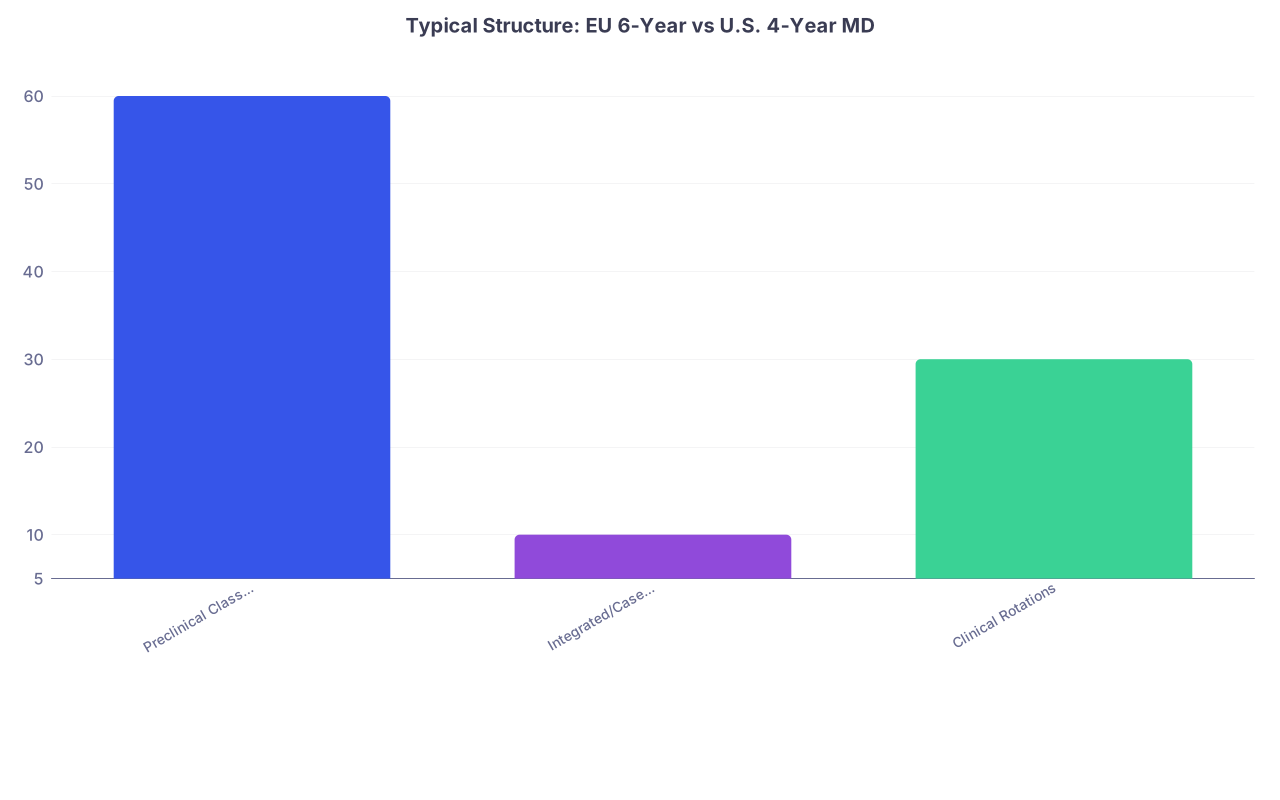
(For many EU 6-year programs aimed at high-school graduates, the first 2–3 years are heavy on classroom/basic science with less early patient contact; the percentages above are rough illustrative proportions, not universal truth.)
Structural Differences That Actually Matter
1. Entry level: high-school vs. bachelor’s degree
Most English-language EU programs admit students straight from high school into a 6-year curriculum. U.S. MD programs admit after at least 3–4 years of undergrad, usually with a completed bachelor’s degree.
That difference shows up in:
- Maturity and study skills
- Prior exposure to biochemistry, molecular biology, statistics, psychology
- Expectations of independent learning
So EU schools often spend a chunk of the early years on content U.S. students already covered in undergrad. That eats time that U.S. schools can use for integrated clinical reasoning, population health, systems-based practice, etc.
When schools claim “same content as a U.S. MD,” they rarely adjust for this academic starting point.
2. Lecture-heavy vs. integrated, case-based teaching
Plenty of EU schools still run on a traditional, siloed model:
- Massive lectures
- Subject exams that barely talk to each other
- Minimal structured small-group case discussions
U.S. MD programs have been beating the “integrated systems-based, early clinical exposure, active learning” drum for years. Is that always done well? No. But the direction of travel is clear: more clinical reasoning earlier, less passive memorization.
I’ve talked to students at well-known EU English programs who said:
- “We had 400+ slide lectures for pharmacology, and the exam was pure recall.”
- “Clinical correlations were an afterthought—like one slide at the end.”
- “Nobody mentioned USMLE-style questions in the official curriculum; seniors just handed us third-party question banks.”
If your goal is practicing in Europe, that might be fine. For the U.S., where Step 2-style problem-solving dominates, it’s a handicap.
3. Exams: pattern recognition for the US vs. local tradition
U.S. MD schools are built around NBME-style exams and the USMLE ecosystem.
EU schools are built around their national licensing exams and EU standards.
That creates a pretty brutal misalignment in some programs:
- Heavy emphasis on oral exams and “tell me what you know” viva-style grilling
- Narrow, professor-specific expectations that reward regurgitating their notes
- Minimal exposure to multi-step, integrated multiple-choice questions
You can be “top 10%” in your class and still get smacked by U.S. board-style questions because you trained for a different sport.
4. Clinical rotations: depth, supervision, and responsibility
Clinicals are where marketing claims blow up the fastest.
In many EU English programs:
- Access to procedures and hands-on tasks is tightly controlled
- Locals may be favored for more meaningful roles vs. international students with limited language ability
- Teaching during rounds can be sporadic, faculty assessment highly variable
I’ve heard versions of this line from multiple EU grads:
“I saw a lot. I did very little.”
Compare that to a U.S. third-year clerkship where students are:
- Writing daily notes
- Presenting patients
- Getting pimped on rounds
- Getting evaluated with standardized tools tied to ACGME competencies
Again, you can supplement this with electives in the U.S. (and many successful EU grads do), but it’s not inherently “equivalent.”
The USMLE Problem: “We Prepare Students for the Boards”
Some EU schools publicize USMLE pass data. Most don’t. That’s telling.
| Group | Step 1 Pass Rate* |
|---|---|
| U.S. MD (LCME-accredited) | ~95%+ |
| U.S. DO | ~90%+ |
| Top-tier EU programs (self-selected) | ~70–85% |
| [Weaker EU/Caribbean-type programs](https://residencyadvisor.com/resources/international-med-schools/any-caribbean-school-is-fine-what-long-term-outcomes-actually-show) | Often <60% |
*Approximate, based on available reports, alumni surveys, and typical patterns; EU data is rarely transparently published.
The key problem: for many EU schools, USMLE prep is external to the official curriculum. It’s student-driven:
- Students self-organize into USMLE study groups
- Use UWorld, AMBOSS, Anki, First Aid independently
- Attend review courses on their own time and dime
The school may offer:
- A seminar or two about “U.S. opportunities”
- Some faculty who loosely know what USMLE is
- Maybe a subject exam or OSCE that mimics some aspects of U.S. assessment
That’s not the same as a curriculum designed around USMLE-level reasoning.
If a program says “USMLE preparation is the responsibility of the student,” translate that as: “Our curriculum is not actually built to U.S. standards; you’re on your own.”
| Category | Value |
|---|---|
| Local exams and classes | 80 |
| Dedicated USMLE-style prep | 20 |
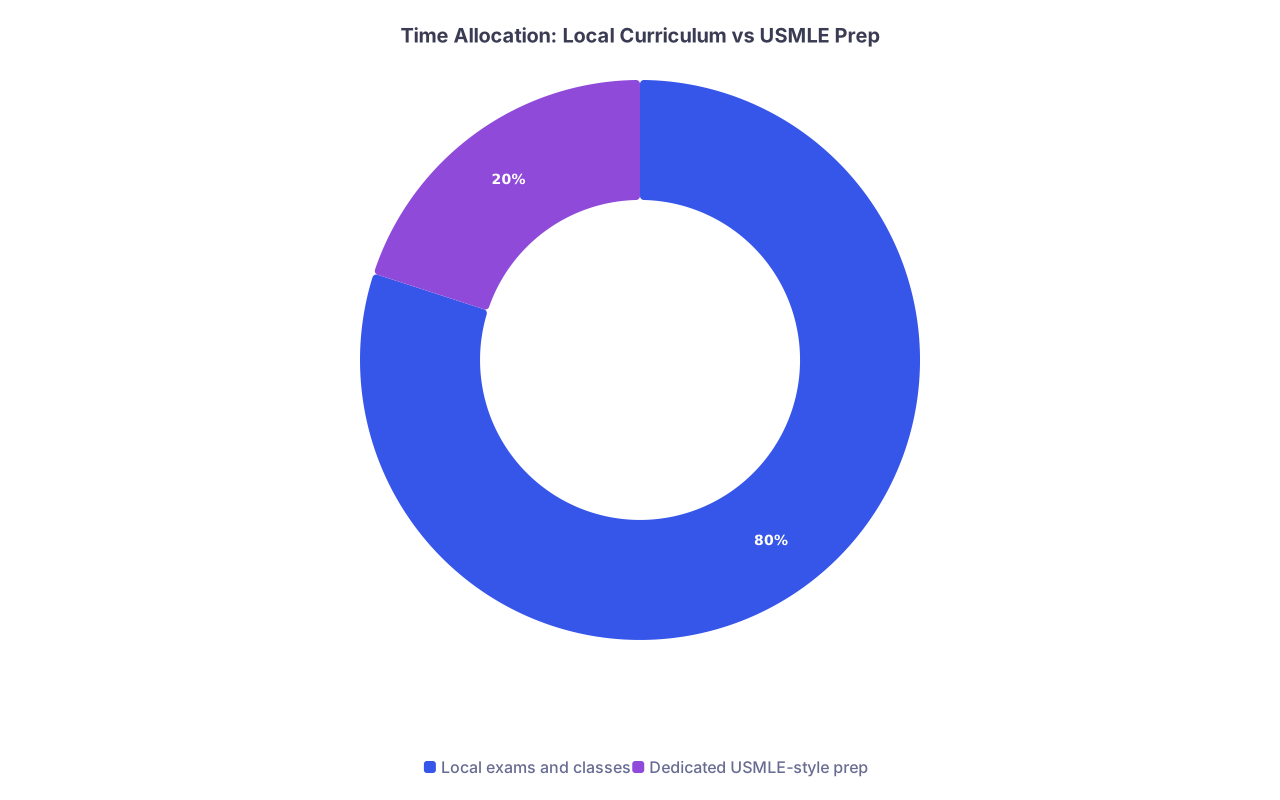
For many EU students targeting the U.S., that 20% is nights, weekends, and summers—while their U.S. MD counterparts are getting tested continuously in that format.
Accreditation, Recognition, and the FAIMER/ECFMG Trap
A favorite marketing trick: hiding behind acronyms.
You’ll see:
- “Listed in the World Directory of Medical Schools (WDOMS)”
- “Recognized by the medical council of X country”
- “Graduates eligible for ECFMG certification”
Here’s the uncomfortable truth:
Being listed or recognized is the low bar. It means “not totally fake.” It does not mean “equivalent to U.S. MD.”
Also, ECFMG has tightened rules:
- By 2024+, international graduates must come from a school accredited by an agency that meets certain WFME/ECFMG standards.
- That filters out some garbage schools.
- It still doesn’t guarantee U.S.-style curriculum, strong USMLE performance, or good Match outcomes.
Equivalence in bureaucratic paperwork is not equivalence in educational quality or U.S. competitiveness.
Match Outcomes: Where the Myth Really Cracks
You can talk curriculum all day; residency directors care what you can do and how you score.
Here’s the reality:
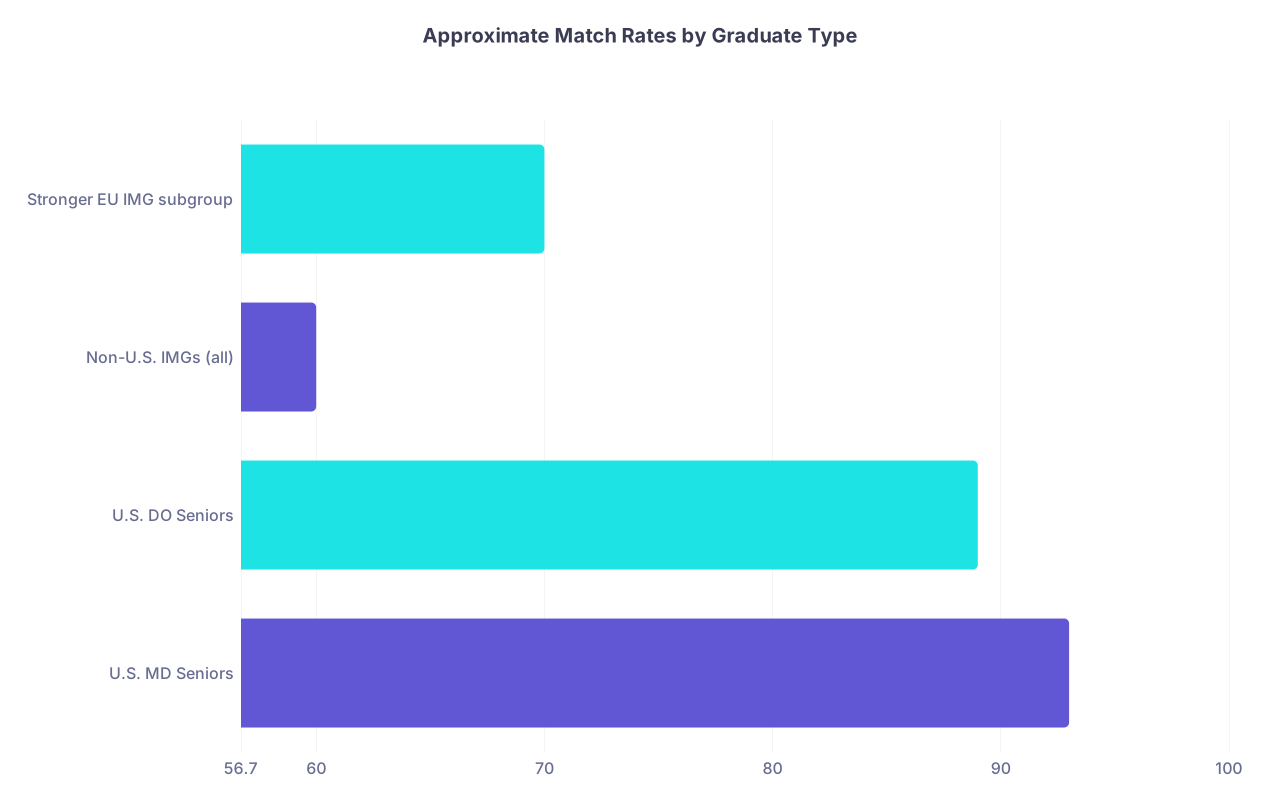
- U.S. MD seniors match at rates around 92–94% overall.
- International medical graduates (IMGs) overall match around 55–65% depending on the year.
- Among IMGs, EU English-language grads are one subset. Better than some Caribbean output, worse than most U.S. MD.
And those who match from EU programs tend to be:
- Strong test takers (Step 1/2 CK often well above average)
- Proactive about U.S. clinical electives
- Aggressive in seeking research or networking opportunities
Not “typical product of a perfectly equivalent curriculum.” More like “exception who managed to build a U.S.-friendly profile on top of a non-U.S. baseline.”
| Category | Value |
|---|---|
| U.S. MD Seniors | 93 |
| U.S. DO Seniors | 89 |
| Non-U.S. IMGs (all) | 60 |
| Stronger EU IMG subgroup | 70 |
Again, these are ballpark numbers from recent NRMP data and alumni patterns, not precise for every country or school. The gap, though, is very real.
The Language and Clinical Reality on the Ground
One more thing marketing rarely emphasizes: the hospital doesn’t speak English just because the classroom does.
In many EU programs:
- Lectures, slides, and exams for internationals are in English.
- Patients, nurses, and often the clinical team… are not.
Consequences:
- You miss nuances of the history and physical.
- You’re sidelined during rapid decision-making.
- You struggle with documentation systems in the local language.
This isn’t about intelligence; it’s logistics. If your goal is training for U.S.-style, team-based, communication-heavy care, you are practicing with one arm tied behind your back during many rotations.
Some students partly fix this by:
- Taking intensive language courses
- Spending their first 1–2 years getting conversational or better
- Or doing 4th/5th year electives in English-speaking environments (UK, Ireland, U.S.)
But you have to treat that as your problem to solve, not something the curriculum automatically handles.
Where EU English-Language Programs Do Shine
Now, I’m not saying these programs are trash. That’s lazy thinking on the other extreme.
They can be a good path for certain people:
- You didn’t get into U.S. MD/DO and refuse the for-profit Caribbean route.
- You genuinely want to live and practice in Europe and see the U.S. as a “maybe.”
- You value lower tuition and cost of living over the prestige or convenience of U.S./Canadian schools.
Some EU programs have:
- Excellent basic-science teaching (ironically, often more rigorous than many U.S. programs).
- Huge volume of patients with diverse pathology.
- Strong reputations locally and decent ones globally (e.g., Charles University, Semmelweis, some Polish faculties, etc.).
If you go in with eyes open, they can be a solid option.
What they are not is a clone of “Harvard but in English, with cheaper rent.”
How to Actually Judge “Equivalence” Before You Commit
Ignore the website gloss. Ask for data and specifics.
At minimum, push the school for:
USMLE performance (if they claim to prepare you)
- How many students take Step 1/2 CK each year?
- Pass rates? Average scores?
- How are they tracking and verifying this?
Match outcomes to the U.S.
- How many grads apply to the U.S. yearly?
- How many match? In what specialties?
- Names of hospitals, not just “our graduates go to the U.S.”
Contact hours and teaching format
- How many hours/week in small groups, case-based work, or simulation?
- How early do students see patients with meaningful responsibilities?
Language realities in clinical years
- Are there dedicated English-speaking wards or teams?
- What level of local language proficiency is expected for full participation?
If they can’t give you straight answers, that tells you everything.

| Step | Description |
|---|---|
| Step 1 | Considering EU English MD |
| Step 2 | Demand USMLE & Match Data |
| Step 3 | Evaluate Local/EU Career Path |
| Step 4 | Consider As Serious Option |
| Step 5 | High Risk for U.S. Path |
| Step 6 | Focus on Local Accreditation & Language |
| Step 7 | Goal = U.S. Residency? |
| Step 8 | Transparent, Strong Outcomes? |
The Short Version: What’s Actually True
Let’s kill the lazy myth cleanly.
Are English-language EU programs recognized and capable of producing competent physicians?
Yes, many are.
Are they automatically equivalent to U.S. MD curricula—in structure, USMLE alignment, and U.S. residency competitiveness?
No. Often far from it.
You can make one of these programs work for a U.S. career, but you’ll likely have to:
- Self-study intensely for USMLE using U.S.-oriented resources.
- Arrange U.S. clinical electives and letters of recommendation.
- Accept that your Match odds are lower than the average U.S. MD grad, even if you’re strong.
So, if you’re reading glossy lines like “our curriculum mirrors U.S. schools,” translate it properly:
“We teach medicine. Some students eventually make it to the U.S. The rest is on you.”
Key Takeaways
- Course titles and accreditation don’t equal U.S. MD equivalence. Content depth, teaching style, assessment, and USMLE integration are what count—and those are usually not the same.
- Outcomes, not claims, should drive your decision. Ask for concrete USMLE and Match data, not vague assurances about “opportunities abroad.”
- You can get to U.S. residency from an EU English program—but it’s an uphill, self-driven path, not a built-in feature of the curriculum.


