The mythology about “where IMGs come from” is outdated. The data shows a very specific, highly concentrated pipeline into ECFMG certification and, ultimately, U.S. residency—and it does not look like the casual Reddit narrative.
If you are thinking about attending an international medical school with the goal of training in the United States, you need numbers, not anecdotes. So let’s walk through what the data actually shows about ECFMG certification trends by region, which regions dominate U.S.-bound IMGs, and what that means for your planning.
I will draw primarily from ECFMG, NRMP, and FSMB data up to around 2023–2024. Exact yearly numbers fluctuate, but the patterns are stable and very clear.
1. The ECFMG Funnel: How Many IMGs Actually Make It?
Start with the big picture. ECFMG certification is the gatekeeper for IMGs entering U.S. residency. No certification, no ACGME-accredited residency.
What the data shows across recent years:
- Roughly 9,000–11,000 individuals achieve ECFMG certification per year.
- Of these, a substantial majority apply to U.S. residency programs through ERAS and NRMP.
- In recent NRMP Main Residency Matches, IMGs (both U.S. citizen and non-U.S. citizen) make up around 25–30% of all active applicants and about 23–26% of all matched PGY-1 positions.
Most critical point: the pipeline is not evenly distributed around the world. A relatively small set of regions and even a handful of countries dominate the ECFMG-certified, U.S.-bound IMG pool.
2. Regional Breakdown: Who Really Sends the Most IMGs?
ECFMG and NRMP data, combined with FSMB physician census reports, consistently show that five broad regions account for the majority of U.S.-bound IMGs:
- South Asia (especially India, Pakistan)
- Caribbean (offshore schools targeting U.S./Canadian students)
- Middle East & North Africa (including Egypt, Lebanon, Jordan, Iran)
- Latin America (Mexico, Dominican Republic, Brazil, etc.)
- Europe (especially Eastern Europe and a few Western European schools)
Let us quantify this in rough proportions. These are approximations pooled from several years of ECFMG and FSMB data and rounded for clarity—not single-year official counts, but directionally accurate.
| Region | Share of IMGs in U.S. Workforce* |
|---|---|
| South Asia (incl. India, Pak) | ~30–35% |
| Caribbean (offshore schools) | ~20–25% |
| Middle East & North Africa | ~10–15% |
| Latin America | ~10–15% |
| Europe (incl. Eastern Europe) | ~10–15% |
| Other regions (Africa, East Asia, etc.) | ~5–10% |
*Share of all international medical graduates in the U.S. active physician workforce, not U.S. graduates. Ranges reflect different years and classification schemes but the pattern is stable.
You can argue over a few percentage points. You cannot argue the hierarchy: South Asia + Caribbean together feed roughly half or more of the IMG pipeline.
3. South Asia: The Single Biggest Engine of U.S.-Bound IMGs
If you collapse the data country-by-country, one region sits clearly on top: South Asia.
Across ECFMG and FSMB data, India and Pakistan alone consistently rank among the very top source countries for U.S. IMGs.
Key patterns
- India is typically the #1 or #2 source country of IMGs in the U.S.
- Pakistan nearly always sits in the top 3–5.
- Together, India + Pakistan often account for roughly a quarter of all IMGs in the U.S. physician workforce.
Why?
Because these countries produce massive numbers of medical graduates, and a non-trivial fraction of them target the U.S. You do not need all that many percent to get a lot of volume when the denominator is huge.
What this means for you as an applicant
From a preparation standpoint:
- Competition among Indian and Pakistani grads for U.S. residency is fierce. Many have strong exam-taking culture, heavy clinical exposure, and aggressive study strategies.
- Historically, these applicants pushed high USMLE Step 1 and Step 2 CK scores, giving program directors a large, well-known pool of experienced IMGs to choose from.
- There is also a dense alumni network: many U.S. residency programs already have or have had Indian/Pakistani graduates, which reinforces the pipeline.
So if you are planning to be a U.S.-bound IMG from outside this region, your “peer competition set” includes a lot of very exam-focused South Asian applicants. That should influence how seriously you treat Step 2 CK and clinical experience.
4. Caribbean Schools: Volume Machines, Different Dynamics
The Caribbean is a completely different phenomenon.
Most South Asian or Latin American IMGs attend schools that mainly serve domestic health systems, then a subset aim for the U.S. Caribbean offshore schools are built from the ground up to send graduates into U.S. and Canadian residencies. This changes the numbers and the incentives.
The data reality
Across ECFMG certification trends and NRMP match data:
- U.S. citizen IMGs make up a large share of the IMG pool, and a huge fraction of those are from Caribbean schools.
- A small number of large Caribbean schools produce a disproportionate share of all U.S.-bound IMGs.
Think of names you see over and over in residency rosters:
- St. George’s University (Grenada)
- Ross University (Barbados, formerly Dominica)
- American University of the Caribbean
- Saba University
These four alone account for thousands of U.S.-bound applicants across a few years. Many smaller schools add to the volume, but in tiny numbers each.
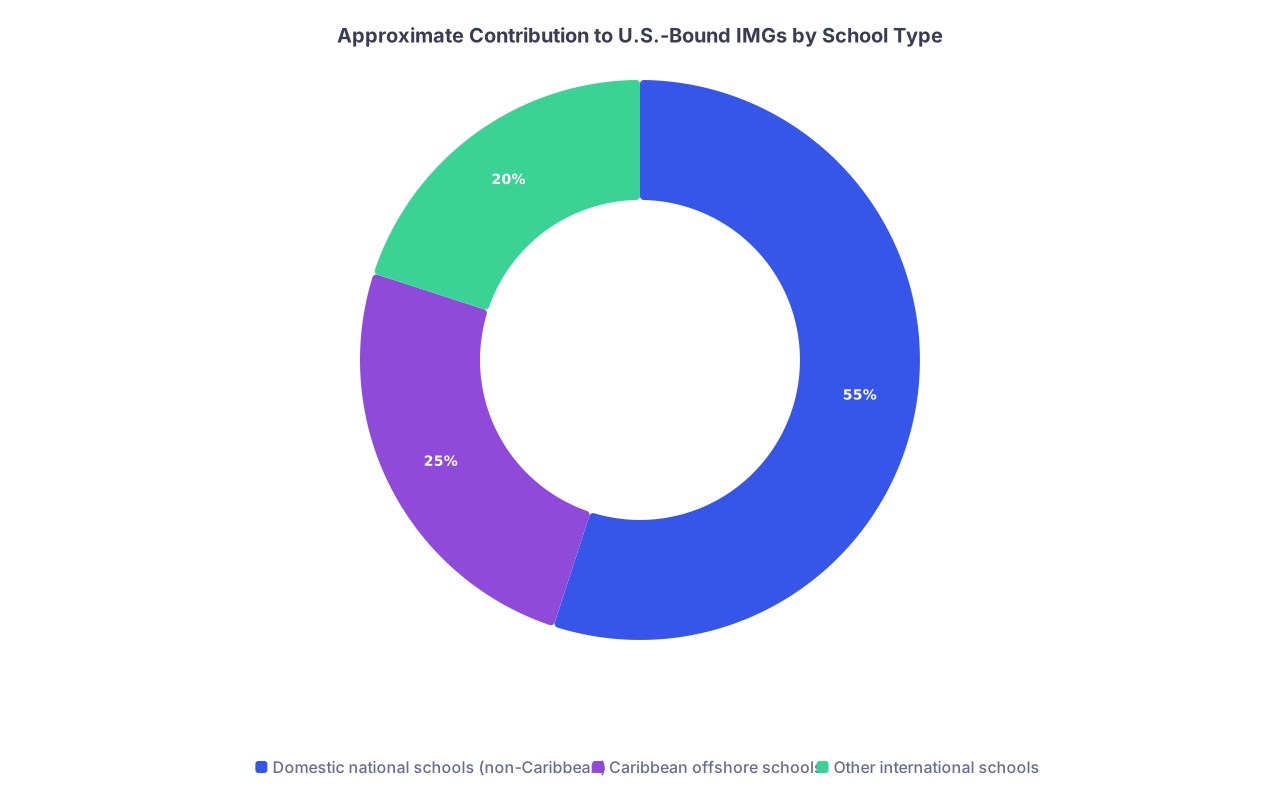
| Category | Value |
|---|---|
| Domestic national schools (non-Caribbean) | 55 |
| Caribbean offshore schools | 25 |
| Other international schools | 20 |
Again, these are rough, aggregated estimates. But the proportion is directionally correct: Caribbean offshore programs are a large minority of the U.S.-bound IMG stream despite being a tiny fraction of global medical schools.
The catch
High volume does not mean high success rate.
Caribbean schools admit many students with lower GPA/MCAT stats who were not competitive for U.S. MD/DO schools. Many of those students never reach the match, fail exams, or struggle to get interviews. ECFMG certification filters some of this, but the attrition before and after certification is real.
Data-backed takeaway: Caribbean schools produce a lot of U.S.-bound IMGs, but the risk of non-match is significantly higher compared with top-performing IMGs from strong national systems like India, Pakistan, or parts of Europe and the Middle East.
If you are choosing a Caribbean route, you are buying volume, infrastructure for U.S. exams, and a clear path—but with higher downside risk if your scores and clinical evaluations are not in the top group of your class.
5. Middle East & North Africa: Smaller Region, High Impact
Look at the data on active IMGs by country, and you will see a different pattern here: these countries do not produce massive global numbers of doctors, but they are heavily overrepresented in U.S.-bound IMGs relative to their size.
Countries that consistently show up near the top:
- Egypt
- Lebanon
- Jordan
- Iran (though political and visa constraints complicate the path)
- Syria (historically, though recent conflict has altered patterns)
In many of these places, the medical education systems are rigorous, with strong foundations in basic science and clinical exposure. You also see localized cultures of “U.S. medicine as a pathway,” often concentrated in specific universities.
I have seen applicants from a single Lebanese or Egyptian faculty of medicine dominating the IMG pool for a specialty at a mid-size U.S. program. Tight networks, strong mentorship, and a long tradition of sending grads abroad create a multiplier effect.
For you, the message is clear: If you are comparing “any foreign school” to an established national school in Egypt, Lebanon, or similar, the data tells you the latter usually has a better track record into the U.S.
6. Latin America: A Broad, Uneven Source
Latin America is numerically important but structurally fragmented.
On paper, you see:
- Large numbers of medical schools in Mexico, Brazil, Argentina, Colombia, Dominican Republic, etc.
- Solid absolute numbers of U.S.-bound IMGs, but spread across many institutions with widely variable quality and U.S.-orientation.
The Dominican Republic is a good illustration: it hosts a few schools that attract U.S. citizens seeking an international option (e.g., Universidad Iberoamericana, UNIBE) and many more that are primarily focused on domestic practice. Matching data shows some Dominican and Mexican grads in U.S. primary care programs, but not in the same concentrated way as Caribbean offshore schools.
Latin American IMGs who succeed in the U.S. typically follow one of two data-backed patterns:
- Strong domestic school, high Step 2 CK, plus research or extended U.S. clinical experience.
- U.S. citizen or U.S.-linked student at a regionally well-known school that proactively builds U.S. affiliations.
Statistically, Latin America sits in the middle: not the highest volume, not the lowest; not the most U.S-focused, not the most isolated. That ambiguity counts as risk if you do not have a clear plan.
7. Europe and Eastern Europe: Moderate Volume, Mixed Signals
Europe is not the monolith people imagine when they say “European medical school.”
You have:
- Western European schools (Germany, France, UK, etc.) that mostly feed their own health systems. A small fraction apply to the U.S. with strong academic profiles.
- Central and Eastern European / post-Soviet schools that have marketed heavily to international students (including from the U.S., Canada, Israel, and elsewhere).
The data shows that:
- Overall European contribution to the U.S. IMG pool is significant but not dominant.
- A handful of Eastern European schools show up repeatedly in IMGs matched to internal medicine, family, psych, etc. They are essentially regional analogues to Caribbean schools, but often with lower tuition and different language barriers.
From a pure data perspective, the “European” advantage is overstated. Program directors care about:
- Scores
- Clinical performance
- Communication
- Letters from known U.S. or highly trusted faculty
“Europe” on the diploma does not automatically boost your odds compared with a good Latin American or Middle Eastern school. Track record and personal performance matter more than geography branding.
8. Trendlines: How Are These Patterns Shifting?
Static snapshots are dangerous. You need trajectory.
Several trends are shaping who gets ECFMG certified and who successfully enters residency:
1. USMLE Step 1 becoming pass/fail
Previously, very high Step 1 scores were a key weapon for IMGs, especially those from less-known schools. Now:
- Step 2 CK has become the main numerical differentiator.
- Clinical performance, letters, and research have gained relative weight.
- IMGs from schools with strong research cultures and better English-language training (often South Asia, Middle East, some Europe) are in a better position than purely exam-prep-oriented Caribbean programs whose students cannot back up scores with strong clinical reviews.
2. Growing U.S. MD/DO graduate numbers
U.S. medical schools have expanded class sizes and new schools have opened. Osteopathic (DO) schools especially have increased output. This pushes up competition for residency spots, particularly in competitive specialties.
Net effect on IMGs:
- Primary care and internal medicine still absorb many IMGs, but the bar is rising.
- Surgical and highly competitive specialties that were already nearly closed to IMGs are even harder to crack.
- Programs with heavy IMG reliance (e.g., some community internal medicine, family, psych) now have a larger pool of domestic grads to consider alongside you.
3. ECFMG accreditation requirements (2024 and beyond)
ECFMG has tightened its institutional accreditation expectations. The core rule:
- From 2024 forward (implementation has been evolving), physicians seeking ECFMG certification must graduate from a medical school accredited by an agency that meets certain global standards (often WFME-recognized).
This is not a trivial detail. It effectively:
- Favors established national schools in countries with formal accreditation systems.
- Applies pressure to newer or lower-tier offshore schools to formalize accreditation—or risk their grads losing U.S. eligibility.
If your target school cannot clearly show ECFMG-acceptable accreditation, you are gambling your entire U.S. path.
9. Strategic Takeaways by Region
Let me be blunt. If your goal is U.S. residency, you do not pick a region by vibes. You pick based on:
- Historical match outcomes
- ECFMG track record
- School-level U.S. focus
- Your tolerance for risk and delay
Here is a simplified comparative view:
| Region | Volume to U.S. | Typical U.S. Orientation | Risk Profile for Student |
|---|---|---|---|
| South Asia | Very high | Moderate (varies by school) | Moderate (high competition) |
| Caribbean (offshore) | High | Very high | High (match rate variability) |
| Middle East & N. Africa | Moderate | Moderate to high (select schools) | Moderate |
| Latin America | Moderate | Low to moderate | Moderate to high (school-dependent) |
| Europe (incl. Eastern) | Moderate | Variable | Moderate |
“Risk profile” here is not a mathematical metric; it is a synthesis of:
- Variability of school quality
- Historical match success
- Attrition and exam failure patterns
- Dependence on a narrow bandwidth of specialties
If you want to minimize risk and you have strong academic capability, the data still favors:
- A reputable, nationally recognized school in your home region (especially South Asia, MENA, parts of Europe), coupled with:
- High Step 2 CK
- Robust English communication
- Documented U.S. or high-quality clinical experience
- Some research if you aim beyond basic primary care
If you are a U.S./Canadian student locked out of domestic schools and considering offshore options, then among Caribbean programs, only the top few large, established schools have a long-standing, data-supported track record. Everyone else is extrapolating with much thinner evidence.
10. How to Use These Trends in Your Decision-Making
Let me translate all this into concrete decisions you face as a premed or early medical student.
Do not choose a school or region without seeing hard data:
- ECFMG certification numbers over several years
- NRMP match lists by specialty and location
- Percentage of graduates sitting USMLE / applying to U.S. residencies
Benchmark yourself against the real competition:
- Look at the Step 2 CK averages for matched IMGs in your target specialty.
- Assume you will compete against high-scoring South Asian and MENA applicants and a large set of Caribbean grads.
Treat region as a proxy, not destiny:
- Being in a high-output region (South Asia, Caribbean) helps only if you are in the top segment of your cohort.
- Being in a low-output region does not doom you if your school is solid and your personal metrics are excellent.
Plan for tightening standards:
- Make sure your school’s accreditation status is aligned with ECFMG rules for your expected graduation year.
- Expect U.S. programs to keep raising the bar for IMGs as domestic graduate numbers climb.
11. Final Synthesis
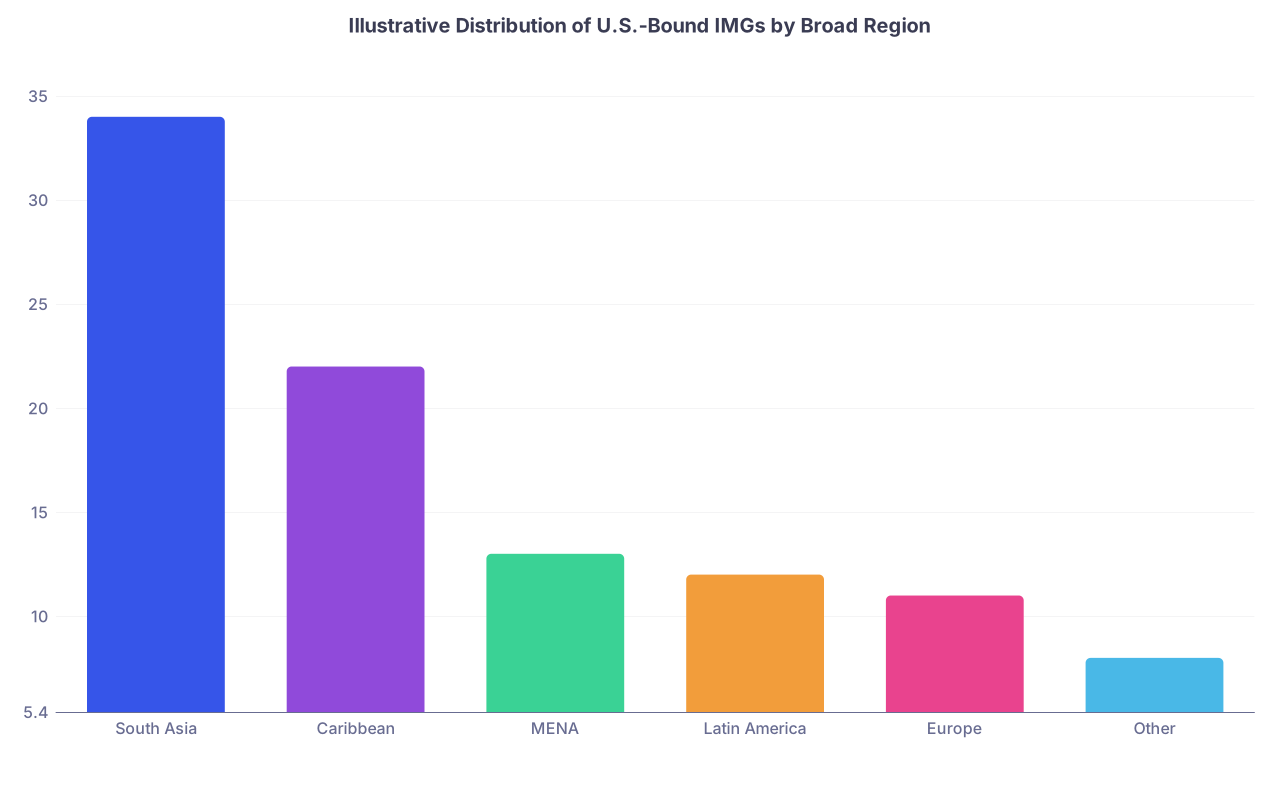
| Category | Value |
|---|---|
| South Asia | 34 |
| Caribbean | 22 |
| MENA | 13 |
| Latin America | 12 |
| Europe | 11 |
| Other | 8 |
If you compress everything we have walked through into a single picture, the distribution looks roughly like the bar chart above. A few key conclusions:
- The U.S.-bound IMG pipeline is highly concentrated: South Asia and Caribbean schools supply a disproportionate share of ECFMG-certified, U.S-residency–seeking graduates.
- Region alone does not determine your outcome, but it shapes your competitive landscape and your risk: Caribbean gives you volume and infrastructure but higher attrition; strong national schools in South Asia, MENA, and parts of Europe give you better academic footing but fierce competition.
- With Step 1 pass/fail and ECFMG accreditation tightening, the advantage shifts even more toward applicants who combine strong institutional pedigree, high Step 2 CK, and convincing clinical performance—regardless of region.
If you are serious about U.S. training, treat your choice of region and school as a data problem, not a romantic one. The trends are clear for anyone willing to look past the marketing.